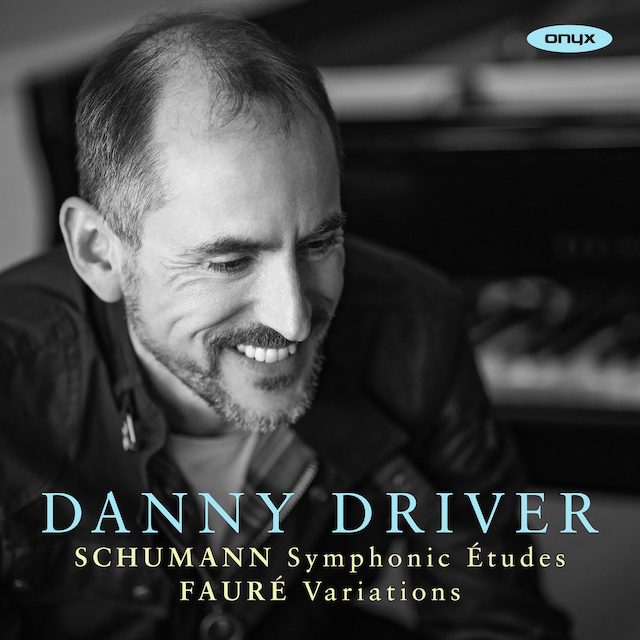
FAURE: Theme and Variations, Op. 73; SCHUMANN: Symphonic Études, Op. 13 – Danny Driver, piano – Onyx 4278 (9/25/26) (52:26) [Distr. by PIAS] ****:
Recorded 14-15 April 2023, this recital by British pianist Danny Driver (b. 1977) pairs two significant exercises in variation form, Gabriel Fauré’s Thème et Variations in C♯ minor, Op. 73 (1895) and Robert Schumann’s Symphonic Études, Op. 13 (1834-37; 1890, ed. Brahms), works that combine fluid virtuosity with melodic and structural invention.
Robert Schumann (1810-1856) in 1834 embarked on a serious relationship with one Emestine von Fricken, a pupil of Friedrick Wieck, whose father Baron von Fricken, had composed a martial set of variations in C# minor. Schumann proffered some advice, but he began to court the theme – while discarding Ernestine – on his own, reviving his interest in 1837, after considerable discussion in Leipzig with the visiting Chopin on the subject – after Paganini – of technical studies that could no less convey “a true poetic image.”
More than Chopin, Schumann conceived of the piano as a reduced “orchestral” instrument, less inclined to the salon than to the concert hall. That same year, the influence of an English composer intervened: William Sterndale Bennett (1816-1875) introduced Schumann to a tune from an opera by a fellow Romantic composer Heinrich Marschner (1795-1861), whose treatment of Walter Scott’s Ivanhoe, Der Templar und die Jüdin, contains “Proud England rejoice!” that would inspire Schumann’s grand finale to his Études.
Johannes Brahms, editing the Études in 1890, restored the five posthumous studies to the published edition, which Driver inserts (after Étude VI) in his preferred sequence, in retrograde until the final two, now played as No. 2 prior to the first. The idea, claims Driver, is “to integrate all variations withheld . . .in a way that highlights their beauty without stalling the narrative flow of the whole.” Indeed,
Driver’s potent execution of No. 6 “Agitato,” marked con gran bravura, well fulfills its purpose, serving as a splendid contrast to the first selected, posthumous variant, No. 5, a shimmering study in treble droplets that move staccato e legato. The succeeding two, No. 4 and No. 3, proceed, respectively, with lyrical, ornamental caution descending; then, more ornamented and syncopated, contrapuntal, set in boldly punctuated strokes.
Driver now inserts Étude 9: Presto possible, set in pungent octaves that explode even more thunderously, then rolling in scalar motion to an abrupt conclusion. Posthumous Variation No. 1 enters, an extended, quasi-chorale illuminated by high arpeggios. Much of the thick harmonization seems to prepare us for the music of Franck. Étude 3 ensues, an ornamental series of flourishes shared by both hands.
The last of the selected posthumous pieces, Etude 2, proceeds like an enriched sarabande that assumes misty, then voluptuous, harmonization. Variation 7 is marked Allegro molto, a trial for wrist action in persistent staccato, reminiscent of Schumann’s early Toccata in C, Op. 7. The spirit of J.S. Bach’s preludes reappears here, in Variation 8, Sempre marcatissimo, moving like a percussive, trilled march that exploits the extremes of the keyboard range. Variation 10, Con energia sempre, refuses to relent its aggressive momentum, moving with a power we recognize from several of the ferocious studies by Chopin.
The penultimate Variation 11, Con espressione, moves in veiled harmony, perhaps serving as a model for Debussy, but retaining a delicate tracery in the treble over bass tremolos. The texture becomes increasingly liquid and dynamically poignant, soon evaporating into the bass. At last, the Finale: Allegro brillante, the martial tribute (in D-flat major) to William Sterndale Bennett, the work’s dedicatee. Contrapuntal bravura marks the evolution of the rondo, with shimmering episodes to divide the scalar periods. With each repetition of the main theme, Driver injects more incisive attacks, then backs off so that the delicate interplay and modest polyphony can be savored.
Gabriel Fauré (1845-1924) remains notable for his essentially salon style, a broad range of intimate piano works that tend to be brief, poetic, and romantic in character. His unusually broad 1895 Theme and Variations seizes upon Schumann’s example for tonality and color, achieving a palpable unity of effect over the course of its quarter of an hour performance time. French piano master Alfred Cortot deemed the work “one of the greatest and most beautiful pieces written for the piano.”
Constructed as a theme followed by eleven variants, the work evolves lyrically and dramatically, ending not in glory, but in a subdued, contrapuntal texture that defies the conventional, “heroic” strategy. The clarity of line and sustained, taut rhythmic unity of the performance may remind auditors of the compelling virtuosity of Gyorgy Cziffra. The coda presents an affirmation of authentically “symphonic” dimensions.
Driver opens the slow march of the theme, 4/4, in dotted rhythm, with resolve. The first variant keeps the theme’s bass under treble, bouncing figures. Even as the variations increase in speed, the key of C# minor persists, maintaining unity-in-variety. Variation IV arrests our interest by utilizing three voices, outside arpeggios embracing a middle aria. The succeeding variant exploits a duet character, with passing dissonances to create tension. Variation VI resonates with Schumann, the bass progress dominant. Variation VII reveals the composer’s study of Bach, set as a four-voice, syncopated canon.
The succeeding two variants display creativity in syncopation and harmonic modulation. Variation IX possesses its own aura, marked Quasi adagio, it summits to a high G# and then sinks into the horizon. Variation X moves in jagged metrics, and the nervous vitality has something of a Beethoven scherzo. Its last chord, a sustained pedal point, leads to Variation XI, ruled by Bach in four-part polyphony, in mixed triple and quadruple meter. The key change to C# major imparts a bright closure to the otherwise austere landscape.
—Gary Lemco
More info at Amazon