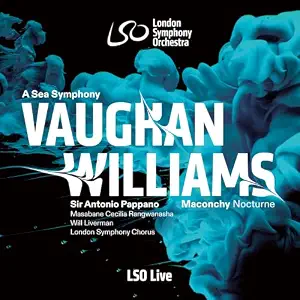
VAUGHAN WILLIAMS: A Sea Symphony; MACONCHY: Nocturne for Orchestra – Masabane Cecilia Rangwanasha, soprano/ Will Liverman, baritone/ London Symphony Chorus/ London Symphony Orchestra/ Sir Antonio Pappano – LSO Live LSOO910 (69:45) (9/11/26) {Distr. by PIAS] ****:
Recorded 9-12 February 2025, these two works embrace a British master composer and one of his gifted pupils as they respond to Nature’s bounty. Ralph Vaughan Williams (1872-1958) conceived his Symphony No. 1, his “Sea Symphony,” between 1903 and 1909, initiating the English symphony tradition while under the spell of American poet Walt Whitman’s Leaves of Grass and his Passage to India.
A hybrid choral symphony, the work exhibits aspects of an oratorio, cantata, and the influence of Beethoven’s Ninth Symphony. The choir itself serves as a major medium for the composer’s sense of universal vastness. The dominant key centers lie in B-flat minor and D major, modulating as the poet utilizes the metaphor of sailors’ voyages to symbolize the traversal of the human soul through the cosmos. But omnipresent endures the sea, an immense, awesome force that initiates all life but maintains the malign power to destroy it.
In four movements of classical design, the work opens, Moderato maestoso, with Whitman’s “Behold the sea itself!” a fanfare erupts in vivid color imagery, which will reappear in various guises; and another theme, imitated by the words “and on its limitless, heaving breast, the ships.” The call to adventure and exploration extends with baritone Liverman and the chorus now engaged in a militant embarkation to an awaiting global expanse. Soprano Rangwanasha sings of the brave souls (and flags) of lost men at sea, inclusive of all nations.
The chorus responds with the broader thought of “all brave captains and . . .all intrepid sailors and mates.” The baritone metaphorically waves “a pennant universal for. . .all brave sailors, All seas, all ships.” The sea’s beauty has its complement in awesome, fatal power, though by the coda the menace has subsided.
Ensues a slow movement, Largo sostenuto, “On the Beach at Night,” a haunted nocturne that vacillates between C minor and E major. While the waves mildly kiss the shoreline, the baritone ponders Man’s place in a vast universe. A martial pace, softly muted, carries the meditation into collaboration with the full chorus and orchestra, realizing an intense pathos. With the repeated thought, “A vast similitude interlocks all,” a resignation settles upon the atmosphere.
The third movement, “The Waves,” serves as the music’s scherzo, for chorus and orchestra. The fanfare motif literally seems to splash and spray, exhibiting flamboyant energy and diverse orchestral colors, perhaps influenced by Debussy and Ravel. The immense power and willfulness of the sea bear their own inexorable logic. A vessel proceeds through winds and “myriad waves” at its own peril. Fate itself might be following the ship in its wake, exhilarating and terrible, at once.
The last movement, entitled “The Explorers,” begins with more fanfare and celebratory riffs, openly borrowed from Edward Elgar’s The Dream of Gerontius. “O vast Rondure, swimming in space” appears to lift the composite seas into the upper reaches of the stratosphere. Vaughan Williams gropes his way to a state of transcendence, the sea as metaphysics. Adagios and lentos mark the long progress of this movement, the chorus often intoning in hushed, awed tones over pedal points. Such a rare vision and vista demands a worthy witness: “Finally shall come the poet worthy that name, the true son of God shall come singing his songs.”
The conceit becomes clear: the visionary poet, a Divine shaman, shall facilitate the sublime journey, when ship and human souls assume their grand quest to set sail toward the “that undiscovered country from whose bourne no traveler returns.” The orchestral tissue becomes ever more luminous as the ship prepares to launch, not so far from Wagnerian illumination. Soprano and baritone have engaged in a potent yet endearing duet, “Away, O soul, hoist instantly the anchor.”
Vaughan Williams invokes folk impulses, shanty rhythm, to lighten the burden of finitude with an eternal optimism. The last two movements might celebrate the notion of “daring,” reckless abandon, yet savoring a metaphysical security: for are not all seas “the seas of God?” Not darkness, but a fair radiance emerges, with the harp’s dispelling any sense of weight, as the voyagers disappear, Molto adagio e tranquillo, into the aether.
Dame Elizabeth Maconchy (1907-1994) composed in various genres, including 13 string quartets, conceived between 1930 and 1980. Besides operas, she wrote her Nocturne for Orchestra (1950), which exudes influences from Janacek and Bartok in her use of harmonic dissonance while retaining a clear lyrical impulse. The melodic curve might pay homage to Bartok’s Concerto for Orchestra, but the syntax proves brighter, martially assertive, while remaining within the conservative, chromatic community. The score bears an overt allusion to Coleridge’s Rime of the Ancient Mariner, here set in misty, haunted filigree, appropriate to the poet’s narrative of the journeying Moon. A piece worth re-hearing and frequent concert engagements.
—Gary Lemco