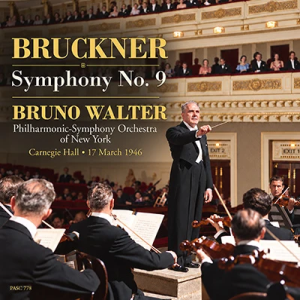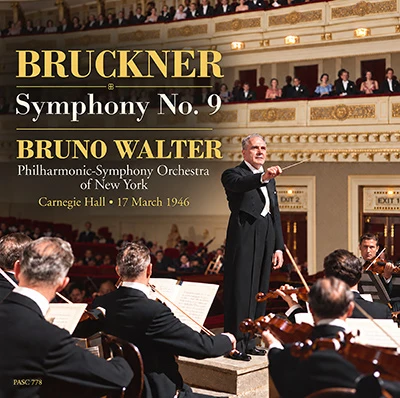
BRUCKNER: Symphony No. 9 in D Minor, WAB 109 – Philharmonic-Symphony of New York/ Bruno Walter – Pristine Audio PASC 778 (53:43) [www.pristineclassical.com] *****:
The concert at New York City’s Carnegie Hall, 17 March 1946, had conductor Bruno Walter’s leading the Philharmonic-Symphony in Anton Bruckner’s Ninth Symphony (1887-1896), a monumental composition in the three movements, dedicated by the composer “to the majesty of all the majesties, the beloved God.” The scale and scope of this “farewell to life,” as Bruckner deemed his Adagio movement, invites comparisons to Beethoven’s Ninth in the same key, and similar in the placement of a demonic Scherzo as the second movement. While Otto Klemperer had introduced this music to New York in 1934, Walter possibly saw in 1946 that the symphony proffered spiritual reconciliation for the ravages of World War II and the possibility for transcendence.
In three movements – and therefore incomplete – Bruckner’s Ninth has had several interpreters who evolved my own conception of its structure and spiritual import: Furtwaengler, Beinum, and Jochum, each of whom captured its grave ambit and its ceaseless, lyrical and dramatic energies. From the opening string tremolos and trumpet and tympani entrance for the Feierlich, misterioso first movement, Walter builds the first of several climactic periods, this first dramatic, as opposed to the “song-period” that ensues. The warmth of the Philharmonic strings and winds pulsates in lulling melodic sequence repeated with mounting yearning and a sensibility of high reverence.
A third period emerges via an oboe solo, bucolic and impulsive, but ominously menaced. Bruckner’s logic for the Classical sonata-form has adjusted to imbibe Schubert’s melodic template for thematic evolution. The sheer volume of musical subjects and their respective modulations reaches beyond the bounds of traditional harmony, with the sonorous support of Wagnerian chromatics to announce Bruckner’s subjective vision of Valhalla.
The contextual sonority assumes the diapason of a huge, orchestral organ prelude and variations, the themes perpetually layered in ostinati, stretto, canon, or passing fugal filigree. Walter does not cater to slow tempos to emphasize the Romantic Agony of the occasion; those who know his later 1959 CBS commercial recording soon realize the wrenching urgency of the present interpretation. The intensely guided transition to the first movement coda includes allusions from Wagner and his own Seventh Symphony, now condensed so as to hurl Fate or Cosmic Necessity at us, ineluctable and remorseless.
The second movement Scherzo, opening with impious pizzicatos in the strings and competing choirs in the woodwinds over a pedal point, breaks out in a fury of percussive motion. It seems the forces of destruction rampage in swirling, dizzy, demonic impulses, often becoming torrential. Sudden pauses, with gentle woodwind riffs and horn calls, only to be once besieged by the spirit of brazen, martial resolve.
Bruckner marks in F# major Trio Schnell, and it possesses an impishness worthy of Mendelssohn, tempered by natural, folksong invocations. The ternary form asserts its structural dominance, but the Furies insist on assailing the doors of civility. Oboe an tympani cavort with the Philharmonic strings to sweep once more to a terrible revenge, as Hamlet might conceived it. The punctuations have become manic, wild, and breathless, and suddenly, they halt.
Those who admire Bruckner typically gravitate to his grand adagios, and the Ninth bears such a “mountainous” movement, the Adagio in e major, 4/4, that unfolds in three parts. The music strains fr height, for glory in Nature and in Divine Revelation, at once. Besides its affective similarity to Wagner’s Parsifal, the music contains a potent fugue section, as if Bruckner were reconciling his musical foundations as decreed by Divine Providence.
Akin to the main theme of Liszt’s Faust-Symphonie, the Adagio exploits all 12 notes of the chromatic scale, opening in tonal ambiguity, in which the use of the leaping minor ninth chord allows development in poignantly separate directions. Trumpets blaze forth, as do the Wagner tubas, followed by a variant of the “Dresden Amen,” so the procession retains its mystery while groping to new regions of expression. A huge lament ensues, offset by woodwind pipings from Nature, though the string line feels fraught with anguish.
A pregnant pause leads to another eruptive sigh and brazen response, rounded off by the “Dresden” declamation of faith, itself repeated over grumbling bass lines that soon cause disruption and doubt. Walter attends to Bruckner’s directive, “Slow, fiery,” urging the serpentine melodic impulses forward and upward. Suddenly, a spirit of sweet balm arises over pizzicato strings, then voluptuous strings, a bass line that invites pungent brass harmonies.
Again, the volume evaporates to allow the Parsifal tribute to surge forth, the power of faith to reconcile all opposites. Now, the chorale element dominates, assailed as it is by frantic motion in the winds. But the brass section asserts a primacy of resolution, literally heaving with explosive witness, then silence. The mystery appears once more, announcing the last ascent to the Revelation that “all shall be changed, changed utterly.” A restful sequence, held by pedal point, invites the flute, strings, and held, brazen walls of deliverance to serve as “flights of angels” to our prolonged silence.
Pristine’s accompanying liner note well documents the context of the occasion, with its competing press responses to this rare musical event. Walter, however, feels no ambiguity in the force of mission.
—Gary Lemco