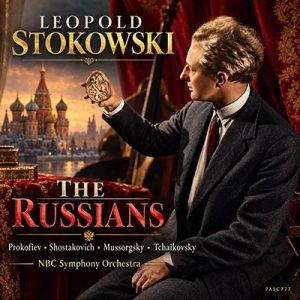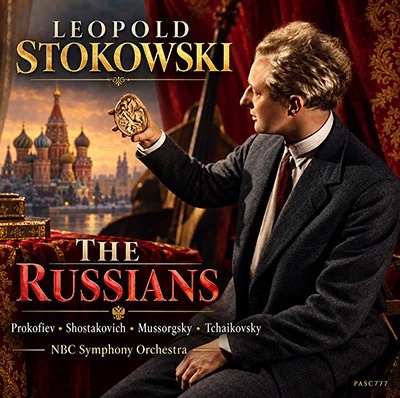
STOKOWSKI: The Russians = PROKOFIEV : The Love for Three Oranges Suite; SHOSTOKOVICH: Symphony No. 6; MUSSORGSKY; Pictures at an Exhibition; TCHAIKOVSKY: The Tempest, The Storm – Jennie Tourel, mezzo-soprano/ Westminster Choir/ NBC Symphony Orchestra/ Leopold Stokowski – Pristine Audio PASC 777 (2 CDs = 2:33:49, complete contents detailed below) [www.pristineclassical.com] *****:
Conductor Leopold Stokowski (1882-1977) shared the NBC Symphony podium with Arturo Toscanini for three years, 1941-1944, somewhat to Toscanini’s chagrin, who had penned – but not sent – an irate letter in October 1941 excoriating Stokowski’s radio performance of the Franck Symphony in D Minor. Earlier in their respective careers, Toscanini had referred to Stokowski as a “charlatan.” But Stokowski had managed to win over the NBC players’ respect for his unorthodox seating arrangements and his willful podium manner, given his colossal sense of color and innate sympathy for selected composers. Stokowski’s programming, moreover, compelled players and audiences to confront new, often challenging, repertory, which contributed to the intellectual life of New York City during a time of national crisis.
Stokowski leads the NBC Symphony, 18 November 1941, from the Cosmopolitan Opera House, beginning with Serge Prokofiev’s suite from his 1921 opera The Love for 3 Oranges, based on a satirical play by Gozzi, the music for which one critic quipped as “Russian jazz with Bolshevik trimmings.” The score abounds with a fiercely capricious energy, opening with the “Infernal Scene,” rife with grueling, percussive ostinatos.
“The Prince and the Princess” might be an homage to Rimsky-Korsakov of Scheherazade, an immediate balm after the scathing harmonies of the opening scene. The NBC strings and woodwinds ply their trade most sweetly, since Prokofiev permits a loving sentiment. The famed “March,” made even more notable by Jascha Heitetz in transcription, calls us to arms with brisk and mischievous fanfare and insistent warmongering. The NBC battery and high winds seem happy to exert visceral, dynamic utterance.
From the same day and venue, we engage with the Sixth Symphony (1939) by Dmitri Shostakovich, the acerbic tone of which closely follows on the heels of Prokofiev. Yevgeny Mravinsky had led the world premiere, and among the first recordings, those by Stokowski in Philadelphia (1940) and Fritz Reiner with the Pittsburgh Symphony (1945) set the standard. In three iconoclastic movements, the symphony moves through a long first movement, Lento, followed by two energized movements, Allegro and Presto.
Stokowski initiates a grudging, plaintive Lento, marked by minor thirds and diminished seventh chords, complemented by a potent string trill. Shostakovich exploits his fondness for polyphony, maintaining canonic ostinatos even after the texture thins out to chamber music resonance. Emotionally turbulent gestures erupt, leaving the mournful sound of the English horn amidst a barren landscape. The lyrical anguish well reminds us that Shostakovich admired Gustav Mahler’s musical means, his huge swathes of chiaroscuro. Over a string pedal, the brass proclaims a solemn chorale to accompany the initial, melancholy theme, now tolerant of Stokowski’s portamentos. Dark motives in the winds and strings close out the movement in a valedictory atmosphere, forlorn, but still able to arouse applause from the New York audience.
The “subversive” character of this music becomes evident in the Allegro, a tour de force for the NBC woodwinds, who might be starring in the Marx Brothers’ At the Circus. The humor, however, belongs more to the gallows than to MGM, given the dark, heaving swirls and eerie, percussive harmonies that infiltrate the occasion. The NBC flute offers some coloratura consolation, but the intense, galloping winds refuse to abate. More applause. The last movement, Presto might play as a manic parody of Rossini in jerky gallop, cross-fertilized by bawdy satire. Stokowski sets a game tempo, and he maintains a firm grip on the frolicsome menace, that manages a brief violin solo from Mischel Piastro. Stokowski’s NBC displays their brilliant level of execution throughout, a whirlwind performance that quite dazzles.
Seven days later, 25 November 1941, Stokowski led his own “symphonic synthesis from Mussorgsky’s Boris Gudonov (1869), again from Cosmopolitan Opera House. Stokowski had given the United States premiere of Mussorgsky’s original version in 1929, but he felt a direct, orchestral presentation of six scenes from the opera would better dramatize the popular effect economically. Stokowski links the episodes with chimes and low gongs, infusing the orchestral tissue with the noted “Stokowski sound,” effected by free bowing from the violins.
The musical narrative, “Outside the Novodievichi Monastery,” unfolds in glorious colors, eminently Russian in brooding character, contrapuntal and vividly sonorous, heaving with dark passions, personal and political. The NBC string line assumes the role of the Russian people, a kind of Greek chorus. The bells and gongs inject a penetrating, punishing character to the context, especially the Coronation Scene. The hymn and splendid fanfare that arise we know from Beethoven’s use in his first “Rasoumovsky” Quartet. The meditative “Monks’ Chant” leads to the “Siege of Kazan,” which, in spite of the feral energy, still misses having Boris Christoff vocalize. “The Church if St. Basil” casts a wistful, regretful countenance on the narrative, which can end only one way, with the “Death of Boris,” who, having “gained the highest power,” realizes the calamity of his soul.
Tchaikovsky composed The Tempest in 1873 at the suggestion of critic and composer Vladimir Stasov, and the music premiered in Moscow on 19 December 1873, conducted by Nikolai Rubinstein. Stokowski performs Tchaikovsky’s musical reaction to Shakespeare’s The Tempest from Studio 8-H in New York City, 7 March 1943. The tale’s combination of magic (Prospero), love (Miranda and Ferdinand), and natural/supernatural powers (Ariel, Prospero, Caliban) attracted Tchaikovsky and his love of spectacle, setting his single-movement tone-poem in F minor and allowing his imaginative rendering of the narrative full rein.
A vista of the sea opens the music, the minor-key, string arpeggios and horn riffs not so distant from Wagner. The natural energy calls forth Ariel, who, at magician Prospero’s bidding, will unloose a grand storm. Prospero has his own fanfare, a signal of his mystical power, announced by the timpani. The storm wrecks the ship carrying its mortal intruders onto Prospero’s island, eliciting daughter Miranda’s famous awe, “O brave new world, that has such people in it.”
A cautious love music soon ripens into one of the composer’s ardent professions of yearning, sweeping gloriously upward. A skittering scherzando episode may indicate Caliban’s grumpy presence, but the love music virtually ignores his influence, ascending to heights we already know from the fantasia on Romeo and Juliet (1869). More “Wagnerian” brass motifs and high woodwinds allow Prospero and Ariel their respective influence; but, when Prospero relinquishes his magic, the music returns to the brooding, enduring presence of the sea to conclude the drama.
Tchaikovsky’s music for Alexander Ostrovsky’s play The Storm (1864) did not meet his criteria for publication in his lifetime, so it remained unperformed until 1896, as directed by Glazunov. Stokowski leads the NBC Symphony on 29 November 1942 for his rendition of the single-movement tone-poem in E minor. We hear the early form of Tchaikovsky’s romantic strategy: a rolling timpani and vigorously dark introduction begins to trace the course of the protagonist, Katerina’s fate, from her youth to her capacity for love and her eventual, tragic demise.
Tchaikovsky juxtaposes his love theme against some violently assertive figures in six beats. The string section bears the weight of the yearning element, which leads into some obligatory counterpoint from the opposed emotional forces. The fervor of the music partakes of Liszt, Berlioz, and Schumann for color influences, but no less indebted to the composer’s Russian soul. True to its title, stormy throes of passion engulf the texture, with glimmers of nostalgia attempting to delay the hurled, whipped catastrophe.
Adapted from the film score he composed for Sergei Eisenstein’s classic film, Alexandre Nevsky in 1938, Prokofiev developed a cantata of programmatic power and emotional urgency. Stokowski leads the performance from Studio 8-H on 7 March 1943, the text sung in English by the disciplined Westminster Choir. Given the contemporary event, with Hitler’s forces having invaded Russia, the film’s depiction of the invading Teutonic Knights and Prokofiev’s potent score convey significant resonance. Eisenstein chose the white hoods (of the KKK) for his Knights from the D.W. Griffith class, Birth of a Nation.
A combination of militancy and cosmic eeriness suffuses the score, especially in “The Crusaders on Pskov,” where Stokowski carefully guides the eldritch qualities to their full potential. An energized declaration of a nation arisen to repel invaders, the alternating male and female chorus, accompanied by the NBC battery, alert us that a fierce resistance ensues. The famous “The Battle on the Ice” had been filmed by, among other cinematic tricks, mounting cameras on horses’ chests to gain the combatants’ perspective. My model for this section has perpetually been Fritz Reiner and the Chicago Symphony. Stokowski, too, manages a vast sense of disquiet, as his string basses and whistling winds and brass prepare us by a series of shimmering pedal points.
The chugging, ostinato motion catapults upon us images of swords and spears finding their human targets, until Lake Chudskoe swallows the Teutons, followed by a whirlwind celebration dance and hymn. Russian-American mezzo-soprano Jennie Tourel (1900-1973) passionately laments her lover’s death on “The Field of the Dead,” bestowing a kiss of peace on the eyes of the honored dead. The melodic contour and sobbing strings might easily have suited Prokofiev’s great ballet, Romeo and Juliet. With the conclusion, “Alexander’s Entry into Pskov,” the propaganda aspect of both the film and the musical score announces itself, a brightly lit victory celebration, a Russian peasant revel. Nevsky himself simply expresses the triumphant will of a resolute people, who, by dint of fickle leaderships, had become our allies.
The set concludes with Leopold Stokowski’s singular arrangement of Mussorgsky’s Pictures at an Exhibition, performed in Studio 8-H of Radio City, 21 March 1943. Stokowski eliminated those pictures attributed to the French taste that motivated Ravel’s orchestration. Generally, Stokowski wants a darker series of testaments to architect Viktor Hartmann, and his responsive NBC Symphony delivers a virtuoso color ensemble, often massive in texture, as well as selectively transparent and luminous.
The second appearance of the “Promenade” proves rather telling, already anticipatory of “Speaking to the Dead in a Dead Language.” The obvious rubato and string slides in “The Old Castle” recall a much older performance tradition of the 19th Century. Stokowski takes the lumbering “Bydlo” episode at a rather startling, militant pace, and we cannot decide if we are to be crushed or slid over. A third incarnation of the “Promenade,” this a troubled andante that vibrates just at the moment the humor of the “Unhatched Chicks” wobble in their shells.
More cynical humor arises in “Samuel Goldenberg and Schmuyle,” with virtuoso wind playing and deeply resonant string bass execution. Stokowski plays the “Catacombs” as a Dantesque descent, extended with the wonderfully graduated conversation with the dead, and reaching a paroxysm of folkish terror in “Baba Yaga,” replete with effects from “A Night on Bare Mountain.” We arrive safely, however, enthralled by “The Great Gate of Kiev,” a metaphor for the brazen orisons of the Kingdom of Heaven.” We pause for a reverent prayer before sparkling counterpoint resumes the ascent – another brief moment of spiritual gratitude – and then the tolling bells and frenetic brass and battery arrive at Mussorgsky’s especial Valhalla. Stokowski’s audience likely remains there.
–Gary Lemco
Leopold Stowkowski – The Russians
PROKOFIEV : The Love for Three Oranges – Suite, Op. 33a; Alexander Nevsky, Op. 78;
SHOSTOKOVICH: Symphony No. 6 in B Minor, Op. 54;
MUSSORGSKY (arr. Stokowski): Boris Gudunov – Symphonic Synthesis; Pictures at an Exhibition (arr. Stokowski);
TCHAIKOVSKY: The Tempest. Op. 18; The Storm, Op. 76 –
Jennie Tourel, mezzo-soprano/ Westminster Choir/ NBC Symphony Orchestra/ Leopold Stokowski