
Monthly Archive: June 2017
Audio News for June 18, 2017
Hi-res Streaming Service — Primephonic is presenting a unique offering of lossless-only classical music—no lossy compression allowed! They have a growing library, featuring over 200 labels, including those oft-reviewed here at Audiophile Audition — Naxos, Pentatone, HM, Chandos, Channel Classics. That, along with the several thousand recording artists, makes a rich portfolio for any audiophile. My own investigation of niche areas in their digital shelves revealed offerings of great breadth and depth. Summer Classical Music Festivals — Given the fair number of followers of this site outside of North America, it is worth noting the myriad of music festivals through throughout Europe and beyond. While many of these host operas—ranging from the classics to those quite contemporary—there are other offerings as well. A light sampler—from Finland, the Savonlinna Opera Festival (performed in the famous Olavinlinna Castle, premiering a new opera The Castle in the Water) and the Vantaa Festival (early music, period instruments, Bach, Byrd, Tallis…); in Warsaw the BA..CHopin and his Europe Festival (keyboard, chamber music, symphonic literature); in the UK the Glyndebourne festival (classical and contemporary operas); France’s Festival d’Aix-en-Provence (opera, chamber music, vocal concerts), to name but a few. Streaming Classical Music Shows — There are many […]

FRANZ SCHMIDT: Symphony; R. STRAUSS: Intermezzo Excerpt – Vienna Phil. Orch./ Semyon Bychkov – Sony
FRANZ SCHMIDT: Symphony No. 2 in E-flat Major; R. STRAUSS: Dreaming by the Fireside – Vienna Philharmonic Orchestra/ Semyon Bychkov – Sony 88985355522, 55:20 (6/2/17) ****: Semyon Bychkov and the VPO celebrate music that proves endemic to Vienna, in their under-rated favorite son, Franz Schmidt. Generally speaking, the late-Romantic music of Franz Schmidt (1874-1939) has not exported well; and he remains a local, Viennese figure whose currency runs short of Bruckner and Mahler, his having been overshadowed, as well, by the members of the more progressive Second Viennese School. The few acolytes of Schmidt’s music have been Mahler, Mitropoulos, and Mehta, and of late, Welser-Moest, Sinaisky, and the family Jarvi. Likely, Schmidt’s political loyalties (to National Socialism) did not win him post-War favor, nor did his remark to a potential advocate—Herbert von Karajan—when Schmidt told him he had no future in conducting. The E-flat Symphony (1911-1913) can be construed as a “pastoral symphony,” with its own influences inherited from Bruckner and Richard Strauss. One commentator calls this music “brassy, bold, and even belligerently optimistic.” The first impulse of the Lebhaft movement rings bucolic, babbling brook hypostasized into a pantheistic chorale. Schmidt manipulates large, brassy and battery elements with a kind of […]

HANDEL: Susanna – Göttingen Festival Orch./ NDR Choir, Laurence Cummings – Accent
HANDEL: Susanna (complete oratorio) – Emily Fons (Susanna)/ Christopher Lowrey (Joacim)/ Colin Balzer (1st Elder)/ Raimund Nolte (2nd Elder)/ Ciara Hendrick (Daniel)/ Göttingen Festival Orchestra/ NDR Choir, Laurence Cummings – Accent ACC26406 (3 CDs), 184:00 [Distr. by Harmonia mundi] ****: New recordings, especially as fine as this one, are always welcome. But Hunt still rules the roost. Susanna marked a turning point in Handel’s compositional activity. England at that time had come to expect certain things from Handel oratorios—religious themes, lots of choruses, and relatively sophisticated arias of decent complexity. The oratorio struck many at the time as more of an opera, with simpler arias, fewer choruses, and a theme that, while biblical, touches on far more than a simple morality tale. The story of Susanna, taken from the apocryphal writings appended to the Book of Daniel (though included as canonical in the Greek version of the Old Testament, the Septuagint), involves a woman leered upon as she bathes by lecherous Elders of Israel, who then accuse her of adultery in order to cover their own disgusting lasciviousness. The Prophet Daniel in the end comes to her defense, and all ends well. One can easily see the operatic implications in […]

Steve Davis – Think Ahead – Smoke Sessions Records
Steve Davis – Think Ahead – Smoke Sessions Records #SSR 1704 – 75:34 – ****: Steve Davis comes through again on Think Ahead… (Steve Davis – trombone; Steve Wilson – alto and soprano sax, flute; Jimmy Greene – tenor sax; Larry Willis – piano; Peter Washington – bass; Lewis Nash – drums) Trombonist, Steve Davis, mentions in the liner notes of his new CD, Think Ahead, that he is a big baseball and basketball fan. It is apropos then to use baseball terms to describe Davis as a clutch hitter. You know that your clutch hitter will be both dependable, and can handle most any situation. Steve Davis is rock solid both as a band leader (he is nearing twenty titles) and absolute first choice trombone sideman. He is a founding member of the super group, One For All, and also a professor at the Hartt Music School at the University of Hartford. On his latest CD, Steve has assembled a who’s who of veteran jazz super stars (all clutch hitters) to help back his musical vision. The front line features Steve Wilson on alto and soprano sax and flute, and Jimmy Greene on tenor sax. The rhythm section of […]

SCHUBERT: Piano Trio; “Trout” Quintet – Trio Wanderer/ Christophe Gaugue (vla.)/ Stephanie Logerot (bass) – HM
SCHUBERT: Piano Trio No. 2 in E-flat Major, D. 929; “Trout” Quintet in A Major, D. 667 – Trio Wanderer/ Christophe Gaugue, viola/ Stephanie Logerot, double bass – Harmonia mundi HMX 2908748. 80:27 (6/23/17) [Distr. by Harmonia mundi/PIAS] *****: Two chamber music Schubert marvels from the archives of the Trio Wanderer celebrate their 30th anniversary. Schubert began his E-flat Major Piano Trio in 1827, a monumental work of pointed emotional contradictions and even periodic anguish. Robert Schumann took careful notice of this music, calling the opening Allegro a “furious meteor.” Comprised of four themes, the first of these undergoes the least transformation, while the last becomes a principal motif for the dramatically virile score, which expands to a breadth exceeded only by the “Great” C Major Symphony. Movie as well as music lovers know the poignant Andante con moto through the vehicle of director Stanley Kubrick’s 1975 period drama Barry Lyndon, one of the more realistic treatments of military life, based on Thackeray’s novel. This remarkable, frequently haunted movement enjoys the splendid benefit of Raphael Pidoux’s resonant cello. This melancholy theme will return in the Allegro moderato finale, a kind of tragic reminiscence. The 2000 recording remains attractively bright in […]

CHOPIN: Les Grandes Polonaises = Seven Polonaises by CHOPIN – Pascal Amoyal, piano – La Dolce Volta
CHOPIN: Les Grandes Polonaises = No. 1 in c-sharp minor, Op. 26; No. 2 in e-flat minor, Op. 26; No. 3 in A Major, Op. 40, No. 1 “Military”; No. 4 in c minor, Op. 40, No. 2; No. 5 in f-sharp minor, Op. 44 “Tragic”; No. 6 in A-flat Major, Op. 53 “Heroic”; Polonaise-Fantasie in A-flat Major, Op. 61 – Pascal Amoyal, piano – La Dolce Volta LDV 25, 63:32 (4/29/16) [Distr. by Harmonia mundi/PIAS] **** Pascal Amoyal surveys the seven official Chopin polonaise with passion and poetic zeal. Pascal Amoyal (b. 1971) recorded the integral set of seven “official” (Paris) Chopin polonaises 27-30 April 2015, recalling, of course, that Chopin had in fact produced some sixteen others from the time he was seven-years-old. The resonant Steinway Amoyal employs (D-357) has been very closely “miked” by Jean-Marc Laisne, to the point that we can hear the digital depressions on the keys as Amoyal strikes them. The Frederyk Chopin Society of Warsaw had bestowed its Grand Prix du Disque to Amoyal for his 2010 survey of the complete Nocturnes, and he feels the nationalistic Polonaises aim at a more specific context than the “universal” appeal to night-music. Amoyal opens with […]

ISAAC: In the time of Lorenzo de’ Medici and Maximilan I – Hespèrion XXI/ La Capella Reial de Catalunya/ Jordi Savall – Alia Vox
Henricus ISAAC: In the time of Lorenzo de’ Medici and Maximilan I – Hespèrion XXI/ La Capella Reial de Catalunya/ Jordi Savall – Alia Vox multichannel SACD AVSA9922, 76:06 (Distr. by [PIAS] Classics) *****: Magnificent readings of music by an underperformed master. Henricus Isaac (also known as Heinrich Isaac, 1450 – 1519) is one of the true masters of an extraordinarily complex and difficult age. He was born in Brabant, but spent most of his life in Burgundy, Austria, Italy, and Germany. Florence became the city he would always call home, in no small part because of the invitation of Lorenzo the Magnificent, whose patronage established Isaac as a man of fame, renown, and respect. Yet even after the repose of the magnificent one, Isaac could leave the Medici court and become the chief composer under Emperor Maximilian I. He was prolific, inspired, educated, and perhaps the foremost master of the art of counterpoint of any contemporary. His influence was wide and profound. Anton Webern adored him. The richness of his polyphony, the astonishing independence of the voices, and the exquisite melodic impulses that underline everything he does makes one wonder why he isn’t more well- known and appreciated. This […]

The Ed Palermo Big Band – The Great Un-American Songbook – Cuneiform, Rune
The Ed Palermo Big Band – The Great Un-American Songbook: Volumes I & II [TrackList follows] – Cuneiform, Rune 435/436 (2-CDs) 58:49, 54:48 [2/24/17] *****: Who can mix prog-rock, British pop music, Miles Davis, Jeff Beck and West Side Story? It could only be the one and only Ed Palermo. (Ed Palermo – leader, conductor, arranger, alto saxophone; Barbara Cifelli – baritone saxophone, Eb mutant clarinet; Matt Ingman – bass trombone; Charley Gordon – lead trombone; Ronnie Buttacavoli – lead trumpet; Katie Jacoby – electric violin; John Bailey, Steve Jankowski – trumpet; Clifford Lyons – lead alto saxophone, clarinet; Phil Chester – second alto saxophone, flute piccolo, soprano saxophone; Bill Straub – lead tenor saxophone, flute, clarinet; Ben Kono – second tenor saxophone, flute, oboe; Michael Boschen – trombone; Ray Marchica – drums; Paul Adamy – electric bass; Bob Quaranta – acoustic piano; Ted Kooshian – electric keyboards; Bruce McDaniel – guitar, vocals, arranger (track 7, CD 1), producer, mixing, mastering; Mick Starkey, Napoleon Murphy Brock – guest vocals) Alto saxophonist Ed Palermo and the Ed Palermo Big Band are probably most famous for several Frank Zappa tributes. On Palermo’s latest outing he takes a stab at mostly British rock […]

FRANCK: Violin Sonata; CHAUSSON: Concert for Piano, Violin and String Quartet – Isabelle Faust (vln.) / Alexander Melnikov (p.)/ Salagon Quartet – HMM
FRANCK: Violin Sonata in A Major; CHAUSSON: Concert in D Major for Piano, Violin and String Quartet, Op. 21 – Isabelle Faust, violin/ Alexander Melnikov, piano/ Salagon Quartet – Harmonia mundi HMM 902254, 67:11 (5/26/17) [Distr. by Harmonia mundi/PIAS] ****: The Faust-Melnikov duo realizes two powerful masterpieces from the Belgian cyclical tradition. Recorded June 2017, the 1886 Franck Violin Sonata here benefits from the chosen instruments used by Faust and Melnikov to realize something of the mysticism of the circumstances surrounding the work’s premiere by Ysaye and Bordes-Pene in Brussels. Faust plays a Stradivarius 1710 “Vieuxtemps” that employs gut-strings, while Melnikov performs on an Erard from 1885. Together their sound remains nasal and dry, intimate and pinched, as if each note were a distinct moment in time. The two themes of the opening Allegro ben marcato weave in liquidly pensive tones, perhaps a mite too slowly for some tastes. Franck has already set the form for his cyclic work, based on Liszt and Schubert models for the unity of development. The succeeding Allegro in d minor conveys a passionate turbulence offset by excursions into the major mode. The sooty, nasal quality of the violin adds a palpably charcoal texture to […]
![Nick Finzer – Hear & Now [TrackList follows] – Outside in Music](https://www.audaud.com/wp-content/uploads/2017/06/Finzer-front.jpg)
Nick Finzer – Hear & Now [TrackList follows] – Outside in Music
Nick Finzer – Hear & Now [TrackList follows] – Outside in Music OiM1701, 57:19 [2/17/17] ****: Trombone in the here and now. (Nick Finzer – trombone, co-producer; Lucas Pino – tenor saxophone, bass clarinet; Alex Wintz – guitar; Glenn Zaleski – piano; Dave Baron – bass; Jimmy Macbride – drums) Trombonist Nick Finzer’s third release, Hear & Now, is a notable jazz album. First, it introduces Finzer’s new sextet, also dubbed Hear & Now. Second, it confirms trombones are masterful jazz instruments and trombonists continue to be dynamic jazz group leaders and composers: think Trombone Shorty, the members of New Orleans’ band Bonerama and Robin Eubanks. Third, the socio-political elements which flit through the hour-long Hear & Now resonate loud and clear in a time of turmoil, confusion, hatred and conflict: Hear & Now reinforces the idea that instrumental jazz music should, when possible, have connections to all our lives: not just musical but political, emotional and so on. All but one of the nine tracks are Finzer originals (there is one cover by Duke Ellington). Finzer starts with the initial single, “We the People.” The tune’s sentiment mirrors a quote by Indian philosopher, speaker and writer Jiddu Krishnamurti—the quote […]

SCHUMANN/MERTZ: Piano/Guitar Double Album Review
SCHUMANN – Davidbundlertanze, Humoreske, Blumenstück – Luca Buratto – Hyperion 68186, 64:58 ( 4/28/17) ****: Johann Kaspar MERTZ: “The Last Viennese Virtuoso” – Frank Bungarten (ten string guitar) MDG SACD 905, 67:10, (4/14/17) ****: Two Biedermeier recitals for solo instruments representing the intimate musical aesthetic of the domestic salon. The recordings under review here are by composers who were exact contemporaries in the first half of the 19th century. Within the field of European Cultural History, the period from the Restoration of the old regimes after the Napoleonic disturbance to the first big wave of Revolutions in 1848 has been designated the “Biedermeier.” This originally denoted a style in furniture design but expanded to describe a cultural sensibility, one that affixed to an emergent bourgeois identity. Essentially a conservative tendency, Biedermeier evokes many other enduring Central European traits, such as simple and elegant craftsmanship, a pious and nostalgic worship of both history and Nature, a preference for amateur and domestic productions over aristocratic ostentation. How does this apply to music? A Biedermeier interior provides clues. First there is the furniture: smallish chairs and low couches, which are pretty but not so comfortable, their wood local but stained to look like […]

BRAHMS: Pieces for Piano, Intermezzi – Arkadi Volodos, piano – Sony
BRAHMS: Pieces for Piano, Op. 76: Nos 1-4; 3 Intermezzi, Op. 117; Six Pieces, OP. 118 – Arkadi Volodos, piano – Sony 88875130192, 54:10 (5/19/17) ***: In an all-Brahms program of limited duration but passionate intensity, Volodos will win admirers and possibly alienate purists. This release of Brahms piano music (2015-2017) by Russian pianist Arkadi Volodos (b. 1972) will generate a degree of controversy that I am not likely to resolve. First, the brevity of the disc does not bode well, since I cannot fathom why producer Friedmann Engelbrecht did not insist Volodos complete the Op. 76 cycle, even perhaps adding the two Op. 79 Rhapsodies or the Op. 4 Scherzo. Doubtless, Volodos remains a colorist of distinction and sensitivity, and he has a natural sympathy for these abbreviated, intensely concentrated expressions of the late Brahms sensibility of stoic loneliness and passionate resignation. The question whether Brahms “purists” will respond favorably to Volodos’ over-ripe Steinway and his application of pedal will linger as a matter of taste. My own first impulse was to compare Volodos to Romanian Radu Lupu, whom I find to be more delicately chaste. The Glenn Gould approach entirely derives from Schoenberg, looking backward at Brahms […]
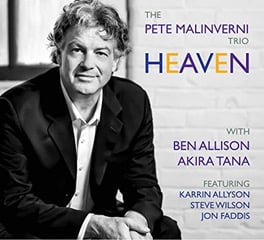
The Pete Malinverni Trio – Heaven – Saranac Records
The Pete Malinverni Trio – Heaven – Saranac Records 55:48 ****: A stellar program fit for the constellation ( Pete Malinverni – piano; Ben Allison – bass; Akira Tana – drums; guests: Karrin Allyson – voice track 4; John Faddis – trumpet track 7; Steve Wilson – alto saxophone track 9 ) The use of the word heaven in song titles is fairly ubiquitous, but not so much in jazz album titles. There are two that come readily to mind. Miles Davis’ Seven Steps To Heaven and “Little “ Jimmy Scott’s Heaven. So pianist Pete Malinverni ’s own offering Heaven can look for its own place among these releases and it does so with some effect. Malinverni’s interest in selecting this word for his release was informed by two events that caused him to reflect on immortality. Firstly the death of his wife in 2012, and secondly a personal health scare, although eventually unfounded, drove an acknowledgement of life’s fragility. Malinverni and the band jump in with the title track “Heaven” by Duke Ellington which was released in 1968 on the Second Sacred Concert album. The tune swings along nicely as Malinverni adjusts up at each chorus with Allison offering […]

Two LG 4K TV Reviews — OLED 65″ and UHD 43″
LG 4K TVs — OLED65E6p and 43UH610A The OLED series from LG comes in various models (A, B, E, and G) and sizes. This E model is the second from the top. The upscale G model has a better sound system, at a $1700 up charge; it also has a curved screen OLED series. I opted for the E series, because I use my main stereo system or a sound bar. (For more information about OLED technology, go to: https://en.wikipedia.org/wiki/OLED) The main features that the E model has over the lower models is it supports both Dolby Picture and HDR (high dynamic range) 10. HDR10 uses and 10 bit color depth, where Dolby Vision uses 12 bit color depth. (The 10 bit has 1 billion possible colors; the 12 bit has 68 billion). This gives Dolby Vision a clear advantage, with more brightness and color variations. Currently it is only useable for anyone making players, cameras, TVs or discs using it as a standard in their product—with an associated licensing fee—though it is expected to be more common in the nearer future. HDR10 is an open source standard with no licensing fee. It still has an advantage over with […]

Johann Baptist VANHAL: Six Quartets, Op. 6 – Eybler Quartet – Brilliant Classics
Johann Baptist VANHAL: Six Quartets, Op. 6 – Eybler Quartet – Brilliant Classics 17003, 70: 10 (4/27/17) *** 1/2: Charming works from a one-time illustrious contemporary of Haydn in the same formative Classical style. (Julia Wedman; violin I/ Aislinn Nosky; violin II/ Patrick Jordan; viola/ Margaret Gay; cello) The Eybler Quartet takes its name from a lesser known early composer of the 18th century string quartet, Joseph Leopold Eybler. On this recording they advance the cause of a similarly neglected Viennese composer Johann Vanhal, an almost exact contemporary of Haydn, who was improbably, it seems to us now, more celebrated and published in his day than either Haydn or Mozart. Only recently did I encounter a symphony by Vanhal and never any of his quartets, so I was much intrigued by the claim that he was a “significant innovator in the development of the Classical or Viennese style.” This is all the more remarkable, considering that Vanhal was born in servitude and thus rose from a social position far lower even than Haydn, and eventually achieved independence free of court or municipal control, a position achieved just briefly by Mozart. This group was assembled from members of the Tafelmusik Baroque […]

ALWYN : Film Music Vol. 4 – BBC Philharmonic / Rumon Gamba; Chandos
ALWYN : Film Music Vol 4 [contents below] – BBC Philharmonic / Rumon Gamba; Chandos 10930 reviewed as 24-96 flac download; TT: 77:33 [Distr. by Naxos] ****: A fine collection of Alwyn film music portraying lots of stiff upper lip from the 1940s and 1950s. William Alwyn (1905-1985) has been very well served over the years by Chandos. Included are a cycle of the symphonies with Richard Hickox at the helm of the London Symphony Orchestra, sundry orchestral music, concertos, chamber works including the string quartets, and this, their fourth volume of music for the cinema. Alwyn contributed scores for around 70 films during his long career, though IMDB includes another 57 items written for documentaries, other shorts and television, and all between 1937 and 1963. A substantial 46 works date from 1939-1945, written for wartime productions of one sort or another. Some have survived in the public’s psyche; I guess the better-known ones include ‘The Winslow Boy’, ‘The Rocking-Horse Winner’, ‘Odd Man Out’, ‘The Fallen Idol’, ‘The History of Mr Polly’, and two included in this new release, ‘The Master of Ballantrae’ and ‘The Ship that Died of Shame’. One of the last he composed was a score for […]

Carl Schuricht: Lucerne Festival = MOZART: Piano Concerto No. 27; BRAHMS: Symphony No. 2 – Robert Casadesus (p.) / Swiss Festival Orch. Vienna Phil. – Audite
Carl Schuricht: Lucerne Festival = MOZART: Piano Concerto No. 27 in B-flat Major, K. 595; BRAHMS: Symphony No. 2 in D Major, Op. 73 – Robert Casadesus, piano/ Swiss Festival Orchestra/ Vienna Philharmonic – Audite 95.645, 68:21 (5/19/17) [Distr. by Naxos] *****: Grand music-making defines these two concerts led by veteran Carl Schuricht. The appearance of Carl Schuricht (1880-1967) on the podium has always captivated my attention, for his style combined a rigorous fidelity to the score with a strong, personal sense of free expressivity. Schuricht’s seamless sense of transition rather aligned him with Furtängler and Knappertsbusch rather than with the Weingartner or Toscanini approach. In fact, the very-paradoxical-elusiveness of the Schuricht style lies in its balance between academic familiarity with the score and his imposition of rhythmic and dynamic suasion, as if the discussion had gravitated to a consideration of his temperamental opposite, Celibidache. For the concert of 19 August 1961, Schuricht leads the Swiss Festival Orchestra and guest pianist Robert Casadesus (1899-1972) in Mozart’s last piano concerto, the B-flat Major, K. 595, with its own valedictory sensibility. The complete serenity in this performance doubtless arises from the sheer security of style brought about by two veterans’ long experience […]

RAVEL: Piano Concertos; FALLA: Nights in the Gardens of Spain – Steven Osborne (p.) / BBC Scottish SO / Ludovic Morlot – Hyperion
RAVEL: Piano Concerto in G Major; Piano Concerto in D Major for the Left Hand; FALLA: Nights in the Gardens of Spain – Steven Osborne, piano/ BBC Scottish Symphony Orchestra/ Ludovic Morlot – Hyperion CDA68148, 63:03 (6/2/17) [Distr. by Harmonia mundi/PIAS] ****: The French and Spanish virtuoso works recorded here by Steven Osborne vibrate with colossal energy. Steven Osborne (b. 1971) recorded the music of Ravel several years ago—2011—to considerable acclaim. Here (rec. 25-26 May 2016) with the able assistance of conductor Ludovic Morlot, Osborne delivers a sparkling rendition of the 1930 G Major Concerto that assimilates as much Gershwin into the heady mix as it does the occasional Basque motif that speaks to Ravel’s heritage. Years ago, another British pianist, John Ogden, revealed a similar affinity for this jazzy, brilliant score – with the Atlanta Symphony Orchestra—and then literally dissolved from public view. Osborne embraces the frisky and alternately lyrical aspects of the work without its flair and flamboyant bravura having become ostentatious. The second movement Adagio assai moves with grace and facile clarity that testifies to the composer’s mutual admiration of Mozart and Saint-Saëns. Whatever Liszt influences permeate the score appear in the wild last movement, Presto, rendered […]

Milstein Rarities = LALO: Symphonie espagnole; MENDELSSOHN: Violin Concerto; DVORAK: Violin Concerto – Nathan Milstein (vln.) / Philadelphia Orch. / Eugene Ormandy / Phil.-Symph. of NY/ Arturo Toscanini / Leopold Stokowski – Pristine Audio
Milstein Rarities = LALO: Symphonie espagnole in d minor, Op. 21; MENDELSSOHN: Violin Concerto in e minor: Andante & Allegro non troppo; Allegro molto vivace; DVORAK: Violin Concerto in a minor, Op. 53 – Nathan Milstein, violin/ Philadelphia Orchestra, Eugene Ormandy (Lalo)/ Philharmonic-Symphony of New York/ Arturo Toscanini (Mendelssohn)/ Leopold Stokowski (Dvorak) – Pristine Audio PASC 503, 66:15 [www.pristineclassical.com] *****: The aristocrat of violinists, Milstein, has three rare performances restored to us by Mark Obert-Thorn. A few moments after my receipt of Mark Obert-Thorn’s latest restoration, “Milstein Rarities,” I played the collaboration of 26 October 1947 of the Dvorak Violin Concerto with Stokowski and the New York Philharmonic. Not only does this document preserve a new addition to the legacy of Leopold Stokowski, it illuminates Milstein’s approach to a work he did not begin to record over the course of his career—thrice—until 4 March 1951 in Minneapolis with Antal Dorati. Milstein (1904-1992), like Jascha Heifetz, had been a pupil of Leopold Auer; but unlike Heifetz, Milstein did not nurture a ‘sang froid’ demeanor in his art to complement the technical proficiency he displayed. I had the good fortune to interview Milstein briefly after a performance of the Beethoven Concerto in […]
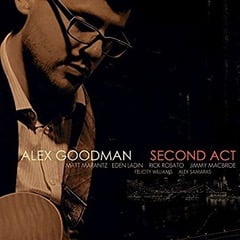
Alex Goodman – Second Act – Lyte Records
Alex Goodman – Second Act – Lyte Records LR040 73:00 ***: An appealing sample of Goodman’s goodies ( Alex Goodman – guitar; Matt Marantz – saxophone; Eden Ladin – piano/Fender Rhodes; Rick Rosato – bass; Jimmy MacBride – drums; Felicity Williams & Alex Samaras – vocals tracks 5-8, 10,11 ) Guitarist Alex Goodman is a Toronto Canada native who is following on a stellar line of Toronto guitarists such as Ed Bickert, Lorne Lofsky, Reg Schwager and Lenny Breau ( a transplanted American) all of whom made names for themselves internationally. Goodman ,who now resides in New York City, has recorded Second Act, that chronicles happenings in the life of a jazz musician living in New York. As tends to be the case with most young musicians these days, all of the compositions on this release were composed by Goodman. Additionally he has brought together a supporting cast of first rate players and improvisors and who collaborate in every sense of the word. Furthermore there are two other Canadians who are added to the mix as singers, namely Felicity Williams and Alex Samaras and they intertwine wordless vocals on several of the tracks. The opening track is entitled “Questions” and […]

Vadim NESELOVSKYI Trio – Get Up and Go – BluJazz
Vadim NESELOVSKYI Trio – Get Up and Go – BluJazz 3449 – 61:00, (1/20/17) ****½ : Terrific compositions which span jazz and classical sensibilities played by a first rate trio. (Vadim Neselovskyi; piano, melodica/ Ronen Itzik; drums, percussion/ Dan Loomis; bass/ Sara Serpa; voice (4,11)) The title of the Vadim Neselovskyi trio debut release “Get Up and Go”, suggests an attitude of brisk enterprise. While there is a bench on the cover, there is no one sitting on it. Apparently, they have gotten up and gone, leaving behind a single red ball and dusting of pigeon feathers. The first thing I look for on a recording is “All compositions by…”. It is a sign that we may be lucky to discover a complete and unknown musical world. Presumably, Mr. Neselovskyi, an instructor at Berklee College of Music, does not need to demonstrate to his students the finer points of the American Song Book; Instead, he offers eleven of his own compositions, each one ambitious in design and ranging widely in mood and expressive reach. The opening track On a Bicycle is predictably about velocity. Unlike Joseph Haydn, who can make a durable melody out of 12 notes, Vadim employs about […]

BACH: St. John Passion – 3 Releases: Academy of Ancient Music/ Crouch End Festival Chorus & Bach Camerata / Stuttgarter Hymnus-Chorknaben – Naxos, MDG
BACH: St. John Passion – James Gilchrist (Evangelista)/ Neal Davies (Christus)/ Sophie Bevan (soprano)/ Iestyn Davies (Alto)/ Ed Lyon (Tenor)/ Rodererick Williams (Bass)/ Benedict Kearns (Petrus)/ Tony Ward (Servus)/ Choir of King’s College, Cambridge/ Academy of Ancient Music/ Stephen Cleobury – King’s College multichannel SACD KGS0018 (2 discs), 109:23 [Distr. by Naxos] *****: BACH: Johannes-Passion – Veronika Winter (soprano)/ Franz Vitzthum (countertenor)/ Andreas Post (tenor)/ Christoph Schweizer (baritone)/ Thomas Laske (baritone)/ Bernhard Spingler (bass)/ Stefan Weible (tenor)/ Lucian Eller (bass)/ Hille Perl (viola da gamba)/ Stuttgarter Hymnus-Chorknaben/ Handel’s Company/ Rainer Johannes Homburg – MDG multichannel SACD (2+2+2) MDG 9021985 (2 discs), 106:77 ****: BACH: St. John Passion (sung in English) – Sophie Bevan (soprano)/ Robin Blaze (countertenor)/, Benjamin Hulett (tenor)/ Robert Murray (Evangelist)/ Andrew Ashwin (Pilate, Peter)/ Neal Davies (bass-baritone)/ Ashley Riches (Jesus)/ Peter Jaekel (organ)/ Crouch End Festival Chorus & Bach Camerata/ David Temple – Chandos multichannel SACD (2 discs) CHSA5183, 109:77 [Distr. by Naxos] ****: Three terrific representations of this seminal work. Aside from the very close timings on each of these releases, there are a few other things in common. The use of a counter-tenor (unfortunate), period instruments (all three superb ensembles), and the use of Super […]
Stereotypes Audio

Cembal d’amour

Pure Pleasure / Speakers Corner

Cedille


