
Monthly Archive: October 2017

Dayna Stephens – Gratitude – Contagious Music
Dayna Stephens – Gratitude – Contagious Music CGM002, 51:28 ****: Tenor saxophonist has a unique approach to jazz! (Dayna Stephens – tenor saxophone, baritone saxophone,EWL synthesizer, bass; Julian Lage – guitar; Brad Mehldau – piano, tack piano; Larry Grenadier – bass; Eric Harland – drums, cymbals) Born in Brooklyn and raised in the Bay Area, saxophonist Dayna Stephens traveled Eastward to attend the Thelonious Monk Institute Of Jazz and the Berklee School Of Music.He has played with many notable jazz artists including Kenny Barron, Gerald Clayton, Taylor Eigsti, Julian Lage, Eric Harland and Ambrose Akinmusire. But Stephens has established himself as a frontman, composer and interpreter. His slow, deliberate development of saxophone melodic lines eschews the overtly flashy improvisational representations of his predecessors and present counterparts. On the latest release Gratitude (his 8th as a band leader), Stephens has reassembled the top-notch group of musicians (Julian Lage/guitar; Brad Mehidlau/piano; Larry Grenadier – bass; Eric Harland – drums) that graced 2014’s Peace. With appropriate emotion and pathos, Stephens has crafted a musical catharsis of his recovery from a severe medical illness. Gratitude, with only one original number, draws its inspiration from modern composers. The opening track (written by Oliver Manchon) is […]

BEETHOVEN: Piano Concerto No. 3 & No. 5 – Norman Krieger, piano/ Buffalo Philharmonic Orchestra/ JoAnn Falletta – Decca
BEETHOVEN: Piano Concerto No. 3 in c minor, Op. 37; Piano Concerto No. 5 in E-flat Major, Op. 73 “Emperor” – Norman Krieger, piano/ Buffalo Philharmonic Orchestra/ JoAnn Falletta – Decca DD41154/ 481 5583, 76:00 (7/1/17) [Distr. by Universal] ****: Norman Krieger and conductor Falletta address two concerto staples by Beethoven. American pianist Norman Krieger has had an impressive list of scholarly appointments, at the USC Thornton Division and Indiana University, to complement his long concert career. A pupil of luminaries Adele Marcus, Maria Curcio, Alfred Brendel, and Russell Sherman, Krieger brings refinement and a polished technique to the vast repertory at his command, with an emphasis on contemporary composition. The two Beethoven concertos recorded here for Decca derive over a long incubation period: the c minor Concerto from 12 October 2004, and the E-flat Concerto from 25 March 2015. Aside from the usual, historical aspects of the c minor Concerto—its 1803 inception’s marking the “second period” of the composer’s creative development—the performance brings few “revelations” as such; but the collaboration bears a healthy, vibrant energy, and the blend of keyboard and orchestral ensemble seems intent on producing a luxuriant sonic envelope. Much of Beethoven’s dramatic sense in the first […]
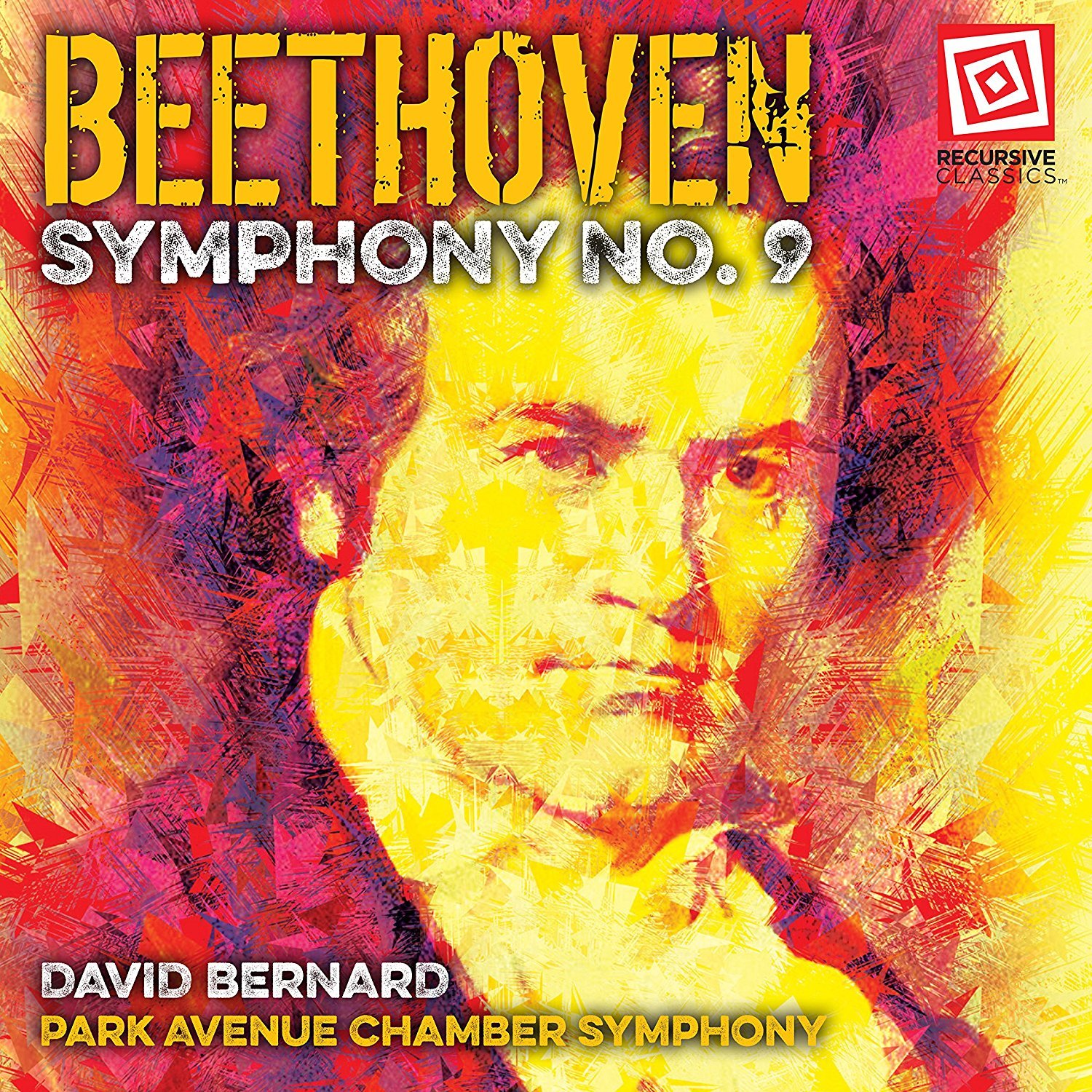
BEETHOVEN – Symphony No. 9 in D Minor – Park Avenue Chamber Symphony / David Bernard ‒ Recursive
BEETHOVEN – Symphony No. 9 in D Minor, Op. 125, “Choral” Ruth Sampson, Soprano / Edith Dowd, Alto / Cameron Schutza, Tenor / Brian Kontes, Bass / New Amsterdam Singers / West Point Glee Club / Young New Yorkers’ Chorus / Park Avenue Chamber Symphony / David Bernard ‒ Recursive Classics RC2058306; 65:38 (7/8/2017) Performance: ***1/2; Sound: *** A virile and proposive performance. But not all the playing is of sterling character, and the recorded sound is something of a letdown. Talk about a long gestastion period! While the “Choral” Symphony may have been completed and premiered in 1823, Beethoven himself more or less conducting, the idea of setting Friedrich Schiller’s “Ode to Joy,” which provides the text of the finale, came to Beethoven as far back as 1793, almost a decade before the First Symphony saw the light of day. Then in 1812, year of the Eighth Symphony, Beethoven returned to Schiller’s poem, thinking of incorporating parts of it in a choral-orchestral overture, which turned out instead to be the entirely orchestral overture Namensfeier (“Nameday”). But the idea wouldn’t rest. Around the same time, Beethoven promised his publisher Breitkopf & Härtel that he was working on two new symphonies, […]

John BLOW: “Begin the Song!”, “An Ode on the Death of Mr Henry Purcell”, “The Nymph of the wells”; Chaconne; Sonata – Simon Boden, Thomas Walker, tenors/ Arcangelo/ Jonathan Cohen – Hyperion
John BLOW: “Begin the Song!”, Chaconne a 4 in G major, “An Ode on the Death of Mr Henry Purcell”, “Ground in G minor”, “The Nymph of the wells”, Sonata in A major, “Dread Sir, the Prince of Light” – Simon Boden, tenor/ Thomas Walker, tenor/ Arcangelo/ Jonathan Cohen – Hyperion CDA 68149, 76:36 (9-29-2017) *****: This newest miracle of Restoration sound and poetry from Hyperion explores the world of John Blow, Gentleman of the Chapel of Charles II, with four odes and a tasty sampling of instrumental delights. The highlight must be the Ode on Purcell’s death, 20 minutes of alternating pairs of duets and solos in which Blow, following as closely as he can Dryden’s brilliant writing, transforms the somber occasion – “Alas too soon retir’d, as he too late began” – into visual experiences which demand music. The authentic sweetness of the singing by Boden and Walker in “We beg not hell our Orpheus to restore” and “The power of harmony too well they know” feels completely personal, as if intended for actual friends along with the larger public audience. This music might have been written for Arcangelo whose every member seems on board for a highly […]

Kathleen Ferrier Remembered = Songs by SCHUBERT, BRAHMS, WOLF, MAHLER, STANFORD, RUBBRA, JACOBSON, PARRY – Kathleen Ferrier, contralto – SOMM Recordings
Kathleen Ferrier Remembered = Schubert: 9 Lieder; BRAHMS: 9 Lieder; WOLF: “Auf einer Wanderung”; MAHLER: “Urlicht” from Des Knaben Wunderhorn; STANFORD: “La Belle Dame sans Merci”; RUBBRA: Three Psalms, Op. 61; JACOBSON: “Song of Songs”; PARRY: “Love is a bable,” Op. 152, No. 3 – Kathleen Ferrier, contralto/ Frederick Stone, Gerald Moore, and Bruno Walter, piano – SOMM Recordings SOMMCD 264, 79:30 (6/23/17) [Distr. by Naxos] *****: The restoration of long-buried Kathleen Ferrier archives warrants our unconditional praise and support. Contralto Kathleen Ferrier (1912-1953) has long achieved legendary, cult status with lovers of vocal music and simultaneously heroic personalities. The Carlisle Festival of 1937 marks her emergence as a vocal artist of consequence, and in 1939 Ferrier made her first radio broadcast. Wartime Britain and a 1942 move to London offered Ferrier the chance to join CEMA, the Council for the Encouragement of Music and the Arts, and the association led to work with Sir Malcolm Sargent, Sir John Barbirolli, and Benjamin Britten. Fate granted Ferried a mere ten years of active musical service on a major stage, but her impact on music still resounds. The former record company, Arabesque, had a disc, “A Voice is a Person,” that celebrated […]

“The Unbroken Line” = DEBUSSY: Images; Preludes; RAMEAU: Castor et Pollux; Nouvelles Suites – Jeffrey LaDeur, piano – MSR Classics
“The Unbroken Line” = DEBUSSY: Images I; Preludes II; RAMEAU: Selection from Castor et Pollux; Selection from Nouvelles Suites – Jeffrey LaDeur, piano – MSR Classics MS 1654, 69:39 [Distr. by Albany] ****: An interesting concept that rings quite true. Jeffrey LaDeur is a widely performing artist who is also the founder of the noted Delphi Trio and Founder and Artistic Director of the New Piano Collective, a consortium of internationally renowned pianists. Debussy is somewhat in his blood as he returns to Weill Hall in 2018 to commemorate an ongoing survey of the composer’s music in the anniversary of the year of his death. Here he attempts to make, in very erudite album notes, an association of Debussy’s admiration for the music of Rameau, and even his musical construction based upon some of that of the earlier artist. He certainly is correct when asserting that Debussy was interested in maintaining and developing the “pure” French tradition, especially when opposing it to the then pervasive—and some would say, persuasive—influence of Wagner. But I am afraid that the concept fails to emerge in a formidable manner on this disc, simply because there is not enough Rameau here to make the case. […]

“A Tribute to Janet” = Oboe Quartets by Mozart, Britten, Knussen, Francaix – Britten Oboe Quartet – Harmonia Mundi
A Tribute to Janet = Oboe Quartets by Mozart, Birtten, Knussen, Françaix— Britten Oboe Quartet (Nicholas Daniel, Jacqueline Shave, Clare Finnimore, Caroline Dearnley) — Harmonia Mundi HMM 907672, 61:09 ****: This recording combines various “oboe quartets” by a diverse group of composers, beginning with W.A. Mozart, then moving in time to Jean Françaix, Benjamin Britten (for whom this ensemble is named), and Oliver Knussen. The oboe quartet of course is a string quartet minus one of the violins, not four oboes. Nicholas Daniel is the oboe player, and in the work by Françaix and a single movement by Mozart, he moves to the English horn. The two pieces I liked best were the Mozart Quartet (K. 370) and the Quatour pour cor anglias, violon, alto et violoncelle by Françaix written in 1970. The Mozart piece starts the recording (and is augmented by a single movement piece by Mozart, an Adagio for English horn, K.580a. It reveals a highly polished ensemble, which seems continually well-balanced, articulate, and enrobed in a beautiful acoustic. Yet, a recital of music from different periods can be a challenge for the listener. The Britten and Knussen depart from the comfort of Mozart’s tonality. The Françaix could easily be described as tonal, […]

“Remix” = BACH: Chaconne, Selected Works for Solo Violin, arranged for Piano – Tanya Gabrielian, piano – MSR Classics
“Remix” = BACH: Chaconne from Violin Partita No. 2 in d, BWV 1004 (arr. Alexander Siloti); Violin Sonata No.3 in C, BWV 1005 (four movements in sequence, arr. Bach, Saint-Saens, Saint-Saens, Arturo Cardelus); Andante from Violin Sonata No. 2 in a, BWV 1003 (arr. Alexander Siloti); Cello Suite No. 2 in d, BWV 1008 (arr. Leopold Goldowsky) – Tanya Gabrielian, piano – MSR Classics MS 1594, 60:54 [Distr. by Albany] *****: Sit back, relax, and let your spirit soar. I’ve been waiting for an album like this; though I much prefer the Busoni arrangement of the Chaconne to that of Siloti—who is still excellent—there are some marvelous moments to be had from this release. Bach, of course, was no stranger to the idea of performing his music for solo strings on keyboard, and multiple sources indicate that he did just this, and often, having no reserve, and even seeing it as a necessity that additional harmony be added. Many composers, including Brahms and Schumann, have done just that in different circumstances and for different reasons. The transcribers here were all Bach lovers, and there is not a dud in the bunch. The performances are transcendent, idiomatic, and, simply, gorgeous. Pianist […]

DEBUSSY: Masques; … D’un cahier d’esquisses; L’isle joyeuse; Images ; Estampes; Children’s Corner – Steven Osborne, piano – Hyperion
DEBUSSY: Masques; … D’un cahier d’esquisses; L’isle joyeuse; Images I; Images II; Estampes; Children’s Corner – Steven Osborne, piano – Hyperion CDA68161, 73:21 [Distr. by Harmonia mundi] *****: A long time coming, but well worth the wait. It’s been since 2006 that Steven Osborne released his Debussy Preludes, one of the better sets to come out in the last twenty years, so it’s nice that he has turned his sights on the Frenchman again. This time the album is of a very popular nature, since at least five of the works are among the most played. Masques is from 1904, a much more evasive and subtle work than its companion from the same time, L’isle joyeuse, supposedly a “happy” time indeed as the composer had shipped his wife off to Normandy—and she attempted suicide for the first time that year—while eloping with Emma Bardac. Perhaps this dual pairing is reflected in new-found love in L’isle joyeuse while expressed in Masques, according to his widow, the “tragic expression of existence”—who can say? Either way, Steven Osborne turns in appropriately suitable readings of great expressivity. The 1903 Estampes (the French name for Japanese prints), is thought to be the result of his […]
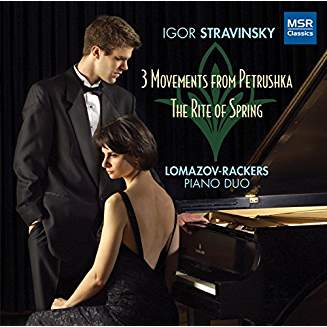
STRAVINSKY: Piano Four Hands — Petrushka; The Rite of Spring – Lomazov-Rackers Piano Duo – MSR Classics
STRAVINSKY: Three Movements from Petrushka (piano four-hands version); The Rite of Spring (piano four-hands version) – Lomazov-Rackers Piano Duo – MSR Classics MS 1628, 47:46 [Distr. by Albany] ****: Stravinsky created multiple piano versions of his great ballets, not necessarily for performance, but for rehearsal. There is even a record of he and Debussy playing the score of Rite of Spring together during one of these prelims. Hearing these is often enlightening, as there are parts which conductors either fail to bring out properly during performance, or are the result of bad orchestration on the composer’s part (yes, this certainly did happen with some of these gargantuan orchestrations). The resulting clarity can be illuminating, while at the same time they obviously lack the dramatic import and sheer overwhelming volume of sound that we are all used to. In the case of the multi-player arrangements, they can be done for two pianos or one piano-two players, and the Lomazov-Rackers Duo has opted for this latter setup as they believe it leads to the best presentation of these pieces. Now common in recitals, these once backstage wonders are taking their rightful place in the eyes of the public, only adding to the […]

LISZT: Hungaria; Orpheus; Prometheus; Hamlet; Hunnenschlacht – Thomas Beeecham/Stanislav Macura/ Ernest Ansermet/Mark Erklär – Praga Digitals
LISZT: Hungaria; Orpheus; Prometheus; Hamlet; Hunnenschlacht – USSR Ministry of Culture Symphony Orchestra/ Mark Ermler/ Royal Philharmonic Orchestra/ Thomas Beecham/ Prague Radio Symphony/ Stanislav Macura/ Orchestra de la Suisse Romande/ Ernest Ansermet – Praga Digitals SACD PRD 250 384, 75:21 [Distr. by Harmonia mundi/PIAS] ****: The sequel to Volume One proves equally as stirring. For a review of Volume One in this series, please see Gary Lemco’s August 14th, 2017 posting. I share his satisfaction and enthusiasm for the first edition, and only second it with this wonderful sequel. I need to make mention that the sound is phenomenal in its remastered two-channel SACD guise, ranging from 1958 to 1989. I would also be remiss if I didn’t mention that these are not cheap, coming in around $23 on Amazon, a little steep for rereleases of any stripe. However, would I buy them? You bet! The nationalistic fervor provided by Liszt’s 1854 Hungaria allowed it to achieve enormous success right from the beginning, with the composer conducting the premiere in 1856. His Heroic March in Hungarian Style provided the basis for the piece, and Liszt himself said that “all wept, both men and women.” Ermler and his USSR band, colorful, […]

NICHOLAS DEYOE : ”for Duane” – wasteLAnd Ensemble – Populist Records
NICHOLAS DEYOE : ”for Duane” = Finally, the cylindrical voids tapping along; 1560; Lied/Lied; Immer wieder; Lullaby 6 “for Duane” – wasteLAnd Ensemble – Populist Records PRO13, 62:27 (10/20/2017) ***: Experimental, yes—in a way—but very intriguing! Populist Records is a small Los Angeles based label specializing in new and experimental music from within the LA arts community. This release was just premiered last night, October 20, 2017, (at the writing of this review, October 21.) The premiere show was held at the Tymele Arts Theatre and based just on what I have heard here I would have loved to have been there! (I get out to LA fairly often for LA Phil concerts and new music adventures of various sorts.) The show featured music from this album, with performances by cellist Ashley Walters (who also has a new album on Populist to be reviewed), composer-performer Nicholas Deyoe, the wasteLAnd ensemble, violinist Batya MacAdam-Somer, and more. (Publicity materials indicate that Solarc Brewing was also “there pouring some special beers they’ve created for the occasion”. Another reason I would have wanted to be there!) Nicholas Deyoe is the founder of wasteLAnd as well as a composition professor at Cal Arts. He has […]

Gregory Lewis – Organ Monk, The Breathe Suite
Gregory Lewis – Organ Monk, The Breathe Suite – Self-released, 49:32 [5/5/17] ****: One man’s response to violence. Listeners who want to hear cutting-edge Hammond B3 organ jazz, need to be aware of Gregory Lewis, AKA Organ Monk. Lewis’ moniker is well-chosen. He has been known to delve into Thelonious Monk’s music. More importantly the organist, band leader and composer is committed to exploring and developing a distinctive discourse which—like Monk—uses traditional jazz to propel jazz forward. Lewis does this and much more on his latest outpouring, the 49-minute, six-track conceptual album, Organ Monk, The Breathe Suite. Lewis’ previous CDs (Organ Monk, 2010; Uwo in the Black, 2012; and American Standard, 2013) pushed the perception of a jazz organ group to new heights. On his self-released The Breathe Suite Lewis goes even further. The six movements on The Breathe Suite provide a clue to Lewis’ intentions. Four pieces are named after African-Americans killed for no reason, sometimes by white police, other times by confrontational white men. The final two pieces reference the Ausar Auset Society, a Pan-African religious organization. One of the stated purposes of Lewis’ The Breathe Suite is to “serve as an outlet for a deep emotional interface […]
Streams and Podcasts for 27 October 2017
This week, The Music Treasury presents recordings by the pianist John Browning, a highly regarded and decorated musician in the mid-1900s. Featured works will include two etudes by Rachmaninoff, Beethoven’s “Tempest” piano sonata, Barber’s concerto, along with works by Chopin, Mozart, Haydn, and Bach. The show is hosted by Dr. Gary Lemco, and can be heard on Sunday, 29 October 2017, between 19:00 and 21:00, PDT. In addition to being a radio show, it is also presented as streaming broadcast: kzsulive.stanford.edu

SZYMANOWSKI: Violin Concertos; KARLOWICZ: Violin Concerto – Tasmin Little, violin/ BBC Symphony Orchestra/ Edward Gardner – Chandos
SZYMANOWSKI: Violin Concerto No. 1, Op. 35; Violin Concerto No. 2 in a minor, Op. 61; KARLOWICZ: Violin Concerto, Op. 8 – Tasmin Little, violin/ BBC Symphony Orchestra/ Edward Gardner – Chandos CHSA 5185, 73:18 (9/1/17) ****: Tasmin Little embraces the early 20th Century Polish violin concerto tradition with an easy and articulate grace. Just preceding the First World War, Karol Szymanowski traveled extensively around the Mediterranean, including Italy and North Africa, whose respective influence combined with the composer’s long admiration of French music, particularly of Debussy and Roussel. The Violin Concerto No. 1 (1916) testifies to the composer’s new-found lyricism and unified sense of form: in one, extended rondo movement, the music falls into five identifiable sections. The poem “May Night” by Tadeusz Micinski invokes many of the effects of the music: fireflies, nereids, fairies, and other ephemeral beings close to Shakespeare’s Queen Mab. Pan plays his pipes in the woodlands, and Szymanowski means to capture a delicate majesty in the richly fertile scoring of his concerto. The composer wrote the work with Paul Kochanski in mind, and that fine instrumentalist helped conceive the cadenza. A kind of ecstatic virtuosity marks Tasmin Little’s solo part, with its improvvisando elements, […]

Concert Review—Ballaké Sissoko and Vincent Ségal, Kora/Cello
It was a rich musical synergy this week at the Old Church—the concert blending the sounds of the distinctive Kora harp, with antiquity roots in Africa, with more contemporary guitar and cello, with definite jazz lilt. Two ensembles presented that evening—the Portland Kora Project trio, followed by the duo of Ballaké Sissoko and Vincent Ségal. The kora harp is an instrument worth taking note of, especially as it shone in the hands of this evening’s performers, with some two dozen strings reaching down from its neck and across the bridge of its resonating gourd. The opening set by the Portland Kora Project gave a glimpse into the sound spectrum of the kora — without the visual cues, the first impression is that of classical (western) harp, with a range of timbres from the bright high notes to the deep bass strings. With two kora from which to chose, Will Dudley brought the instruments to life with a mix of scale passages (pentatonic, for the first pieces) along with rhythmic ostinato patterns, from which he was able to deftly pull out floating melodies. This was in pleasant counter point to the guitar work of Ben Finley—the two of them had playful exchanges of […]

David Benoit – The Steinway Sessions – Steinway & Sons
David Benoit – The Steinway Sessions – Steinway & Sons 30066, 69:17 ****1/2: Jazz pianist excels in his solo debut…after 35 years of recording! (David Benoit – piano) It is always interesting hear jazz pianists in a solo format. The absence of a rhythm section shines a more revelatory light on the overall technique from both hands in the adaptation.. David Benoit – The Steinway Sessions represents his debut on the label. As the pianist remarks in the liner notes, this is his first solo recording in his stellar thirty-five year career. The tracks are comprised of familiar, previously recorded tracks and the premiere of “Etudes For The Contemporary Pianist”. Opening the festivities is “Kei’s Song” (from the 1987 album, Freedom At Midnight). The lyrical texture and rolling tempo is catchy. Benoit’s technique is forceful at times, and full of innate warmth. “Every Step Of The Way” may be Benoit’s most recognized composition. This solo rendition maintains the dynamic rhythm of the original. The volume modulation and joyful upbeat vibe is shaded with soulful inflections. Covering Bill Evans is always challenging. The selection of “Letter To Evan” (written by the iconic pianist for his son, just two months prior to […]

Christian Sands – Reach – Mack Avenue
Christian Sands – Reach – Mack Avenue MAC1117, 65:36 ****: Masterful jazz from an emerging jazz giant! (Christian Sands – piano; Marcus Baylor – drums; Gilad Hekselman – guitar; Christian McBride – double bass; Yasushi Nakamura – double bass; Christian Rivera – percussion; Marcus Strickland – tenor saxophone, bass clarinet) Christian Sands has become a notable jazz pianist at a young age. He started playing at the age of four, and attended the prestigious Manhattan School Of Music. One of his earliest mentors was Billy Taylor. His other influences include Wynton Marsalis, Kenny Garrett, Marcus Foster and Christian McBride. Sands rose to prominence, touring with McBride’s band, Inside Straight. Still in his twenties, he has recorded several albums as a leader and became an American Pianist Association Jazz fellowship Awards Finalist. Sands’ latest release on Mack Records, Reach is a collection of original compositions and two unlikely covers that bridge a diverse assortment of jazz styles. He is primarily backed by Marcus Baylor (drums) and Yasushi Nakamura (double bass), with some notable guest artists. The opening track, “Armando’s Song” (sounds like a homage to Chick Corea) begins with a lively piano-groove intro. The main impetus of the arrangement is […]

Sean HICKEY: A Pacifying Weapon/Concerto For Recorder, Winds, Brass, Percussion And Harp – Michala Petri (recorder) – Our Recordings/Nordsco Records
Sean Hickey – A Pacifying Weapon/Concerto For Recorder, Winds, Brass, Percussion And Harp – Our Recordings/Nordsco Records OUR-LP001 audiophile vinyl, 41:50 ****: Modern classical music with a global perspective! (Sean Hickey – composer; Michala Petri – recorder; Jean Thorel – conductor Royal Danish Academy Of Music Concert Band; Clemens Schuldt – conductor Lapland Chamber Orchestra) As a new millennium is underway, musical expression, including classical is evolving in its own way. Compositions reflect some of the changes made by 20th century composers. Minimalism (Phillip Glass,Steve Reich) and Post–Modernism were skeptical of grandiosity and universal application. emphasizing political and social context. Postminimalism (Louis Andriessen, Gavin Byars, John McGuire) went a step further with pulse-driven music. Other genres like New Complexity and New Simplicity defined the new century of composers. Polystylism and Eclecticism exposed compositions to a variety of genres and techniques with global modalities. Sean Hickey is an example of 21st century classical music. He studied electric guitar in Detroit and was commissioned to write chamber and orchestral works by various organizations, including Lincoln Center For The Performing Arts. His current release, A Pacifying Weapon (Concerto For Recorder, Winds, Brass, Percussion And Harp) was inspired by an indie folk group Indigo […]

Voices of Defiance = String Quartets by ULLMANN, SHOSTAKOVICH, LAKS – Dover Quartet – Cedille
Voices of Defiance = ULLMANN: String Quartet No. 3, OP. 46; SHOSTAKOVICH: String Quartet No. 2 in A Major, Op. 68; LAKS: String Quartet No. 3 – Dover Quartet – Cedille CDR 90000 173, 73:06 (10/13/17) [Distr. by Naxos] *****: The Dover Quartet embraces three visions of the Holocaust, music that testifies to Humanity’s stoic resilience. The Dover Quartet presents three composers who were victims of, and who fought against, Fascism. Viktor Ullmann (1898-1944) composed his 3rd String Quartet in the concentration camp at Theresienstadt in 1943; he was murdered soon after he was moved to Auschwitz the following year. Dmitri Shostakovich (1906-1975) composed his 2nd Quartet in Moscow in 1944, following horrific scenes during the Siege of Leningrad and the long fight between the Soviets and the Nazis. Simon Laks (1901-1983) wrote his 3rd Quartet in Auschwitz in 1945; that year he was transported to Dachau, which was liberated before he could be killed. I do not usually embrace Holocaust themes, although some readers may recall my review years ago of Great Conductors of the Third Reich, a video of those eminent artists whose participation in Nazi musical events offered legitimacy to a degenerate regime. Moreover, at an Emory […]

PDX JAZZ In Portland, Oregon Concert October 19th, 2017 with the Marquis Hill Quintet
We are not living in the balmiest of times when it comes to the local arts scene. For years, Portland, Oregon had boasted several fine Jazz venues, and it was just a matter of choosing between them on a Friday night. But then, one after another closed up. The last one, the legendary Jimmy Mak’s, closed its doors last fall. However, before we could begin to wallow in despair, a relief operation was mounted by the outstanding Jazz PDX organization, which promises to revitalize jazz in the city and put Portland back on the map for world-class Jazz events. PDX Jazz goes back to 2003 when it began as the presenting organization for the Jazz festival. The Festival was established as both a cultural tourism initiative and as an educational outreach aimed at broadening understanding of the rich legacy of Black American music. It is in the last two years, though, that PDX Jazz has redoubled its efforts to promote jazz. Last year’s Jazz festival brought out Maria Schneider, the most illustrious modern jazz composer of our time, and her orchestra to Portland for the their West Coast debut. And as the leaves begin to fall and […]

Adrian Cunningham – Jazz Speak – Arbors Records
Adrian Cunningham – Jazz Speak – Arbors Records ARCD 19457 61:14**** An album that has a welcoming combination of measured and harmonic expression ( Adrian Cunningham – tenor sax, clarinet, flute; Ted Rosenthal – piano; John Clayton – bass; Jeff Hamilton – drums) Multi-instrumentalist Adrian Cunningham’s latest release Jazz Speak takes a look at the jazz experience as a convergence of music and travel. As Cunningham says in the liner notes “ both music and travel takes you out of your comfort zone, stretch you, test you , and most importantly, connect you”. Working with a top notch trio composed of pianist Ted Rosenthal, bassist John Clayton, and drummer Jeff Hamilton, Cunningham brings his unique talent to a session of originals and other compatible material that are suitable to his high level of creativity. The album opens with one of those Cunningham originals “The Source” which speaks to a neighbourhood in Harlem to which the composer is attached. The number has a familiar bounce that is associated with the area and where Cunningham’s tenor sax delivers his interpretation with assurance. Each of the other band members chips in with a brief reassuring solo. Two recognizable numbers follow and are given […]
Stereotypes Audio

Cembal d’amour

Pure Pleasure / Speakers Corner

Cedille


