
Monthly Archive: February 2018

FELIX DRAESEKE = Orchestral Works Vol. 1 & 2: Symphony in G; Symphonia tragica; Piano Concerto; Gudrun Overture; Symphonic Prologue to Penthesilea, Op. 50 – Claudius Tanski, p/ Wuppertal Sym. Orch./ George Hanson – MDG
Nicely priced rerun for some obscure music. FELIX DRAESEKE = Orchestral Works Vol. 1 & 2: Symphony in G, Op. 12; Symphonia tragica, Op. 40; Piano Concerto in E-flat, Op. 36; Gudrun Overture; Symphonic Prologue to Penthesilea, Op. 50 – Claudius Tanski, p/ Wuppertal Sym. Orch./ George Hanson – MDG 335 2018 (2 CDs), 73:01 [Distr. by Naxos] ***1/2: Felix Draeseke (1835 – 1913) is a strange dude. A confessed Lisztian/Wagnerian, his whole life seems dedicated to forcing these two idioms into more standard vehicles, even though he wrote eight operas, four symphonies, and thrived on choral music. His orchestration is nothing particularly original, and his intensely contrapuntal methodology belies much of what is found in the greatest works of his two heroes. He was finally, after many years of uncertain economic stability, able to establish himself in the 1890s after his promotion to professor at the Royal Saxon Conservatory, and was somewhat lionized during his lifetime, especially by Liszt, who gave him unqualified support after hearing Draeseke’s early piano sonata. But though he was performed widely (Hans von Bülow, Arthur Nikisch, Fritz Reiner, and Karl Böhm all conducted him), his music was ultimately determined to be problematic and not […]

HANDEL: Concerti a Due Cori – Freiburger Barockorchester/ Gottfried von der Goltz and Petra Muellejans – Harmonia mundi
The aural delights abound in Handel’s settings for duo-wind choirs, rendered expertly by the Freiburg ensemble. HANDEL: Concerti a Due Cori = F Major, HWV 334; B-flat Major, HWV 332; F Major, HWV 333 – Freiburger Barockorchester/ Gottfried von der Goltz and Petra Muellejans – Harmonia mundi HMM 905272, 48:54 (2/9/18) ****: Handel had a tendency to compose music that would occupy and entertain audiences who came specifically to hear his own works. Many of his concertos mean to serve as appetizers for his major vocal compositions, oratorios and concert versions of operas. Those Concerti a Due Cori recorded here (10-12 October 2014) were the products of the Covent Garden oratorio seasons, 1747/48. Handel rescored excerpts of his oratorios for double wind choirs and strings, wonderful “preludes” for the exciting vocal performances about to be engaged by an equally multifarious group of musicians. At the time, extra wind players were in abundance, especially after the 1745 suppression of the Jacobite rising and the disbanding of what had become surplus military bands. The B-flat Concerto, HWV 332 likely accompanied the premiere of the oratorio Joshua 9 March 1748. The Ouverture no less advertises Alexander Balus, to be premiered two weeks after […]

Satoko Fujii Orchestra New York – Fukushima – Libra
Never forget. Satoko Fujii Orchestra New York – Fukushima – Libra 214-044 57:34 [12/15/17] ****: (Satoko Fujii – conductor, composer; Oscar Noriega – alto saxophone; Ellery Eskelin, Tony Malaby – tenor saxophone; Andy Laster – baritone saxophone; Dave Ballou, Herb Robertson, Natsuki Tamura – trumpet; Joey Sellers, Joe Fiedler, Curtis Hasselbring – trombone; Nels Cline – guitar; Stomu Takeishi – bass; Ches Smith – drums) Do people remember Fukushima? The Fukushima Daiichi Nuclear Power Plant suffered major damage from the magnitude 9.0 earthquake and tsunami which hit Japan on March 11, 2011. The chain of events caused a nuclear meltdown, radiation leaks, and permanently ruptured several reactors making them impossible to restart. The environmental harm is far from over. Radioactive water has leached into water and soil in the general area, and highly radioactive water leaked into the Pacific Ocean years after the event. One person who has never forgotten is composer Satoko Fujii. In 2016, she gathered together her all-star, 13-member Orchestra New York to record the ensemble’s tenth album, the 57-minute Fukushima, which is her personal viewpoint on the Fukushima episode and aftermath. Fujii (who conducted this session but did not play an instrument) provides plenty of space […]
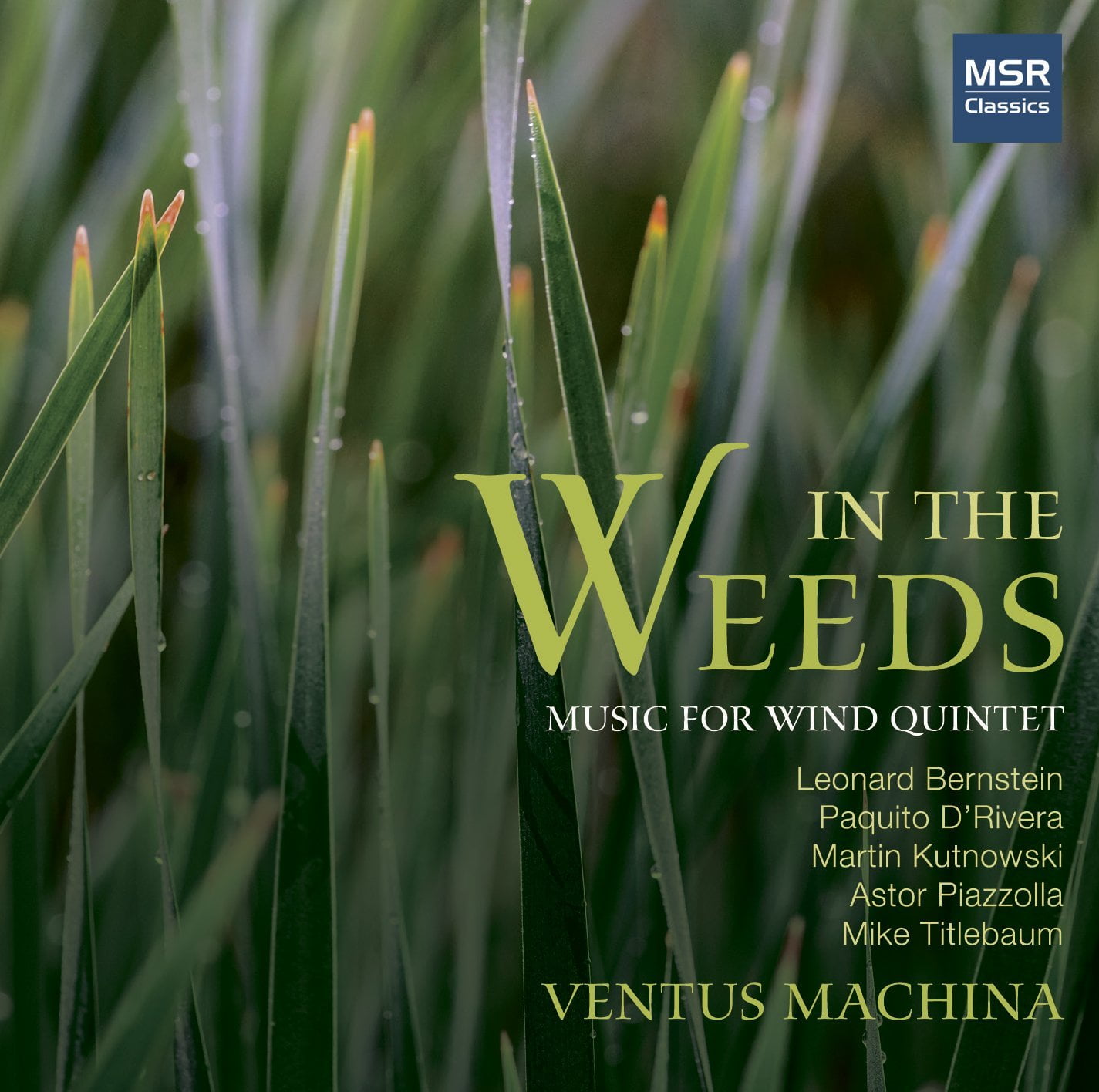
In the Weeds: Music for Wind Quintet by Bernstein, D’Rivera, Kutnowski, Piazzolla, & Titlebaum—Ventus Machina—MSR Classics
In the Weeds: Music for Wind Quintet. Music by Bernstein, D’Rivera, Kutnowski, Piazzolla, & Titlebaum—Ventus Machina (Karin Aurell, Christie Goodwin, James Kalyn, Ulises Aragon, and Patrick Bolduc—MSR Classics MS1633—61:00, ****1/2: Ventus Machina is the name of a wind quintet of music professionals from Mount Allison University in New Brunswick, Canada. The format isn’t assured, like a string quartet (two violins, viola, and cello), but this ensemble performs music for flute, oboe, clarinet, french horn, and bassoon. And several pieces on the album were written especially for the ensemble. The two most recognizable pieces are arrangements. The first is of Bernstein’s West Side Story, and the second is of Piazzolla’s Milonga sin palabras. Having spent a lot of time performing wind ensemble music myself, I can vouch for the high quality of each performer and their contribution to a well balanced ensemble. The acoustic for the recording is especially supportive for the repertoire. So, having established that Ventus Machina is a quality ensemble, let’s look at the unfamiliar pieces included. Martin Kutnowski’s Tonadas y mateadas from 2015 is a single movement work with contrasting sections. It’s a tonal piece with definitively modern harmonies. The piece is approachable, including moments I perceive as […]

LISZT: Piano Concerto Nos. 1 & 2; Petrarch Sonnets; Tannhauser Overture – Jorge Bolet, piano/ Lawrence Foster/ Edo de Waart – Audite
A restored series of RIAS appearances by Jorge Bolet will delight and astound in his thorough grasp of the Liszt style. LISZT: Piano Concerto No. 1 in E-flat Major; Piano Concerto No. 2 in A Major; Annees de Pelerinage, Deuxieme Annee: 3 Petrarch Sonnets; Overture to Tannhauser – Jorge Bolet, piano/ Radio Symphony-Orchestra Berlin/ Lawrence Foster/ Edo de Waart – Audite 97.738, 79:09 (1/19/18) [Distr. by Naxos] ****: The Cuban piano virtuoso Jorge Bolet (1914-1990) enjoyed a special relationship with the music of Franz Liszt, his having been selected to supply the sound track for the 1960 motion picture Song Without End, in which Dirk Bogarde portrayed the legendary Hungarian musician. Bolet traveled to Berlin and the RIAS studios several times between 1971 and 1982, and happily, his studio and concert performances have been preserved and here issued for the first time. The familiar 1855 E-flat Concerto (30 November 1971) with Lawrence Foster, live, combines electric fluency and romantic girth, eagerly indulging the dialogue between the piano, individual instrumental colors, and the full complement of strings, brass and tympani. After a blistering Allegro maestoso, the one movment work glides into an operatic Quasi Adagio in which Bolet’s keyboard exerts recitative […]
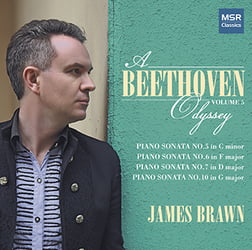
“A Beethoven Odyssey”, Vol. 5 = Piano Sonatas, Nos. 5, 6, 7 & 10 – James Brawn, p. – MSR Classics
The journey continues, and a superb one it is. “A Beethoven Odyssey”, Vol. 5 = Piano Sonatas: No. 5 in c, Op. 10/1; No. 6 in F, Op. 10/2; No. 7 in D, Op. 10/3; No. 10 in G, Op. 14/2 – James Brawn, p. – MSR Classics MS 1469, 71:12 *****: It’s been two years since the last volume of James Brawn’s sensational Beethoven series, and I was starting to get worried! The first four appeared with predictable regularity, and then this drought occurs. Happily, volume five is now here, and we are all the better for it. I hope MSR decides to move ahead before I get any older! The virtues present in the previous releases are all here—stringent channeling of the composer’s innermost ideas, wonderful articulation, fine sense of rubato, and an absolutely uncluttered technical arsenal that presents Beethoven not as a heroic giant but as an immensely personal communicator. This composer, such a fabulously creative and innovative artist, is always found—to me, at least—at his most perfect in the piano sonatas and string quartets. The symphonies are great, but their statements are larger than life, while the chamber music reflects life itself. Brawn seems to get […]

Jascha Spivakovsky: Bach to Bloch, Vol. IV = Works for Solo Piano by BACH; BEETHOVEN; CHOPIN; SCHUMANN – Jascha Spivakovsky, piano – Pristine Audio
The fourth installment of the Spivakovky Edition revels in the Romantic ethos of composer and performer. Jascha Spivakovsky: Bach to Bloch, Vol. IV = BACH: Fantasia in c minor, BWV 906; BEETHOVEN: Piano Sonata No. 31 in A-flat Major, Op. 110; CHOPIN: Impromptu No. 1 in A-flat Major, Op. 29; Etude in c minor, Op. 10, No. 12 “Revolutionary”; Etude in f minor, Op. 25, No. 2; Etude in G-flat Major, Op. 25, No. 9 “Butterfly”; Bolero in C Major/a minor, Op. 19; SCHUMANN: Carnaval, Op. 9 – Jascha Spivakovsky, piano – Pristine Audio PAKM073, 71:30 [www.pristineclassical.com] *****: The latest installment of the Jascha Spivakovksy (1896-1970) legacy derives from a series of recordings that span approximately eighteen years, 1948-1966, derived from radio appearances and home recitals. Many of us who audition these rare and recently-revived performances marvel at the musical acuity and innate, Romantic sensibility of this magnificent artist, who never enjoyed the prestige of a commercial recording contract. Each interpretation bears Spivakovsky’s idiosyncratic temper and musical line, his astute rhythmic pulse and sense of the dramatic space between notes. Nothing that we hear bears the sense of routine or mediocrity of thought. We seem to become eaves-droppers on a […]
SIBELIUS: Symphony Nos. 5, 6, & 7 – Philharmonia Orchestra/ Herbert von Karajan – Praga Digitals
The last three of the Sibelius symphonies vibrate with a clarity and intensity peculiarly Karajan’s. SIBELIUS: Symphony No. 5 in E-flat Major, Op. 82; Symphony No. 6 in d minor, Op. 104; Symphony No. 7 in C Major, Op. 105 – Philharmonia Orchestra/ Herbert von Karajan – Praga Digitals PRD 250 355, 77:30 [Distr. by Harmonia mundi/PIAS] ****: At the behest of EMI music producer Walter Legge (1906-1979), Austrian conductor Herbert von Karajan (1908-1989) received a kind of political/artistic reprieve in 1946, his having been banned from musical activities in Vienna by the Soviet occupation for Karajan’s participation in Nazi cultural life. Legge wished to see his recently formed Philharmonia Orchestra of London enjoy a honing process under such musical directors as Karajan, Dobrowen, and Susskind. The Sibelius symphonies recorded here date from 1955 and 1960 (E-flat Symphony), respectively, celebrating the better of ten and fourteen years’ association between Karajan and the most superb British orchestra ensemble after the formation of Beecham’s Royal Philharmonic. Karajan certainly adds to the pantheon of great Sibelius interpreter, but we must ponder why the Symphony No. 3 in C, Op. 52 never received from him its due in terms of live or recorded performance. […]
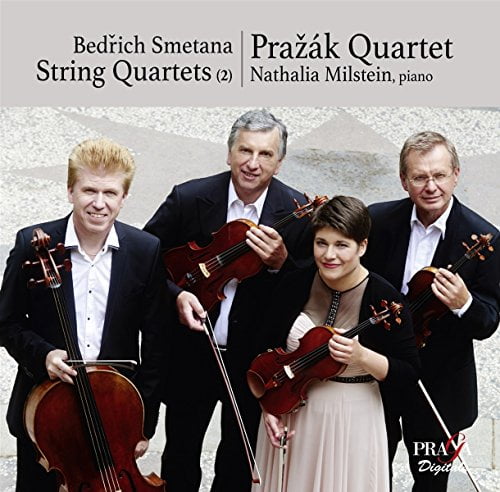
SMETANA: String Quartet No. 1 & No. 2; Piano Trio – Prazak Quartet/ Nathalia Milstein, piano – Praga Digitals
Intense and masterfully performed, these three Smetana chamber music staples enjoy fiercely passionate renderings. SMETANA: String Quartet No. 1 in e minor “From My Life”; String Quartet No. 2 in d minor; Piano Trio in g minor, Op. 15 – Prazak Quartet/ Nathalia Milstein, piano – Praga Digitals PRD/DSD 350 151, 75:53 (2/16/18) [Distr. by Harmonia mundi/PIAS] ****: Recorded in 2017, these refreshed performances of Bedrich Smetana’s famous 1876 String Quartet No. 1 and his 1855 Piano Trio, along with the lesser known d minor Quartet of 1883, can claim a visceral authority in the lexicon of stellar interpretations. The French pianist Nathalia Milstein (b. 1995) joins violinist Jana Vonaskova and cellist Michal Kanka in the spirited tribute to the Czech spirit that defines the Smetana legacy. The opening chord of “From My Life” should notify the alert listener of the fierce and passionate gravitas of the ensuing performance of this most autobiographical of chamber works. “What I set out to do was to retrace the unfolding of my life in music,” wrote Smetana, after a stroke in 1874 had begun its inexorable debilitation of his musical and mental faculties. Josef Kluson’s anguished viola serves as the emissary of Smetana’s […]

Isaac Hayes — Shaft, Hot Buttered Soul, Black Moses — Triple Release!
Audiophile Audition is proud to present a three-fold re-release of music by Isaac Hayes… Isaac Hayes – Hot Buttered Soul – Enterprise/Stax ENS 1001 (1969)/Craft/Concord Music Group CR00034 (2018) 180-gram stereo vinyl, 45:24 *****: Soul and popular music are re-imagined by Stax veteran on terrific Craft records update. (Isaac Hayes – vocals, keyboards; Marvell Thomas – keyboards; The Bar-kays/Willie Hall – drums; James Alexander – bass; Michael Toles – guitar) Isaac Hayes began his illustrious career as a songwriter and producer for Stax records in the 1960’s He co-wrote (with David Porter) influential hits like “Soul Man”, “When Something Is Wrong With My Baby” and “Hold On, I’m Coming”. After the death of Otis Redding (Stax’s #1 star), the label need a significant lift. This came in the release of the ground-breaking album, Hot Buttered Soul by Isaac Hayes in 1969. Soul music was dominated by Motown and the precise, dance-friendly 3 minute single. The success of the label was indisputable, but the timing for something more transformative was imminent. Hayes reinvented soul music (and on a larger scale popular music) with this epic release. There are only four songs on this album and the elongated arrangements (with The Bar-Kays […]

BACH: Keyboard Partita No.2 in C minor; Italian Concerto; The Well-Tempered Clavier (selections); Chaconne (trans. Busoni) – Simone Leitao, p – MSR Classics
Leitao is a marvelous Bachian, proven in every measure. BACH: Keyboard Partita No.2 in C minor, BWV 826; Italian Concerto in F major, BWV 971; Selections from The Well-Tempered Clavier, Books I & II; Chaconne from Violin Partita No.2, BWV 1004 (trans. Busoni) – Simone Leitao, p – MSR Classics 1665, 57:24 *****: Simone Leitao may not have been a student of Glenn Gould (she studied with Ivan Davis, Geir Braaten, and Linda Bustani), but the beautiful 48-year-old Brazilian certainly sounds more like him than any recent pianist I have heard. Her articulation, particularly, seems representative of the Gouldian ethos, short and clean, yet pregnant with tonal beauty and exceptional clarity. It surprised me greatly, pleasantly, as I am a confirmed Gould fan. The program is also quite cut from the Gould playlist, starting with a riveting presentation of the Partita No.2 in C minor, always a favorite of the late great Canadian. Leitao takes it with the dance titles in mind, and offers an engaging and superbly personal performance. The Italian Concerto is another Gould staple—though he professed to not like it much—and Leitao’s tempi are remarkably close to Gould, especially the non-manic and measured first movement. According to […]

BEETHOVEN: Septet Op. 20; STRAUSS: Till Eulenspiegel einmal anders! – OSM Chamber Soloists/ Andrew Wan – Analekta
The Chamber Society of Montreal makes pure magic of Beethoven’s Septet and an arrangement of Richard Strauss. BEETHOVEN: Septet in E-flat Major, Op. 20/R. STRAUSS: Till Eulenspiegel einmal anders! – OSM Chamber Soloists/ Andrew Wan – Analekta AN 2 8788, 50:00 (3/16/18) [Distr. by E1] ****: Beethoven composed his Septet in 1799, much as a “preparation” for his First Symphony. An immediate success, the piece utilizes the Tempo di minuetto third movement for his Op. 49, No. 2 Piano Sonata in G Major (1795). All the movements of Op. 20 are in major keys, making the work as a whole energetically upbeat. In six movements, the Septet resembles the divertimentos and cassations popular in Vienna at the time. The first movement features a strong violin solo in the manner of a concertante piece. Beethoven’s deft blend of winds attests to a young master of timbre balance. The French horn has a marvelous part in the Adagio. The fourth movement proffers a set of variations on a Rhineland tune, Ach schiffer, lieber schiffer. The scoring of one instrument per part allows the cello and the bassoon to move higher up in range than Mozart or Haydn would have permitted. The immediate popularity […]

BEETHOVEN: Symphony Nos. 1 & 6 – Orchestre National de l’O.R.T.F./ Boston Symphony Orchestra/ Serge Koussevitzky – Pristine
The Beethoven “Nine” with Serge Koussevitzky conducting has become a recorded reality! BEETHOVEN: Symphony No. 1 in C Major, Op. 21; Symphony No. 6 in F Major, Op. 68 “Pastoral” – Orchestre National de l’O.R.T.F./ Boston Symphony Orchestra/ Serge Koussevitzky – Pristine Audio PASC 522, 59:55 [www.pristineclassical.com] *****: Ask, and ye shall receive! In the course of my review of PASC 515—the first ever release—of Serge Koussevitzky’s conducting Beethoven’s 4th Symphony coupled with a previously unissued Seventh, I noted that, except for a reading of the Beethoven C Major, posterity could boast of a complete Beethoven Nine with Koussevitzky. Now, Andrew Rose and Pristine deliver another coup: the first ever issue of Koussevitzky’s conducting Beethoven’s 1st Symphony, this time coupled with an unissued live performance (23 October 1943) of the Sixth. The First Symphony hails from a French radio re-broadcast of a 25 June 1950 live performance with the Orchestre National de l’O.R.T.F., obviously made on tour, after Koussevitzky had turned his long tenure with the BSO over to Charles Munch. The recording delivers reliable sound, but it does suffer from cross-talk interference from another station, allowing one to hear from time to time another piece of music bleeding […]

BEETHOVEN: Piano Sonata Op. 101; BRAHMS: Two Rhapsodies, Op. 79; SCHUMANN: Kreisleriana, Op. 16 – Alexander Beridze, piano – NY Classics
A Romantic recital by pianist and philanthropist Alexander Beridze warrants our attention. BEETHOVEN: Piano Sonata No. 28 in A Major, Op. 101; BRAHMS: Two Rhapsodies, Op. 79; SCHUMANN: Kreisleriana, Op. 16 – Alexander Beridze, piano – NY Classics NYC 11.12.2014, 65:00 (11/12/14) [www.newyorkpianofestival.com] ****: A native of the Republic of Georgia, Alexander Beridze (b. 1980) teaches at the Center of Musical Excellence in Manhattan. He is the founder of the New York Piano Festival, as well as the Artistic Director. In 2014, he was an artist in residence at the Shepherd School of Music at Rice University. He is the President of the New York Music Foundation Inc., a not for profit 501 C 3 that he started in 2014. He has organized and performed in charity concerts to help children in Georgia, Russia and America, supporting the Sloan Kettering Cancer Center and Downside Up, a Russian non-profit organization, which provides support for families of children with Down syndrome. He won the gold medal at the 53rd (2009) World Piano Competition at age 29. In 2011, Beridze performed in recital at Alice Tully Hall in New York City. His performances have been broadcast in the United States, the Republic of […]

Wes Montgomery – Wes Montgomery In Paris: The Definitive ORTF Recordings – Resonance Records
Wes Montgomery – Wes Montgomery In Paris: The Definitive ORTF Recordings – Resonance Records HCD-2032 (2-CD box), 102:47 ****1/2 (Wes Montgomery – guitar; Harold Mabern – piano; Arthur Harper Jr. – double bass; Jimmy Lovelace – drums; with special guest Johnny Griffin – tenor saxophone) In November, Resonance Records released a rare live recording of a 1965 Wes Montgomery performance. In partnerships with the Institute National de L’Audiovisul (INA). Wes Montgomery – In Paris is notable for many reasons. It is the first time, the Montgomery estate will be paid for this recording which had been previously bootlegged. The concert marked the only overseas trip for Montgomery, and helped to further Zev Feldman’s stalwart recovery of ORTF (Office Of French Radio And Television) material. The initial foray Larry Young – The ORTF Recordings was the first release. Montgomery fronted a quartet consisting of pianist Harold Mabern (Miles Davis, Harry “Sweets” Edison, Donald Byrd), bassist Arthur Harper Jr. (Bud Powell, Heath Brothers, Lee Morgan) and drummer Jimmy Lovelace (Rahsaan Roland Kirk, George Benson, Tony Scott). As a bonus, saxophonist Johnny Griffin (Art Blakey, Thelonious Monk, Lionel Hampton) played on three tracks. Montgomery (along with Bill Evans) has been an integral part […]
Streams and Podcasts, 16 Feb 2018
In honor of the 75th Anniversary of the Lausanne Chamber Orchestra, we celebrate conductor Victor Desarzens, who led the ensemble from 1942 to1973. Of the many highlights of his career, Desarzens is to be particularly noted for his re-vitalization of baroque music as well as championing contemporary composers. The show will feature works by Bach, Mozart, Haydn, Hindemith, Malipiero, and Frank Martin. Host Gary Lemco will be presenting this show on Sunday evening, 18 February 2018, from the sponsoring station KZSU in Stanford, as well as concurrent streaming broadcast on the ‘Net at kzsu.stanford.edu. The show runs from 19:00 to 21:00, PST.

Sam Dees – The Show Must Go On – Atlantic
Re-mastered vinyl shines a light on a lesser-known soul talent! Sam Dees – The Show Must Go On – Atlantic SD 18134 (1975)/Pure Pleasure Records PPAN 0698 (2018) 180-gram stereo vinyl, 38:04 ****1/2: (Sam Dees – vocals; Glen Woods – guitar; David Camon – bass; Sherman “Fats” Carson – drums) There may not be a more genuine musical genre than Soul music. Uniquely American, it evolved from gospel, r & b, blues and traditional folk genres. There were many influences like Clyde McPhatter, Hank Ballard and Etta James. The first icons of Soul (among many) included Ray Charles, Little Richard, Sam Cooke, Aretha Franklin, Al Green, Jackie Wilson, The Staple Singers and James Brown. The most prominent record label was Motown (Stevie Wonder, Smokey Robinson, Marvin Gaye and The Temptations) with its inordinate crossover success. Stax celebrated the Memphis sound and boasted artists like Wilson Pickett and Otis Redding. A third label (not as successful) was Atlantic Records. But that label became renowned for launching the careers of Ray Charles and Aretha Franklin. These two singers transcended the mold and left a defining mark on the music industry. One of the lesser-known talents who got his start at Atlantic was […]

Edgar Steinitz: Roots Unknown – OA2 Records
A striking meeting of Latin Sephardic traditional music and jazzy Klezmer. Edgar Steinitz: Roots Unknown – OA2 Records – 45:40 (1/19/18) ****½ ; (Edgar Steinitz; clarinets/ Bonnie Birch; accordion/ Jeff Busch; percussion; Julian Smedley; violin, viola/ Wayne Porter; drums/ David Friesen; Hemage bass/ Jay Thomas; flugelhorn, tenor sax, flute, trumpet) By day, jazz clarinetist Edgar Steinitz works as a rehab physiatrist at hospitals in the Tacoma, Washington area. However, for years he has pursued a music vocation on the side. His musical odyssey began in New York City, where he took in the vibrant jazz scene as a youth. He then relocated to the Pacific Northwest where he has practiced medicine for more than 20 years while taking music lessons from David Friesen. Our readers should not assume that this is a vanity recording by a musical amateur, for the playing is accomplished by both the leader and his more well-known associates. The concept of Roots Unknown is unusual: a tribute to an exotic musical and cultural tradition that derives from the Sephardic Jewish Diaspora in South America. There is an ample serving of more recognizable Klezmer inflected music, in which accordion and violin set the stage for fervent clarinet […]

FRANK MARTIN: Music for Winds—MSR Classics
A lost Suite from a pageant by Frank Martin is melodic and rhythmically incisive. FRANK MARTIN: Music for Winds—Concerto pour les instruments a vent et le piano—Concert Suite from Ein Totentanz zu Basel im Jahre 1943—Zwischen Rhone Und Rhein—Massachusetts Chamber Players/Matthew Westgate—MSR Classics, MS1602, 53:28, ****: In 2016 I reviewed a recording of Swiss composer Frank Martin’s (1890-1974) complete play Ein Totentanz zu Basel im Jahre 1943 (CPO 777 997-2). This is a performance of the concert suite along with his Concerto for Piano and Wind Instruments (Concerto pour les instruments a vent et le piano) and the march (Zwischen Rhone und Rhein). At the suggestion of the composer’s wife Maria, the suite (probably written by the composer) was published in 2004. In the middle of the horrors of World War II (1943) Swiss mime artist Mariette von Meyenburg, asked her uncle Frank Martin to compose music for a theatrical performance that would portray death in a new way. The work’s purpose was to see death “as a positive happenstance and …to express in music that kind of peace with death,” as stated in the program notes for the performance. Martin liked this characterization, which comes from the central European […]
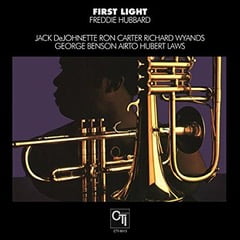
Freddie Hubbard – First Light – CTI 6013 (1971) – Pure Pleasure Records (2017)
This vinyl recording is a wonderful addition to any jazz library. Freddie Hubbard – First Light – CTI 6013 (1971)/Pure Pleasure Records (2017) 180-gram stereo vinyl, 33:32 ****1/2: (Freddie Hubbard – trumpet, flugelhorn; Jack DeJohnette – drums; Ron Carter – bass; Richard Wyands – piano; George Benson – guitar; Airto Moreira – percussion; Phil Kraus – vibes; Wally Kane – flute; Hubert Laws – flute; George Marge – flute, clarinet Romeo Penque – flute, English horn, clarinet, oboe; Wally Kane – bassoon; Jane Taylor – bassoon; Ray Alonge – French horn; James Buffington – French horn; Margaret Ross – harp; Alfred Brown – viola; Emmanuel Vardi – viola; Charles McCracken – cello; George Ricci – cello; (David Nadien; Psul Gershman; Emmanuel Green; Harold Kohon; Joe Malin; Gene Orloff; Matthew Raimondi; Tosha Smaroff; Irving Spice) – violins; with arrangements by Don Sebesky) As jazz emerged into the 70’s, things were changing rapidly. Miles Davis led a foray into electric instrumentation and West Coast Jazz was born. A sub-genre of cool jazz, players were evolving out of the bebop and hard bop molds into a calmer sound. At the heart of this movement was CTI Records. Artists like Stanley Turrentine, Wes Montgomery, […]

George ONSLOW: String Quintet, Piano Sextet – Ma’alot Quintet / Markus Becker (piano) / Nabil Shehata (bass) – DG Gold Hybrid
Nicely performed and recorded music from an obscure composer now returning to some popularity. George Onslow: Quintet Op. 81; Sextet Op. 30 – Ma’alot Quintet with pianist Markus Becker and double bass Nabil Shehata. DG Gold Hybrid SACD MDG 903 2012-6 (2/23/18) TT: 56:02 You’ll be forgiven if the name George Onslow doesn’t leap into your mind when thinking of classical composer, but he was quite influential at his peak in the 1820s and 30s. He wrote many chamber pieces, 4 symphonies and 4 operas. After his death in 1853 he became a bit lost to classical listeners, but of late there have been recordings of his works that have met with modern favor. This new multi-channel disk from DG Gold offers two works by Onslow, including the Quintet Op. 81 and the Sextet Op. 30. Performed by the Ma’alot Quintet with pianist Markus Becker and double bass Nabil Shehata, this is a fine collection of Onslow’s music. He has a style all his own, and I’m hearing both German and English references. Both works are a good listen, and I’ll seek out his symphonic works to get another window into his style. Audio wise the disc is not a […]

In Tune – The Oscar Peterson Trio + The Singers Unlimited – MPS
In Tune – The Oscar Peterson Trio + The Singers Unlimited – MPS 0212401MSW 32:29****: ( Oscar Peterson Trio : Oscar Peterson – piano; Jiri Mraz – bass; Louis Hayes – drums; The Singers Unlimited : Gene Puerling; Don Shelton; Len Dresslar; Bonnie Herman ) Between 1963 and 1968 and belatedly in 1995 Oscar Peterson along with several iterations of bassists and drummers recorded a series of trio and one solo album that were produced live by Hans Georg Brunner-Schwer for his MPS label, and were held privately by him, and for contractual reason were not available until 1968. More recently an eight CD box set was released that covered the six individual albums plus two volumes of ten tracks comprising the unreleased Lost Tapes. In addition to the above noted sessions, Oscar Peterson also recorded a couple of other albums for MPS including Reunion Blues with Milt Jackson and the subject of this review In Tune with The Singers Unlimited( TSU). Peterson discovered TSU and introduced them to MPS as he believed that their intricate vocal harmonization would have a broad audience. The genesis of TSU was the Hi-Lo’s with two of its members Gene Puerling and Don […]
Stereotypes Audio

Cembal d’amour

Pure Pleasure / Speakers Corner

Cedille


