
Monthly Archive: October 2017

Jeff DINGLER: In Transit
Jeff DINGLER: In Transit – 41:43 (9/4/17) ****; (Jeff Dingler; bass/ Brad Shepik; guitar/ Lou Rainone; piano/ Gusten Rudolph/ Josh Bailey; percussion) Ethiopian inflected jazz, both buoyant and brainy. From the title of this new release—In Transit—as well as the cover, which shows a murmuration of swallows against an orange desert sky, we gather we are headed somewhere exotic. It is only after opening the sleeve that we discover this place is Ethiopia. In the photo, it is easy to spot the gringo walking through a busy African suk, carrying his bass. We don’t learn what prompted his Abyssinian sojourn, only that some of the pieces are “influenced directly from the rich sounds and musical traditions of Ethiopia, while others are more abstract interpretations of scenes of the country.” The African flavors consist of the ubiquitous pentatonic scale (filtered through a bebop sensibility), a percussion layer which can become an exuberant chorus, and some colorful ornamentation indigenous to the guitar. More generally, throughout the record, one feels the generosity of African music, its uplift and celebration. The bassist’s eight charts are very well done. They are much more than simple hooks on generic Afro-grooves. Dingler describes Merkato Navigation as a […]

The Great Harry Hillman – Tilt – Cuneiform
The Great Harry Hillman – Tilt [TrackList follows] – Cuneiform, Rune 433, 43:07 [5/26/17] ****: (Nils Fischer – reeds; David Koch – guitar, effects; Samuel Huwyler – bass; Dominik Mahnig – drums) The Great Harry Hillman: Swiss post-jazz ready for discovery. There’s something slightly off-kilter about this Lucerne, Switzerland quartet. And that’s the point. This unassuming but forward-veering jazz group inexplicably borrowed its name from American Olympian Harry Hillman, who won three gold medals in the 1904 Summer Olympics. The Great Harry Hillman also plays what some have called post-jazz, which pulls influences from jazz, rock, flowing improvisation and other sources into a modern mélange which, at times, echoes Tortoise, the Neil Cowley Trio, and other likeminded artists. The Great Harry Hillman (or TGHH for short) formed in 2009, and the 43-minute Tilt is the band’s third release and first on the cutting-edge Cuneiform imprint. If you think a foursome who gets its name from an obscure athlete might be a bit different, you’d be correct. Electric guitarist David Koch, bassist Samuel Huwyler, drummer Dominik Mahnig and multi-reeds player Nils Fischer create music which is very much in the contemporary vernacular, combining delicate melodies, snaking rhythmic aspects, and a shared […]
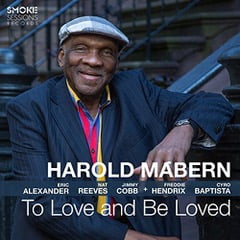
Harold Mabern – To Love And Be Loved – Smoke Sessions Records
Harold Mabern – To Love And Be Loved – Smoke Sessions Records SSR-1706 64:40**** For a taste of old fashioned musical goodness this is it. ( Harold Mabern – piano; Eric Alexander – tenor saxophone; Nat Reeves – bass; Jimmy Cobb – drums; Freddie Hendrix – trumpet # 3, 4, 7; Cyro Baptista – percussion #1) There are an endless number of idiomatic phrases that refer to age. Among them are: “you’re only as old as you feel”, “many a fine tune played on an old fiddle” and “growing old gracefully”. Any and all of these phrases may be used to describe two of the key principals on this “retro” session. Pianist Harold Mabern was 81 and drummer Jimmy Cobb was 88 at the time of this recording on April 17, 2017. The release To Love And Be Loved is a tribute to their longevity and their creativity, with no indication that either of these fine musicians is slowing down. This “live” session is spiffed up with compositions from the repetoire of older popular standards, familiar jazz themes, and a tune from tenor man Eric Alexander. “To Loved And Be Loved” by Sammy Cahn and Jimmy Van Heusen was used […]
Streams and Podcasts for 8 October 2017
This week, The Music Treasury presents the noted conductor Hans Knappertsbusch. Featured will be works by Johann Strauss, Richard Wagner, concluding with Bruckner’s Symphony #3 in D Minor. The show is hosted by Dr. Gary Lemco, who has generously provided an overview of the life and music of Knappersbusch, appended below. The show can be heard on Sunday, 8 October 2017, between 19:00 and 21:00, PDT. Dr. Lemco is the show’s host, it is presented as a radio show with streaming broadcast: kzsulive.stanford.edu Hans Knappertsbusch, Conductor Hans Knappersbusch (1888-1965) noted conductor of Richard Strauss, Richard Wagner, Anton Bruckner, and the German orchestral tradition, was born in Elberfeld and studied music and philosophy at the Cologne Conservatory and Bonn University. His studies with Fritz Steinbach led to an assistantship with Siegfried Wagner and Hans Richter at Bayreuth. In 1922, Bruno Walter left Munich for New York, and Knappertsbusch succeeded him as General Music Director of the Bavarian State Orchestra and the Bavarian State Opera, with a lifetime contract. His open resentment of the Nazi party led to frequent encounters, and he found himself suspended from musical activities. His first concert after WW II had him remark, “Now, let us hear Beethoven […]

DVORAK: String Quartet Op. 105, String Quintet Op. 97 – Takacs Quartet/ Lawrence Foster, viola – Hyperion
DVORAK: String Quartet in A-flat Major, Op. 105; String Quintet in E-flat Major, Op. 97 – Takacs Quartet/ Lawrence Foster, viola – Hyperion CDA68142, 64:59 (9/29/17) [Distr. By Harmonia mundi/PIAS] ****: Splendid readings of to late Dvorak chamber music staples provide a lush hour of listening pleasure. Antonin Dvorak, while enjoying his position as Director of the National Conservatory of Music in New York City, conceived of a new “national anthem” for America, having remarked that it seemed “a pity that for America to use an English tune for one of its anthems.” The theme Dvorak invented finds its way in to his magnificent String Quintet in E-flat (1893), a work which flowered in Spillville, Iowa, which boasted a substantial Czech community as well as a frequent visiting locale for Native American tribes. The rich harmonic and sonorous vocabulary of the composer emerges from the outset, Allegro non tanto, which allows the plangent, two violas to interact, while drum patterns and throbbing pedal points evolve in often pentatonic scales. The chromatic syntax—wavering between g minor and B-flat Major—no less manipulates dynamics ingeniously, alternating from pianissimos to lush fortissimos. True to Dvorak’s late works—especially those that emerged from his American […]

Easy Rider Soundtrack – Dunhill Records
Easy Rider Soundtrack – Dunhill Records DSX 50063 (1969)/MVD Audio MVD8151LP (2017) – stereo vinyl, 37:38 ****: (Featuring the music of Steppenwolf; Smith; The Birds; The Holy Modal Rounders; Fraternity Of Man; The Jimi Hendrix Experience; The Electric Prunes; and Roger McGuinn) As the 1960’s cinema evolved, the anti-hero dominated the narratives. Movies like Butch Cassidy And The Sundance Kid, Bonnie And Clyde, Hud, and Midnight Cowboy examined the social mores (of the absence) of the counterculture. But it took a long time to shed a light on the peculiar “Hippie” movement. Mike Nichols’ The Graduate was a shrewd glimpse into the angst of suburban disaffection. But in 1969, Dennis Hopper and Peter Fonda tackled the complex, idyllic world of sex drugs and rock and roll in Easy Rider. With a meager budget (allegedly around $60,000) , the saga of two dope dealers (Fonda and Hopper) cruising across America on motorcycles became a smash hit. It elevated Jack Nicholson (a late replacement for Rip Torn) to stardom. The crossover appeal was a boom for independent films and more importantly, rock music in films. The soundtrack for Easy Rider was also trend-setting. The various songs represented a visceral connection to the […]

BRAHMS: The Complete Piano Trios – Emanuel Ax, piano/ Leonidas Kavakos, violin/ Yo-Yo Ma, cello – Sony
BRAHMS: The Piano Trios = Piano Trio No. 2 in C Major, Op. 87; Piano Trio No. 3 in c minor, Op. 101; Piano Trio No. 1 in B Major, Op. 8 – Emanuel Ax, piano/ Leonidas Kavakos, violin/ Yo-Yo Ma, cello – Sony 88985 40729 2 (2 CDs) 29:00; 56:00 (9/15/17) ****: The three Brahms piano trios find expressive power in three equally kindred spirits. This set of the complete Brahms piano trios opens with the 1880-1882 Piano Trio No. 2, Op. 87, in which the composer’s style had transformed into a leaner, more economical style than had been his wont. The stringed instruments open the work in octaves—here Kavakos’ 1734 Stradivarius violin and Ma’s 1712 Stradivarius cello—with Ax’s Steinway entry on alternate beats, we have triple versus duple meters. The cross-rhythmic effect infiltrates the movement, with the two strings’ intoning thirds and sixth against the piano’s various accompaniments. The gift of (melancholic) melody still belongs to Brahms, as does an intimate warmth in this realization. The last page delivers a splendid, resolute peroration. The Andante con moto looks to Beethoven’s example of a double-theme and (five) variations, given a melody of Hungarian, gypsy flavor. Ax delivers a […]

Handel Goes Wild – L’Arpeggiata, dir. Christina Pluhar — Erato
Handel Goes Wild – L’Arpeggiata, dir. Christina Pluhar — Erato 019295811693, 75:33, **** (9/30/17) (Valer Sabaus, countertenor, Nuria Rial, soprano, Gianluigi Trovesi, clarinet, Boris Schmidt, double bass, Francesco Turrisi, piano, Dorn David Sherwin, cornetto) Soon I will be at Carnegie Hall to see L’Arpeggiata again. “What kind of group is that?” a friend asked. That’s where I pause. Putting your finger on just what L’Arpeggiata is poses a challenge. “They play baroque music,” I start. I get a nod in return. “But they do it in their own unique way…” Then I load a YouTube video, and now my friend nods, smiling. “Good stuff!” Then the conversation moves to “what kind of music is that?” Ah, well… The piano and jazz clarinet that both play roles in this release of Handel wasn’t part of Christina Pluhar’s ensemble when it was founded. I felt the ensemble went into new territory with their release of Music for A While, featuring the music of Henry Purcell. In my own opinion, it has been their most successful release (and it did include both piano and clarinet). It’s a modern take on Purcell, for sure, but the creativity and arrangements just worked. It was a […]

Leonard BERNSTEIN: The Complete Solo Piano Works—Leann Osterkamp, piano—Steinway & Sons
The Complete Solo Piano Works of LEONARD BERNSTEIN: Seven Anniversaries—Five Anniversaries—Sonata for Piano—Four Anniversaries—Thirteen Anniversaries—Bridal Suite—and many others, previously unrecorded and unpublished—Leann Osterkamp, piano—Steinway & Sons 30076, 47:20, 45:21, ****: The intimacy and variety of Bernstein’s solo piano works burst forth passionately. When the Bernstein household wheeled in a sad looking, brown upright piano that Aunt Clara wanted to get rid of, the ten-year old Leonard recalled, “And I remember touching it….and that was it. That was my contact with life, with God. From then on….I had found my universe, my place where I felt safe. This thing suddenly made me feel supreme….” Leonard Bernstein (1918-1990), as author, teacher, composer, writer, pianist and conductor best personified the democratization and popularity of classical music in America in the early and mid-twentieth century. This two disc set of miniatures represents all his works for solo piano, including works previously unpublished. Many are miniatures written as tributes, gifts, and memorials to friends, family, and colleagues that were composed across the range of his career. For Bernstein, the solo piano often is an expression of affection for people he loved. Sometimes these small and short pieces of music speak volumes about a musical personality […]

Russian Symphonies = RIMSKY-KORSAKOV: Symphony; STRAVINSKY: Symphony, Scherzo Fantastique – Moscow Radio Symphony/ Boris Khaikin/ Columbia Symphony Orchestra/ CBS Symphony/Igor Stravinsky – Praga Digitals
Russian Symphonies = RIMSKY-KORSAKOV: Symphony No. 1; STRAVINSKY: Symphony Op. 1, Scherzo Fantastique – Moscow Radio Symphony/ Boris Khaikin/ Columbia Symphony Orchestra/ CBS Symphony – Praga Digitals PRD 250 341, 79:55 (9/22/17) [Distr. by Harmonia mundi/PIAS] ****: Two Russian symphonies in a strong Romantic tradition complement each other on this sonically alert disc. The name of Russian conductor Boris Khaikin (1904-1978) appears occasionally on compact discs, usually in regard to his extremely active operatic career. His present performance of the equally infrequent Symphony No. 1 (1865) of Nikolai Rimsky-Korsakov (rec. 26 March 1966) may well incite further issues of his work, considering the splendid, clear resonance and visceral excitement of this reading. Although Anton Rubinstein had composed an “Ocean Symphony” around 1853, several commentators—especially Cesar Cui—dubbed Rimsky-Korsakov’s work “The first Russian symphony” because of its strong reliance of Russian folk tunes, conceived under the guidance of Mily Balakirev. The composer acknowledged the influence of the German school, Robert Schumann in particular, as an especial model. The music of Glinka and Balakirev proves no less active in the score, as well as the color results of the composer’s having studied the Berlioz treatise on orchestration. The rather somber opening movement Largo […]

Editorial for October 2017
Eighty Trips Around the Sun: Music by and for Terry Riley is a celebration of that great composer-pianist Terry Riley, bringing together a collection of his compositions for solo and duo piano spanning fifty years, from his twelve-tone Two Pieces to his free-wheeling Be Kind to One Another. This set also includes eight tribute pieces composed for Riley’s eightieth birthday year in 2015, in world premier recordings. Pianist Sarah Cahill has long been a strong champion of contemporary music, having commissioned, premiered, and recorded numerous compositions for solo piano. Composers who have dedicated works to her include John Adams, Terry Riley, Frederic Rzewski, Pauline Oliveros, Yoko Ono, and Ingram Marshall, and she has also premiered pieces by Lou Harrison, Julia Wolfe, Toshi Ichiyanagi, George Lewis, Leo Ornstein, and many others. Cahill has worked closely with Terry Riley for over twenty years—starting in 1996 when she commissioned the first of his four-hand pieces, Cinco de Mayo, for a festival celebrating the 100th birthday of Henry Cowell at Cal Performances in 1997. She has interviewed him several times on the radio, including a joint interview and performance with Riley and John Cale (from the Velvet Underground). Cahill toured with “Terry Riley […]

The Verdehr Trio, “International Connections 2” = Violin, Clarinet, Piano trios by Nicolas BACRI; Yang LIQING; Peter DICKINSON; Jonathan HARVEY; Wolfram WAGNER; Kam Kee YONG; Guido Lopez GAVILAN; Peter SCULTHORPE – Verdehr Trio – Crystal Records
The Verdehr Trio, “International Connections 2” = Nicolas BACRI: A Smiling Suite; Yang LIQING: Trio; Peter DICKINSON: Celebration Trio; Jonathon HARVEY: Clarinet Trio; Wolfram WAGNER: Trio for Violin, Clarinet and Piano; Kam Kee YONG: And the Fallen Petals; Guido Lopez GAVILAN: Como un antiguo bolero; Peter SCULTHORPE: Reef Singing – Walter Veredehr, violin/Elsa Ludwig-Verdehr, clarinet/Silvia Roederer, piano – Crystal Records CD974, 67:08, (3/13/17) ****: The ‘making of a medium’ shows dedication and history. The Verdehr Trio has built a nearly four decades rich legacy of commissioning and recording hundreds of new works for the violin and clarinet—husband and wife pair—and piano, in the rich tradition of the iconic works for this combination by Brahms, Khatchaturian and others. I have heard almost all over their twenty-four CDs, most of which are releases by Crystal Records—which has a nearly six decades long legacy of recorded American music—and have never been disappointed. A huge part of the success of the Trio lies with the quality of the performances. Walter Verdehr is a superb and sensitive violinist with ample skill, a rich timbre and elegant phrasing. Else Ludwig-Verdehr, clarinetist, is one of the country’s great clarinetists with equally supple technique, a sensitive phrasing and beautiful tone with […]
Stereotypes Audio

Cembal d’amour

Pure Pleasure / Speakers Corner

Cedille


