
Monthly Archive: May 2018

BACH: Mass in B Minor – Les Arts Florissants/ William Christie – Harmonia mundi
A well-intentioned, hugely successful interpretation of this timeless work. BACH: Mass in B Minor – Katherine Watson, s/ Tim Mead, ct/ Reinoud Van Mechelen, t/ Andre Morsch, b/ Les Arts Florissants/ William Christie – Harmonia mundi HAF 8905293 (2 CDs), 52:16, 52:47 ****: The B-minor’s keep on comin’. I suppose we cannot be too critical of the efforts, seeing as how one of the world’s greatest masterworks automatically serves as a recording magnet. And when you add names like William Christie to the mix, whose involvement with this work spans decades and goes back to his very youth outside Buffalo, New York, the results will be something to talk about. This indeed proves the case here. Christie’s goal in this recording is to not only present the work as a testament to the Christian faith, which he readily admits it is, but also to provide a humanistic covering to the work, an equally inspiring testament to the human race. With that in mind, his musical aspirations here include some quick tempos—by his own admission—that serve to slightly undermine the fully religious immersion found in this piece, an act of homage to the dance-like elements that he finds in the music. […]
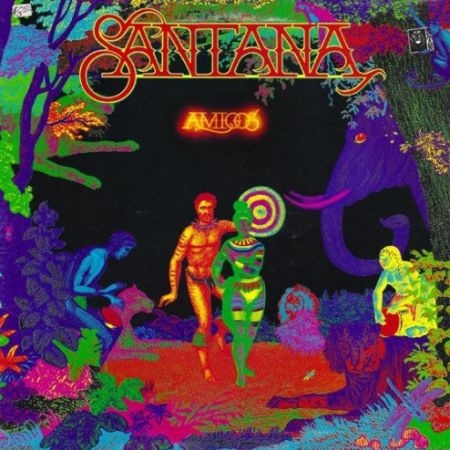
Santana – Amigos – Columbia Records (1976)/Speakers Corners (2013)
Carlos Santana’s 1976 comeback album gets a terrific sonic upgrade. Santana – Amigos – Columbia Records PC 33576 (1976)/Speakers Corners (2013) 180-gram stereo vinyl, 41:14 *****: Mexican born guitarist Carlos Santana moved to San Francisco as a young child. He was already a trained musician, first in violin and then guitar. There is an array of business owners in The Mission District who still claim to have launched Santana into the vibrant Sixties music scene. As a teenager, Santana became a part of San Francisco rock lore. In 1966, at the Fillmore West (the Fillmore Auditorium at the time), he filled in for an “ailing” Paul Butterfield with an all-star band of local rockers. The rest is history. Bill Graham embraced the musical phenom and the rapid ascent to stardom was underway. The combination of hard rock and Latin/African jazz rhythms was unique. The addition of timbales and congas made the percussion stand out. The lineup for the first self-titled album included Greg Rolie (vocals, organ, piano), Dave Brown (bass), Michael Shrieve (drums), Michael Carabello (congas) and Jose Chepito Areas (timbales). The album yielded a hit single, “Evil Ways”. More importantly, Santana delivered the breakout performance at Woodstock with a […]

Jefferson Airplane – Volunteers – RCA LSP-4238 (1969)/Speakers Corners(2017)
A superior vinyl re-mastering of an iconic, political 1960’s rock band! Jefferson Airplane – Volunteers – RCA LSP-4238 (1969)/Speakers Corners(2017) 180-gram stereo vinyl, 44:19 ****1/2: The San Francisco Sound enjoyed a huge impact on popular music. Bands like The Grateful Dead, Big Brother And The Holding Company, Quicksilver Messenger Service, Mother Earth, The Steve Miller Band, The Electric Flag and Moby Group adopted the freewheeling spirit of the Beatnik culture and its folk-based structures. Additionally, the various roots backgrounds and musical genres were intermingled in the evolving scene. At the Fillmore, it was not unusual to see a jazz great like Miles Davis sharing a bill with The Grateful Dead. In 1967 The Monterey Pop Festival connected San Francisco rock to the larger national culture. One of the bands at the festival was Jefferson Airplane. Formed in the mid 1960’s, the core members Marty Balin, Paul Kantner, Jack Casady and Jorma Kaukonen merged their blues and folk backgrounds into a psychedelic rock sound. Their first release, The Jefferson Airplane Takes Off (1966) included songs like “It’s No Secret” and “Coming Up The Years” which expanded their local fan base. In 1967, there was a confluence of events that lifted the […]
The Music Treasury for 13 May 2018 — Conductor Albert Louis Wolff
Albert Louis Wolff This week, The Music Treasury will feature the French conductor and composer, Albert Louis Wolff. His main focus was opera; he conducted the premier performance of several works throughout Europe. His long career spanned both World Wars, and while he was primarily based in Europe, he also conducted opera in the North and South Americas. Orchestral and operatic works by Lalo, Massanet, Franck and others are on this week’s show, aired on Sunday, 13 March 2018, from 19:00 to 21:00 PDT. The show can be heard on its host station from Stanford University, KZSU, as well as its simulcast Internet stream, kzsu.stanford.edu. As always, the show is hosted by Dr Gary Lemco. The following notes, derived from Wikipedia, shed more light on Wolff and his career. Albert Louis Wolff, Conductor Albert Louis Wolff (19 January 1884 – 20 February 1970) was a French conductor and composer of Dutch descent. Most of his career was spent in European venues, with the exception of two years as a conductor at the Metropolitan Opera and a few years in Buenos Aires during World War II. He is most known for holding the position of principal conductor with the Opéra-Comique in […]

Turtle Island Quartet – Bird’s Eye View – Azica Records
An interesting and intricate take on jazz compositions linked to Charlie Parker. Turtle Island Quartet – Bird’s Eye View – Azica Records ACD71318 61:55**** (Alex Hargreaves – violin; David Balakrishnan – violin; Benjamin von Gutzeit – viola; Malcolm Parson – cello) Crossover albums often end up to be less than advertised for a variety of reasons, including the performers’ lack of understanding or appreciation of the intended musical form. However the Turtle Island Quartet’s newest release Bird’s Eye View delivers the goods with an interesting and intricate take on jazz compositions associated as least in name, to Charlie Parker. The disc opens with the group exploring a composition by violinist David Balakrishnan which is a lengthy four part story under the rubric “Aeroelasticity: Harmonies Of Impermanence”. The four sections are “Backlash” “Lonesome George” “Pralaya” and “Flutter Point”. While there does not appear to be a musical theme that bolts all these compositions together, there are some commonalities that can be discerned by a reading of the liner notes. For example, sections I and IV bring the issue of the effects of air currents on planes into their definition. Hence the associated music is driven by re-arranged instrumental textures, and energetic […]
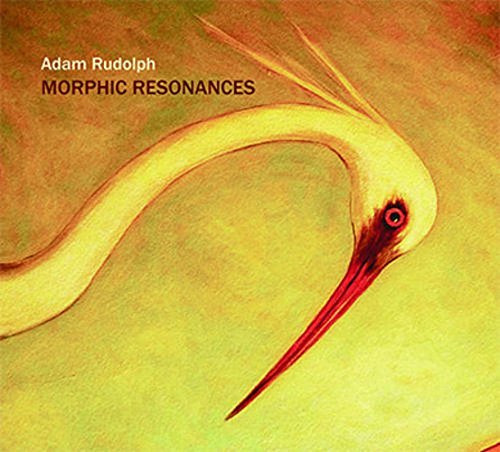
Adam Rudolph – Morphic Resonances – Meta
Emphasizing Adam Rudolph as composer. Adam Rudolph – Morphic Resonances [TrackList follows] – Meta/M.O.D. Technologies 021, 55:09 [10/6/17] ****: You won’t find percussionist Adam Rudolph on the hour-long Morphic Resonances. That’s because the seven tracks focus on Rudolph’s compositions, performed by other musicians, including two pieces by the Momenta String Quartet; one tune by the Odense Percussion Group; another composition with two groups working together (the Kammeratorkestret Ensemble and the Figura Ensemble); two duo pieces featuring flautist Kaura Watanabe and guitarist Marco Cappelli; and one tune for violinist Sana Nagano. Morphic Resonances is Rudolph’s 23rd as a leader and the final installment of a trilogy which includes 2015’s The Epic Botanical Beat Suite and 2017’s Glare of the Tiger. All three are connected by Rudolph’s application of the same intervallic and rhythmic materials. Rudolph explains, “Each sounds as different from the other because I used a different process to create the music on each.” The emphasis on Morphic Resonances is on Rudolph’s through-composed music. Some music was commissioned by the ensembles on the album. Others were written and offered to artists. Morphic Resonances was issued as high-resolution digital download and as compact disc with a booklet. This review refers to […]

GRAINGER Complete Music for Wind Band, Vol. 1 -The Royal Norwegian Navy Band / Bjarte Ingest – Naxos
Grainger heard and unheard in a nice debut CD of an ongoing collection from Naxos GRAINGER Complete Music for Wind Band, Vol. 1: Molly on the Shore, Country Gardens, Shepherd’s Hey – The Royal Norwegian Navy Band / Bjarte Ingest (Texts and translations included) – Naxos CD 8.573679 TT: 67:59 ****: This is the first volume in a complete sequence of Percy Grainger’s music for wind band and it very closely follows Grainger’s instructions on performance and scoring, whether for Hammond organ, Swiss hand bells or steel marimba. Grainger wrote a series of Chosen Gems for Winds, which include beautiful transcriptions of music by composers such as Bach, Franck and Fauré. This first volume also contains some of his greatest and most joyous creations—the immortal Country Gardens, Shepherd’s Hey and Molly on the Shore, along with many more selections. I’ve always been a fan of Grainger’s music, going back to my high school band days, where Grainger’s Lincolnshire Posy was always a favorite. Grainger’s music is always exuberant and emotive. The performance by the Royal Norwegian Navy Band is top notch, precise and energetic, just what Grainger’s music calls for. Several of the works in this CD are world premiere […]

RIMSKY-KORSAKOV: Scheherazade, and other orchestral works – Philadelphia Orchestra/ Leopold Stokowski – Pristine Audio
Mark Obert-Thorn restores one of the great wonders of Stokowski’s art, his brilliant and convincing versions of Rimsky-Korsakov’s scores. RIMSKY-KORSAKOV: Scheherazade, Op. 35; Russian Easter Overture, Op. 36; The Maid of Pskov (Ivan the Terrible): Prelude to Act 3; Scheherazade: The Sea and Sinbad’s Ship: take recorded 3 May 1927; Appendix: The Tale of the Kalender Prince: alternative take of Side 4 – Philadelphia Orchestra/ Leopold Stokowski – Pristine Audio PASC 529. 71:55 [www.pristineclassical.com] *****: If any American orchestral ensemble in the so-called “Golden Age” of recording could compete with—and even surpass—European counterparts, the Philadelphia Orchestra under Leopold Stokowski holds special distinction. Producer and Restoration Engineer Mark Obert-Thorn resuscitates the series of Rimsky-Korsakov performances that Stokowski committed to shellacs 1927-1939. The lithe, sensuous gloss of the orchestra combines with Rimsky-Korsakov’s natural elasticity of melodic line to produce some of the most refreshed Russian music we are likely to experience in 2018. Stokowski had the distinct advantage of first-rate men at the principal desks of his Philadelphia Orchestra, including Mischa Mischakoff, concertmaster—who went on to Toscanini’s NBC Symphony—Daniel Bonade, clarinet, and Marcel Tabuteau, oboe. The disc opens with a rousing performance of the 1888 Russian Easter Overture, a work I myself […]

Kris Davis and Craig Taborn – Octopus – Pyroclastic
Two are better as one. Kris Davis and Craig Taborn – Octopus [TrackList follows] – Pyroclastic PR 03, 58:38 [1/28/18] ****: (Kris Davis – piano; Craig Taborn – piano) What’s better than one? Two, of course. Duets in jazz are nothing new. But two pianos improvising together is still somewhat rare. Such collaborations need simpatico, communication and two minds working as one. Such is the case with Kris Davis and Craig Taborn. The two were part of Davis’ 2016 CD/DVD, Duopoly, a series of duets with Bill Frisell, Tim Berne, Julian Lage and others. During their time in the studio, it became evident Taborn and Davis had a stimulating chemistry. The two decided to go out on the road on a 12-date tour in Autumn, 2016 with engineer Ron Saint Germain. The result is the hour-long, six-track live document, Octopus, issued on Davis’ Pyroclastic imprint. The performances, which run in length from seven minutes to nearly 15 minutes, incorporate pre-composed material; wholly improvised sections; and two carefully chosen cover tunes. Taborn and Davis’ conversant style is parallel to the free jazz of likeminded pianists such as Cecil Taylor, Don Pullen or Paul Bley. Throughout the program there’s a sense of […]

Dave Liebman, Tatsuya Nakatani, Adam Rudolph – The Unknowable – RareNoise
Consistently excellent ‘spontaneous composition’. Dave Liebman, Tatsuya Nakatani, Adam Rudolph – The Unknowable [TrackList follows] – RareNoise RNR089, 48:50 [2/23/18] ****: (Adam Rudolph – kongos, djembe, tarija, zabumba, thumb piano, sintir, mbuti harp, slit drum, percussion, overtone flutes, Fender Rhodes (track 11), live electronic processing, co-producer; Dave Liebman – tenor and soprano saxophones, c flute, native American flute, recorder, piri, Fender Rhodes (track 10); Tatsuya Nakastani – drum kit, gongs, metal percussion, percussion) Fully improvised music can be difficult for some to embrace. Some may think there would not be any melody; or the harmonies would suffer; or the freedom of being musically in the moment might lead to chaos and noisy commotion. One listen to the 48-minute album The Unknowable by saxophonist Dave Liebman; drummer and percussionist Tatsuya Nakatani; and percussionist Adam Rudolph should dispel any quibbles about the benefits of a totally improvising trio. This is the first time Liebman, Nakatani and Rudolph have worked as a threesome. However, the three artists have interacted in other ways. Rudolph (whose résumé includes Don Cherry, Jon Hassell, Sam Rivers and Pharaoh Sanders) performed with Liebman during a 2016 club residency. Nakatani (who has released over 80 recordings) and Rudolph played […]

RACHMANINOV: Symphony Nos. 1, 2, 3; BALAKIREV: Russia; Tamara – London Symphony Orchestra/ Valery Gergiev – DSD
The survey of the Rachmaninov symphonies, along with two symphonic poems of Balakirev, testifies to Gergiev’s sympathy for the “Old Russian” school. RACHMANINOV: Symphony No. 1 in D minor, Op. 13; Symphony No. 2 in E minor, Op. 27; Symphony No. 3 in A minor, Op. 44; BALAKIREV: Russia; Tamara – London Symphony Orchestra/ Valery Gergiev – DSD LSO0816 (3 CDs plus 1 Pure Blu-ray) 77:57; 73:57; 76:13 (4/20/18) [Distr. by PIAS] ****: Valery Gergiev recorded the three Rachmaninov symphonies between 2008 and 2015. Despite the catastrophic first performance of the First Symphony in D minor (27 March 1897) under Glazunov, and the score’s subsequent disappearance until 1944, the reconstructed work bears the impact and tumultuous energy of a young composer inflamed at once by romantic passion—via Tolstoy’s Anna Karenina—and a sense of the gypsy notion of fate. Each movement opens with a four-note figure, and a dire descending sequence in the low strings. Like his idol Tchaikovsky, Rachmaninov feels compelled to write contrapuntal progressions as though to legitimize his claim to the symphonic tradition. Gergiev’s performance of the first movement Grave – Allegro non troppo proves less histrionic than the rendition by Eugene Ormandy, tending to the lyrical and […]
The Music Treasury for 6 May 2018 – The Hungarian String Quartet
The Hungarian String Quartet For a significant portion of the 20th century, the Hungarian Quartet was a defining voice for string quartet literature. In addition to the quartets of the classical and romantic periods, they were involved with the new music of the time, presenting the premier performance of Béla Bartók’s String Quartet No. 5. The show, hosted by Dr Gary Lemco, can be heard in the Bay Area on radio station KZSU, as well throughout the Internet, at kzsu.stanford.edu, Sunday 6 April 2018 from 19:00 to 21:00, PDT. The show will feature works by Glazunov, Beethoven, Kodaly, and concludes with Schubert’s Death and the Maiden quartet. History of the Hungarian String Quartet The Hungarian String Quartet (founded 1935; disbanded 1972) was originally brought together with Sándor Végh (a pupil of Jenő Hubay and Zoltán Kodály at Budapest Academy) as the first violin, but achieved a balanced footing in 1937 when the virtuoso violinist Zoltán Székely (graduate of the same Academy, along with the Quartet’s violist, Dénes Koromzay (1913–2001) was recruited. At that point Sándor Végh moved to the second violin desk, and in 1940 he left to found the Végh Quartet. He was replaced by the Russian, Alexandre Moszkowsky. […]

Editorial for May, 2018
Generation harmonia mundi Harmonia mundi and [pias] are promoting an excellent collection of material from Harmonia mundi’s vast archives, developed over the sixty years since their inception in 1958. The first of these two box sets, entitled Generation harmonia mundi: The Age of Revolution, reflect a sweep of music traditions—from the ancients to the moderns—on 16 CDs, culled from the first 30 years of their libraries. These include: Ancient Greek Music From Renaissance to Baroque The Baroque Revolution A fresh look at the score The twentieth century This collection includes works by Purcell, Schütz, Bach (Magnificat, Mozart, Brahms, Schobert, Chausson, Berio, Schoenberg, and others The second set—Generation harmonia mundi: The Family Spirit— takes another pass the archives, in its 18 CDs of recordings taken over the past 30 years. From Monteverdi to Vivaldi The New Keyboard Virtuosos The New Romantic Historically Informed Performance The Masters of Lied These box sets, offered this month courtesy of [pias] and Harmonia mundi—all you need to do to enter is to fill out the form here: Register To Win. [metaslider id=65010] AUDIOPHILE AUDITION began as a local program in San Francisco and then in 1985 as a weekly national radio series hosted by John […]

WoodWired Duo: “In the Loop” = Works for Flute and Bass Clarinet, by Hannah Leffler and Cheyenne Cruz
Hannah Leffler and Cheyenne Cruz have joined forces to create an outstanding group, WoodWired Duo, and the release of their debut album, “In the Loop”—a new musical odyssey!

Jared Gold – Reemergence – Strikezone Records
Pure Hammond gold… Jared Gold – Reemergence – Strikezone Records 8817 – 51:19 ****: (Jared Gold – Hammond B3 organ; Dave Stryker – guitar; Billy Hart – drums; Jeremy Pelt – trumpet (#1, 3, 5) It’s been awhile since Jared Gold’s last CD (on Posi Tone Records), but Gold has kept plenty busy as a first choice organ sideman in New York City. His talents have also been recognized as he was recently voted as the Top Rising Star on organ in the annual Downbeat magazine poll. For his initial release on the new Strikezone label, Gold has assembled a great trio with guitarist Dave Stryker (who runs the label), and veteran drummer, Billy Hart. Jeremy Pelt (who seems to be a busy man himself—we just reviewed his new Cannonball Adderley tribute with Jim Snidero), guests on three tracks here. As expected, this CD shines, and will appeal to Hammond B3 aficionados. It’s a mix of standards (two Gershwin tunes), blues, gospel, a Beatles tune, as well as an original from both Gold and Stryker. What is unmistakable is the groove set by Gold and Stryker, and the strong presence of Billy Hart, as usual. There are no issues with […]

Presentiment: Orion Weiss = GRANADOS: Goyescas; JANACEK: In the Mists; SCRIABIN: “Black Mass” Piano Sonata
Orion Weiss initiates his own label with a recital ominous in its visions of the WW I apocalypse. Presentiment: Orion Weiss = GRANADOS: Goyescas, Op. 11; JANACEK: In the Mists; SCRIABIN: Piano Sonata No. 9, Op. 68 “Black Mass” – Orion Weiss, piano – Orion Weiss, 74:18 (3/2/18) ****: Orion Weiss (b. 1981) has chosen three major piano compositions from the period 1911-1913, each anticipating the throes of WW I and its cataclysm for the world spirit. What Gustav Mahler would label the “Century of Death” had already begun to “flood the aesthetic of the old with anxiety, nostalgia, and confusion.” Weiss describes this music as conveying “foreboding, tormented by premonitions of a horrific future.” Performing on a Steinway CD 888 at SUNY Purchase (May 2014) as produced by David Frost, Weiss achieves alternately liquid and clarion tones that project love and death as two sides of a fateful coin. The 1911 six-movement piano suite Goyescas, Op. 11 of Enrique Granados takes its sensibility from the often Gothic paintings of Francisco Goya, “the last of the Old Masters and the first of the New.” The subtitle of the suite Los majos enamorados indicates that the subject will be love-affairs of […]

BERLIOZ: Harold in Italy – Lawrence Power, viola/ Bergen Philharmonic Orchestra/ Andrew Manze – Hyperion
Berlioz and kindred spirit Weber receive colorful and vibrantly energetic readings from violist Power and conductor Andrew Manze.

Jim Snidero & Jeremy Pelt – Jubilation! Celebrating Cannonball Adderley – Savant
Celebrating Cannonball’s 90th Birthday year with a sweet dedication… Jim Snidero & Jeremy Pelt – Jubilation! Celebrating Cannonball Adderley – Savant SCD2167 – 53:23 – ****: (Jim Snidero – alto sax; Jeremy Pelt – trumpet; David Hazeltine – piano; Nat Reeves – bass; Billy Drummond – drums) I was fortunate enough in August, 2012 to finally catch a concert at the iconic London jazz club, Ronnie Scott’s. Holding court there that night was the Cannonball Adderley Legacy Band led by drummer, Louis Hayes. Vincent Herring did the honors that night channeling ‘Ball. However, Jeremy Pelt, on trumpet, was on fire that night. Needless to say, it was a memorable night. Six years later on the occasion of the 90th birthday year of Cannonball, Savant Records is issuing a tribute to Cannon’s magic. Jeremy is back, working as a co-leader with altoist, Jim Snidero. The rhythm section is top notch with first call pianist, David Hazeltine, bassist, Nat Reeves, and drummer, Billy Drummond. Recorded at the Red Rock Studios in Dec. 2017, the set list is replete both with the Adderley Brothers classics as well as tunes written by bassists, Sam Jones, and Walter Booker, whom both had tenure with the […]
Stereotypes Audio

Cembal d’amour

Pure Pleasure / Speakers Corner

Cedille


