
Monthly Archive: June 2018

H.I.F. BIBER: The Mystery Sonatas — Christina Day Martinson, Boston Baroque — Linn
H.I.F. BIBER: The Mystery Sonatas — Christina Day Martinson, violin; Boston Baroque, dir. Martin Pearlman — Linn CKD501, 120:21, (5/19/18) ***: Heinrich Ignaz Franz von Biber today is remembered as one of the great virtuosos of the middle baroque and an important innovator in Germanic violin composition. And among his surviving works, this collection, the Sonatas of the Mystery of the Rosary, receive a lot of attention due to their baroqueness. Each of the sonatas is based, it would seem, on a prayer from the Rosary. The printing of the collection was made with scenes depicting stories from the life of Christ. Some consider the pieces as musical meditations. Beyond the suggestion of these sonatas as program music, these sonatas are more curious because of Biber’s use of string mistuning, often called scordatura, from the Italian. Only the first and last pieces use a normally-tuned violin; the others vary the tuning of one or more strings which promote different chordal possibilities, but moreover, change the sonic quality of the instrument. As depicted on this cover, the most interesting sonata for scordatura is the tenth sonata, the Crucifixion. The performer must cross the middle two strings, forming a “cross” between the […]

Editorial for June, 2018
Dmitry Sitkovetsky, Mozart Violin Sonatas Complete This month, Audiophile Audition is featuring a recent release of the Complete Sonatas of Wolfgang Amadeus Mozart. Featuring Dmitry Sitkovetsky on the violin, along with pianists Konstantin Lifschitz and Antonio Pappano, this four CD set is presented as a handsome boxed set. Sitkovetsky has enjoyed a career as a violinist, conductor, and arranger. As music director of the Greensboro Symphony, he is noted as “a renaissance man and a magnetic creative force, who has had a considerable impact on every aspect of musical life, as a performer, creator and catalyst for over four decades. His achievements as a violin soloist are documented in many recordings of all the major concertos and a wide selection of chamber repertoire. Among these are the Prokofiev, Shostakovich, Bartok, Elgar and Dutilleux’s concerti as well as the complete Bach works for violin solo and the complete Mozart Violin Sonatas among many others.” This month’s offering is courtesy of Hänssler Classic and Naxos. Hänssler Classic is one of the most successful independent labels for classical recordings. Based in Germany, it has over 800 recordings from which to choose. To enter in the drawing for the Complete Mozart Violin Sonatas, merely fill out […]
The Music Treasury for 9 June 2018 — Leonard Bernstein
This week, The Music Treasury presents the first in a series of shows exploring the life and work of Leonard Bernstein. The show is aired between 19:00 and 21:00 PDT from its host station KZSU 90.1 in the Bay Area; it is also streamed simultaneously through the ‘Net, from kzsulive.stanford.edu. More details of the show can be found below; as always, the host is none other than the inimitable Gary Lemco. The Historic Leonard Bernstein 2018 marks the centennial of composer/pianist/conductor Leonard Bernstein (1918-1990), among the most versatile musical personalities this country has produced. Because of his sheer range of accomplishment, he is virtually impossible to catalogue. The Music Treasury intends several tributes, of which this is the first. We consider his very first piano recording, and then move on to 1946-1951, to present selected musical works that exemplify Bernstein’s diverse tastes, as eclectic as his personal, creative style. Your host, Gary Lemco, spent a long day with Maestro Bernstein, 9 December 1977, discussing various musical topics, including what had been a proposed biography of Dimitri Mitropoulos, Bernstein’s predecessor at the helm of the New York Philharmonic Orchestra. Playlist: Diamond: Prelude and Fugue No. 3 in C# Copland: Preamble for […]
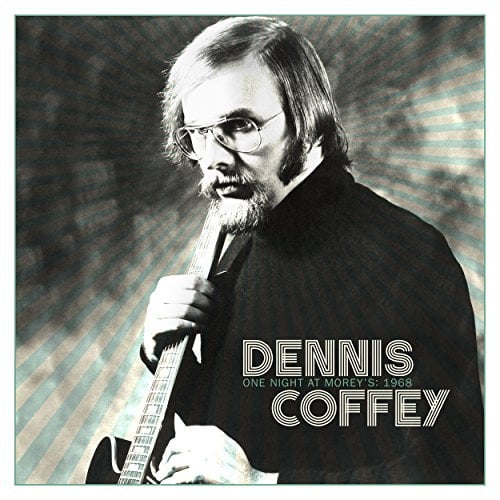
Dennis Coffey – One Night at Morey’s: 1968 – Omnivore Records
Master of the groove… Dennis Coffey – One Night at Morey’s: 1968 – Omnivore Records OVCD 284 – 60:31 (Dennis Coffey – electric guitar; Lyman Woodard – organ; Melvin Davis – drums) Fans of funky guitar, in the know, are well aware of the legacy of guitar ace, Dennis Coffey. From the 1950s well into the 1970s, Coffey was everywhere. He was active all over Detroit, and was featured in the Funk Brothers sessions, backing on many of the Motown hits, such as “Just My Imagination,” “Ball of Confusion,” “Cloud Nine,” and numerous others. Just like the Wrecking Crew in California, who provided the rhythm section for southern California recorded hits, the Funk Brothers provided the catchy hooks for the Motown vocalists. Dennis Coffey was right in the middle providing the guitar groove. When Coffey was not in the recording studios, he had a weekly trio gig for several years with organist, Lyman Woodard, and drummer, Melvin Davis. Much like Booker T and the MGs in Memphis, this trio could lay into the groove on pop and soul classics. Psychedelic riffs were also part of their repertoire. The trio had a once weekly residency at Morey Baker’s Showplace Lounge in […]

DAG WIREN: Symphony No. 3 – Iceland Symphony Orchestra/Rumon Gamba – Chandos
Tuneful and entertaining 20th century orchestral music from a notable Swedish composer. DAG WIREN: Symphony No. 3—Sinfonietta—Serenade for Strings—Divertimento—Iceland Symphony Orchestra/Rumon Gamba – Chandos, 70:18 [Dist. by Naxos] ****: At the young age of 22, the Swedish composer Dag Wiren (1905-1986) went to a performance of Honegger’s oratorio Le Roi David at the Stockholm opera. It changed his life. “My eyes were opened and my ears heard what they had previously been deaf to,” Wiren exclaimed. He was studying organ, piano, conducting and composition at the Stockholm Conservatory. He visited Paris in 1931, a common practice for budding young composers in the world (Copland, Glass, etc.). He learned more from attending concerts Paris in the 1930’s (Stravinsky, Prokofiev, Les Six) than he did from studying orchestration with Leonid Sabaneyev. When Wiren came home he composed the most popular work, the Serenade for Strings (1937). Rather than embrace modernism, Wiren belonged to a group of Swedish composers (Larsson, Koch and others) often referred to “Composers of the Thirties” who embraced neo-classism. The Serenade for Strings deserves its popularity—there’s a clarity of structure, superb balance, abundant melodic content and droll humor that’s reminiscent of his Danish colleague Nielsen. But these are also […]

DOHNANYI: Serenade for String Trio; String Quartet; Sextet for Piano, Clarinet, Horn, and String Trio – The Nash Ensemble – Hyperion
The Nash Ensemble thoroughly beguiles us in diverse chamber works by Ernst von Dohnanyi. DOHNANYI: Serenade for String Trio, Op. 10; String Quartet No. 3 in A minor, Op. 33; Sextet for Piano, Clarinet, Horn, and String Trio, Op. 37 – The Nash Ensemble – Hyperion CDA68215, 76:08 (6/1/18) [Distr. by Harmonia mundi/PIAS] ****: Dohnányi composed the Serenade for String Trio in 1902 during a concert tour to London and Vienna, just seven years after his Op. 1 Piano Quintet. He created serenade in the tradition of both Brahms and Robert Fuchs, even while maintaining a strong, Hungarian flavor. The Serenade begins with a lively march—and its own inversion of the theme—and this tune will end the work, cyclically. The Nash Ensemble—Stephanie Gonley, violin; Lawrence Power, viola; Adrian Brendel, cello—jars us with the crisp, Magyar accents and rustic impulses that would soon influence Bartok and Kodaly. Kodaly, in a letter to his wife Emma, exclaimed, “It is for the Serenade alone that I love him.” A slow movement Romanze follows, evoking the traditional serenade with guitar-like pizzicato, a lyrical song in the violin part interrupted briefly by a passionate outburst. The third-movement Scherzo: Vivace exploits chromatic, irregular rhythmic energies […]

Norman Connors – Love From The Sun – Buddah Records
This vinyl upgrade of a 1973 under appreciate jazz album is wonderful! Norman Connors – Love From The Sun – Buddah Records BDS5142 (1973)/ Pure Pleasure Records PPAN BDS5142 180-gram stereo vinyl, 40:49 ****: Philadelphia drummer Norman Connors became aware of jazz at a very early age, elementary school. As a middle schooler he got to sit in for Elvin Jones with none other than John Coltrane. After studying music at Temple University and Julliard, Connors first recorded with Archie Shepp in 1967 (Magic Of JuJu). he played with Pharaoh Sanders for a few years and eventually signed with Cobblestone Records (a division of Buddha Records) in 1972. His traditional jazz roots became influenced by rhythm and blues during the 1970’s and beyond. In 1973, Connors released Love From The Sun on Buddha Records. The album served as a bridge between old school jazz and the emerging fusion movement. Featuring Herbie Hancock (with several of the musicians in his Mwandishi ensemble) and a pre-stardom Dee Dee Bridgewater, Connors established himself as a unique musician and arranger. Pure Pleasure Records has released an audiophile vinyl re-mastering of Love From The Sun. Somewhat overlooked in 1973, it seems appropriate to re-examine this […]

NOTHING PROVED – New works for viols, voice and electronics – Parthenia Viol Consort – MSR Classics
A fascinating collection of music by women composers. A feast for the mind and the ear! NOTHING PROVED – New works for viols, voice and electronics – Music by Hildegard Von Bingen, Kristin Norderval, Tawnie Olson, Frances White – PARTHENIA (viol consort)/ Beverly Au, bass viol/ Lawrence Lipnik, tenor viol/ Rosamund Morley, treble viol/ Lisa Terry, bass viol/ Kristin Norderval, soprano/ Dashon Burton, bass-baritone/ Valeria Vasilevski, narrator – MSR Classics Stereo CD [MS1635] (4/10/18) ****: This disc contains music by woman composers, starting with a chant by Von Bingen, then following with three contemporary works. Here’s the program to give you a brief idea of the music on offer: HILDEGARD VON BINGEN CHANT “Alleluia, O Virga Mediatrix” (1150) FRANCES WHITE A FLOWER ON THE FARTHER SIDE for viol quartet and electronic sound (2010) KRISTIN NORDERVAL NOTHING PROVED CAN BE for viol quartet, soprano, and interactive audio processing (2008) I. On the Execution of Lord High Admiral Thomas Seymour II. The Doubt III. Grieve and Dare Not IV. Fortune TAWNIE OLSON THORNS for viol quartet and bass-baritone (2013) FRANCES WHITE FROM A FAIRY TALE for viol quartet (2013) Story by JAMES PRITCHETT The four compositions on this disc are all pieces […]

Eliane Elias – Music From Man Of La Mancha – Concord Records
The promise of a long buried project is now fulfilled Eliane Elias – Music From Man Of La Mancha – Concord Records CJA00099 53:25****: If the old advertising slogan “good things come to those that wait” is to be believed, then the Eliane Elias release Music From The Man Of La Mancha gives credence to that idea. Originally recorded in 1995, it is only being released now due to prior unresolved contractual problems. The material stems from the 1965 Broadway production of Man From La Mancha with the music composed by Mitch Leigh. The original source material was two fold: firstly a 1959 teleplay entitled I, Don Quixote which in turn was informed by the Seventeenth Century work by Miguel de Cervantes called Don Quixote. The sessions were put together by two high intensity Elias lead trios along with percussionist Manolo Badrena on eight of the nine tracks. There are no vocals on this release. Given that Broadway musicals are structured form that do not readily lend themselves to a jazz interpretation, only a few albums by jazz artists come readily to mind: Miles Davis-Porgy and Bess; Oscar Peterson-West Side Story; and Eddie Costa-Guys and Dolls. When this session was […]

BARTOK: Violin Concertos – Christian Tetzlaff, violin/ Finnish Radio Symphony Orchestra/ Hannu Lintu – Ondine
Visceral Bartok violin concerto performances by Christian Tetzlaff find sumptuous support from the Finnish Radio Symphony under Hannu Lintu. BARTOK: Violin Concerto No. 1; Violin Concerto No. 2 – Christian Tetzlaff, violin/ Finnish Radio Symphony Orchestra/ Hannu Lintu – Ondine ODE 1317-2, 60:41 (4/13/18) Distr. by Naxos] ****: Now that the First Violin Concerto (1907; pub. 1956) of Bela Bartok has become “common currency” among active violinists, its romantic history, too, has the benefit of familiarity. Bartok had been smitten with the talented Hungarian violin prodigy Stefi Geyer, a pupil of Jeno Hubay at the Academy of Music in Budapest. Bartok called his musical “Confession” a form of “direct music” such as he had never penned before. He wrote to Ms. Geyer that the first movement meant to be a “transcendent and intimate portrait” of her, while the second movement should represent the “outgoing and confident” aspects of her personality. An intended third movement, a picture of Geyer’s “cool, indifferent, silent” character—or her response to his courtship—Bartok never completed. Bartok did utilize the slow movement for the first of his Two Portraits, Op. 5 (1911), retaining the opening motif D-F#-A-C# that defines the “Stefi theme.” Christian Tetzlaff (rec. 18-19 October […]

BARTÓK: Concerto for Orchestra; Piano Concerto No. 3 – Javier Perianes, piano / Munich Philharmonic / Pablo Heras-Casado – Harmonia mundi
A natural pairing. Why has it been done so rarely? BARTÓK: Concerto for Orchestra; Piano Concerto No. 3 – Javier Perianes, piano / Munich Philharmonic / Pablo Heras-Casado – Harmonia mundi HMM 9002262, 62:11 (2/2/18) [Distr. by Harmonia mundi] ****: These two works from Bartók’s years of self-imposed exile in America represent a gentler, kinder Bartók, certainly, than the brutal modernism of his first two piano concerti of 1926 and 1931. Perhaps it was the influence of the franker, more conservative American music fancier or of the American music he heard from the likes of Copland and Roy Harris that gave Bartók permission to chill out a bit once he arrived on North American shores. But there’s more than that: both works share a new seeming sense of optimism, a celebration of what Carl Nielsen called “the life force.” That same optimism informs Bartók’s final, though incomplete, Viola Concerto, with its whirling dervish of a finale. In the Piano Concerto No. 3, Bartók exchanged gnarly chromaticism and percussive keyboard writing for a new diatonic lyricism, though of course a lyricism on his own terms. (The sound musical architecture, however, is not new: even the hard-as-nails First Concertofollowed the tenets of […]
Stereotypes Audio

Cembal d’amour

Pure Pleasure / Speakers Corner

Cedille


