
Monthly Archive: July 2017

Leonid DESYATNIKOV: Sketches to Sunset; Russian Seasons for violin, voice and strings – Brno Philharmonic Orchestra/Lithuanian Chamber Orchestra/Phillipp Chizhevsky – Quartz Music
Leonid DESYATNIKOV: Sketches to Sunset; Russian Seasons for violin, voice and strings – Brno Philharmonic Orchestra/Yana Ivanilova, voice/Roman Mints, violin/Alexey Goribol, piano/Lithuanian Chamber Orchestra/Phillipp Chizhevsky – Quartz Music QTZ2122 [Distr. by Naxos] (4/21/2017) 58:50 ***1/2: Some of the Most Interesting Music You’ve Never Heard Of. First: Who is Leonid Desyatnikov? Unfortunately, the booklet notes with this very interesting disc sort of assume we (I..?) know. We get nice biographical information on violinist Roman Mints, conductor Phillipp Chizhevsky, pianist Alexey Goribol and soprano Yana Ivanilova – but not the composer. From his website, we learn that Leonid Desyatnikov was born in 1955 in Kharkiv, Ukraine and graduated from the Leningrad Conservatory. Desyatnikov has written a number of theatre works including operas for the Bolshoi Theatre and a number of works for chorus and/or orchestra. Desyatnikov has collaborated with Gidon Kremer many times since 1996 including the works on this album in a chamber version of Sketches to Sunset and Russian Seasons. Desyatnikov has also made a much respected name for himself scoring for films, mainly marketed in Ukraine and Lithuania. Based just on this introduction to Leonid’s music I would certainly like to hear more. Sketches to Sunset was originally a […]

SCHUBERT: Symphony No. 8; DVORAK: Symphony No. 9 – Munich Philharmonic/ Sergiu Celibidache – Munich Philharmonic Archive
SCHUBERT: Symphony No. 8 in b minor, D. 759 “Unfinished”; DVORAK: Symphony No. 9 in e minor, Op. 95 “From the New World” – Munich Philharmonic/ Sergiu Celibidache – Munich Philharmonic Archive MPHIL0004, 74:12 (6/16/17) [Distr. by Warner Classics] *****: The orchestral alchemy of Sergiu Celibidache resonates by way of this first release from the Munich Philharmonic’s label. Romanian conductor Sergiu Celibidache (1912-1996) assumed the conductorship of the Munich Philharmonic in 1979, and he remained with the ensemble until 1996. The orchestra itself has launched its own label, which means that a huge component of their archives will make accessible a powerful legacy of this conductor’s work in concert performances. The pairing of Schubert’s Unfinished Symphony (30 September 1988) and Dvorak’s New World Symphony (16 June 1985) marks the initial release; and the readings instantiate Celibidache’s repute as a master of orchestral color, whose demanding—even manic—rehearsal standards brought forth readings of intensely concentrated thought and unbridled passion. Comparatively speaking, the less eccentric performance lies in the Schubert symphony, which suffers neither colossal inflation nor exaggerated, slow tempos. The focus bears on Schubert’s instrumental coloring of superb melodies, moving in gracious, dramatic character. Schubert abandons conventional sonata-form in his first movement, […]
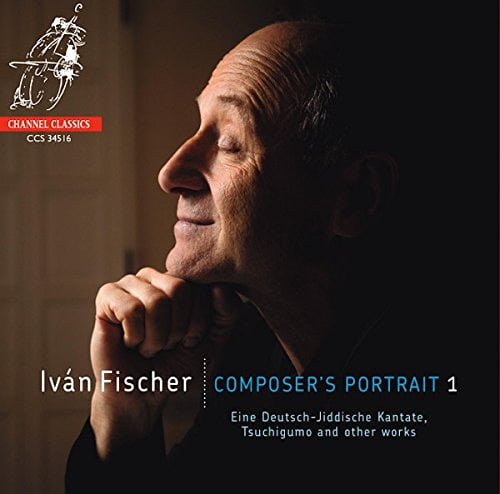
Iván Fischer – Composers Portrait – Wim Van Hasselt (trumpet), Nora Fischer (sop.), Kobra Vocal Ensemble, Budapest Festival Orchestra w/ Iván Fischer conducting – Channel Classics
Iván Fischer – Composers Portrait- With Wim Van Hasselt (trumpet), Nora Fischer (soprano), Kobra Vocal Ensemble, Budapest Festival Orchestra w/ Iván Fischer conducting – Channel Classics CCS 34516 (9/9/16) TT: 55:12 *** 1/2: Iván Fischer shows his composing credentials, with an eclectic collection paired with a fine recording. If I mention Iván Fischer you will almost certainly know of his many wonderful recordings. But Fischer is now leading a somewhat double life. He started his musical efforts at about age 20 as a composer, but has spent the last decades conducting. Of late, Fischer has returned to his composing roots, and this disc features several of his works, most are world premiers. Fisher describes himself not as a composer but as a composing conductor, and the many composers whose music he conducts are his teachers and his sources of inspiration. If Fisher was seen to be a bit quirky and eclectic at the podium, you will also find those traits in his music. The disc starts with a fanfare, then quickly moves on to a variety of pieces, some with his soprano daughter Nora. There is Tsuchigumo, a 20-minute satirical children’s opera, an Indian raga that mates a string quintet with […]

Jon Davis – Happy Juice – Posi-Tone
Jon Davis – Happy Juice – Posi-Tone PR8171 [7-7-2017] 49:33 ****: Talented jazz pianist pays tribute to legends! (Jon Davis – piano; Boris Kozlov – bass; Mark Ferber – drums) Jon Davis’ fourth release for Posi-Tone, Happy Juice is a ten-track showcase split evenly with original compositions and covers. The musical contexts suggest an association with the dynamic jazz piano movement of the 60’s. In particular, Davis is paying tribute to his personal heroes, Herbie Hancock, Chick Corea, Keith Jarrett, McCoy Tyner and Bill Evans. The opening title cut is a bluesy swinger that starts with some punctuated chord runs. The rhythm section (Boris Kozlov – bass/Mark Ferber – drums) is flawless and support the vibrant piano solos. “Slant Six” (another Davis-penned opus) has some underlying, pronounced grooves and utilizes up tempo chords, soulful notation and pulsating elegance. The first cover is the haunting Bill Evans classic, “The Two Lonely People”. Like Evans, Davis explores the melancholic sentiment and then at 1:37 slips into a supple groove that radiates with warmth and complexity. The second “cover’ is a latin-tinged version of Chick Corel’s “Tones For Joan’s Bones”. Davis’ gliding lyricism and awe-inspiring tempo development is potent. His piano leads are […]

Alex Cline’s Flower Garland Orchestra – Oceans of Vows – Cryptogramophone
Alex Cline’s Flower Garland Orchestra – Oceans of Vows [TrackList follows] – Cryptogramophone CG148 (2-CDs) [Distr. by Mack Ave. Records] 64:73, 52:34 [3/10/17] ****: Spirituality and musicality as one. (Areni Agabian – voice; Chi Li – erhu, zhonghu, zheng, qin; Jeff Gauthier – electric violin; Miguel Atwood-Ferguson – electric 5-string violin; Maggie Parkins – cello; Will Salmon – flute, recorders; Nels Cline, G.E. Stinson – electric guitars; Wayne Peet – electric piano, organ; Yuka C. Honda – electric keyboards, samples; Scott Walton – bass, keyboard; Brad Dutz – vibraphone, hand drums, crotales, gongs, percussion; Alex Cline – drums, gongs, percussion; Vicki Ray – conductor; Thich Nhat Hanh, Brother Phap Khe, Duc Nguyen, Brother Phap Hai, Sister Dang Nghiem – prerecorded voices) Faith and spirituality permeate drummer/percussionist Alex Cline’s music. His Buddhist beliefs suffused through The Constant Flame (Cryptogramophone, 2001) and were embedded as elements of Cline’s improvised rendition of Roscoe Mitchell’s long-form work, For People in Sorrow (Cryptogramophone, 2013). Buddhist inspiration and influence are crucial ingredients in Cline’s latest opus, the double-disc project, Oceans of Vows (also Cryptogramophone), credited to Alex Cline’s Flower Garland Orchestra. Like For People in Sorrow, Cline enlisted friends, family and close musical associates including Cryptogramophone […]

BRAHMS: “The Symphonies” – Boston Symphony Orchestra/ Andris Nelsons – BSO Classics
BRAHMS: “The Symphonies” – Boston Symphony Orchestra/ Andris Nelsons – BSO Classics 1701/03, 3 discs, 178:43 (5/26/17) ****: A bracing addition to an already rich field. The Brahms symphonies are, without a doubt, among the masterpieces of the genre; filled with the master’s characteristics superb orchestrations, straight-forward but lovely harmonies and beautiful memorable melodies. They, therefore, have an equally well known array of recorded performances; hundreds in fact, including several renowned renditions by the venerable Boston Symphony Orchestra. Interestingly, the BSO has not issued a spate of recordings of the whole four symphonies as a set; only ones by Erich Leinsdorf in the 1960s and that of Bernard Haitink from the early1990s being the only ones I am aware of. This new set by present music director Andris Nelsons is a bit bold and bracing. Just the opening of the first Symphony in c-minor and the opening of the Symphony No. 4 in e-minor illustrate a gutsier, more “articulated” vision of these works which holds true for the second and third as well. I was thinking the orchestra sounds almost “Wagnerian” in spots with very precise uses of attack and silence; but we know Brahms, himself, would have disdained such […]
Tardo Hammer Trio – Swinging On A Star – CellarLive
Tardo Hammer Trio – Swinging On A Star – CellarLive CL010717 46:45****: A pianist of cosmopolitan ideas and coherence of approach ( Tardo Hammer – piano; Lee Hudson – acoustic bass; Steve Williams – drums) One might have thought when Tardo Hammer appeared on NPR’s Piano Jazz with Marian McPartland on November 14, 2008, which followed his 2007 release Look Stop & Listen, he might have moved the needle on his career, but not so. For whatever reason, no further recordings were forthcoming until 2013 when he released Simple Pleasure for this label. Four years on, Tardo Hammer has a new album Swinging On Star for CellarLive which confirms that he is a pianist of cosmopolitan ideas and a coherence of approach that deserves a listen. In creating this set list, Hammer and his cohorts bassist Lee Hudson and drummer Steve Williams have sought to build a musical statement that uses familiar themes to deliver new wine in old bottles. Starting with Gil Evans’ “Gone” which is a re-statement of Gone, Gone, Gone from George Gershwin’s Porgy and Bess. Propelled by drummer Williams, pianist Hammer romps through the number with stop-time panache. The title track “Swinging On A Star” was […]

GRANT STEWART TRIO: Roll On – Cellar Live
GRANT STEWART TRIO: Roll On – Cellar Live 100616, 49:25 (6/23/17) ****½: A trio session of standards to match the best of the late ‘50s classics, with exquisite drumming by Phil Stewart. (Grant Stewart; tenor saxophone / Phil Stewart; drums / Paul Sikivie; bass) The name of this excellent jazz label Cellar Live conjures up a pleasing image. It is a Saturday night, we descend the few stairs, slip a sawbuck into the can at the door or give it to the man with the tattoos, and seek a table facing the bassist. Anon the frothy refreshments appear and the three musicians take their places. One, two three… and the air is quickened by tone, feeling, idea. Hush, chattering youngsters, for these are musicians of outstanding merit. And so the glorious evening rolls on to its conclusion. And ascending the few stairs into the evening air we know the world to have been repaired by art and something like love. Preserve the image folks, for the jazz clubs are not well. Like the macaw and the whooping crane they have retreated to the verge of extinction. Even in Portland, Oregon, a town oversupplied with musicians, the last jazz club […]

BEETHOVEN: Bagatelles for Piano, Op. 126; SCHUMANN: Davidsbündlertänze, Op. 6; PROKOFIEV: Sarcasms ‒ Nikita Mndoyants, piano ‒ Steinway & Sons
BEETHOVEN: Bagatelles for Piano, Op. 126; SCHUMANN: Davidsbündlertänze, Op. 6; PROKOFIEV: Sarcasms ‒ Nikita Mndoyants, piano ‒ Steinway & Sons 30075, 64:41 ****: A study in contrasts, perhaps, but this fascinating recital has the proper glue to hold it together. I was immediately attracted to this recital album by the program. What a clever choice we have here: Beethoven’s finest piano cycle, if we can call it that, perhaps Schumann’s most personal collection of character pieces, and then Prokofiev at his most uncompromisingly modernist—bagatelles for the 20th century. Even though the Bagatelles, Op 126, are a disparate group with no program, overarching or otherwise, the notes to this recording tell us that musicologist Lewis Lockwood found “the key relationships between the pieces progress in a succession of descending major thirds.” This is, of course, something an ultra-sensitive listener might intuit, but in any event the pieces, alternating slow-fast, form the same kind of pleasing whole that the composer’s multimovement late string quartets do. That is, a whole on Beethoven’s terms. The pieces are also a fascinating compendium of late-Beethoven compositional traits. The most immediately striking pieces are the fast numbers: No. 2, Allegro, seems like a dialog between two speakers, […]

Dimitar NENOV: Piano Concerto; Ballade No 2 – Ivo Varbanov (piano) / Royal Scottish National Orchestra / Emil Tabakov – Hyperion
Dimitar NENOV: Piano Concerto; Ballade No 2 – Ivo Varbanov (piano) / Royal Scottish National Orchestra / Emil Tabakov – Hyperion CDA68205, reviewed as hires 24-96 flac download; TT 63:42 [Distr. by Harmonia mundi/PIAS] *****: The Bulgarian composer, Dimitar Nenov (1901-1953), wrote the substantial piano concerto included in this new Hyperion release between 1932 and 1936. This period of political turmoil is perhaps reflected in the utterly gripping, heart-wrenching opening to the work. It certainly grabbed my attention; it must surely have created quite an impression at its first performance in 1937, with the composer at the keyboard. The concerto is in a single movement in three parts (rather than three discrete movements) and the first part is an energetic vivace. Alternately outpouring with emotion and quietly thoughtful the music integrates piano with orchestra with many an original approach to scoring, timbre and architecture, some components such as the clusters still sounding avant-garde even now. The second section follows with the briefest of lacunae, and is based on a Bulgarian folk-song about unrequited love. Again, the construction of the piece goes in surprising directions. The third section is quick in tempo which Martin Georgiev in his excellent essay for the […]

Kashmar – West Coast Toast – Delta Groove
Kashmar – West Coast Toast – Delta Groove DGPCD174, 48: 32 ***1/2: West Coast Blues lives on! (Mitch Kashmir – harmonica, vocals, claves; Junior Watson – guitar; Fred Kaplan – piano, Hammond organ, cabs; Bill Stuve – double bass; Marty Dodson – drums) Everyone has heard about Delta or Chicago Blues. The origins of the linkage between these genres has been documented frequently. But West Coast Blues is not as renowned or discussed as its counterparts. It originated in the 1940’s by musicians who migrated from Texas. The genre was influenced by jazz and jump music, and featured “jazzy” guitar solos, piano and smooth vocals. The first star of West Coast Blues was T-Bone Walker (of “Stormy Monday” fame.). Others including Lowell Fulson, Amos Milburn, Percy Mayfield and Charles Brown and more importantly, George “Harmonica” Smith graced the company. Now the legacy being carried by Santa Barbara vocalist and harmonica virtuoso, Mitch Kashmir. Kashmar has assembled a top-notch blues ensemble (Junior Watson/guitar; Fred Kaplan/piano, Hammond organ; Bill Stuve/double bass; Marty Dodson/drums) for his latest release, West Coast Toast (Delta Groove). The album is a living testament to the vital West Coast blues scene. Kicking off the festivities is […]

Narciso YEPES: The Complete Solo Recordings, works by BACH, VILLA_LOBOS, POULENC, SOR, SCARLATTI, RODRIGO, TARREGA – Narisco YEPES (guitar) – Deutsche Grammophon
Narciso YEPES: The Complete Solo Recordings (20cds) Spanische Guitarrenmusik vol. 1&2; Fernando Sor: 24 Etuden; Musica Espanola; Bach/Weiss; Hietor Villa-Lobos: 12 Etuden; Rendezvous mit Narciso Yepes; Musica Catalan; Werke fur Laute ; Bach: Werke fur Laute vol. 1&2; Poulenc/Brouwer, etc; Guitarra Romantica; Guitarrenmusik 20th Century; Gitarrenmusik aus funf Jahrhunderten; Tarrega: Recuerdos; Domenico Scarlatti; Rodrigo: Trez Pieza Espanolas; Romance de Amor; – Deutsche Grammophon 479 – 7316, (6/917); ****: The entire solo recordings for guitar by Narciso Yepes. Classical guitarists of my generation (b.1962) are probably too young to have registered the initial impact of Andres Segovia (or Pablo Casals for that matter). The reputation was one thing, but the old Decca records never sounded as good as they should have. By the mid ‘70s it was stereo we wanted and a label with authority and aesthetic appeal. It was inevitable that the avid fans and players would find their way (admittedly with a brief diversionary infatuation with Liona Boyd) to the Yellow Label and its preeminent guitarist, Narciso Yepes. The first of many records to appear, “Five Centuries of Spanish Music,” had an attractive centuries-to-dollars ratio and a charming picture of a traditional Spanish scene with a couple of donkeys. […]

Furtwängler Celebrates Bruckner = Symphony No. 9 in d minor; Symphony No. 7 in E Major: Adagio – Berlin Philharmonic Orchestra/ Wilhelm Furtwängler – Praga Digitals
Furtwängler Celebrates Bruckner = Symphony No. 9 in d minor; Symphony No. 7 in E Major: Adagio – Berlin Philharmonic Orchestra/ Wilhelm Furtwängler – Praga Digitals PRD/DSD 350 125, 79:56 (7/7/17) [Distr. by Harmonia mundi/PIAS] *****: Praga Digitals restores the famous Furtwängler 1944 Bruckner Ninth with a new, grand intensity not to be denied. Much ink has been invested into discussions of the famed, live sound document, from 7 October 1944, in which Wilhelm Furtwängler left us his only surviving thoughts on Bruckner’s 1894 Ninth Symphony, prepared for the Bruckner Society in an edition by Orel and further edited by Robert Haas. The date of the performance and its venue clearly place this convulsively agonized reading squarely within the throes of a crumbling Third Reich, the ironic locale for some of the humanitarian conductor’s most fervently passionate concerts. The various prior incarnations of this historic performance on label such as Music & Arts preserved its sonic defects as well as its hyper-romantic virtues: those sonic imperfections seem to have completely disappeared in this marvelously wrought version from Praga, and the cumulative effect has become monumental in its emotional impact. I do not feel compelled to recount the music’s debts to […]

Cipriani POTTER: Piano Concerto No. 2 in D Minor; Piano Concerto No. 4 in E Major; ‒ Tasmanian Symphony Orchestra / Howard Shelley, piano and conductor ‒ Hyperion
Cipriani POTTER: Piano Concerto No. 2 in D Minor; Piano Concerto No. 4 in E Major; Variazioni di bravura on a Theme by Rossini ‒ Tasmanian Symphony Orchestra / Howard Shelley, piano and conductor ‒ Hyperion CDA68151, 73:57 **** Virtuoso writing for both the piano and orchestra by an English Romantic. What first attracted me was the name: mellifluous Italian first name wedded to the kind of blunt Anglo-Saxon surname that, once upon a time, proclaimed the family profession. Then there was the portrait on an album cover, image of an intense if not downright fierce-looking young man. If that weren’t enough to stimulate interest, what about the fact that here was a composer from the “land without music” (as German critic Oscar Schmitz famously described England) who had managed to write ten(!) symphonies? Remember Mahler’s trepidation at starting a tenth symphony? The supposed curse that hung over the ninth symphony because no composer after Beethoven had completed a tenth? Well, Cipriani Potter (1792–1871) is one of at least two composers I can think of who completed a tenth symphony before Mahler’s day, the other being Joachim Raff, who went Potter one better. (Louis Spohr wrote ten symphonies as well, […]
Henri DUTILLEUX: Orchestral Works – Seattle Symph./Ludovic Morlot — Seattle Symphony Media
Henri DUTILLEUX: Orchestral Works [3 CD set, Tracklist follows] — Seattle Symphony — Media SSM1013, 78:29, 73:02, 60:23 [Distr. by Naxos] *****: Riveting, magnificent, and superbly played. Back in 2014 I was very happy with the first volume of this collected complete orchestral works of Henri Dutilleux, saying that “the orchestra sounds as full and technically proficient as it always did, with Maestro Morlot providing dignified and exceptionally educative leadership.” I cannot overplay the splendid nature of the sound here, truly exceptional. Robert Moon was even more elated in 2015, expressing very favorable response to this issue that contains the masterly Second Symphony, opining that “the performances and recording are superior, making this one of the best classical CDs of the year.” Apparently, we never did receive the third volume of this series, and now we have it as part of the collected orchestral pieces. Dutilleux is a fantastic composer, though his long life belies the number of works composed. He was the expert craftsman, using only the requisite number of notes needed for any composition, no more, no less, and convinced that there is no such thing as merely marking time in music. Everything has purpose, reason, and effect. […]

Kevin Hays & Lionel Loueke – Hope – Newvelle Records
Kevin Hays & Lionel Loueke – Hope – Newvelle Records NV008LP – 180 gm vinyl – ****1/2: Another audiophile world tour from Newvelle Records… (Kevin Hays – piano, vocals; Lionel Loueke – guitar, vocals) As the latest LP issue in the subscription audiophile LP series of Newvelle Records, Hope, from the combined talents of pianist Kevin Hays, and guitarist, Lionel Loueke, demands both rapt attention and an open free mind to appreciate its wondrous audio delights. Kevin and Lionel communicate intuitively, both blending and taking lead seamlessly. Lionel is from the Republic of Benin in West Africa, and his highly percussive guitar playing combines jazz and African rhythms in an intoxicating brew, that is enhanced by both native and wordless vocals- using his voice and tongue to simulate instrumental and beat effects. His presence clearly inspires Hays both on Lionel’s “world” compositions, as well as opening up the sonic landscape for Kevin on the tracks that the pianist wrote. For audiophile fans the listening experience is flawless, truly remarkable for guitar and piano presence. The vibration of strings and piano key strike is “felt” and the blend of the two instruments is spot on, with each having their leads floating up […]

Leonid Kogan plays Russian Music = Violin Concertos by KHACHATURIAN, KHRENNIKOV, PROKOFIEV, WEINBERG, DENISOV – Leonid Kogan, violin/ Pierre Monte / Krill Kondrashin / Pavel Kogan / Yevgeny Svetlana /Boston Symph. Orch. – Praga Digitals
Leonid Kogan plays Russian Music = KHACHATURIAN: Violin Concerto in d minor; Rhapsody-Concerto for Violin and Orchestra; KHRENNIKOV: Violin Concerto No. 2 in C Major, Op. 23; PROKOFIEV: Violin Concerto No. 2 in g minor, Op. 63; WEINBERG: Violin Concerto in g minor, Op. 67; DENISOV: Partita for Violin and Chamber Orchestra after J.S. Bach – Leonid Kogan, violin/ Boston Symphony Orchestra/ Pierre Monteux (Khachaturian)/ USSR State Symphony Orchestra/ Kyrill Kondrashin (Rhapsody, Prokofiev)/ State Academic Symphony/ Yevgeny Svetlano (Khrennikov)/ Moscow Philharmonic Orchestra/ Kyrill Kondrashin (Weinberg)/ Instrumental Ensmble/ Pavel Kogan (Denisov) – Praga Digitals PRD 250 373 (2 CDs) 73:40; 79:56 (7/14/17) [Distr. by Harmonia mundi/PIAS] *****: Leonid Kogan displays his incisive, often blazing talent in Russian concertos that embrace a spectrum of musical styles. Leonid Kogan (1924-1982) embodied the Russian counterpart to his self-proclaimed idol, Jascha Heifetz. Aristocratic in mien and temperament, Kogan studied not with Leopold Auer but with his most esteemed pupil, Abram Yampolsky, with whom he perfected a classical technique that tolerated no imprecision or false rhetoric. Several composers created works for Kogan’s especial talent, of which two—the Khachaturan Concerto-Rhapsody and the Khrennikov Concerto in C – find their way into this assemblage of performances, 1958-1981. Even […]

Silvestri in Philadelphia = TCHAIKOVSKY: Manfred Symphony; BRITTEN: Young Person’s Guide to the Orchestra – Philadelphia Orchestra/ Constantin Silvestri – Pristine Audio
Silvestri in Philadelphia = TCHAIKOVSKY: Symphony in B Minor after Byron’s Manfred, Op. 58; BRITTEN: Young Person’s Guide to the Orchestra (after Purcell), Op. 34 – Philadelphia Orchestra/ Constantin Silvestri – Pristine Audio PASC 490, 74:37 [www.pristineclassical.com] ****: The gifted Romanian Silvestri makes colors in his debut with the great color-ensemble, Philadelphia Orchestra. Romanian conductor Constantin Silvestri (1913-1969) made his debut with the Philadelphia Orchestra 25 November 1961 for a concert that included one of his own compositions, Prelude and Fugue, which may be accessed through Pristine as a download. What we do possess on this disc – which had slipped past me until Andrew Rose kindly designated me a copy – are two scores that testify to Silvestri’s strong suit. In my interview with Silvestri’s talented pupil Sergiu Commissiona in Atlanta, I asked Sergiu to name Silvestri’s most enduring legacy as a musical pedagogue, and without hesitation, he quipped, “A great and immediate capacity for making colors.” Tchaikovsky’s 1885 Manfred Symphony, much of which the composer—and Leonard Bernstein—detested, resulted from a desire by Mily Balakirev to see Lord Byron’s 1817 poem—via a program devised by Stasov—converted into music, especially since Hector Berlioz had toured Russia 1867-68, leading his own […]
Streams and Podcasts for 14 July 2017
This week, The Music Treasury will be spotlighting none other than Arturo Toscanini, that most exceptional of conductors in the first half of the 20th Century! Toscanini began his career as a cellist, but turned to conducting when he was a young adult. Initially a conductor of opera, including the La Scala and the New York Metropolitan opera houses, he also conducted symphonic literature, and performed all-American concerts in the states during the second world war. Music from these concerts will be featured on Sunday, with works by Gershwin and others. The show can be heard on Sunday, 16 July 2017, between 19:00 and 21:00, PDT. Gary Lemco is the show’s host, it is presented as a radio show with streaming broadcast: kzsulive.stanford.edu. On both Saturday and Sunday, Edmund Stone will feature his observations on some parts of the vast repertoire of film scores in his show, The Score. It too is broadcast as a streamed radio show, from its host station in Portland: AllClassical.org. The show can be heard between 14:00 and 15:00 PDT. On Sunday, there will be an encore presentation of the previous week’s show of “Team Portraits”, including scores from The Magnificent Seven, The Avengers, Star […]

Portland Jazz Festival Opening Night – Maria Schneider Orchestra – February 2017
Portland Jazz Festival Opening Night – Maria Schneider Orchestra at Newmark Theater From time to time, Audiophile Audition will offer reviews of concerts or festivals of note. This review is from the opening evening of the Portland Jazz Festival, earlier this year. Maria Schneider’s first ever west-coast tour allowed Portland Jazz fans a much anticipated opportunity to see her 18-unit band in performance. One envies those who experienced this music for the first time, as it hugely enlarges one’s sense of what is possible in the medium of jazz. It is oft noted that Maria Schneider’s music has its roots in mid-western Americana. Indeed, many of her famous pieces evoke landscape: farm and field, water and animal life. In this regard, she is jazz heir to Barber and Copland. While her musical vision and sensibility are as distinctive as any of the great Jazz composers, a great part of her appeal is her affirmation of solid things, real experiences, the fragility of the connections and values that sustain life. Yet her mastery of tonal color and her ability to conjure so much out her band is unique. In spite of hours of listening to her recordings and carefully attention to […]

The Lightning Fields—New music for trumpet and piano = Music by Michael DAUGHERTY, Kevin MCKEE, Richard PEASLEE, Anthony PLOG, Daniel SCHNYDER – Jason Bergman, trumpet & flugelhorn – Steven Harlos, piano – MSR
The Lightning Fields—New music for trumpet and piano = Music by Michael DAUGHERTY, Kevin MCKEE, Richard PEASLEE, Anthony PLOG, Daniel SCHNYDER – Jason Bergman, trumpet & flugelhorn – Steven Harlos, piano – MSR Classics Stereo CD MS 1630 (11/16/16) ****: Some fine contemporary music for trumpet and piano played with gusto, well recorded This disc is a world premiere recording of captivating contemporary music for trumpet or flugelhorn—some unaccompanied, some with piano. The music here is varied, but always dynamic. The trumpet and flugelhorn playing by Bergman is first rate, and as a former brass player myself, I’m impressed with the technique he offers, and the quality of his intonation. Most of the works are for piano and trumpet, but the McKee work, The Adventures of…. is for unaccompanied trumpet and it is a distinctive showpiece. Another standout is Plog’s Sonata for Trumpet and Piano, written in 2009. Plug has consistently written interesting contemporary music, and his Sonata is no exception. At the opening, the trumpet is almost treated like carillon bells, after which the dissonant piano enters to great effect. Michael Daugherty’s The Lightning Fields, from which the disc derives its title, I found to be quite enjoyable. The […]
Fenemor’s Kiwi Blue – Blues Jam
Fenemor’s Kiwi Blue – Blues Jam Self-Produced, 48:57 ****: (Adrienne Fenemor – B3 organ, vocals; Marvin Horne – guitar; Brian Floody – drums) B3 player adds vocals to her repertoire. The influence of American jazz is global. One of the purely American instrumental genres is the Hammond B3 organ. On the other side of the world, New Zealand native Adrienne Fenemor became a devotee of B3 music. According to her bio, she may be the first B3 player in her country. Studying the recordings of Jimmy Smith, Groove Holmes, Joey DeFrancesco and Jack McDuff, Fenemor began performing at festivals in New Zealand and Australia. Inevitably, she moved to the States, and paid her dues playing through the Midwest. Now relocated to New York, she is a regular on the city jazz scene. Her instrumental album, “Mo Puddin’” has steadily climbed the jazz charts. On Fenemor’s latest release Blues Jam, she has added a new dimension to her impressive B3 licks, vocals. Fronting a classic B3 trio format (Marvin Horne/guitar; Brian Floody/drums), the change in direction is stellar. With a dynamic jazzy agility, a nine-track assortment of covers (and one original composition) showcases the next step in her career trajectory. The […]
Stereotypes Audio

Cembal d’amour

Pure Pleasure / Speakers Corner

Cedille


