
Monthly Archive: July 2017

Lynelle James, piano = BEETHOVEN: Piano Sonata No. 28; ROSLAVETS: 5 Preludes; SCRIABIN: Piano Sonata No. 4; SCHUMANN: Symphonic Etudes, Op. 13 – Lynelle James, piano – Blue Griffin
Lynelle James, piano = BEETHOVEN: Piano Sonata No. 28 in A Major, Op. 101; ROSLAVETS: 5 Preludes; SCRIABIN: Piano Sonata No. 4 in F-sharp Major, Op. 30; SCHUMANN: Symphonic Etudes, Op. 13 – Lynelle James, piano – Blue Griffin BGR435, 61:28 (5/1/17) [Distr. by Albany] ****: A gifted pianist makes a resonant impression in a recital of diverse musical colors. Pianist Lynelle James recorded this recital 13-15 April 2016, which displays her capacity for rich colors in a variety of musical styles. After a somewhat hesitant—or just too slow—Allegretto ma non troppo opening for the 1816 Piano Sonata No. 28 in A Major of Beethoven, Ms. James becomes more confident in her stride and declamations as the movement unfolds, and she finds excellent energy in the second, martial movement and the pungently contrapuntal last movement. As in many of the “later-style” Beethoven opera, this sonata condenses classical form into tight, cogent spaces, often indulging in sudden and canonic excursions into the minor modes of the main themes. The Allegro last movement enjoys an extremely fluent sense of musical transition, especially as the competing motor elements traverse a panoply of registers. The music of Nikolay Roslavets (1881-1944) has a special attraction […]
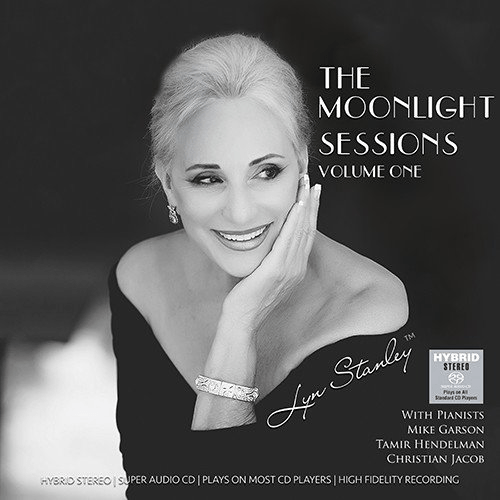
Lyn Stanley – The Moonlight Sessions, Volume One – A.T. Music LLC – SACD
Lyn Stanley – The Moonlight Sessions, Volume One – A.T. Music #3105 – stereo-only SACD and Vinyl, 51:00 ***: A fantastic volume of standards, when can I get volume two? (Lyn Stanley – vocals; Mike Garson, Christian Jacob, Tamir Hendelman – piano; Chuck Berghofer – bass; Ray Brinker, Bernie Dresel, Joe LaBarbara – drums; John Chiodini – guitar; Rob McChesney – trombone; Henrick Meurkens – harmonica; Luis Conte – percussion; Chuck Findley – trumpet; Rickey Woodard – tenor saxophone; Bob McChesney – trombone; Corky Hale, Carol Robins – Harp; Snaps – Steve Genewick) When you look at the cover of Lyn’s latest release, you know you will be hearing a true class act. A black and white picture of the smiling singer graces the cover, and I’m already transported back to a first-rate 1940s jazz club. Another special treat: the liner notes feature a line from all of the songs, adding a poetic tone even before you hit play on the CD. With this being an SACD, all the songs are beautifully performed and mixed well from start to finish. We kick it off with “All or Nothing at All,” where a plaintive trumpet solo immediately invokes a foggy night […]

Sean Jones – Live From Jazz at The Bistro – Mack Avenue Records
Sean Jones – Live From Jazz at The Bistro – Mack Avenue Records # MAC 1111 – 64:06 – ****1/2: Sean Jones heats up The Jazz Bistro… (Sean Jones – trumpet and flugelhorn; Orrin Evans – piano; Luques Curtis – bass; Obed Calvaire – drums (#2, 3, 6); Mark Whitfield, Jr. – drums (#1, 4, 5, 7); Brian Hogans – alto and soprano sax (#2, 3, 4, 6) Several years ago at the Detroit Jazz Festival, I first experienced trumpeter, Sean Jones. I left the Festival convinced that he was heading for big things as a solo artist. Both as a leader, and as a sideman on several stages at the Festival, and at jam sessions late at night, Sean simply lit up the stage in Detroit. He was a firebrand with blistering power on burners, yet with a tender warm, open tone on ballads. His presence was strongly felt. Jones has now released his eighth album for the Detroit label, Mack Avenue. Sean brings his energy to a live audience at St. Louis’ jazz club, The Bistro. Backed by his long tenured quintet, Jones was ripe and ready to unleash largely new material on an eager audience. Opening with […]

Art Pepper and Bill Watrous – Art Pepper Presents “West Coast Sounds” Vol. 4 – Omnivore
Art Pepper and Bill Watrous – Art Pepper Presents “West Coast Sounds” Vol. 4 – Omnivore OVCD 225 – 1979 – 58:15 – ****1/2 Alto and trombone, a mellow blend… (Art Pepper – alto sax; Bill Watrous – trombone; Russ Freeman – piano; Bob Magnusson – bass; Carl Burnett – drums) The first recording that Art Pepper made for the Japanese label, Atlas, in 1979 was actually the fourth one that Atlas released in its series of West Coast jazz sessions from Pepper. The Japanese jazz listening market at the time dug the west coast style of lightly swinging contrapuntal arrangements. Since Art was under contract to Galaxy at the time, Pepper had to officially be the main sideman to the “leader,” a role that he actually appreciated since he could then channel his passionate playing as his sole responsibility. He was able to choose the actual sidemen, and for this March, 1979 recording, Pepper chose wisely. Russ Freeman was one of his favorite pianists, soulful and rock solid in his swing. Bob Magnusson was his regular bassist, and Carl Burnett was perfect to anchor the groove. Bill Watrous, now 78, was early in his career at that time, and […]

BRUCKNER: Symphony No. 3 & WAGNER: Tannhäuser – Gewandhaus Orch. Leipzig/ Andris Nelsons – DGG
BRUCKNER: Symphony No. 3 & WAGNER: Tannhäuser – Gewandhaus Orchestra Leipzig/ Andris Nelsons – DGG 479 7208, 75:55 (5/5/17) ***½: Patience rewarded (intermittently) on a long Bruckner journey. In a Bruckner symphony, there is quite a lot of standing around waiting for something to happen. One might compare it to the experience of whale-watching, drifting about pleasantly on a placid surface, while anticipation builds. One senses a stirring as an idea gathers itself beneath the surface. Then, having built to an inevitable statement, it breeches with glorious beauty. Once subsiding, the waters become almost apologetically calm, and there is, for a moment, nothing more interesting than the stray seagull. I judge Bruckner symphonies by the frequency and relative power of these emphatic demonstrations. By that standard, the present offering ranks high, but well behind the memorable symphony number four. Andris Nelsons and the Gewandhaus Orchestra give a confident reading of this fine work. The Yellow Label engineers, however, have their hands full managing the impossible task of squeezing the enormous dynamics of this live concert onto a small plastic object. With anything like average home stereo equipment, you will be fiddling with the nobs on the pianissimo sections, which at […]

Art Pepper and Lee Konitz – Art Pepper Presents West Coast Sessions, Vol. 3 – Omnivore
Art Pepper and Lee Konitz – Art Pepper Presents West Coast Sessions, Vol. 3 – Omnivore OCD 224 – 1982 – 56:04 – ****: Hot and cool – Art Pepper and Lee Konitz… (Art Pepper – alto sax and clarinet; Lee Konitz – alto sax; Michael Lang – piano; Bob Magnusson – bass; John Dentz – drums) Recorded just six months before Art Pepper’s death, the latest in the re-released West Coast Sessions series, from Omnivore Records, matches Art Pepper with Lee Konitz. It is somewhat similar to another L.A. based session that was recently released by Laurie Pepper(on her Widows Taste label) that featured Art and Warne Marsh. Both these recordings blend cool/cerebral saxophonists with the hot “wear your heart on your sleeve” passion that Art Pepper brought to the bandstand. All of the West Coast Sessions (there are several more hopefully that will be released in the near future) had Art officially as a sideman, when they were originally released between 1979 to 1982 on the Japanese label, Atlas, individually, and later as a box set. Since Art was under contract with Galaxy Records, he could not record for another label at the time. Art was able to […]

Jascha Heifetz: The Legendary Los Angeles Concerts = BRAHMS; HALVORSEN; BEETHOVEN; DVORAK; SARASOTE – Jascha Heifetz, violin/ Gregor Piatagorsky, cello/ NY Phil. Orch./ Leonard Bernstein/ LA Phil. Orch./ Zubin Mehta/ Bell Telephone Hour Orch./ Donald Vorhees – Rhine Classics
Jascha Heifetz: The Legendary Los Angeles Concerts = BRAHMS: Double Concerto in a minor, OP. 102; HALVORSEN: Passacaglia for Violin and Cello from Suite in g minor by Handel; BEETHOVEN: Violin Concerto in D Major, Op. 61; DVORAK: Humoresque in G-flat Major, Op. 101, No. 7; SARASATE: Habanera, Op. 21, No. 2 – Jascha Heifetz, violin/ Gregor Piatagorsky, cello/ New York Philharmonic Orchestra/ Leonard Bernstein (Brahms)/ Los Angeles Philharmonic Orchestra/ Zubin Mehta (Beethoven)/ Bell Telephone Hour Orchestra/ Donald Vorhees – Rhine Classics RH-004 (2 CDs) 38:47; 50:08 [www.rhineclassics.com] *****: Jascha Heifetz performances previously unreleased emerge on a new, important label in excellent sound. Violin virtuoso Jascha Heifetz (1901-1987) still stands as the artistic ideal for the many admirers of his craft: Isaac Stern once referred to the Twentieth Century as “the age of Heifetz.” The soul of sang froid on the concert stage, Heifetz turned his potent emotionalism inward: his burnished tone, elastic bow technique, and unerring finger technique virtually revolutionized the modern concept of the violin art. Cavils often arose to Heifetz’ s application of bow pressure; and his phrasing, so smoothly articulated, could warrant the reaction of “glibness” or “over-refined” to his interpretations. But for the combination of […]

Pablo Casals and Rudolf Serkin: BEETHOVEN: Works for Cello and Piano – Pablo Casals, cello/ Rudolf Serkin, piano – Praga Digitals
BEETHOVEN: Works for Cello and Piano = Sonata in F Major, Op. 5, No. 1; Sonata in g minor, OP. 5, No. 2; Seven Variations on “Bein Maennern, welche Liebe fuehler” from Mozart’s The Magic Flute, WoO 46; Twelve Variations on “Ein Maedchen oder Weibchen” from Mozart’s The Magic Flute, Op. 66; Sonata in A Major, Op. 69; Sonata in C Major, Op. 102, No. 1; Sonata in d Major, Op. 102, No. 2; Twelve Variations on “See, the conqu’ring hero comes” from Handel’s Judas Maccabaeus, WoO 45 – Pablo Casals, cello/ Rudolf Serkin, piano – Praga Digitals PRD 250 372 (2 CDs) 80:35; 81:30 (6/16/17) [Distr. Harmonia mundi/PIAS] ****: Praga restores the classic set of Beethoven works for cello and piano by the legendary Casals and Serkin. Most lovers of the great cello masters will acknowledge Pablo Casals (1876-1973) as the legendary representative of the 19th Century “romantic” school of musicianship, which rather came to an end with the advent of Emanuel Feuerman. Casals collaborated with Bohemian pianist Rudolf Serkin (1903-1991) in 1952 and 1953 specifically to record Beethoven’s oeuvre for cello and piano, excluding the transcription of the Op. 17 Horn Sonata. The two veteran musicians had endured […]

Streams and Podcasts for 7 July 2017
Streams and Podcasts for 7 July 2017 This week, The Music Treasury will be featuring the artist Nada Loufti. Loufti is a pianist of note, comfortable in traditional classical literature as well as music of contemporary composers and jazz. She has directed concert series and premiered new compositions. The show, hosted by Gary Lemco, can be heard through the link: kzsulive.stanford.edu, Sunday July 9 between 19:00 and 21:00, Pacific Daylight TIme. For aficionados of the screen, The Score features expositions of film scores, a genre of much breadth and depth. Host Edmond Stone explores it through different aspects — composer, time period, film theme… It can be heard this Saturday, 8 July, between 14:00 and 15:00, Pacific Daylight time, from its host stations, Portland’s All Classical: www.allclassical.org. There is also an “encore edition” of the previous week’s offering on Sunday, also between 14:00 and 15:00. For 9 July, the subject is “people on the lam” (Catch Me If You Can, The Fugitive, North by Northwest…).
Streams and Podcasts
Streams and Podcasts As the 21st Century continues to sweep along, Audiophile Audition is broadening its offerings—in addition to providing reviews of new releases in recordings and audio equipment, it will provide regular postings announcing broadcasts of interest to audiophiles. The initial offering will be two shows—The Music Treasury, from Stanford University public station, with Gary Lemco as host, and The Score, which is hosted by Edmund Stone and broadcast through a local station along with a syndicated network. Both of these shows are accessible through the ‘Net. Audiophile Audition keep its viewers apprised of the schedule, as well as the content, when it is available. This is a new offering for this site; we will be seeking additional programs of interest to include in its announcements.

Giacomo Gates – What Time Is It? – Savant Records
Giacomo Gates – What Time Is It? – Savant Records SCD2157 43:31****: An intriguing session for the hip — certainly not for the hipsters (Giacomo Gates – vocals; Jerry Weldon – tenor saxophone; John Di Martino – piano; Tony Lombardozzi – guitar; Lonnie Plaxico – bass; Vincent Ector – drums) Giacomo Gates is hip (cooler than cool) but he is not a hipster (a person who follows the latest fashions and trends). When your hip, deciding what to record is a challenge since the tried and true might not always work. Gates avoids these song clichés for the most part, and delivers an intriguing session under the title What Time Is It? Using his rich baritone to full effect, and after a spoken introduction about clocks and watches to What Time Is It?, Gates swings into “ I Didn’t Know What Time It Was” with guitarist Tony Lombardozzi giving the fret board a work-out, followed by tenor saxophonist Jerry Weldon showing his full tone. Todd Dameron’s “On a Misty Night” is an expressive delight that after a run though of the verses, Gates takes off with a verbal ad lib based on these verses. Back in 1957, when the doo-wop […]

“Pange lingua: Music for Corpus Christi” – Choir of Clare College, Cambridge/ Michael Papadopoulos, organ/ Graham Ross – Harmonia mundi
“Pange lingua: Music for Corpus Christi” – Choir of Clare College, Cambridge/ Michael Papadopoulos, organ/ Graham Ross – Harmonia mundi HMM 907688, 75:19 ****: A fine historical selection of the Corpus Christi through the centuries. It was Thomas Aquinas who composed the hymn Pange lingua, used on the Maundy Thursday procession in the Roman Catholic Church. And Aquinas is the chief of the medieval poets who solemnized this feast, ancient in the west, and still present even in some Anglican churches, though it was abolished there in 1548 (today it is the “Day of Thanksgiving for the Institution of Holy Communion”). Originally however, the institution of Corpus Christi as a feast resulted from work on the part of Juliana of Liège, a 13th-century Norbertine canoness (b. 1191) in Liège, Belgium. Her devotion to the Blessed Sacrament was enhanced by a vision of the Church under the appearance of the full moon having one dark spot, which signified the need for this celebration. She had the vision for the next 20 years but she kept it a secret. Finally, after petitioning the bishop, in 1246 a celebration of Corpus Christi was appointed to be held in the local diocese each year […]

JC Hopkins Biggish Band – Meet Me At Minton’s – Harlem Jazz Records
JC Hopkins Biggish Band – Meet Me At Minton’s – Harlem Jazz Records 52:27 **** A musical journey worth taking ( JC Hopkins – piano; Noah Jackson – bass; Charles Goold – drums; Solomon Hicks – guitar; Claire Daly – baritone sax; Christopher McBride – alto sax; Troy Roberts – tenor sax; Corey Wallace – trombone; Bruce Harris – trumpet; Phillip Dizack – trumpet; Bryan Davis – trumpet; Joseph Doubleday – vibes; Brandee Younger – hard; Ismel Wignall – congas; Andy Bey – celeste; Kevin Burke, Aria Hendricks – vocals) To those readers and jazz listeners of a certain age, Minton’s Playhouse was a Harlem jazz club founded by tenor saxophonist Henry Minton in 1938. It gained its fame in the 1940s as the home for the development of bebop and its innovators such as Charles Parker, Thelonious Monk, Dizzy Gillespie and Kenny Clarke.But, with time, the club and the music eventually faded away. However in 2013 the name was revived by entrepreneur Richard Parsons and this delightful musical romp by the JC Hopkins Biggish Band entitled Meet Me At Minton’s is worthy of its name. JC Hopkins Biggish Band is cracker jack outfit that plays with a whole lot […]

Franco DONATONI: Argot; Pierre BOULEZ: Anthèmes; Witold LUTASLAWSKI: Partita for violin and piano – Véronique Mathieu (vln.) /Jasmin Arakawa (p.) – Navona Records
“Argot” = Franco DONATONI: Argot; Pierre BOULEZ: Anthèmes; Witold LUTASLAWSKI: Recitativo e Arioso; Subito for violin and piano; Partita for violin and piano – Véronique Mathieu, violin/Jasmin Arakawa, piano – Navona Records NV6105 [Distr. by Naxos] 45:17, (7/14/17) ***: Very impressive somewhat wild ride violin recital. Young Canadian violinist Véronique Mathieu is an appreciable talent, as is her pianist (in the Lutaslawski), Jasmin Arakawa. Artistically and technically this is a very demanding and impressive program of modern violin music. The title work, Argot, by Franco Donatoni, is, interestingly, the most ‘traditional’ sounding work here. Donatoni is not nearly as well known as some of Italy’s other mid-century and post-war experimentalists; such as Luciano Berio, Luigi Nono and the somewhat later Luigi Dallapiccola. Yet, his music is bold and expressive. The two pieces that comprise Argot are partly a technical flourish and partly an almost ethnic sounding expression with bits of gypsy and folk-inspired ornamentation throughout. A lot of Donatoni’s orchestral music is very challenging but well worth exploring, incidentally. Boulez’ Anthèmes has gotten a bit of play and some other recorded performances these past twenty years. Written for Yehudi Menuhin in 1992, Athèmes uses a variety of extended techniques and […]

STRAVINSKY: Music for Violin and Piano Vol.1 – Ilya Gingolts/ Peter Lauls – BIS
STRAVINSKY: Music for Violin and Piano Vol.1 – Ilya Gingolts/ Peter Lauls – BIS SACD 2245, 60:48, (7/7/17) ****½: In Stravinsky’s late-period laboratory of chamber music reinvention. Stravinsky was famously skeptical of the violin, especially in combination with the piano. Well into his career, he had produced no chamber music with this conventional pairing. In his own words: “For many years I had taken no pleasure in the blend of strings struck in the piano with strings set in vibration with the bow. In order to reconcile myself to this instrumental combination I was compelled to turn to the minimum of instruments, that is to say, only two, in which I saw the possibility of solving the instrumental and acoustic problem.” This changed in 1930, when he met the violinist Samuel Dushkin. This meeting provided both inspiration and insight in how to write for these two instruments. He made up for lost time with a new productivity in chamber music, a genre one does not usually associate with the Maestro. This release features the violin/piano music that arose from this fruitful encounter circa the early 1930’s. What we have are mostly arrangements made by Stravinsky himself from the famous ballets […]

MENDELSSOHN: Symphonies 1 through 5 – Yannick Nezet-Seguin & Chamber Orch. of Europe – DGG
MENDELSSOHN: Symphonies 1-5 – Yannick Nezet-Seguin & Chamber Orchestra of Europe – DGG 479 7337 CD 1 73:01, CD: 2 66:57, Cd 3 60:12, (6/16/17) ****: Rarely heard compilation of all five Mendelssohn symphonies played live by the sparkling Chamber Orchestra of Europe. There has never been any argument about Beethoven’s Nine Symphonies. They are synonymous with classical music itself. At once the most enduring product of the industry and the standard by which greatness is measures, they sit cozily in their boxes as radiant and redundant exemplars of musical genius. Brahms follows next as a cultural icon. His Four are as cosmologically complete as the compass points or the seasons. Recently, the rise in Schumann’s reputation has seen increasing attempts to assemble his symphonies, too, as a summation and epitome of his musical career. The recording under review attempts to make a rare case for the Mendelssohn Five. It seems plausible enough, but let’s examine the reasons why it has been so seldom attempted. First, there is the big Lobsgesang symphony-cantata, the longest by far, which is never performed. Directly inspired by Beethoven’s Ninth, it attaches a substantial chorale to three conventional movements. The texts are echt Lutheran piety, […]

Horenstein Early Recordings = BACH Choral Preludes (trans. Schoenberg); HAYDN: Symphony No. 94; MOZART: Overtures, Le nozze di Figaro and La Clemenza da Tito; SCHUBERT: Symphony No. 5 – Berlin Phil. Orch./ Jascha Horenstein – Pristine
Horenstein Early Recordings = BACH (trans. Schoenberg): Gott, Schoepfer, Heiliger Geist, BWV 631; Schmucke dich, O liebe Seele, BWV 654; HAYDN: Symphony No. 94 in G Major “Surprise”; MOZART: Le nozze di Figaro – Overture, K. 492; La Clemenza da Tito – Overture, K. 691; SCHUBERT: Symphony No. 5 in B-flat Major, D. 485 – Berlin Philharmonic Orchestra/ Jascha Horenstein – Pristine Audio PASC 506, 69:02 [www.pristineclassical.com] ****: Pristine restores Jascha Horenstein’s German-Austrian repertory of 1929 to the active catalogue. Mark Obert-Thorn re-masters the 1929 Polydor recordings by Jascha Horenstein (1898-1973), his electrical performances of music to which he did return later in his recording career. Some collectors will recognize this program as having had prior issue on the Koch Legacy label (5-7054-2) in inferior sound. What becomes significant in this program lies in the fact that circumstances—mostly political—would prevent Horenstein’s access to the recording studio until Vox Records signed this versatile conductor in 1952. Each of the performances presents a driven, committed interpreter of the Great German Tradition, rather linear in conception and quite brightly lit in the interior vocal lines, especially in the Mozart selections. The Marriage of Figaro Overture suffers no “romantic” distortion in what proves a […]
Editorial for July 2017
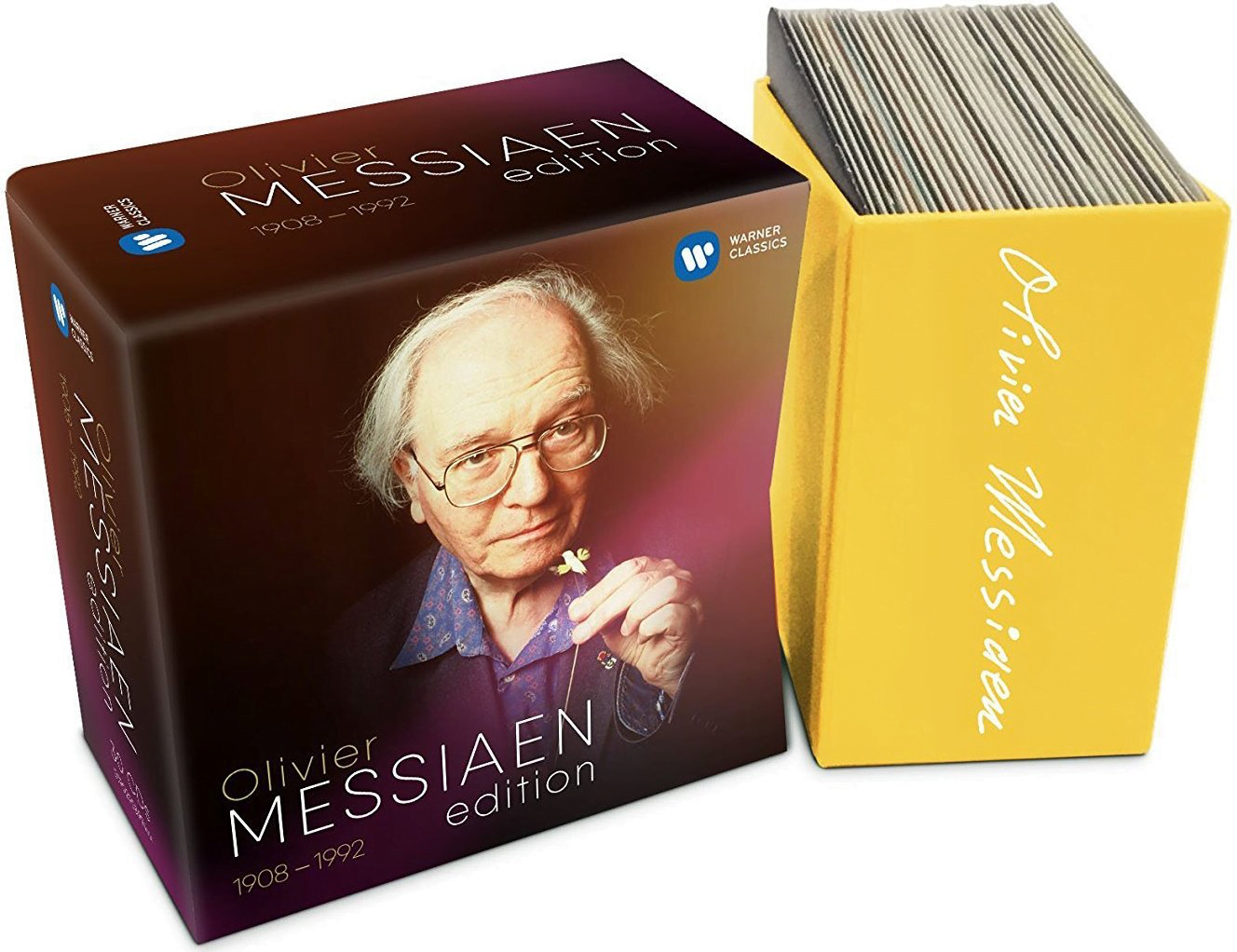
For our July free drawing we are offering Warner Classics exceptional 20th Anniversary of Messiaen Edition! Olivier Messiaen is an extraordinary figure of the musical landscape. His deep mysticism and reverence found voice in many genre — piano, organ, solo voice, choral settings, orchestras, and that so significant chamber music piece: The Quartet for the End of Time. This edition enhances the original 18 CD set with an additional 7 CDs, offering some landmark performances of several of his major works. There is a very impressive suite of performers, chamber ensembles, and orchestras, with conductors such as Meiji Ozawa, Kent Nagano, Pierre Boulez, André Previn, and Simon Rattle. Audiophile Audition Review. All you need to do to enter the drawing is simply click on the Register To Win banner on the Home Page and fill out the few fields we request. The lucky winner of the set will be announced here next month. Detailed information about Warner Classic’s exceptional release can be found here: Messiaen Edition – 20th Anniversary EDITORIAL AUDIOPHILE AUDITION began as a local program in San Francisco and then in 1985 as a weekly national radio series hosted by John Sunier, and aired for 13½ years on up to 200 public […]
Stereotypes Audio

Cembal d’amour

Pure Pleasure / Speakers Corner

Cedille


