
Monthly Archive: September 2017

Von HERZOGENBERG: Piano Trios – Vienna Piano Trio – SACD
Von HERZOGENBERG: Piano Trios op. 24 & 36 – Vienna Piano Trio – SACD MDG 942 2017-6, 65: 38, (5/17/17) ****; An exemplar of the the Brahmsian chamber school in two large-scale, absorbing piano trios. (David McCarroll; violin; Matthias Gredler; cello/ Stefan Mendl; piano) The portrait of Heinrich von Herzogenberg included in the notes of this new MDG release merit careful study. We see an elegant figure representative of German High Culture at its artistic acme with a fine wool jacket, silk cravat, and the inevitable pince nez. The beard, not quite as assertive as that of Herr Brahms, is nevertheless impressive, with incipient mustachios adding a dapper accent. The eyes have to be taken in turn. The left stares out into space—or the future— with an astonished fixation, while the right drowsily drifts to the side as if in pleasant contemplation of a familiar scene. On the picture, we notice a stamp from a Berlin photo agency, while the location is the composer’s home, Leipzig, cities that might well stand for the new and the old in German Musical Culture. We learn in the outstanding notes that Herzogenberg was a composer at the crossroads. Lines had long been drawn-up […]

Back Before Bach: Musical Journeys = Music by 16th & 17th century German and Franco-Flemish composers – Piffaro/ Joan Kimball /Robert Wiemken – Navona
Back Before Bach: Musical Journeys = Music by sixteenth and early seventeenth century German and Franco-Flemish composers – Piffaro/ Joan Kimball & Robert Wiemken, artistic co-directors – Navona Records NV6106, 61:03 (9/1/17) *****: The six members of Piffaro—the Philadelphia-based, self-styled “Renaissance band”—return with four guests in an all-instrumental album designed to show the musical precedents that set the stage for German Baroque and Bach. Conceived in the manner of a Renaissance consort, Piffaro play their arrangements in various enticing configurations of the group’s assembly of lute, guitar, shawms (including a schalmei), harp, bagpipes, dulcians (and even a douçaine), recorders, crumhorns, percussionists, and sackbuts. Because the disc’s 38 tracks have been assembled as if they were the proof of a post-graduate thesis – including seven different settings of “Christ ist erstanden” by Bach and six of his predecessors, and four of “Innsbruck, Ich müss dich lassen” – could listening all the way through at one sitting could be a transformative experience for those so inclined and steeped in history; however, there are a few gems for audiophiles seeking demo tracks. The haunting beauty of Bach’s “Christum wir sollen loben schon” chorale, is followed by an Allemande by Scheidt featuring incredibly nuanced […]

The Passion Of Charlie Parker – Impulse
The Passion Of Charlie Parker – Impulse 574416-7 50:16**** An unorthodox consideration of a singular musician and the music he created. ( Donny McCaslin – tenor saxophone; Ben Monder – guitar; Mark Giuliana – drums track #3; Eric Harland – drums-all except #3, vibraphone track#6; Scott Colley – bass except tracks #1, 9, 11; Larry Grenadier – bass tracks #1, 9; Craig Taborn – piano,Wurlitzer Electric Piano, Hammond B-3 organ; Guest vocalists – Madeleine Peyroux; Barbara Hannigan; Gregory Porter; Jeffrey Wright; Luciana Souza; Kurt Elling; Kandace Springs; Melody Gardot; Camille Bertault With the Centenaries this year of the births of Ella Fitzgerald, Dizzy Gillespie and Thelonious Monk, one wondered when the centenary of that other musical genius Charlie Parker would arrive. The answer to that is 2020, but perhaps the release of The Passion Of Charlie Parker might be considered as a precursor to that anniversary. The construct of this album is interesting, in that a sampling of Charlie Parker’s compositions, with lyrics by David Baerwald (except for track 3 and 12), are offered as vocals by a potpourri of singers. The idea is to trace Bird’s life as a musical story and it works rather well. Madeleine Peyroux lopes […]

Barbara HARBACH: Orchestra Music III, Portraits in Sound – London PO/ David Angus – MSR Classics
Barbara HARBACH: Orchestra Music III, Portraits in Sound – London Philharmonic Orchestra/ David Angus – MSR Classics MSR 1614, 62:54 [Distr. by Albany] ****: Volume 11 in this impressive series proves a winner This is the eleventh volume of MSR’s extraordinary commitment to Barbara Harbach, polyglot extraordinaire, by the looks of her resume one of the busiest musicians on the planet, wonderful keyboardist (organ and harpsichord), and, at times, a very fine composer. In fact, her prolific output defies all normal ideas of time management, and she must spill out music like Mozart with a never-ending sense of inspiration. If I seem cautious it is because I detect an unevenness in the composer’s output. Of course, one could argue this about any composer, but sometimes Harbach’s music seems incomplete to me, or at least lagging in ideas that were perhaps put down on final paper too soon. I am happy to report that most the works on this symphonies disc fall into the “excellent” category, and are quite moving and enthralling. Her style doesn’t vary too much—I can’t see her music existing without other of the “American” school like Harris and Thomson—but her ideas, in many instances, bolster the exceptional […]
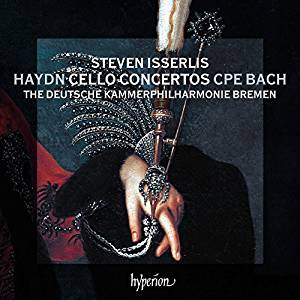
HAYDN: Cello Concertos 1 and 2; CPE BACH Cello Concerto in A major; BOCCHERINI Adagio; MOZART – Steven Isserlis, cello. Deutsche Kammerphilharmonie Bremen – Hyperion
Steven Isserlis = HAYDN Cello Concertos 1 and 2, Hob VIIb:1 and 2. CPE BACH Cello Concerto in A major Wq 172. MOZART “Geme la tortorella” from La finta giardiniera. BOCCHERINI Adagio from Cello Concerto G.480 – Steven Isserlis, cello. Deutsche Kammerphilharmonie Bremen – Hyperion CDA68162, 77:47 (9/1/17) *****: On an exceptionally well-filled disc, Isserlis makes his first recordings of the two Haydn concertos since 1996, when he did them for RCA with Roger Norrington conducting the Chamber Orchestra of Europe. This one features Isserlis himself at the head of the Deutsche Kammerphilharmonie Bremen, playing his supremely beautiful Marquis de Corberon “Nelsova” Stradivarius of 1726. Recorded in the orchestra’s hall, the soundstage, space and balance are ideal, just slightly ahead of the band, capturing Isserlis’s tawny cello sound, fingers occasionally slapping against the fingerboard with astonishing dimensionality. In addition to his relaxed, confident, commanding technique, which seeks musical solutions rather than what will be easiest or most flashy, Isserlis brings a deep knowledge of stylistic options—and buys into, in an entirely 21st century way, the implications and obligations of such knowledge. As it turns out, his performances of the two Haydn concertos also make a strong case for the equivalency […]

Bill Brovold and Jamie Saft – Serenity Knolls – RareNoise
Bill Brovold and Jamie Saft – Serenity Knolls [TrackList follows] – RareNoise RNR076, 76:28 [3/31/17] ****: Guitarists Bill Brovold and Jamie Saft expand their horizons. (Bill Brovold – electric guitar; Jamie Saft – Dobro, lap steel guitar) This instrumental duo project by guitarist Bill Brovold and multi-instrumentalist Jamie Saft is an unexpected venture. Anyone familiar with Brovold or Saft’s previous musical output may suppose the 76-minute, 12-track Serenity Knolls to have powerful, aggressive material. Saft is known for his keyboard contributions to hard-hitting artists such as Plymouth, Bobby Previte, Merzbow and others who are notable for brash music. Brovold was part of the NYC no-wave movement of the early ‘80s, collaborating with Rhys Chatham; Brovold also led the Detroit band Larval; and has many more credits. Both Saft and Brovold reside in the Hudson Valley area in upstate New York, became friends, and eventually decided to record together. The end result is this RareNoise release, which is an unanticipated excursion into Americana. Brovold is heard on electric guitar while Saft is on Dobro and lap steel guitar, and the most immediate impression is understatement: a nearly introspective, minimalist and folk-flecked flair. There’s more rural and pastoral, more acoustic blues and […]
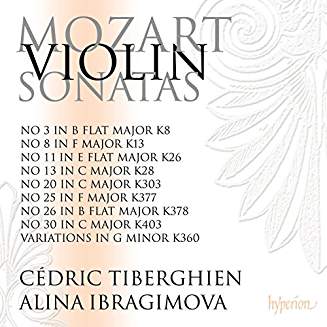
MOZART: Sonatas for Keyboard and Violin, Volume 4 – Alina Ibragimova (violin)/ Cédric Tiberghien (piano) – Hyperion
MOZART: Sonatas for Keyboard and Violin, Volume 4 – Alina Ibragimova (violin)/ Cédric Tiberghien (piano) – Hyperion CDA 68164 [2 CDs], 119:17 [Distr. by Harmonia mundi] *****: A tempting collection of an ongoing series. It’s a little strange that we received the video of Mozart’s String Quintets by Ibragimova and company, yet not one of her sonatas discs—of which this is volume four already. Better late than never, especially when the performances are so ingratiating. Mozart’s Violin Sonatas dotted his career starting at about age eight, when the pieces were solely conceived as piano works with optional violin part. By the time we get to the final sonatas much has changed, though one does get the distinct feeling that the composer never let go of the piano-predominates philosophy. Nevertheless, discernable democracy does indeed creep into this unique Mozartian genre, and it is really heartening to see that Ibragimova—and Hyperion—are willing to release a “complete” series on modern instruments. These sonatas do not appear that frequently on professional recitals anymore—time was, they did. But the more exciting Beethoven seem to usurp any efforts the back-seated composer came up with, with the exception of college and conservatory performances, and even used primarily […]
Streams and Podcasts for 2 September 2017
This week, The Music Treasury presents music performed by the Prazak Quartet. From (then) Czechoslovakia, this group grew out of the Prague conservatory in the 1970s. The show will feature two pieces by Dvorak, a Brahms quintet, and one of Beethoven’s Rasoumovsky quartets, No.1 in F Major. The show can be heard on Sunday, 3 September 2017, between 19:00 and 21:00, PDT. Dr. Lemco is the show’s host, it is presented as a radio show with streaming broadcast: kzsulive.stanford.edu On both Saturday and Sunday, Edmund Stone will share his observations and insights on some parts of the vast repertoire of film scores. It too is broadcast as a streamed radio show, from its host station in Portland: AllClassical.org. The show can be heard between 14:00 and 15:00 PDT. This Saturday, 2 September, Edmund Stone’s show is “Great Villains”, where he will explore the music associated with Darth Vader, Voldemort, Dracula, and others. Sunday will have an encore broadcast of last week’s show, “Spaced Out”, featuring “extra-terrestrial” film scores: Apollo 13, Star Wars…
Stereotypes Audio

Cembal d’amour

Pure Pleasure / Speakers Corner

Cedille


