by Audiophile Audition | Nov 24, 2018 | Component Reviews, Special Features
Memories of RMAF 2018 (Rocky Mountain Audio Festival)
Well, it’s been about a month since RMAF had concluded and most of the review sites have thoroughly whipped up and baked their cakes with every ingredient to put in the mixture of coverage. Best Sound, Best Room, Best Presenters, Best New Look, Best Groomed Designers, etc. Reviewers mention every component and nut and bolt in the display rooms. Good for the review sites/magazines to drum up advertising revenue for mentions. Hey, Audiophile Audition relies on advertising too; we just are not in the game of producing hundreds of pages of pabulum and eye candy in order to satisfy paying a huge staff of writers, along with the overhead of keeping a juggernaut of a mast head published in a magazine. Here at Aud Aud, you get a balanced diet of opinion and reporting.
This edition is called memories of RMAF, because as time goes by, the mind remembers experiences that are “memorable”. It’s like when you go into a HiFi shop and audition multitudes of gear, then go home and dream about the stand out performers. This is exactly what happed with my experience covering RMAF. I had set out to conquer every floor and room at the show, like drafting a Big Rig truck on the highway. Well, I have tons of photo’s and listening notes to describe every audio amoeba in the hotel! However, waiting for the long lasting memories, called for me to become patient and restrained, without regurgitating meaningless boilerplate descriptive terms from the audio dictionary and thesaurus.
So, I decided to follow my compass and remark on issues that I had put forth in my show preview and cover the three most memorable systems and/or components along with the three significant trends in the industry.
Mega System All Out

Von Schweikert Ultra 9 Loudspeaker VAC 450iQ Integrated Tube Amplifier
Wow! Just to think, twenty years ago Albert Von Schweikert and me, then with Spica Speakers shared the same cabinet builder, Ernie. Ernie skipped on us took the money and split to Mexico! Things have changed on a macro scale. Albert is now designer Emeritus with the company and they have birthed the Ultra 9 speaker, employing technology beyond the realm of earthly physics. Its $200,000.00 and not even their top of the line speaker!
Each channel of the ULTRA 9 loudspeaker system is physically time-aligned and consists of a 1,000-watt powered 15″ sealed subwoofer, twin 9″ reinforced ceramic mid-bass drivers, a 7″ reinforced ceramic midrange, a beryllium tweeter, and two 5″ aluminum ribbon super tweeters, one rear firing as part of the ambient retrieval system. The system range goes from: 16 Hz to 45KHz.

Von Schweikert Ultra 9 Integrated Tube Amplifier
Powering the Ultra 9’s was the VAC 450iQ integrated amplifier. I think this must be the most expensive integrated amp I’ve ever seen. It is a standing tower that can produce bountiful amounts of shade in your living room. VAC says the vertical alignment offers better logistical performance of circuit behavior. It uses a flock full of KT 88’s. I did not get the output power rating, but who cares when you hear music floating from a billowy soft cloud in your sound space. It’s priced at $150,000.00.
Notice the tubes are placed sideways on the chassis. Must be a challenge to re-tube the unit? There is also a sensor that indicates when you need to change the tubes. Why not install a sensor that tells you when you need to change your lifestyle too?
Sound impressions were immediate with the system. There were many other gizmos in the system, but you know these two components were the stars of the room. My wandering eyes went directly to them. The fit and finish of the speakers were like a Ferrari sports car. The system was in a large room with plenty of separation between the speakers. Sound was floating around in the room with no discernable point of reference, just as you would hear live music in a large venue. I was looking to see if there were, forgive me, surround speakers, on the sidewalls! The system was effortless in producing the illusion of live music being played. It only took a few minuets to get the full dose of audiophile elixir from that system. They truly were instruments of music reproduction and had ceased to be audio gear.
—Ric Mancuso

Audiophile Audition’s Review Crew…
by Audiophile Audition | Oct 6, 2018 | Component Reviews, Special Features
This upcoming weekend is the annual Rocky Mountain Audio Fest, being held in Denver, Colorado. This is quite the event to attend, with over 400 companies represented, covering the full spectrum of state of the art components.
Audiophile Audition is quite pleased to have one Ric Mancuso attend this event. Ric has been a long-time friend of the site; he enjoys writing—recreationally and professionally; he is quite the avid Audio Enthusiast. Ric is joining the staff of writers at AudAud, with his observations and insights to the ever moving world of audio hardware and system components. When the RMAF draws to a close, he will fill us in on the highlights, along with many of the details.
For more information about RMAF:

And for more info about Ric, please read his following letter of introduction!
Dot Dot Dot. . . (Yes, three dot journalism present)
Hey, who ‘Am I? It’s cool to be invited to contribute as a staff writer and special projects reporter for the Audiophile Audition web magazine. It’s a real honor to be on the roll call.
Ric Mancuso reporting on Ric Mancuso, new staff writer for the Audiophile Audition. Let’s treat me as if I were an audio component up for review.
I’m fairly transparent, and image well. My soundstage is excellent, having done radio shows over the years for large and small stations. My taste in music is an A+ and possess more than a competent knowledge of many genres of music. I’m a musician and know how instruments should sound. I have done special projects for a recording label and know the professional aspects of how it’s done and done well! Grammy Good!
Over the years I’ve worked in several capacities and with many associations in the Audio Industry, running the gamut, from cables, speakers, electronics and accessories. Also beating my chest for High End advocacy internationally. . .
My audio sensibilities tilt to the good to great value for the money audio components, even vintage gear. I love really good cheap eats and also appreciate the exceptional palate bomb $$$$ meal! Oh, and let’s follow it up with worthy wine pairings from $-$$$$. People always ask me, “Are you a good cook?” I say,” I just cook with good ingredients.” This is similar the way I view good audio systems. Look at NAD, for example, I have an original NAD 3020, and it is an amazingly great value, even in today’s market compared to way more $$$$ modern units. It’s like a Julia Child’s recipe for a French omelet. Can’t be beat and simply done.
First assignment: Rocky Mountain Audio Festival takes place in the Denver Tech-Center. October 5th through October 7th.
How Can I Miss You, When You Won’t Go Away?
Recall the song from Dan Hicks and his Hot Licks? Well, it’s been a few years since I have attended an audio show. My ears have rested and my audio pallet has been cleansed of past observances and judgment. Forgetting is renewal to some degree? It’s like returning to the golf course after a long layoff, you play better, because you have forgotten all your mistakes and bad habits! Then you start thinking and not being in the moment, oops, Fore!!
I do miss being away from my passionate and demanding partner. She is called High End Audio. I will be coming into the show with fresh eyes and ears submitting to becoming, vulnerable, impressionable, gullible and swayed by her good looks and charm, All the while, being human and channeling the late Harvey Gizmo Rosenberg. Harvey used to call me frequently, telling me about his modifications to the Spica Angelus he owned. I was running the company for a couple of years with John Bau under the Parasound flag. Harvey said he had run tension wires attached to the speakers to the ceiling rafters and down to the basement to isolate any room vibrations! Miss him greatly.
Looking at the show with new lenses and ears, I will be looking for trends and innovative technologies along with tried and true proven ones too. There is a seminar on the lineage of the LS3/5A speakers, with being able to hear various vintages of them! The rather new Falcon offerings from the UK, will be present to compare. Being a steadfast die hard with that design, I will be looking for Ken Kessler in the wings to chat about his experience. I think he owns two pairs already?
A must check out will be, The Blue Sound products. Familial ties to NAD and Lenbrook Americas in Canada. I will be investigating the RMAF show’s entry-level rock climb from low to mid price selections. Always must have an entry level good value system to show what the benchmarks can be at the strata’s.
I don’t have a drone to follow me around at the show; however, I do have really good radar to sense what sounds good from twenty paces.
Tune in for my RMAF show recap upon my return.
Good listening and Toe Tap!
—Ric Mancuso
by Audiophile Audition | Jan 18, 2018 | Special Features
After a glorious career in Audio of over half a century, John Sunier passed away in January of this year.
John’s incredible energy and drive found a distinctive expression in Audiophile Audition. Starting as a radio show in the 1980s, it transformed into a web site as the 21st century unfolded. Sunier was recognized far and wide as a definitive expert in all matters audio, all matters for audiophiles.
In the last year of his life, John stepped back from his beloved web site, assuming more of a Professor Emeritus role there. He was navigating the challenges of advancing years with the warmth and support of his friends; he was well cared for.
John Sunier is survived by his wife Donna, his cat Melinda, and the memories held by all those who knew him—his colleagues, his friends, and his following throughout the Internet. He will be deeply missed.

Audiophile Audition is creating a collection pictures and reflections honoring the life of John Sunier.
If you have something you would like to share, please write to editor@AudAud.com
Remembrances

by Audiophile Audition | Jul 25, 2026 | Classical CD Reviews
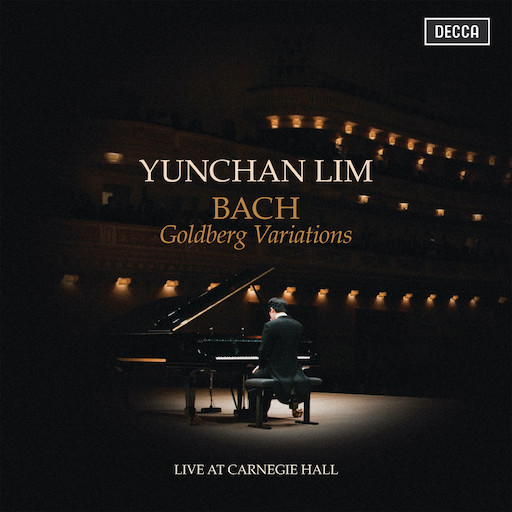
BACH: Goldberg Variations, BWV 988 – Yunchan Lim, piano – Decca 487 1515 (17/12/25) (77:22) [Distr. by Universal] *****:
Pianist Yunchan Lim presented J.S. Bach’s Goldberg Variations for his Carnegie Hall concert of 25 April 2025, a feat that, via recordings, has become synonymous with comparisons: Glenn Gould in 1956, and various interpreters of international stature, like Maria Tipo, Rosalyn Tureck, Jorg Demus, and Daniel Barenboim. Bach himself may have originally contemplated the 1742 piece “Aria and Diverse Variations” as a didactic vehicle – not merely as a “soporific” for Count Hermann Carl von Kaiserling of Dresden – but as the culmination to his Clavier-Übung, a comprehensive study-guide of keyboard practice at the time, a collection of klavier and organ works demanding virtually every technical and expressive skill in a performer’s repertory.
As a musical and arithmetic concept, the Goldberg Variations awe us in their “fearful symmetry,” to cite William Blake, given the progression of every third variant as a canon at a larger interval, and the recurrence of 16 and 32 as numbers for musical measures. All kinds of hyperbolic conceits abound to find transcendent praise for Bach’s achievement, but the “unity-in-variety” idea is not new, nor the integrity of the “Aria” itself, which remains “pure” at both ends of the musical odyssey. Commentators have pointed out the direct similarity of the sarabande “Aria” theme of 14 bars to Handel’s Chaconne and 62 Variations in their initial eight measures. What the individual interpreter must achieve lies in maintaining a seamless continuity while imparting unique character to the short – depending on a performer’s realization of repeats – episodes that constitute the entire necklace. Finally, despite the academic severity of the work, the player must permit a sense of gamesmanship and humorous delight in the astounding, aerial acrobatics of the filigree, whose humor asserts itself overtly in the quodlibet conclusion.
Lim establishes his approach from the outset, his piano tone confident in a modern, even romantic suasion of the “Aria,” with no attempt to make the piano sound like a harpsichord. Tempo and architecture early fused into a lyrical and yet bold evocation of Bach’s musical evolution. The contoured beauty of the “Aria” immediately calls forth the vehement first variation, in bold strokes. But Lim’s stunning legato, too, demands attention, as in Variation XXI, Canone alla Settima, a studied, gorgeous duet in liquid tones. The ensuing Alla breve dances with light feet and an exhilarated trill, while XXII indulges in quick, slickly galloping runs, the filigree indicative of some Brahms gambits in his Handel Variations.
Lim’s execution, both bravura and arioso, reveal themselves as early as Variation V, though for expressive tension and sustained lyricism, we await the epic Variation XXV, whose slow tempo and affective, legato inwardness elicit a special poetry. Barenboim lingers here for over 10 minutes, while Lim’s delicate tracery and dramatically restrained anguish extend for 8.5 minutes. Landowska called this variant her Black Pearl, and the piece requires its own sense of intimate depth. Lim’s fermata lasts forever, until the swirling motions of Variation XXVI catch us in a feverish eddy of pulsating, ornamental filigree. The Canone alla Nona quite dances with polyphonic deftness, its momentum aided by some wicked trills into the festooned antics of Variation XXVIII, without Lim’s succumbing to the temptation of pesante chords in the left hand. Variation XXX serves as an elaborate fanfare, and Lim does not hold back his trumpets and urgent cascades.
Lim’s Quodlibet, a bit marcato to my taste, sounds out two popular songs, a timely moment before the timeless “Aria” reasserts its placid hegemony. There have been many moments of note, as in the strong continuity from Variation V to Variation VII, and the exquisite Andante Variation XV, whose immediate contrast to the startlingly liberated leaps of Variation XIV could hardly be greater, for Canone alla Quinta presents solemn depths that might have inspired Franz Liszt.
In sum, Lim’s account of the Goldberg Variations contains both highly sensitive and breathtaking elements, the work wrought in well considered periods of evolution, with wide lacunae as the Bach experience gains girth and a voluptuous sense of structure. If Lim lacks Glenn Gould’s impetuosity and iconoclastic bravura, he brings an exquisite sense of articulation to the whole. Recording producer David Frost and his technical team deserve honorable mention for their fine document, to be accorded distinction among the annals of fine Bach playing.
—Gary Lemco
Also available on Vinyl

Amazon
by Audiophile Audition | Jul 21, 2026 | Classical CD Reviews
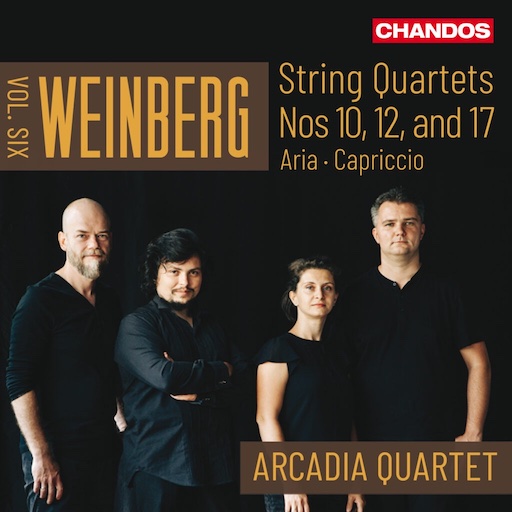
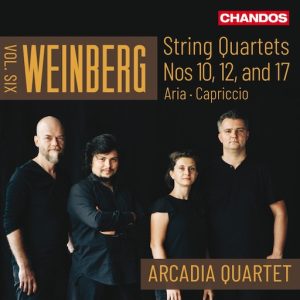
WEINBERG: String Quartet No. 10 in A Minor, Op. 85; String Quartet No. 12, Op. 103; String Quartet No. 17 in D Major, OP. 146; Aria in D Minor, Op. 9; Capriccio in A-flat Major, Op .11 – Arcadia Quartet – CHANDOS CHAN 20363 (85:15) [Distr. by Naxos] *****:
This Volume 6 (rec. 3-5 April 2025) by the Arcadia Quartet, dedicated to the complete quartet oeuvre of Mieczyslaw Weinberg (1919-1996), completes the cycle, especially welcome given the Arcadia Quartet’s ethos, to shed light on Weinberg’s legacy, “this wide-ranging, profound phenomenon, which has been overlooked for so long.” Often, the music of Weinberg must submit to analyses of the political situations that influenced and often constrained his work. Of equal note, Weinberg’s friendship – and creative competition – with his great contemporary, Dmitri Shostakovich, invites comparisons and contrasts. But Weinberg forged a path of musical distinction independent of direct imitation; and rather Weinberg exploited his nationalist Polish, Jewish, and Slavonic roots to master his idiosyncratic means of expression.
Arcadia opens with Weinberg’s String Quartet No. 10 in A Minor (1964), music dedicated to his future second wife, Olga Rakhalskaya. In four movements, the structure follows the old Baroque pattern of slow-fast-slow-fast format that Shostakovich likewise employed in his own Tenth Quartet. Weinberg’s music moves seamlessly through the four movements, drawing upon the long-line, chromatic impulses of his first movement, Adagio, for expressive possibilities. The moody procession while remaining fixed in A minor tonality, exudes a nervous, haunted melancholy.
From amidst a murmuring, eerie sonority a dance-like Allegro second movement emerges, conflicted, rather tussling between the parts. A buzzing in the first violin competes with pizzicatos and high register tessitura, while the cello toys with a plaintive lament. The writing becomes more virtuosic in character, but the mood remains elusive, a frustrated, resentful dance lyric. Violin and cello share the honors of the striking Adagio, the melody set over dissonant, raucous harmonies that suggest a strident call to ams. The anguish of the moment belongs to the first violin; but at a held D-flat pedal point, the music mutes to a somber echo of the former pain that fades away.
With the cello’s move to the enharmonic C#, the music of the last movement, Allegretto – Adagio, assumes a mincing, hesitant motion, eerie as in movement one, but initiating an ungainly waltz rhythm. The music devolves into segments of melody over a drone-like bass in waltz time, lyrical in spite of itself. A pizzicato sequence counters the modal harmonies and open chords, especially in the viola. Some high harmonics enter the moody tapestry, all the while the drone has extended, moving into a nervous, final space.
Weinberg’s String Quartet No. 12 (1969-1970) is dedicated to a Shostakovich pupil, Veniamin Basner and follows Shostakovich’s own model Twelfth String Quartet. No less influential, Bartok’s Third Quartet serves as an expressive icon. The knotty first movement, Largo, presents a concertante first violin part of extreme expressive range, occasionally eruptive in an otherwise sustained, somber atmosphere. At moments, the syncopated evolution of the music becomes static, with its energy drawn from the intervallic interweaving of instruments using12 notes of the chromatic scale without resorting to pure serialism.
The second movement Allegretto – Largo, proceeds like an experiment after the spirit of Bartok, pairing instrumental colors and brief melodic kernels and nervous rhythmic pulses. High whistles against pizzicato chords, glissandos, col legno, sudden interjections, and moody pedal points – until the solo cello in upper register asserts an arioso of an anguished kind to a quiet coda. A violent Presto ensures: A robustly intense march, it takes the Bartok gambit of separating and then combining the instrumental voices, often in vivid, motor rhythms. The dissonances take an ungainly, circuitous route to resolve themselves, indulging in quiet, intimate moments of modal harmony. Weinberg seems to parody Bartok’s notion of “night music.” The music becomes even more vigorous and intense, confronting harsh pizzicatos against an anguished first violin part that screeches the music to a sudden halt.
Annotator David Fanning calls the last, expansive movement Moderato “the strangest movement of all.” Metrically complex and texturally complex, including a contrapuntal section, having moved from 5/4 to 7/8, a blend of canon and double fugue. Melancholy in tone, the effect – for want of a better term – feels Kafka-esque in its sustained, almost mewling, angst. We feel kinships both with Bartok and Shostakovich, though the repetition of a chord repeated 32 times may call us back to the quick second movement of Beethoven’s Op. 135 F Major Quartet. The duets between first violin and cello, the persistent staccatos, collectively feel like calls from some personal abyss.
Weinberg’s String Quartet No. 17 (1986) returns to a defined tonal center, D major. This brief, relatively optimistic score has the Borodin String Quartet for its dedicatee, in honor of the ensemble’s 40th anniversary. Though performed attacca, the quartet has four defined sections. The aggressive, opening Allegro-Adagio tune bears an echo of the String Quartet Op. 11 of Samuel Barber. The music moves quicky to the dominant A major for a chorale tune, a busy enterprise for the four players. The cello enjoys a virtuoso cadenza, which functions as a transition to movement two, Andantino – Adagio.
A duet between violin and viola, after individual solos, segue into the Lento section. David Fanning claims the arioso theme bears resemblance to a “birthday aria” from Weinberg’s operatic treatment of Dostoievsky’s The Idiot. The notion of “original innocence” and its concomitant dangers (as in Melville’s Billy Budd) may account for whatever “confessional” aspects attach to this last of Weinberg’s quartets. Once more, the cello part proves most communicative, even as the violin offers an agitated, contrapuntal foil. The final movement, Allegro, whose relationship to movement one seems clear, but the allusions to previous motifs from other movements confound the process with rather stunning virtuosity, much in the manner of Bartok. The presto coda sings and stings our attention, suddenly harmonized into a resolute, tonal conclusion.
Two 1942 short works by Weinberg complement the later quartets: the Aria in D Minor
may owe debts to Borodin, though commentator Fanning cites Fauré. This work appeared simultaneously with Weinberg’s Symphony No. 1, Op. 10 (another Shostakovich “coincidence”). The piece enjoys a throbbing lyricism for all of its exactly four minutes. Timed at almost 86 minutes. I wondered if the final track, Weinberg’s 1942 Capriccio in A-flat Major, would play on my CD equipment. It did not.
—Gary Lemco

.
.
by Audiophile Audition | Jul 19, 2026 | Jazz CD Reviews
A musical stew, well mixed…
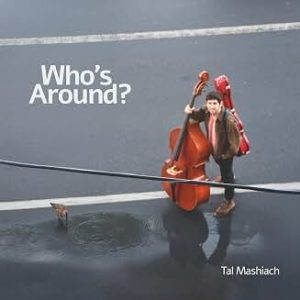
Tal Mashiach – Who’s Around – Anzic Records #ANZ-0095-02 – CD – 38:40 – ****1/2
(Tal Mashiach – guitars, bass, percussion; Ofri Nehemya – drums; Gadi Lehavi – piano, organ, keyboards; Panagiotis Andreou – bass, vocals (#5); Anat Cohen – clarinet (#2, #5); Maya Belsitzman – cello; Itamar Borochov – trumpet (#3); Konstantinos Revelas – bouzouki (#4, #5); Vagelis Karipis – percussion; Victor Pablo – percussion; Yonathan Peled – trombone (#6, #9); Itai Kriss – flute (#6. #9); Khondzi – saxophone, vocals (#7); Elibo Imerlishvili – doli (#7); Benjamin Furman – piano (#8); Gabriel Chakarji – piano, keyboards (#9); Dana Herz – vocals (#9.#10) )
Who’s Around? is an apt title for Israeli guitarist/bassist, Tal Mashiach’s second release for Anzic Records. The sixteen musicians on his CD are a true United Nations melting pot. They hail from all over the world, including Europe, South America, Puerto Rico, and the republic of Georgia. In step with this diverse aggregation, Tal has come up with ten tracks that cover multiple musical genres, including Brazilian samba, Spanish flamenco influences, classical motifs, and swinging jazz. It’s all here, and those with “open ears” will find lots to like.
There is Tal’s deft guitar, and the bonus of virtuoso clarinetist, Anat Cohen, (Tal is a member of her touring band, Quartetinho), on the opener, “Titu.”
Anat returns on “Creta,” which is a whirlwind, with Greek vocals from Panagiotis Andreou, and bouzouki by Konstantinos Revelas.
“Pinto” is a fully fleshed out arrangement with trombone, flute, piano, and percussion, that swings hard and is heavily jazz influenced. “Ajaruli” features Khondzi on sax, and Georgian vocals, driven hard by the doli (Georgian drum) of Elibo Imerlishvili.
My favorite track might be “Lama Ken, Lama Lo,” (Hebrew for “Why Yes, Why No”). Its combo of trombone, flute, a bit of acid electric guitar, and keyboards and organ, is intriguing with many mood changes, from Brazilian samba to a funky ending. The CD ends with cello, guitar, and wordless vocals from Tal’s wife, Dana Herz, on “Duo.”.
Tal Mashiach has lots of talented friends from all corners of the world, now taking a bite out of The Big Apple. You get to meet them here, as they bring to life Tal’s creative vision, on Who’s Around? It’s a journey well worth taking…
—Review by Jeff Krow
Tal Mashiach – Who’s Around
Tracklist:
Intro Titu
Titu
Paco
Intro Creta
Creta
Pinto
Ajaruli
Baiao Mediterraneo
Lam Ken Lama Lo
Duo
by Audiophile Audition | Jul 15, 2026 | Pop/Rock/World CD Reviews, SACD & Other Hi-Res Reviews
Interscope-Capitol Records releases a dazzling vinyl upgrade of a landmark Marvin Gaye album.
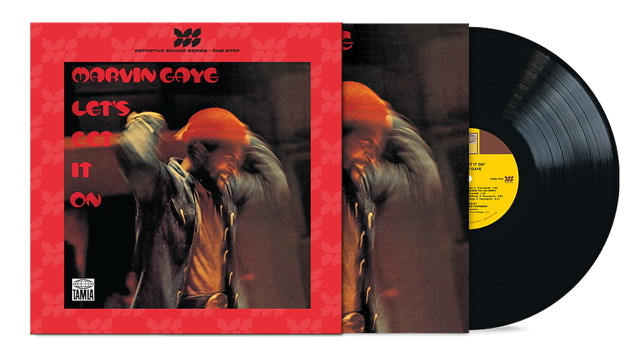
Marvin Gaye – Let’s Get It On – Interscope-Capitol Records [7/17/2026] Definitive Sound Series DSS 11: One Step 180-gram stereo numbered vinyl, 31:37 *****:
(Marvin Gaye – piano, vocals; complete artist listing below)
Motown Records was renowned for the mass commercial appeal of its meticulously produced r & b music. Groups like Smoky Robinson & The Miracles, The Temptations, The Supremes, Gladys Knight & The Pips, Stevie Wonder, Marvin Gaye, Mary Wells and The Jackson 5, to name a few became part of the cultural landscape. Founder Berry Gordy Jr. maintained strict control over every aspect of his artists. But as civil unrest and The Vietnam War raged on, Marvin Gaye changed the Motown dynamic. His 1971 album, What’s Goin’ On electrified the counterculture with anthems like “Inner City Blues”, “Mercy Mercy Me” and the magnetic title cut. Taking advantage of this newly found creative freedom, other acts on the label (most notably Stevie Wonder) began to assume artistic control.
As the latest entry in the Definitive Sound Series, Interscope-Capitol Records has released a 180-gram numbered pressing of the 1973 Marvin Gaye album, Let’s Get It On. This marked a third foray (What’s Goin’ On, Trouble Man soundtrack) into risqué material for the singer. Lush instrumentation, high-profiled guest musicians and tracking vocals created a tapestry of sound that articulated the visceral sensuality and spiritual undertones of this project. It featured all original compositions.. Side A opens with the sultry title track (a huge single) which begins with a saucy wah-wah guitar (Don Peake). Gaye’s masterful seductive vocals (lead and backup) are both soulful and aspirational. His articulation and harmonious inflection are framed by strings, flute, saxophone and hypnotic pulse. It is an earthy gospel sermon. His falsetto, vocalese and sultry delivery infuse “Please Don’t Stay (Once You Go Away)”. Gaye’s command of tender yearning and pleading are a natural fit for 70’s era soul on “If I Should Die Tonight”. This is a complex arrangement with the singer providing lead and counterpoint. He reprises the basic elements of the title cut (“Keep Gettin’ It On”) and it is equally captivating.
While this is a departure from the Motown formula, Gaye remained one of the label’s most enduring performers. “Come Get To This” adopts the tightly constructed funk parameters of his label. It is accessible and upbeat. With slow-burning intensity, “Distant Lover” is sumptuous with emotive late 50’s early 60’s vocals, and different instrumental accents (trumpet, vibraphone). All of the music on Let’s Get It On is layered and atmospheric. “You Sure Love to Ball” has a swaying gritty ambiance amid a direct context. In a change of pace, the finale (”Just To Keep You Satisfied”) explores melancholic loss in a ballad interpretation. Gaye’s plaintive vocals (including talking) are deeply moving.
This numbered audiophile vinyl of Let’s Get It On is another exceptional release in Interscope-Capitol’s Definitive Sound Series. The re-mastered sound (Chris Bellman/Bernie Grundman Mastering) captures Gaye’s silken voice, centered with nuanced clarity, Also, instrumental separation is superior. It was cut from the original analog master tapes. Additional details (bass lines, percussion instruments, backup vocals, strings) are expansive, but never overwhelm Gaye. The One-Step processing (Neotech VR900-D2 High-definition 180-gram vinyl: Dorin Sauerbier/Record Technology, Inc.) provides an intimate quieter soundscape with reduced surface noise. Superior packaging includes a custom slipcase, heavyweight tip-on gatefold and a certificate of authenticity detailing the technical details of the re-mastered album.
Highest recommendation!
—Robbie Gerson
Marvin Gaye – Let’s Get It On
TrackList:
Side A: Let’s Get It On; Please Don’t Stay (Once You Go Away); If I Should Die Tonight; Keep Gettin’ It Own
Side B: Come Get To This; Distant Lover; You Sure Love To Ball; Just To Keep You Satisfied.
Performing Artists:
Marvin Gaye – piano, vocals;
Orchestral arrangements: David Van De Pitte;Gene Page; René Hall; David Blumberg;
Bass – James Jameson; Wilton Felder;
Drums, Bongos, Percussion – Bobbye Hall Porter; Eddie “Bongo” Brown; Paul Humphrey\; Uriel Jones
Guitar – David T. Walker; Eddie Willis; Louis Shelton; Melvin Ragin; Robert White; Don Peake;
Vibraphone, Mallet Percussion – Victor Feldman; Emil Richards;
Saxophone – Ernie Watts – saxophone; Plas Jphnson – saxophone;
Piano – Joe Sample – piano; Marvin Jenkins – piano;

by Audiophile Audition | Jul 15, 2026 | CD+DVD, Classical CD Reviews
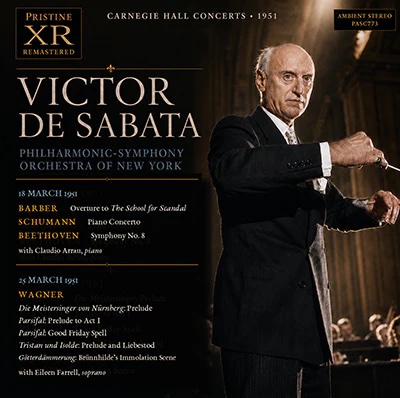
Victor de Sabata = BARBER: Overture to the School for Scandal; SCHUMANN: Piano Concerto; BEETHOVEN: Symphony No. 8; WAGNER: Excerpts from Die Meistersinger; Parsifal; Tristan und Isolde; Götterdammerung – New York Philharmonic – Pristine Audio PASC 773 (2 CDs = 2:26:35, contents detailed below) [www.pristineclassical.com] ***** :
I came to know the art of famed opera conductor Victor de Sabata (1891-1967) originally through recordings from Nuovo Era, Angel Records, Music&Arts, and various pirate companies based in Italy. The performances of the Schumann Piano Concerto with Arrau and the Brahms Violin Concerto with Milstein, both from New York City, stood out dramatically. A more personal, though once-removed, experience occurred in Atlanta, Georgia, when guest conductor Aldo Ceccato visited the Atlanta Symphony. Aware that Ceccato had married de Sabata’s daughter Eliana in 1966, I brought with me a copy of RCA Victor LP LM 1057, the transfers of Respighi’s The Fountains of Rome and Debussy’s Jeux. When Mme. Ceccato saw my offering for her autograph, she exclaimed, “That was my father’s favorite recoding! How did you know?”
Pristine Audio offers two concerts of the New York Philharmonic as led by de Sabata 18 and 25 March 1951, a time when the orchestra, led by the extraordinary Dimitri Mitropoulos, could no less boast of eminent musicians who regularly appeared at the helm: Bruno Walter, Guido Cantelli, and Leopold Stokowski. Sabata opens with Samuel Barber’s 1933 Overture, The School for Scandal, a conservative, sonata-form responsive to the spirit of Sheridan’s 1777 comedy of manners. The woodwind, two-note chirps soon erupts into a pandemonium assuaged by a tender oboe melody of marvelous appeal soon expanded by the strings. De Sabata keeps the motion active and pointed, the shifting colors and rhythmic thrusts acerbically intoned. Happily, the persuasive second melody reappears before the intense, fanfare coda, a kind of musical swashbuckler assertively sounding out the two-note motif.
Chilean piano virtuoso Claudio Arrau (1903-1991) joins de Sabata for the Schumann 1841-45 Piano Concerto: when I mentioned this amazing performance to Arrau in conversation, Arrau’s peremptory response was, “It was a long time ago.” The romantic Schumann work manages to “conform” to a “classical” model by simply repeating each melodic or scalar phrase in movement one twice. Arrau and Philharmonic oboe execute some fine duet sequences as the melodies gain fervor and monumentality. Sabata manages to make the repeat of any arched phrase more intense than its initial statement, a quality that makes the last movement Allegro vivace a thrilling revelation. Arrau’s potent (German) technique possesses a fine capacity for poetic expression, and the first movement balances bravura with nostalgic sentiment. The first movement cadenza, which de Sabata ushers in with some force, exudes charismatic contemplation, a potent trill, and contrapuntal finesse.
The second movement, Andantino grazioso in F major, offers a sustained, erotic intimacy, especially after movement one, derived from notes an agrammatical arranged from “Chiarina” (Clara Schumann) from the piano suite Carnaval. With requisite schwung, the attacca last movement launches into the A major Allegro vivace with resolve tempered by Schumann’s penchant for syncopated polyphony. The march tune parades through 6/4 and 3/2 with no discernible loss of transition; in fact, the momentum ever increases like some magnificent, singing pendulum. The swelling pulse and emotional ardor of the interpretation quite engulfs the New York audience – who having subdued their enthusiasm at the coda of movement one – now have become liberated to express their aroused appreciation.
After intermission, Jim Fassett then announces de Sabata once more as the visiting director from La Scala in Milan, now to lead Beethoven’s 1812 Eighth Symphony. De Sabata reminds us of the inventive charms of this work, which remained the composer’s favorite. The playful wisdom, here compressed into classical structure, allows De Sabata to indulge in the frantic collision of rhythmic and harmonic forces that glide by so glibly. The colossal, joyful brio of the piece consistently assaults our “classical” complacencies of structure and dramatic expectation. Sabata no less communicates in movement one a sense of divine mystery, as the sonata-form process must succumb to Beethoven’s atomic energy. The second movement’s parody of the metronome enjoys an athletically robust realization that well transcends any “courtly” function, as will the ensuing Tempo di menuetto. The music here assumes a ceremonial dignity and pomp that rather reminds us of Handel, whose music would soon influence the Overture to the Consecration of the House. The last movement, Allegro vivace, certainly frolics, but it also explodes with a passion worthy of its symphonic predecessor, the Seventh, Op 92.
Nothing “polite” in this reading; rather, a galloping, vehement reminder of the power potential in each, often “quirky,” kernel of musical tissue in Beethoven’s inventive imagination. The audience gets the point.
De Sabata’s concert of 25 March (Easter Sunday) involves all-Wagner, in which soprano Eileen Farrell (1920-2002) joins De Sabata for the “Immolation Scene” from the last of The Ring operas. De Sabata begins with the well-familiar Prelude to Act I of Die Meistersinger, Wagner’s most “German” opera, concerning the various guilds that laid claim to cultural pre-eminence. A swift, linear, driven tempo marks the occasion, processional and invested with ceremonial, contrapuntal splendor. The Philharmonic’s brass sings out with especial urgency and brilliance.
I venture that De Sabata’s measured reading of the Parsifal excerpts competes, interpretationally, with those of Wilhelm Furtwaengler. The sense of metaphysical significance permeates the occasion, in which the silences prove as stirring as the periods of elevated cadences. The famed “Dresden Amen” floats in a suspended sea of devotion, followed by the trumpet annunciation of The Grail motif. The quality of brass sound resembles a Gabrieli motet from the Renaissance. The ensuing hush of the strings tugs at the heart, the music all gradations of tonal color. De Sabata maintains a taut melodic line, singularly flexible even as the arch broadens into ardent rapture. If the idea of “epiphany” applies, a la James Joyce, to this music, De Sabata realizes it.
The orchestral compression of the opera’s Act III, the “Good Friday Spell,” comes to us from the composer himself. Though the musical context implies a spiritual stasis, De Sabata invests a lyrical drama into the extended meditation, drawing impressive, nuanced, harmonic color from the modulations in the string line and the transition to the woodwinds. The silences once more reveal as much mystery as they delay. The overcoming of Amfortas’ reticence to reveal the Grail invokes a new and permanent state of grace, irradiated by De Sabata’s responsive players.
Eileen Farrell built a reputation for an extraordinary vocal volume, great range, a short temper, and a foul mouth. Certain conductors – Mitropoulos for one – could restrain the unmusical elements in her nature. As for great performances of Wagner’s Liebestod from Tristan, I had the good fortune to audition, first, the Birgit Nilsson recording on Decca with Hans Knappertsbusch and the Vienna Philharmonic, a realization as voluptuous as it was absolutely convincing. For the Prelude, Act I, Knappertsbusch elicited the most compelling cello I had heard in Wagner. The Prelude, naturally, generates its own ineluctable, often sweeping, tension, avoiding its C major tonality through unresolved cadences until the last act coda. De Sabata’s judicious silences imbue the musical line with a dire sense of lingering tragedy, at once melancholy and heroic. This reading convinces us of Nietzsche’s claim that, upon discovering Tristan, he became a Wagnerian. Farrell’s voice conveys a total intoxication of amor, insisting that Isolde’s dead lover yet lives, his eyes a shining halo of light. De Sabata’s grip on the unfolding, erotic musical line refuses to relent until the ecstasies of death-in-life culminate spectacularly.
The “Immolation Scene” concludes The Ring cycle, with Brunnhilde’s elongated farewell to the dead Siegfried, a victim of Wotan and the gods’ treachery, who having stolen the Rheingold from Alberich then assign a mortal to atone and redeem the gods, a reversal of the Christian spiritual logic. Brunnhilde’s own ashes from her funeral pyre will cleanse the taint of betrayal and permit her to reunite with Siegfried in death. The martial sensibility that permeates the scene has its foil in the great longing of the yearning fr a clean death. Farrell communicates tenderness as well as righteousness in her address, telling Wotan’s ravens to convey the message that Valhalla can no longer justify its existence. The Magic Fire recalls Siegfried’s quest along the Rhine, and the collision of elements arouses a metaphysical tenderness for fallen ideals. De Sabata, once described as part Julius Caesar, part Satan, revels in the tumultuous ecstasy of catastrophe-become-redemption. The sense of existential resolve saturates every measure, and we witness the lamentable Fate that leaves none exempt.
Kudos to Pristine and their XR restoration process for having returned to us two colossal musical events. We await more of the same from the De Sabata sessions in New York City.
–Gary Lemco
Victor de Sabata Conducts:
BARBER:
Overture to the School for Scandal, Op. 5;
SCHUMANN:
1Piano Concerto in A Minor, Op. 54;
BEETHOVEN:
Symphony No. 8 in F Major, Op. 93;
WAGNER:
Die Meistersinger: Prelude, Act I;
Parsifal: Prelude Act I;
Good Friday Spell;
Tristan und Isolde: Prelude and Liebestod;
2Götterdammerung: Brunnhilde’s Immolation –
New York Philharmonic
1Claudio Arrau, piano/
2Eileen Farrell, soprano/
by Audiophile Audition | Jul 13, 2026 | Classical CD Reviews
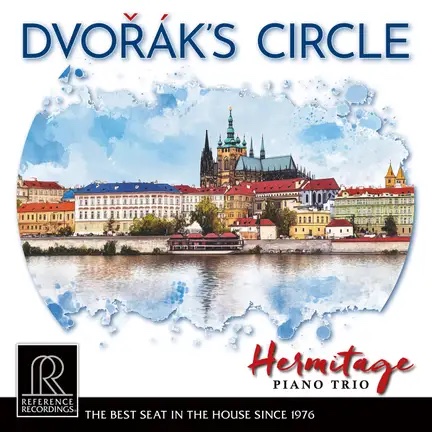
DVOŘÁK’S CIRCLE = DVOŘÁK: Piano Trio No. 3 in F Minor, Op. 65; SUK: Elegy in D-flat Major, Op. 23; Piano Trio in C Minor, Op. 2; FRIML: Piano Trio “Rural Life in Bohemia,” Op. 36 – Hermitage Piano Trio – Reference Recordings RR-1535ACD (72:28) (7/3/26) [www.ReferenceRecordings.com] ****:
The stated intent of this album (rec. 15-18 April 2023) realizes the “intersection” of Antonin Dvořák (1841-1904) and two of his gifted pupils, Josef Suk (1874-1935) and Rudolf Friml (1879-1972). The selected compositions demonstrate the “creativity, connectivity, and diversity” of their individual styles in the chamber music genre, utilizing Dvořák’s F Minor Piano Trio (1883) as the expressive fulcrum around which the composers generate their Romantic sensibility. The members of the Hermitage Piano Trio – Misha Keylin, violin; Sergey Antonov, cello; and Ilya Kazantsev, piano – agreed that “the majestic and powerful” Op. 65 of Dvořák remains “one of the most monumental works in all forms of chamber music.”
Several commentators mention the death of Dvořák’s mother in December 1882 as a possible source for the dire tone of the F Minor Trio, cast in much of the same dramatic terms as his Seventh Symphony, Op. 70. Another debt may well lie in the Brahms Piano F Minor Quintet (1864), a darkly passionate composition with strong ties Franz Schubert, whom Dvořák no less admired. Hermitage Trio addresses the opening movement, Allegro ma no troppo, with immediate, even grim, vivacity, sustaining an unrelieved tension. It soon becomes apparent that the scale of the sonata-form movement exceeds the appellation “chamber music” and assumes a “symphonic” proportion. The few moments of repose evaporate quickly in a storm of tragic impulses, some martial, others nostalgic.
Marked Allegretto grazioso, the second movement (in C# minor) assumes the character of an offbeat peasant dance. A kind of obsession with triplets dominates the strings, resembling a scherzo motif in mixed agogics, while the piano alternates note values to insert the requisite angst. The major mode of the Trio section allows a sense of temporary relief, in an arching melody of rare beauty. Hermitage invests an acerbic but appealing energy into this emotionally ambiguous movement.
The cello then announces the lyric appeal of the music’s “heart,” the third movement, Poco Adagio in A-flat major, which may well serve as a lament for Dvořák’s departed mother, much as the slow movement in the Brahms Horn Trio intimates a similar pathos. Keylin’s violin proves ardently expressive here, while the cello underlines the depth of emotion. Brief moments of imitation move the melodic progress forward without any sense of “academic” procedure. The duet of violin and piano for the coda invites the cello to dream of lovelier times.
Dvorak’s natural gravitation to folk idiom of the Bohemian furiant dominates the last movement, Finale – Allegro con brio, a dance noted for its explosive alternations of mood and tempo. Dvořák maintains the minor mode for his viscerally driving finale in descending octaves, which suddenly sways into a nostalgic waltz that soon gains a new gravitas as it segues to the da capo reprise. Again, moments of canonic imitation urge the music forward with a sense of voluptuous determination.
With the arrival of the main theme from movement one Dvorak yields to the temptation of cyclic form. A temporary concession to the major mode does not alleviate the vivid momentum of this dramatically constructed music, whose coda sums up each of the inspired energies prior, that sense of “so you see, my children” that no less informs his magnificent tone poems.
At the Prague Conservatory where he was enrolled, Josef Suk studied composition with Dvorak and became a favorite pupil, even marrying Dvorak’s daughter Otylka in 1898. Though the Elegy (Adagio) celebrates the happy event of the birth of a son, its literary source lies in the epic poem Vyšehrad by Julius Zeyer (1841–1901), a sentimental portrait of the same fortress celebrated musically by Smetana to open the cycle Ma Vlast. Besides the obvious influence of Dvorak’s style (and that of Brahms) on Suk’s compositions before the 1905 Asrael Symphony, a touch of (Gothic) morbidity colors his work.
Originally scored for violin, cello, string quartet, harmonium and harp, the Elegy assumed its trio form by Suk’s own hand. The adagio suddenly breaks off, ceding to a most ardent evocation of languor before returning to its nocturnally melodic beginning. The violin-cello duets prove thoroughly beguiling, over a soft ostinato from the keyboard. Another surge of emotion – including a brief piano solo – ensues, before each of the instruments enters to collaborate in a swaying, tearful farewell.
While Rudolf Friml’s American reputation rests on Broadway compositions, operettas, and popular songs, his classical output includes some 100 opera of piano music, a one-movement piano concerto, and his one-movement Piano Trio in C Major (1918). The music plays like a Czech pastiche of Bohemian melodic impulses, varying from nostalgic waltzes to operatic allusions to gypsy flourishes. The violin part often mimics his teacher Dvorak and countryman Smetana, while the keyboard alludes to Chopin and Liszt. The cello enjoys a lovely cantilena section that bursts forth in joyous collaboration of the three instruments in a rising crescendo. A pizzicato sonority introduces a frivolous, gypsy finale, a swirling, round dance that breaks off for a sentimental moment before resuming its course to a flippant, bravura coda.
Josef Suk’s Op. 2 Piano Trio (1889) derives from his studies at the Prague Conservatory, originally in four movements for its 1891 premiere. His teacher at the time, Karel Stecker, recommended that Suk show the score to Dvorak, whose composition class Suk joined by invitation. At Dvorak’s suggestion, Suk eliminated the brief scherzo and tightened the structure to its present form.
A powerful series of chords from piano and strings opens Suk’s Allegro, reminding us why Dvorak’s work provides the rubric for this album. The cello introduces the second theme, slow and melancholy, sharing lyrically competing registers. A tripping figure emerges, suddenly becoming ardent over ostinatos and arpeggios from pianist Kazantsev. The urgent, repetitive sequences suggest that the music of Brahms was well known to Josef Suk, as it had been to Dvorak. The second movement, Andante, owes debts to Bohemia’s folk tradition, basking in a nocturnal form of folk dance, almost a tango rhythm. The secondary theme proves equally romantic, and one may find melodic intimations of Grieg even as the “tango” persists.
Two impulses mark the finale, Vivace, a syncopated dance and a march. The writing for all three instruments dwells on the bravura level, with sudden incursions into more melodious riffs despite the bouncy motor element. In its dark er turns, the dotted tune resembles a parody of Beethoven’s “fate” motif, here become a modal Slavonic dance. A pedal point has the instruments sail into the stratosphere and then down amongst us mortals, when a raucous chord alerts us that the coda appears imminent.
Besides some fine ensemble playing, this album features excellent commentary from Marina A. Ledin and Victor Ledin within an attractive and colorful booklet, handsomely produced.
—Gary Lemco
Amazon
by Audiophile Audition | Jul 10, 2026 | Jazz CD Reviews, SACD & Other Hi-Res Reviews
Funk fusion at its best…
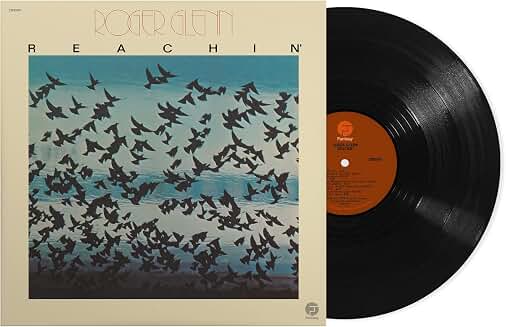
Roger Glenn – Reachin’ – Craft Recordings/Fantasy # CR0070 – 180 gm audiophile vinyl – 1976 – 38:04 – ****
(Roger Glenn – flute, alto & bass flute, vibes; Mark Soskin – Fender Rhodes electric piano, acoustic piano, clavinet, Mini-Moog, ARP String Ensemble; Larry Mizell – Fender Rhodes electric piano, ARP String Ensemble; Ray Obiedo – electric and acoustic guitar; Paul Jackson – electric bass; Gaylord Birch – drums; Bill Summers – congas, bata, percussion; Babu Duru – bata; Moodi Peters – bata; Eric Young – shekere; Butch Haynes – shekere; Pete Escovedo – lead vocals on “Rezo Chango”)
Funk fusion fans have reason for excitement. Craft Recordings, thru their Top Shelf Series of Jazz Dispensary, are re-issuing the debut album, Reachin’, from 1976, of jazz flutist, Roger Glenn. Using lacquers cut from the original master tapes from 1976, on 180 gm vinyl, with remastering by Kevin Gray (at Cohearant Audio) and pressed at Fidelity Record Pressing, the musical stew is on the front burner.
Roger Glenn was virtually a one-man band, as he played flute, sax, clarinet, and vibes. He is the son of the iconic, Tyree Glenn, who played trombone and vibes with Duke Ellington, and Louis Armstrong. Roger only made two albums as a leader, (this album from 1976, and the more current, My Latin Heart), but is known for working with numerous bands, including sideman gigs with Donald Byrd.
What makes this LP special is the involvement of Larry and Fonce Mizell, as producers. The Mizell Brothers are famous for creating a fusion groove for both Motown, and later Blue Note Records. They were part of “The Corporation” production team that helped put out numerous hits, including The Jackson 5’s “I Want You Back.” They were also integral in incorporating percussion instruments like the batu, and shekere, as well as bringing the Moog synthesizer into vogue.
On Reachin’, their influence is strong as the eight tracks bristle with a heady mix of electronics, and percussion backing Roger Glenn’s soaring flutes, and shimmering vibes.
The title cut sets the stage with Glenn’s flute, blending with the synthesizer. “Don’t Leave,” is beyond sensual, and could be used as a soundtrack for an “adult” movie. Sideman, bassist, Paul Jackson, is featured on “E.B.F.S.” while drummer, Gaylord Birch, and guitarist, Ray Obiedo, kick “Overtime” into high gear. Pianist, Mark Soskin, helps make the dreamy ballad, “Gloria,” stand out in a different straight ahead way, minus fusion effects. The closer, “Rezo Chango,” with Spanish lyrics, and lead vocals from Pete Escovedo, is a nice change of pace.
All eight tracks give appreciation for the multi-instrumental talents of Roger Glenn, who is still active in the San Francisco Bay Area, at age 80. Reachin’ is a great place to hear Mr. Glenn, back in the day, in full funk fusion remastered glory.
—Review by Jeff Krow
Roger Glenn – Reachin
Tracklist:
Side One: Reachin’, Rio, Don’t Leave, E.B.F.S,
Side Two: Overtime, Kick, Gloria, Rezo Chango

by Audiophile Audition | Jul 9, 2026 | Classical CD Reviews, Classical Reissue Reviews
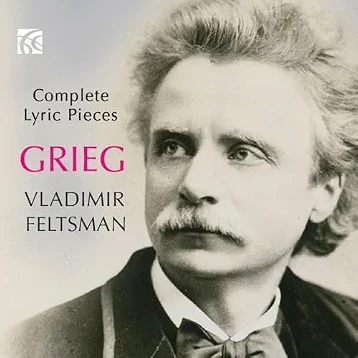
GRIEG: Complete Lyric Pieces: Opp 12, 38, 43, 47, 54, 62, 65, 68, 71 – Vladimir Feltsman, piano – Nimbus NI 6467 (3 CDs = 3 hrs 26 min, detailed listing below) (8/7/26) [www.wyastone.co.uk] *****:
Pianist Vladmir Feltman (b. 1952) recorded the complete sets of Edvard Grieg’s characteristic miniatures, his Lyric Pieces (1867-1901) in sessions at Wyastone Leys 27-29 March 2023. Norwegian composer Edvard Grieg (1847-1903) had assumed the mantle of Robert Schumann in these 60 short pieces, mostly conceived in ternary form that remains homophonic in syntax but decidedly faithful to the folk and dance impulses of his native land. Romantically expressive, artful and melodious at once, these relatively brief pieces present a surface charm undergirded by rigorous harmonic and structural acumen. Taken as a cycle in 10 books, we find that the three-voiced Arietta, Op. 12/1 recurs in parody as Efterklang, Op. 71/7, the Alpha and Omega of his musical journey.
Prior to this release, two pianists – kindred spirits, really – Artur Rubinstein (on RCA LM 1872) and Emil Gilels (on DGG 2530 476) recorded selected examples from the various books of pieces, each rendering the works with suave affection, perhaps even with Romantic affectation. The compendium created by Grieg has no inherent, narrative unity, as such: the miniatures stand as mood pieces and spontaneous utterances of Norway’s meadows and forests, of imaginative legends, of emotional musings, or of the folk-dance tradition ingrained for the composer by Ole Bull (1810-1880) and Rikard Nordraak (1843-1866).
A set like this allows any number of approaches beyond the chronological: The Op. 12 set of miniatures sets the tone for the entire project, from the pert Vals and the more literary Watchman’s Song, the spirit of the Nordic dance rushes in, on both a realistic and preternatural level, while the No. 5 Folkevise could be construed as a Chopin mazurka. The concluding piece, “National Song,” has Feltsman in a more stentorian mode, Maestoso, the last chords of which linger for some time.
The seductively rocking Berceuse which opens the Op. 38 (1884) set of eight pieces seduces us in high registers and soft arpeggios, the melodic line simplicity itself. Folk melodies and a playful Halling ensue, endemic Norwegian impulses, inflected judiciously. Feltsman evinces tonal beauty as a key asset for these gems. The Elegie projects an intimacy that rival music – especially their lieder – by Schumann and Brahms for its immediate effect. Another Vals appears, a bit virtuosic as well as melodious, it might reflect the influence of Tchaikovsky. The lengthy Kanon reveals more debts to Schumann than to Bach, concealing its learned points in the falling intervals of poignant emotion. The middle section sings of Norway proudly.
The set of six pieces of Op. 43 (1888) contain some of Grieg’s most quoted miniatures: I recall a Walter Gieseking 78 rpm of Little Bird and To the Spring. Both Rubinstein and Gilels immortalized Butterfly and the more chromatic Erotik. The light touch required for these concise miracles aligns them with Mendelssohn’s various. Songs without Words. “In My Homeland” may recall Bedrich Smetana as a possible source, but its artful parlando style bears Grieg’s own imprint. Butterfly and Little Bird nod to Schumann’s pictorial scalar passages. To Spring literally ripples with life-giving energy, a throbbing heartbeat that deepens as the passion of living becomes an enchanted paean worthy of Liszt.
Book 4, Op. 47 (1888) offers several masterpieces: the opening Valse-Impromptu challenges angular, rhythmic accuracy and subito legato, all the while altering tempo and accents. Feltsman’s sensitive trill makes a singular impression. Albumblatt, the longest of the set, proceeds in the modal formula well established in his native Norway, which at times prefigures improvisatory jazz elements. Melodie proves eminently vocal, the tune close to Borodin of the Second String Quartet. The drone-saturated Halling ripples with jabbing, folk excitement. A lovely Largo, entitled Melankoli, appears to be static, a piece by Satie, but it accumulates a lyrical breadth and concentration quite beguiling. By contrast, Springdans cuts an ungainly caper brusquely athletic. The concluding Elegie possesses the liquid, intimate nostalgia in passing dissonances that haunts our imagination long after the final cadence.
Grieg’s 1891 Book 5 has become better known in its orchestral guise (with the help of conductor Anton Seidl), the Lyric Suite, Op. 54. Feltsman imbues The Shepherd Boy with an expressive yearning, perhaps for the pleasures of Nature to remain untouched. The ensuing Peasants’ March enjoys a chime-like sonority, quite capable of a percussive, obsessive resolve. The March of the Trolls became the last of the set in the orchestral version, and here it insists on a clarion, staccato sensibility in the outer sections, while the middle part offers a wistful, diaphanous intimacy. The dream-scape Notturno bask in a refined aether not far from the Debussy sensibility, although the scalar progression hints at Schumann. Grieg’s virtuosic Scherzo: Prestissimo leggiero demands a series of contrasted touches, of which the ballade-like middle section, a beautifully harmonized parlando, has its own folk character. The final section, Bell-Ringing, had been meant to conclude the orchestral version, but Grieg chose otherwise. Once again, shades of Debussy (his Sunken Cathedral) invade our sound recollection, as the carillon advances in a martial but gently lyrical Andante.
The most significant piece from the Op. 57 Book 6 (1893) may be Gade, a tribute to the Danish composer (1817-1890) who instigated the so-called “Golden Age” in Denmark. After the extensive opening piece, Vanished Days, with its ballade-like, sectionalized structure and chorale impulses, the Gade, Allegro grazioso, presents a brightly affectionate “domestic” portrait, much in the narrative, duet-style of Schumann. The modally ambiguous Illusion may owe something to Schumann’s Prophet Bird, but without the skittishness. Secret lingers, Andante espressivo, in hesitant progressions, but we still wonder if any revelation occurred. Do we hear echoes of Grieg’s song, “Ich liebe dich?” If so, the secret is out. “She Dances” offers a sturdy, syncopated waltz, ardent and intimate, at once. The coda flitters away, gracefully. “Homesickness,” a consistent trope in Grieg, concludes the set, a moody key Andante whose middle, carillon section might recall an intimate family fest.
I well recall hearing Walter Gieseking play “French Serenade” (No. 3) from the Op. 62 Book 7 (1895), a delicate, slightly mercurial miniature, Andantino. Feltsman injects wistfulness amidst its figures. The opening piece Sylfide finds another allusion to impulses in Schumann, nervously settling into its main motive, fond of non-harmonic notes. “Thanks” takes some time to express its parlando gratitude, given the middle section’s graduated, repeated crescendo before the ritornello main theme. “The Brook” surely owes debts to Schubert, though these nervously bravura waters, Allegro leggiero, could run a menacing course through Liszt. The waters flow more serenely legato in “Phantom,” a liquid impression, if not of Ondine, then some more genial spirit. An extended trill casts the sense of evanescence forward. “Homeward” proffers a confidently assertive march, the middle section anther of Grieg’s hymnal tunes, gently yet urgently nostalgic.
I threw chronology temporarily aside for Book 8, Op. 65 (1897), given my predilection for No. 6, the ubiquitous “Wedding Day at Troldhaugen,” a broad, celebratory anniversary piece (the Griegs’ 25th) for wife Nina and for their home, “The Hill of the Trolls.” Like many of Grieg’s Lyric Pieces, subdominant harmonies and plagal cadences will feature in the stunning sound progressions; here, an infectiously buoyant waltz in C major. Feltsman applies a light hand though maintaining a firm grip on the rising of the ardent melodic line. We hear his sensitive application of Grieg’s idiomatic syntax in the first piece, “From Days of Youth.” There, the influence of Norwegian folk melody and indigenous harmonic syntax suffuses what seems a meandering recollection. The simple parlando of Bondens Sang (“Peasant’s Song”) bridges the gap between folk song and chorale. Several Grieg scholars note the similarities in “Sadness” and the “Folk Melody,” Op. 38/2, with their reliance of the subdominant coloring and the use of plagal cadences. Another waltz lyric, Salon (Allegretto con grazia) plays in an impressionistic, broken style, not far from Ravel. I Balladetone is marked Lento lugubre, and its somber progression lies somewhere between Brahms and Tchaikovsky.
Suddenly, Grieg’s music approaches the 20th century, but he holds the “advances” of Wagner, Schoenberg, and Scriabin at a conservative distance. Book 9 begins with “Sailors’ Song,” a hefty chorus, as it were, with a touch of Handel. “Grandmother’s Minuet,” on the other hand, enjoys an antique daintiness. “At Your Feet” suggests romantic homage, and its luxuriant, nocturnal harmonic language approaches progressions both in Fauré and Anton Rubinstein. “Evening in the Mountains” adds a touch of mystery, built from tiny, melodic kernels and ostinato rhythm, perhaps indebted to the likes of Liszt and Mussorgsky, a dark shepherd’s melody. “Cradle Song” appears on many interpreters’ music stands, since its simple lyricism invades the heart. Feltsman’s touch in the high register warrants the price of admission. Valse mélancolique nods to Chopin and Schumann both, a salon piece unafraid to allow the bass part is sonorous due.
Book 10, Op. 71 (1901) will, at the last piece, “Remembrances,” recall, in openly nostalgic terms, the Op. 12/1 Arietta in waltz tempo. But prior we have six pieces whose entrance to the 20th century call upon us: “Once Upon a Time” speaks to the fairy tale element of our lives, Andante con moto. Feltsman does not over sentimentalize its easy, parlando and clarion lyricism. “Summer Evening” is no less an effective orchestral piece by Delius, a Thomas Beecham staple. Grieg’s lyric casts a plaintive glow, tranquilly urgent. “Little Troll” might have served as an affectionate appreciation of wife Nina, though its spunky, staccato 16ths carry their own, folk motion. “Woodland Peace” could look to Schumann or to America’s MacDowell for kinship, but its elegantly extensive modal harmonies, Lento, belong singularly to Grieg. A last Halling, the echt Norwegian dance, makes a lively, even clangorous, appearance, hopping and skipping in unbuttoned pleasure. Altering the festive mood, Grieg submits Forbi (“Gone”), Op. 71/6, marked Andante doloroso, to intimate the juxtaposition of Life and Death. The passing, briefly contrapuntal, dissonances remain in the realm of Liszt and Mussorgsky.
As a complement to the collection of Lyric Pieces, Feltsman includes (in Disc 2) Grieg’s 1878 four Albumblatter, Op. 28. Identified only by their tempo markings (Allegro con moto – Allegretto espressivo – Vivace – Andantino serioso – Allegro giocoso), each offers a laconic mood, thoughtful or energetic, pieces pianist Feltsman characterizes as “charming and elegant.”
I venture that the entire project intends to be a tribute to Feltsman’s beloved teacher, E.M. Timakin, who bequeathed the world of Edvard Grieg to all of his piano students.
—Gary Lemco
GRIEG: Complete Lyric Pieces – Vladimir Feltsman, Piano
8 Lyric Pieces, Op. 12;
8 Lyric Pieces, Op. 38;
6 Lyric Pieces, Op. 43;
7 Lyric Pieces, Op. 47;
6 Lyric Pieces, Op. 54;
7 Lyric Pieces, Op. 62;
4 Albumblatter, Op. 28;
6 Lyric Pieces, Op. 65;
6 Lyric Pieces, Op. 68;
7 Lyric Pieces, Op. 71;
by Audiophile Audition | Jul 8, 2026 | Pop/Rock/World CD Reviews, SACD & Other Hi-Res Reviews
A bluegrass supergroup geta a vinyl upgrade.
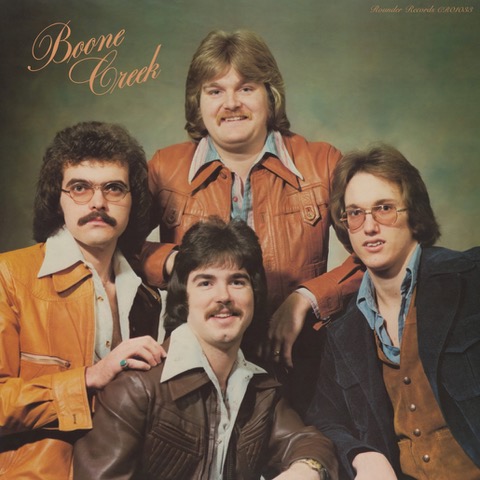
Boone Creek – Boone Creek: Hightone Series – Rounder Records 0081 (1977)/Craft Recordings CR01033 [6/26/2026], stereo vinyl, 44:30 ****1/2:
(Ricky Skaggs – lead vocals, mandolin, fiddle guitar; Jerry Douglas – Dobro, vocals; Wes Golding – lead vocals, guitars; Terry Baucom – banjo, fiddle, vocals)
When Boone Creek formed in 1976, the band was considered one of the first bluegrass supergroups. Headed by the 23-year old prodigy Ricky Skaggs (guitar, mandolin, fiddle), he was joined by Jerry Douglas (Dobro), Wes Golding (guitar), Terry Baucom (banjo) and a few bass players. While the group was only together for two albums, the progressive approach to traditional music included some electric instrumentation, harmonic vocals and virtuosic play.
Craft Recordings has released an updated vinyl of Boone Creek’s debut album. This is quintessential bluegrass with a modern approach. Side A opens with a spirited original composition, “Dixieland”. Terry Baucom’s banjo sets a ferocious pace and Skaggs and Douglas match the intensity and the harmony vocals are impressive. Bill Monroe’s plaintive “Dark As The Night Blue As The Day” captures old school charm with Baucom on fiddle and Douglas shines on dobro. Skaggs’ crystalline tenor and mandolin infuse the traditional “Walking In Jerusalem” with Sunday morning gospel. The three-part harmony is compelling. Perhaps inspired by the great Lester Flatt, “I’m Gonna Settle Down” has percolating solos by Douglas as Golding and Skaggs trade off lead vocals. Things slow down for another traditional number, “Drifting Too Far From The Shore” that exudes warmth and faith despite a cautionary message. “White House Blues” (another Monroe classic) is an unbridled two-minute celebration. The genesis of the band’s moniker is explored on the title cut with Golding singing lead.
A certain highlight is the instrumental tour-de-force (“Intro”) with guitar, banjo, dobro and mandolin all festively articulating the feel of this group. This band feels connected to the emerging 70’s country rock era on songs like “Satisfy My Mind” with beautiful harmonies.When Boone Creek cut loose on “There Ain’t Nobody Gonna Miss Me”, they are standard bearers for modern bluegrass, There is also a connection to modern contexts on “Hitchhiking To California” with aspirational delivery and subtle tempo changes intermingled in the furious instrumentation. “Georgia Sunrise” has a Southern rock style and some electric guitar enhancement. The finale (“Dream Song”) expands the aural landscape with electric piano, sax, trumpet and flute adding texture to the overall template. This is indicative of the trend-bucking nature of the band.
The re-mastered vinyl of Boone Creek is vibrant. All of the interwoven vocal harmonies are captured with precision and are centered in the mix. There is excellent stereo separation on the instruments.
Highly recommended!
—Robbie Gerson
Boone Creek
TrackList:
Side One:
Dixieland;
Dark As The Night Blue As The Day;
Walkin’ In Jerusalem;
I’m Gonna Settle Down;
Drifting Too Far From The Shore;
White House Blues;
Boone Creek;
The Memory Of Your Smile
Side Two:
Intro;
Satisfy My Mind;
Sugar Daddy;
There Ain’t Nobody Gonna Miss Me;
Hitchhiking To California;
Misty Wind;
Georgia Sunrise;
Dream Song.
by Audiophile Audition | Jul 6, 2026 | Classical CD Reviews, Classical Reissue Reviews
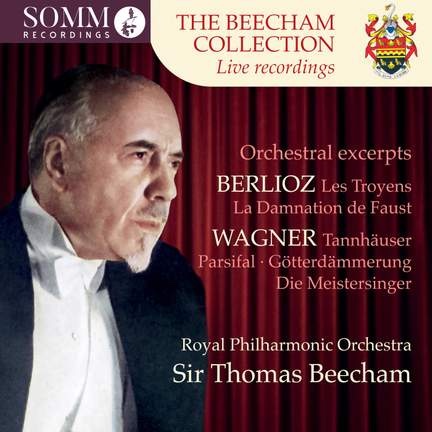
BEECHAM COLLECTION 35 = Orchestral Excerpts from Wagner and Berlioz – Royal Philharmonic Orchestra/ Oxford Bach Choir/ Sir Thomas Beecham – SOMM Recordings (6/19/26) (72:32, complete contents detailed below) [Distr. by Naxos] *****:
Audio restoration engineer and producer Lani Spahr has once more delved into the Sir Thomas Beecham concert archives to unearth excerpts from two distinct appearances at Royal Festival Hall, 7 May 1955 (Berlioz) and 17 December 1958 (Wagner). Along with Sir Hamilton Harty and (later) Sir Colin Davis, Beecham proved a most ardent acolyte of the music of Hector Berlioz. Beginning in 1899, Beecham included many of the French iconoclast’s orchestral and choral works in his repertory, which include recordings both commercial and privately produced of various overtures, oratorios, the Symphonie fantasqique, Harold in Italie, Te Deum, Requiem, Les Troyens, L’Enfance du Christ, and La Damnation de Faust. A muscular, infectious enthusiasm pervades all of Beecham’s Berlioz interpretations, and so having these additions merely confirms our expectations.
Beecham begins with the Prelude to Les Troyens that Berlioz crafted to open Part II of his lengthy narrative, those embracing Acts III-V. Ceremonial and menacing at once, the music serves as a dirge for the fates of Dido and Aeneas. The RPO brass carries the main theme over timpani tremolos that assume a cumulative, chorale-like effect. The Royal Hunt and Storm from Act IV bears a pastoral, idyllic sensibility, as trilled, violin and soft wind bird songs accompany the appearance of water nymphs. Already, intimations of an approaching storm that will drive Dido and Aeneas into a sheltering cave, where they consummate their passion and seal their fates. A potent trombone urges the storm’s progress. Beecham includes the chorus of nymphs and fauns, a decisive element of wild abandon. While Beecham in his 1957 recording had the inimitable Dennis Brain for his horn solos, Alan Civil now takes the French horn part. The storm and “love music” subside, permitting the nymphs and a bucolic serenity to return, and a last horn call heralds the end of the scene.
The popular Hungarian March from Le Damnation de Faust, a dramatic curiosity given its place in the oratorio, enjoys a hearty buoyance, the kind of Beecham “lollipop” that never fails to capture the flamboyant effects in Berlioz with grand aplomb. The coda achieves a momentous, layered surge of colossal energy, quickly greeted by a storm of applause.
To my mind, Britain claims two immensely devoted and successful Wagner conductors: Albert Coates and Sir Thomas Beecham. Beecham had been converted into the Wagner cult in 1899, after his own pilgrimage to Bayreuth. In 1909, Beecham led The Flying Dutchman as his debut Wagner opera. A 1937 rendition of Tristan at Covent Garden elicited from critic Alan Blyth the epithet “zestful conviction” to describe Beecham’s contribution.
Such robust enthusiasm defines the concert of 17 December 1958, opening with a dependable staple, Overture and Venusberg Music from Tannhäuser, Act III, in which the broad arch of the Pilgrim’s Chorus finds an elastically lush exposition, the cadences rich in luxurious color. The RPO trumpets account themselves in clarion transparency, the underlying strings and tympani equally assertive. The move from ardent spirituality to earthbound indulgence occurs seamlessly, the rich chromaticism of the moment colored by selected woodwinds and strings. A Herculean chorale breaks forth, fraught with muscular assertion. The frenzy increases over cymbals and strained strings, a series of rising scalar passages that suggest a cyclonic and obsessive, carnal eddy. As is well documented, Wagner contrived – and loathed – the Venusberg Music for the 1861 Paris production, which demanded an extended ballet sequence. The women’s chorus and harp soften the effect, as if to console the perturbed composer.
The tension between the sacred and profane human impulses finds resolution in Wagner’s final opera Parsifal (1882), freely based on the romance by Wolfram von Eschenbach. The Good Friday Music appears in Act III, in which the leitmotifs of love and death play out against the time of the Crucifixion and the legacy of The Grail. Built on brief but flowing motifs, the music conveys the passion of springtime and paradoxical rebirth amidst the travails of Kundry and a recalcitrant Amfortas, who has refused to reveal the Grail for Communion. Parsifal’s spear becomes the vehicle for redemption and spiritual succession, as the gleaming white chalice signifies. Though Beecham never realized Parsifal in the theater, his performance bears the grip of long experience.
From the opening, orchestral rendering of the emergent dawn duet “Zu neuen Thaten, Theurer Helde,” the tones of Siegfried’s Rhine Journey signal the heroic quest for the finale of Wagner Ring Cycle. Beecham delivers the quick, monumental sweep of the scene, literally catapulting into the frenzy of the occasion. Both dramatic and picturesque, the rendition delivers brilliant wind and brass punctuations, once more urged by horn player Alan Civil. The lively counterpoints enjoy a ardent heft and resolve, the sense of mortality mixed in with the noble heroism, as the “Rheingold!” motif reminds us of the dire source for the entire enterprise. The thunderous coda invokes an unbuttoned applause.
Sir Thomas concludes with Wagner’s Prelude, Act I from Die Meistersinger (1861), a fine example of the composer’s diatonic style that communicates polyphonic exuberance, especially for the redeeming virtues of song. Clarity of line and athleticism of expression mark the performance, etched in bold, vocal C major strokes by Beecham, who basks in the colored sonorities of his RPO. Essentially a comic opera, Die Meistersinger enjoys one of the composer’s better librettos, though the pedantic nature of the text also wanders into blatant, antisemitic “Germanic” dogma. Politics aside, Beecham and his disciplined forces execute a polished, dramatic, and fervently aroused reading, bound for much repetition on auditors’ sound systems.
Kudos to SOMM for this, another gemlike addition for the sustained tribute to the Beecham legacy.
—Gary Lemco
BEECHAM COLLECTION 35
BERLIOZ:
Les Troyens: Prelude;
1Royal Hunt and Storm;
Hungarian March from La Damnation de Faust;
WAGNER:
Tannhäuser: Overture and Venusberg Music;
Parsifal: Good Friday Music;
Götterdämmerung: Siegfried’s Rhine Journey;
Die Meistersinger von Nürnberg: Prelude, Act I
Royal Philharmonic Orchestra
1Oxford Bach Choir