by Audiophile Audition | Feb 1, 2026 | Pop/Rock/World CD Reviews, SACD & Other Hi-Res Reviews
This is a stunning vinyl upgrade of an influential rock album.
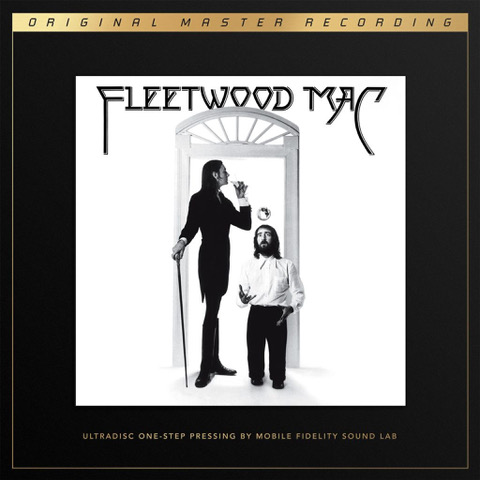
Fleetwood Mac – Fleetwood Mac – Reprise Records (1975)/Mobile Fidelity Sound Lab UDIS 2-065 (2026) Limited Edition One-Step Pressing 180-gram 45 RPM 2-LP Box Set, *****:
(Mick Fleetwood – drums, percussion; John McVie – bass; Christine McVie – keyboards, synthesizer, vocals; Lindsay Buckingham – guitar, vocals; Stevie Nicks – vocals; Waddy Wachtel – rhythm guitar)
Fleetwood Mac was a fixture on the late 60’s and early 70’s British blues scene. Two John Mayall sidemen (Mick Fleetwood and John McVie) with fellow Bluesbreaker Peter Green founded the band. They became a notable recording and live act with minor hits like “Oh Well”, “Black Magic Women” and “The Green Manalishi” After Green’s departure, they began to veer into the mainstream with the addition of Bob Welch and had another single, “Hypnotized” that charted. This transition also saw the emergence of keyboardist/singer Christine McVie as a songwriter with more accessibility. But in late 1974, a seismic change happened to this band. Lindsay Buckingham and Stevie Nicks joined Fleetwood Mac. Now there was a new trio of songwriters/lead singers and the musical dynamics reverberated, propelling them to stardom. In 1975, the self-titled 10th album was released. Singles like “Over My Head”, “Rhiannon”, “Warm Ways” and “Say You Love Me” enjoyed mass commercial appeal. Meticulous studio production helped to define the new Fleetwood Mac. The next album, Rumours transformed the band into a cultural juggernaut.
Mobile Fidelity Sound Lab has released a limited edition re-mastered 45 RPM 2-LP box set of Fleetwood Mac. Side A opens with a Buckingham tune, “Monday Morning”. This song adopts a jaunty pop/rock structure. Buckingham, Fleetwood and John McVie form a cohesive unit and it showcases a slide electric guitar solo. Next up is “Warm Ways”. This arrangement is mellow and features lead vocals by Christine McVie. Her glowing alto voice is surrounded by an ocean breeze tapestry of keyboard and guitar (electric and acoustic). Buckingham re-ignites the band on the lone cover “Blue Letter”. It is a country-tinged rocker with a driving beat and impeccable vocal harmony. Perhaps the breakthrough number on this album is Stevie Nick’s ode to a Welsh witch, “Rhiannon”. Her gritty delivery combines sensuality and raw emotion. Buckingham delivers an incendiary guitar solo and the band interacts seamlessly with John McVie’s forceful bass work. The songwriting is simply excellent. “Over My Head” unfolds gradually and establishes a palpable groove behind McVie’s smoky vocals. There is an understated refinement to the hook-driven music with a great chorus and interesting tempos by Fleetwood. A Stevie Nicks composition (“Crystal”) that appeared on the 1974 Buckingham Nicks album re-emerges with a gentler waltz-time cadence. These two artists harmonize lyrically and the accompanying acoustic guitar and keyboards create a spacious aural landscape.
“Say You Love Me” manages to be a feel-good romantic opus that integrates many elements of modern Fleetwood Mac. The song is catchy with soaring harmonies, overdubbed guitars, painstaking instrumentation and studio aesthetics. Christine McVie’s lead vocals are pleasant and alluring. A certain highlight is the Nicks-penned “Landslide”. Her earnest haunting vocal interpretation pairs with Buckingham’s nimble acoustic finger-picking (with some electric accents) in a scaled-down duet that is timeless. Picking up the pace, “World Turning” represents the multi-faceted complexity of Fleetwood Mac. Co-written by Buckingham and Christine McVie, they share lead vocals as the vaunted bass-drums unit never relents. Buckingham alternates between electric guitar and dobro. Out of the shadows from previous albums, Christine McVie’s “Sugar Daddy” is her 5th songwriting credit and exudes some humor. The raw, explosive finale (“I’m So Afraid”) has Buckingham cutting loose with searing lead guitar and animated vocals.
This limited edition 2-LP 45 RPM box is an impressive sonic achievement. The re-mastered sound (sourced from 1/4”/30IPS Dolby A analog master) is crisp and vibrant. There is considerable detail in the instrumentation tonality, especially the acoustic and electric guitar. Lush tracked vocals are captured with depth. Bottom-end bass and drums is steady and there is minimal surface noise.
Highest recommendation!
—Robbie Gerson
Fleetwood Mac
TrackList:
Side A: Monday Morning; Warm Ways; Blue Letter
Side B: Rhiannon; Over My Head; Crystal
Side C: Say You Love Me; Landslide
Side D: World Turning; Sugar Daddy; I’m So Afraid.

by Audiophile Audition | Feb 1, 2026 | Classical CD Reviews
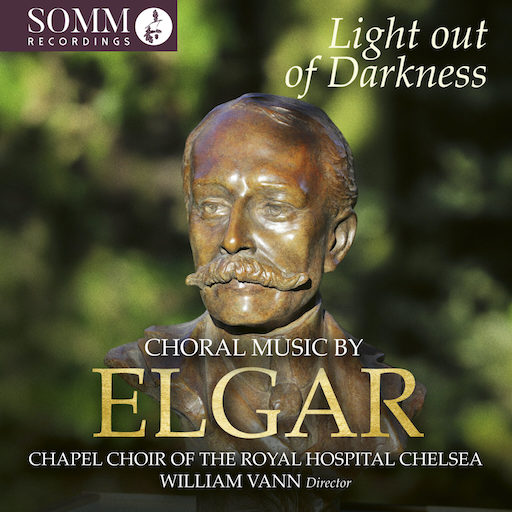
Light out of Darkness: CHORAL MUSIC by ELGAr – Chapel Choir of the Royal Hosptial Chelsea/ Callum Knox, organ / William Vann Director – SOMMCD 0714 (77:29, Complete contents detailed below) (1/16/26) [Distr. by Naxos] ****:
This collection of selected vocal works (rec. 16-18 February 2025) by Sir Edward Elgar (1857-1934) reveals the degree of religious piety expressed by the autodidact composer, who studied Catel’s Treatise on Harmony and refined his organ playing for church music in both Worcester’s Anglican Cathedral and with the choir of St George’s Roman Catholic Church, to which Edward Elgar found appointment as organist, 1885-1889. These self-styled “universities” ingrained in Elgar a lasting ecumenical sensibility which, when combined with the repertory he absorbed from 1877 violin lessons with Adolph Pollitzer in London – with its invasion of Italian and German operatic productions – created a composite, eclectic range of musical alternatives in the young composer.
A significant, organ-based dissonance announces the opening selection, the Chorus “Light out of darkness,” from the cantata (or oratorio, as Elgar preferred) The Light of Life, signifying the divine Mercy wrought by the Crucifixion, herein offered as “remedy” for human frailty. Later on the disc, we have the chorus “Light of the World, we know Thy praise.” The Word has gained ascendancy in all matters of the spirit. Elgar invokes huge, soothing harmonies to invoke that Light that “shines unto the Perfect Day.”
The Apostles (1903), despite its standing as his most expansive composition, Elgar meant to be much larger, but only his 1906 supplement, The Kingdom, came to fruition. “The Prologue” (chorus) claiming “The spirit of the Lord is upon me,” accumulates by degrees a massive dynamic to assert a Gospel of rebirth girded by plangent organ harmonies. The contrast between soprano/alto and tenor/bass antiphons proves effective. Psalm 51 (in a world premiere recording) proffers an extended confession of weakness and sin, a plaint for forgiveness for a life conceived in Calvinist terms, praying for ultimate absolution. The assumption here is that King David regrets his lust for Bathsheba and his destruction of Uriah. The antique atmosphere Elgar creates, an agonized monody, seems a modern setting of a Gregorian chant.
“Praise ye the Lord” could grace any Sunday service, regardless of denomination. Set three strophes of eight lines, the music follows a direct course, intoning a pantheistic reconciliation of all in Nature. Great is the Lord (1910-1912), the longest of the compositions collected, substantially addresses Psalm 48, in order to celebrate the 250th anniversary of the Royal Society. The massive 6-part choir intones motifs one may recall the finale from the Violin Concerto. While beginning D major, the piece modulates to a jarring F# minor, then A-flat major (andante) before the return to the home key.
Elgar insisted the anthem for baritone and SATB chorus be “gigantic,” proclaiming God’s glory even unto the towers and bulwarks of the earth.
The Four Part Songs, Op. 53 date from 1907-1908, composed during a sojourn to Rome. Dedicated to Elgar’s American friend Julia Worthington, the second of the songs, taken from Lord Byron’s The Corsair may hint resonantly at emotional depths beyond the literary. “Deep in my soul” opens in E-flat but soon proclaims a kind of bitonality with A major and then E major. Ms. Worthingtom may claim the identity of “the soul” alluded to in the Violin Concerto. “O Wild West Wind” energetically celebrates the ode by John Keats, a declaration the poetic power to embrace (Nobilemente) the opposite ends of creation, at once. Elgar intends that this music be performed “with the greatest animation but without hurry.” Two Choral Songs (1914) take their texts from the poems of Apollon Nikolayevich Maykov (1821-1897), “Love’s Tempest” and “Serenade.” The first poem allies Nature’s fury with an awakened passion, starting softly then erupting Allegro con fuoco. “Serenade” employs a repeated refrain, “Dreams all too brief, Dreams without grief, Once they are broken, come not again.” The emphasis on unrequited dreams in nervous harmony has echoes in Mahler though the technique may recall Elgar’s familiarity with the part-song style in Brahms.
Go Song of Mine (1909) ranks as Elgar’s finest part-song, based on a text by Cavalcanti (c. 1255-1300) in a translation by Dante Gabriel Rossetti (1828-1882). Its existential theme bespeaks the grim spirit of the times, moving in modes of B, fitting for the original context “A Dispute with Death.” This music may serve as the equivalent of a pungent scene from director Igmar Bergman. Of the eight remaining entries, The recording of Elgar’s setting of the Stabat Mater is another of the premieres on the disc. Scholarly speculation posits that the setting of the hymn by Pergolesi (1736) may have supplied the “enigma” for his most famous orchestral work. The austere Ecce sacerdos magnus (Behold the Great Priest) enjoys the organ’s lush accompaniment as the upper range of voices exalts his heavenly mission.
The mighty organ sets off Elgar’s arrangement of God Save the King (1902), arranged at the invitation of the publisher Novello. A soprano invokes the lines of the first verse, soon joined in unison, and the whole bears a true Handelian majesty: a fitting conclusion to a rare, thoughtful assemblage of inspired music by Elgar.
—Gary Lemco
Light out of Darkness – Choral Music by Elgar
The Light of Life, Op. 29:
Chorus: Light out of darkness;
Chorus: Light of the World, we know
Thy praise;
The Apostles, Op. 49:
Prologue;
Psalm 51;
Praise ye the Lord;
Great is the Lord, Op. 67;
4 Part Songs, Op. 53: Nos. 2-3;
2 Choral Songs, Op. 73;
How calmly the evening;
Stabat Mater;
Ecce sacerdos magnus;
O Salutaris Hostia in G;
O Salutaris No. 1 in E-flat;
O Salutaris Hostia No. 2 in E-flat;
God Save the King (arr. Elgar)
by Audiophile Audition | Jan 29, 2026 | Classical CD Reviews, Classical Reissue Reviews
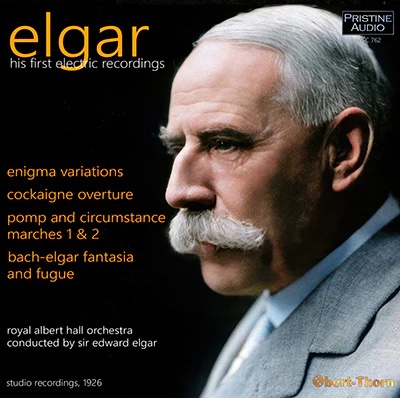
ELGAR: His First Electric Recordings – Pomp and Circumstances Marches, Bach-Elgar Fantasia and Fugue, Enigma Variations, Cockaigne Overture – Royal Albert Hall Orchestra/ Sir Edward Elgar – Pristine Audio PASC 762 (65:25, detailed contents listed below) [www.pristineclassical.com] ****:
Producer and Restoration Engineer Mark Obert-Thorn turns to the banner year 1926, when in Apil and August of that year Sir Edward Elgar took the podium of the Royal Albert Hall Orchestra to engage in what he celebrated as “the greatest discovery made up to that time in the history of the gramophone,” the electrical recording process. Collectors should both embrace this release from Pristine Audio and a companion disc from SOMM Recordings “Elgar from the Archives, Vol. I: Premiere Recordings Remastered” (Somm Ariadne 5046), which restores acoustic performances, 1919-1924, produced by Siva Oke and Lani Spahr. Together, we receive a firm accounting of Elgar’s earliest incursions into recorded posterity from him and those musicians he entrusted with preserving his legacy.
The program opens jingoistically enough with Elgar’s lively 1901 Cockaigne Overture (27 April 1926), an appreciation of the City of London, with its history as “the Land of Delights,” by way of 13th Century poet Rutebeuf. In one unbroken movement, the work subdivides into seven programmatic sections, the good cheer and bustle of London evolve into a “Lovers’ Romance” in E major and then into alternately militant and pious meditation, the military band and the church, respectively, and concluding “In the Streets.” The city-scape’s energy, brash timpani girded by the use of tubas as substitutes for string basses, has Elgar in full throttle, quite relishing his city in terms of open affection, literally nobilmente in the manner of Peter Breughel, the Elder, portraying even excess with endearment, the gift of “the lazy, luscious land.”
Of the Elgar transcription of Bach (28 April and 30 August 1926) Obert-Thorn notes that “a bit of scrappiness in the Fugue” may account for HMV’s limiting the performance to distribution only in France and Italy. The music of Bach helped console Elgar’s creative inertia after the death of his wife in 1920, and Bach’s late music may have provided – as posited by the late Carmine Arena – the impetus for the “Enigma” of the Op. 36 Variations. In conversation, Elgar encouraged Richard Strauss to orchestrate the Fugue; but Strauss’s having failed to proceed, Elgar completed the task in 1922 for the Gloucester Three Choirs Festival. Elgar deliberately utilizes a large ensemble, stating that “‘I wanted to show how gorgeous and great and brilliant [Bach] would have made himself sound if he had our means.” The triple time opening, with treading drumbeats, reminds some auditors of the St. Mathew Passion, but the mightier scoring appears in the Fugue, with brass prominent. The repeat of the exposition subject in a fugue signifies a rarity in Bach, who does not combine individual themes; but Bach scholar and organ virtuoso Albert Schweitzer sees in the da capo format a moral victory “of confident faith.”
Elgar’s duet for violin and piano, Chanson de Nuit (c. 1890), here orchestrated for strings, derives from the same session as Cockaigne, though its companion piece, Chanson de Matin, had been rejected, to be recorded again later, in 1928, with the LSO. The somber dignity of the piece evolves in majestic, nuanced procession, with tiny moments of portamento. The two Pomp and Circumstance marches (27 April 1926) emerge intact, with no cuts. Bold, athletic energy defines No. 1 in D Major, while No. 2 in A Minor projects a startled impetus, nervously and persistently aggressive. The Light of Life, Op. 29 (1896-1903) resembles a cantata, but Elgar preferred to call it an oratorio. Utilizing the leitmotif principle in Wagner, the “Meditation,” which opens the work, Elgar gives voice to themes associated with the Levites’ first chorus, the prayer of the blind man to whom Jesis restores sight, Christ as healer, and lastly, to the Light proper. The kinship in tone to Wagner’s Parsifal Prelude, Act I feels quite palpable.
We have Elgar’s remake of his eminent Enigma Variations (20 August 1926), his having recorded it earlier in 1920 and 1921 for the acoustic horn. Obert-Thorn contributes the epithet “boundless energy” to characterize Elgar’s performance. After a studied presentation of the Theme, rife with rubato and slides, Elgar has his ensemble strings dwell lavishly in the music’s evolution. Intimacy, even spirituality, becomes manifest in the C.A.E. variant, the composer’s wife. The succeeding variants move fleetly but emphatically conscious of the original motif. The most famous and luxurious of the lost, Nimrod, does not take residence in molasses. At key points in the narrative, as such, the influence of the Brahms bass line emerges. “Nimrod” (A.J. Jaeger) casts his own devotional aura, unhurried but mounting to an expressive grandeur that typically defines the Elgar style. Obert-Thorn comments on the labor pains required to revitalize the present incarnation, and his own words encapsulate the aggregate here documented: “affectionate portraits in a most authentic and heartfelt manner, culminating in a brilliant finale.”
—Gary Lemco
ELGAR: His First Electric Recordings
Cockaigne Overture (In London Town), Op. 40;
BACH-ELGAR: Fantasia and Fugue in C Minor, Op. 86;
Chanson de Nuit, Op. 15/1;
Pomp and Circumstances Marches, Op. 39: No. 1 in D; No. 2 in A Minor;
Meditation from The Light of Life, Op. 29;
Variations on an Original Theme, Op. 36 “Enigma” –
Royal Albert Hall Orchestra/ Sir Edward Elgar
by Audiophile Audition | Jan 28, 2026 | Jazz CD Reviews, SACD & Other Hi-Res Reviews
Time traveling back to 1970s classic jazz continues…
Double Review – Joe Chambers Double Exposure; Woody Shaw Love Dance – Time Traveler Recordings
Many jazz fans consider the 1950s and 1960s the “Golden Period” of the genre, both due to its popularity, and the myriad of iconic albums produced by labels such as Blue Note, and Original Jazz Classics (with its subsidiary East and West Coast releases from Prestige and Contemporary). It was also during the time when jazz was most popular without interference from rock music.
Things began to change in the 1970s, and many jazz labels saw harder times, and artists began to explore Europe as a new destination with new appreciative audiences. That’s not to say that smaller labels didn’t fill the void for emerging idioms such as post bop and fusion.
Muse Records, founded in 1972, by impresario, Joe Fields, was perhaps the most recorded independent label of that era, keeping the flame lit for jazz fans yearning for more of the same, that they loved in prior decades. Muse embraced older players, as well as bringing in future stars like Kenny Barron.
Zev Feldman, AKA: the Jazz Detective, presently heavily involved with Resonance Records and Elemental Music, has a new calling with Time Traveler Recordings. Feldman is giving some well deserved love to Muse, by providing long time fans of the label, and introducing a new generation to some of the best “under the radar” issues from the 1970s with the Muse Records Master Editions. Starting in October, 2025, and continuing quarterly, it’s cause for celebration.
What’s even more special about the reissuing process, is the care of the remastering and production. Each album is remastered and cut from the original tapes, with 180 gm heavyweight vinyl pressed in Germany by Optimal Media, and housed in Stoughton Old Style Tip-On jackets. It’s first class all the way. The high gloss covers, and both original and updated liner notes complete the package.
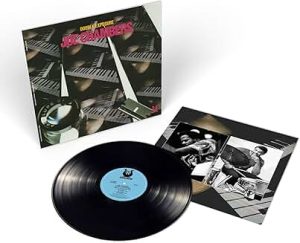
The latest two issues in the series, released at the end of January, are Joe Chambers with Larry Young, Double Exposure, from 1977, and Woody Shaw’s Love Dance, from 1976.
Let’s explore each one:

Drummer, Joe Chambers, is still going strong at age 83. What is special about Joe is that he is also a noted pianist. His album, here, is unique as its six tracks are all duo, with exploratory organist, Larry Young. This was Young’s final album, recorded just four months prior to his death, and Chambers debut recording with keyboards as its primary focus.
Larry was a great match for Chambers here, as Young can provide an other worldly accompaniment to Chambers straight ahead acoustic and electric piano, while Joe can back Larry’s organ with assertive drumming on the two rock influenced closing tracks.
“The Orge” has Joe bringing in tabla, while Larry adds synthesizer to the mix. It’s cerebral yet sprightly, and the organ fills have a spacey feel. There are hints of a Bill Evans piano quality on “Hello to the Wind,” and a low key counterpoint from Young.
“Mind Rain” reprises sections of “The Orge,” with Larry taking lead, backing a repeating piano riff. “After the Rain” is a piano solo from Joe, lyrical with a late night after hours feel.
The closing two tracks are a total departure, as fusion and rock enter on “Message From Mars,” and “Rock Pile.” They are hard driving, highlighting Chambers’ poly rhythmic drumming, similar to what Elvin Jones brought to Larry Young’s iconic Blue Note album, Unity. “Message From Mars” would be a great jam track, appealing to a very wide-open eared listener!
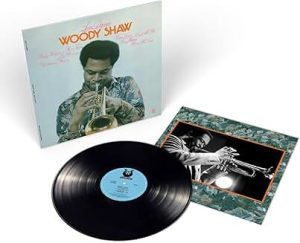
Woody Shaw’s Love Dance from 1976, has the fiery trumpeter fronting a dream front line of horns, including tenor saxist, Billy Harper; a young Rene McLean on soprano and alto sax; and Steve Turre on trombones. The rhythm section is Joe Bonner on piano, Cecil McBee on bass, and Victor Lewis on drums. All these stalwarts went on to distinguished careers. Percussion duties are ably handled by Guilherme Franco, and congas from Tony Waters.
This is prime post bop, with hints of hard bop, and some straight ahead tender ballads. Primarily there is blistering, hard charging blowing from the horns. As always, Woody blows fire, standing out on most every track, with strong contributions from the other horns. Rene McLean provides an astringent high register sax just like his father, Jackie, brought for decades, while the bottom end is often provided by Steve Turre’s burnished tone on bass trombone.
Stand out tracks include the lengthy title track, with superb ensemble playing by the horns, lyrical trumpet by Woody, and aggressive tenor work by Billy Harper. “Obsequious” by Larry Young, has both heat from Rene, and a cooling effect by Joe Bonner’s piano. Cecil McBee’s bass solo has a Latin tinge, while Victor Lewis’ drums push, and inspire throughout.
I especially dug “Sunbath” with its catchy melody, hard bop vibe, and it would make a winning radio play. “Zoltan,” made famous in the 60s by Larry Young has the four horns blowing strongly. “Soulfully, I Love You,” is a major contrast here, mellow, and a superb horn blend. Joe Bonner’s piano, along with Cecil McBee’s bass contribute as well.
The latest releases in this series are well deserved for a new hearing, and just whet the appetite for what’s next in this series. Stay tuned in the future for more sonic goodies from Zev Feldman’s offerings from the Muse Records catalog. Meanwhile, enjoy these two remastered winners…

Joe Chambers/Larry Young – Double Exposure – Time Traveler Recordings/Muse Records/Craft Recordings #TT-MOO5 – 180 gm vinyl – ****1/2
(Joe Chambers – piano, tabla, cymbals, drums; Larry Young – organ, synthesizer)
Side A:
Hello to the Wind; The Orge; Mind Rain
Side B:
After the Rain; Message From Mars, Rock Pile

Woody Shaw – Love Dance – Time Traveler Recordings/ Muse Records/Craft Recordings #TT-M004 – 180 gm vinyl – ****1/2
(Woody Shaw – trumpet; Steve Turre – trombones; Rene McLean – alto and soprano sax; Billy Harper- tenor sax; Joe Bonner- piano; Cecil McBee – bass; Victor Lewis – drums; Guilherme Franco – bass; Tony Waters – congas)
Side A:
Love Dance; Obsequious
Side B:
Sunbath; Zoltan; Soulfully, I Love You (Black Spiritual of Love)
—Reviews by Jeff Krow
by Audiophile Audition | Jan 28, 2026 | Classical CD Reviews
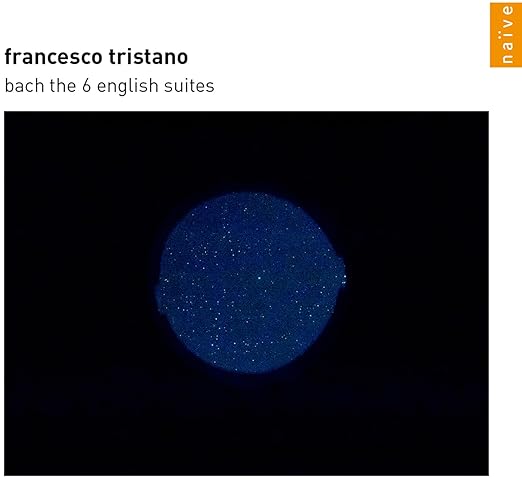
BACH: The 6 English Suites, BWV 806-811 – Francesco Tristano, piano – NAÏVE V8828 (2 CDs = 53:38; 50:49) (2/27/25) [Distr. by Naxos] *****
Recorded in December 2022, this survey of Bach’s 1715 set of six English Suites by Francesco Tristano (b. 1981) has us consistently captivated by the fiery, vigorous approach requisite to their successful realization. While not so concerned to have his Yamaha CFX instrument sound like a harpsichord, a la Glenn Gould, Tristano enjoys an equally lucid, crystalline articulation that maintains the essential dance impulses that Bach refines with deft, contrapuntal audacity. Tristano’s sonic allure in the Bach sarabandes proves as infectious as his visceral delight in the faster dances, the courantes, bourrées and gigues. Although conceived in Weimar presumably for an English sponsor or audience, Bach’s absorption of the Italian and French models into a brilliantly complex organization dwarfs whatever influences Purcell or Dieupart’s suites may have exerted. Albert Schweitzer concisely sums up Bach’s contribution when he states, “Bach goes still further; he always visualizes the form and gives each of the principal dance forms a definite musical personality. For him the allemande represents vigorous but easy motion; the courante represents a measured haste, in which dignity and elegance go side by side; the sarabande represents a grave and majestic walk; in the gigue, the freest of all forms, the motion is quite fancy-free. He thus raises the suite form to the plane of the highest art, while at the same time he preserves its primitive character as a collection of dance pieces.”
The moments of unbridled energy mount by advanced degrees, given the blazing attacks that mark the “Prelude” from Suite No. 4 in F Major and the two “Bourrées” from Suite No. 2 in A Minor, for me set in stone by Glenn Gould but equally vivid in Tristano’s fluent realization. The “Sarabande” from Suite No. 4 evinces a searching, learned quality, while the two “Menuets” and concluding “Gigue” convey a high, if whimsically buoyant, purpose. The percussive, staccato immediacy of Tristano’s “Prelude’ for the Suite No. 3 in G Minor literally took me by storm, while his unbroken momentum retains the tension of the individual, polyphonic lines, which bear his imprint of added grace notes. The flexible shaping of Bach’s allemandes allows their Italian character to sing, despite their “German” designation. Tristano colors the “Allemande” from Suite No. 1 in A with a music-box sensibility, the close imitation pert and lithe. The pair of “Doubles” testifies to the influence of the French clavecinists on Bach’s keyboard style, and Tristan renders them with refined taste.
Perhaps the most demanding of the series, No. 5 in E Minor urges a colossal conception, its opening “Prelude” laden with 200 measures of fugal exhilaration. The “Courante” is set as a moto perpetuo, an Italian athletic contest well met by Tristano. The French court makes its appearance in two “Passepieds,” a dance more light in tone than a menuet, the first of which Bach shapes as a rondo. Tristano’s natural virtuosity finds a perfect vehicle the concluding, witty “Gigue,” receiving the “play catch” treatment from the hands.
The D Minor Suite No. 6 wastes no time establishing its dramatic profundity and emotional largesse. Much of the tablature of the opening “Prelude” and its richly ornamental fugue seems reminiscent of Bach’s organ studies in the form. Tristano extends the regal expressivity of the piece in the ensuing dances, Tristano’s repeated notes cast a relentless, pulverizing effect, so we simply submit to the monumentality of the moment. The succeeding “Allemande” complements the “German” sensibility of the piece, its contrapuntal density offset by Tristano’s clear lines. Much of what remains of this extraordinary work expresses the French taste, with its explosive “Courante” and galanteries in the form of contrasted “Gavottes.” None can deny the expressive power of the D minor “Sarabande,” the very heart of the whole composition. Its Spartan simplicity finds grand contrast in the “Double,” a flowing line in 16th notes that edify the original line with an effervescent glow. We have been awaiting Tristano’s final “Gigue,” a Force of Nature in itself, the fugal material redolent with the Elixir of Life, brought to thunderous fruition by a musical artist for whom Bach represents a divine mission.
—Gary Lemco

by Audiophile Audition | Jan 24, 2026 | Classical CD Reviews
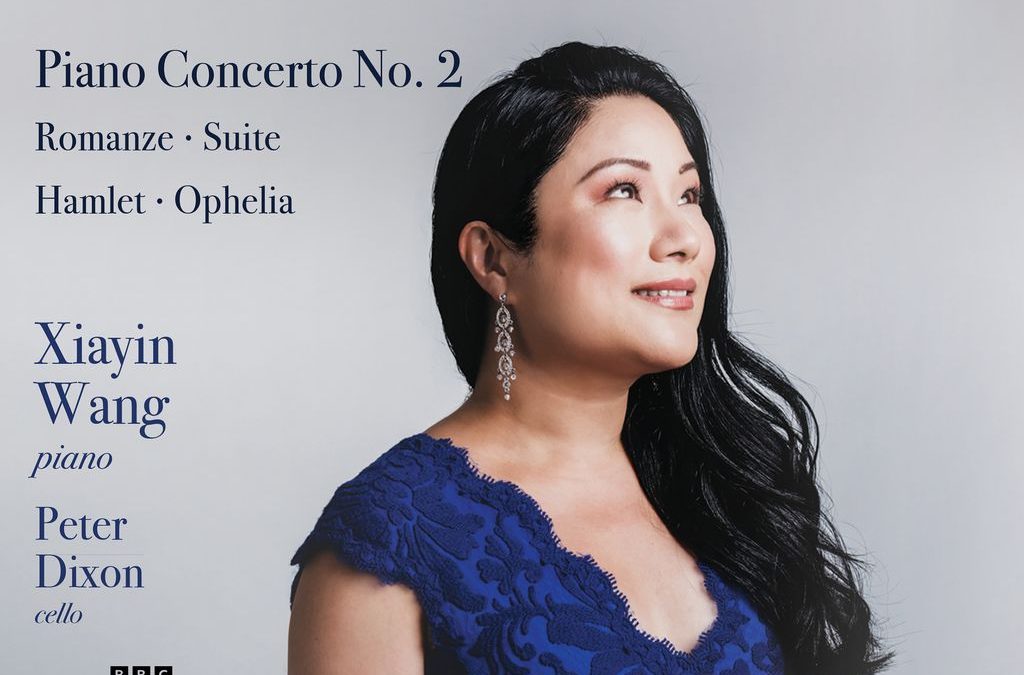
MacDowell: Hamlet/Ophelia, Op. 22; Piano Concerto No. 2 in D Minor, Op. 23; Romanze in E Minor for Cello and Orchestra, Op. 35; Suite No. 1 in A Minor, Op. 42 – Xiayin Wang, piano/ Peter Dixon, cello/ BBC Philharmonic Orchestra/ John Wilson – CHANDOS CHAN 20332 (61:08) (10/29/25) [Distr. by Naxos] ****:
The music of American composer Edward MacDowell (1860-1908) remains firmly, albeit occasionally, entrenched in our concert life, mainly due to the attractive power of his Second Piano Concerto of 1886, and the performances of various symphonic poems that testify to the influence of Franz Liszt. This Volume 2 from conductor John Wilson embraces compositions 1884-1893, with an emphasis on those works created during and subsequent to MacDowell’s honeymoon excursion to England with his wife, Marian Giswold Nevins. Collectors continue to cherish recorded performances of the Piano Concerto by Earl Wild and Van Cliburn, while I recall a particularly successful rendition in Atlanta by Leon Bates.
The program opens with Two Poems for Large Orchestra: Hamlet/Ophelia, conceived in response to a series of Shakespeare productions mounted at the Lyceum Theatre in London, supervised by the acting duo Henry Irving and Ellen Terry. Highly chromatic n texture and favored by some good melodic content, the diptych – in D minor and F major – might owe debts to Liszt’s 1854 Mazeppa for structure and dramatic impulse. The music captures the mood shifts of the two protagonists in Hamlet, their vacillations of manic confidence and deep insecurity, rendered in occasionally tumultuous fashion by MacDowell, who enjoys the effects of terraced dynamics.
Composed in Wiesbaden, Germany between 1884 and 1886, the D Minor Concerto conforms to the virtuoso concerto style established by Liszt and Saint-Saens, MacDowell’s having incorporated some incidental music for Shakespeare’s Much Ado About Nothing and the character of Benedick into his second movement scherzo, Presto giocoso. Quick tempos had been a calling card for MacDowell’s own keyboard prowess, and Xiayin Wang does not balk at the digital challenges – the crisp, fluent articulations – demanded by the composer and characterized by his wife as “gossamer demons.” Both hectic and impelled by sheer velocity, the music manages to project a distinct color wrought of fierce concentration, occasionally reminding us of the famous Scherzo by Henri Litolff.
The first movement, scored in eight distinct tempo periods, opens with a misty Larghetto calmato in violins and horns, followed by a potent cadenza from Wang, attesting to her natural ability to perform the Grieg Concerto. Amplification of the opening materials – with violin, flute, horns, cello pizzicatos – involve more dreamlike figurations and sudden bursts of passion, while the main theme gathers an irrevocable momentum and glistening filigree. Intimacy and spectacle compete for dominance, and both impulses win our approval. The texture becomes increasingly massive, a la Liszt or even Wagner, while the keyboard motion insists on brilliant velocities. A sudden hiatus leads to another solo cadenza, more in the manner of a passionate improvisation with added orchestral, aerial and throbbing colors. The lure of intimacy prevails in the last pages, though the sensibility swells in volume and luster momentarily, only to bask in a hard-won resolution.
A degree of cyclic unity marks the last movement, opening as it does quietly, meditatively Largo before the piano explodes Molto allegro, trills aplenty, and then allowing the original, first movement tune a re-entry before three, new ideas supplant it. Rather martial in tone, the movement enjoys a pompous, semi-gypsy swagger of technical confidence and deft coloration. A mid-point serenity descends upon the procession, rife with romantic overtones, the main melody in sweet strings and winds. But this has been the lull before the final storm, gradually becoming more animated and delicately inflamed, until another zealous crash impels us, Presto and then Prestissimo, to a convulsive, resonant coda.
In immediate contrast, we have MacDowell’s homage to Bohemian cello virtuoso David Popper (1843-1913), the Romanze in E Minor of 1887, also written in Wiesbaden. Melancholy in tone, the piece seems to embrace Massenet and later Elgar at once, repetitious in melodic character but nonetheless intimately expressive. The coda, ethereal, melts into a sweet space.
Wilson concludes with a large orchestral work from 1893, the five-movement Suite in A Minor. Notably German influences pervade the work, since we hear (and feel) allusions from Schumann, Weber, Mendelssohn, and Wagner. Wife Marian intimated that MacDowell’s Celtic heritage accounts for the pantheistic, bucolic elements throughout the work. We open “In a Haunted Forest,” in which the texture enjoys a menace (Maestoso) close to Der Freischuetz, with some impressive woodwind scoring. The ensuing, brief “Summer Idyll” marked as Allegretto grazioso, an indication and waltz feeling shared by Dvorak and Glazunov. “Im Oktober” (1893) serves as the inserted movement to fill out the original four-movement version of the suite. The music alternates between a militant affect and a lyrical sense of repose in sympathy with much of Grieg.
The “Song of the Shepherdess,” marked Andantino semplice, achieves a sense of grandeur and transparent intimacy, at once. The last movement, “Forest Spirits,” combines elements of Weber, Mendelssohn, and Grieg, moving with hurtling energy and a dancing flightiness. Misterioso serves as the dominant impulse, set as a series of scalar motifs that end with a rhythm close to the second movement of Beethoven’s Seventh Symphony. The balletic chirps of the woodwinds might invoke Tchaikovsky to respond. A military fanfare suddenly rushes in to conclude the suite with a precipitous crash. Recorded in Manchester, England, the sonic production from Brian Pidgeon and Mike George proves immediate and clear.
—Gary Lemco
by Audiophile Audition | Jan 22, 2026 | Classical CD Reviews
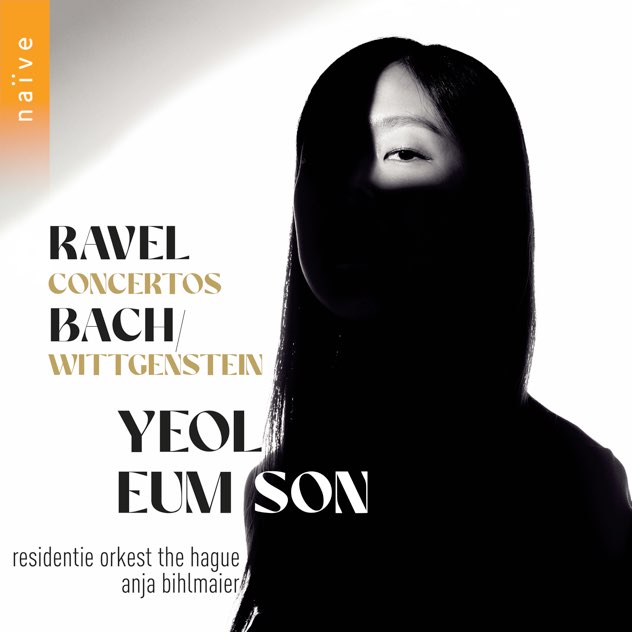
RAVEL: Piano Concerto in G Major; Piano Concerto in D Major for the Left Hand; BACH Prelude and Fugue in C; Prelude in C Minor; Gigue; Siciliana – Yeol Eum Son, piano/ Residentie Orkest the Hague/ Anja Bihilmaier – Naïve V8447 (52:00 (complete details below) (5/12/25) [Distr. by Naxos] ****:
Korean pianist Yeol Eum Son (b. 1986) first came to my attention via the 2009 Van Cliburn Competition; then on its heels, the 2011 Tchaikovsky Competition, both of which illustrated her glistening, clear technical prowess. This album conceived over the period 2022-2024, combining concertante works by Ravel with solo Bach pieces arranged for the left hand – by Paul Wittgenstein (1887-1961), who commissioned the Left Hand Concerto – bears a valedictory character, a signing lament for the World War that preceded the works, coupled with the triumph over adversity that marks the transcriptions, so that a one-armed performer may realize the gift of melody inscribed in the Baroque works.

Maurice Ravel, 1925
From the opening Allegramente whip crack and high piccolo, the 1932 Concerto in G crackles with humor and transparent aplomb, buoyant and mischievous. Basque harmonies collide with jazz rhythms, not to create bad Gershwin but to romp in Spanish sensibilities that no less convey the textural freedom and youthful verve in Mozart and Saint-Saens. Ravel literally tormented himself in creating the operatic Adagio assai, whose lyric tracery, a waltz-sarabande whose purity of line suggests an antique, aristocratic gesture. Such graceful innocence the world may no longer be capable of supporting in our time.
In this second movement, as she has in the cadenza of movement one, Son exerts a lithely fluid line, sustained by a firm sense of pulse. The English horn, who had set the Basque tone of the first movement, restores the main melody, ceded temporarily to clarinet, oboe, and flute. By the last movement Presto, Ravel has yielded to his notion of the piano as primarily a percussive instrument, antagonistic to the gentler persuasions, and so joining trumpet and trombone for a dazzling series of runs over an eddying and mounting tension that threatens to become some martial call-to-arms. The sly glissandi of the various instruments ameliorate the wild aggression, so even the final thump of the bass drum feels more like a smirk than an existential demise.
Ravel’s 1930 Concerto in D for the Left Hand, conceived in one movement subdivided into three parts, suggests a Lisztian symphonic poem with piano obbligato, arising from the somber depths of keyboard and orchestra to proclaim a rebirth of its commissioner’s musical vitality. A grinding sarabande merges from a musical, bass morass dominated by contrabassoon and horn, evolving to an assertion of will by the piano and its liberated cadenza. The improvisation becomes bold and manic, somberly virtuosic, as Ravel stretches the intervals between thumb and index finger, maintaining consistently the illusion of fluid motion. The middle, fast section, in a deliberate jazz style, arises from impulses stated earlier, only slower.
Conductor Bihlmaier delivers crisp attacks, earthy punctuations and stealthy thumps to underline the piano’s dervish romp into a world simultaneously complicated and folk-like. Harp and snare drum effects bristle and clomp, moving us into a musical phantasmagoria, one step away from one Gatsby’s celebrated summer parties. The cadenza from Son utters pure poetry and the love of life and its compensations. Cyclical, symmetrical, and fearfully demanding, the final movement declares a moral, if not a physical, victory of staggering proportions.
To complement the Ravel concertos, Son drew upon Paul Wittgenstein’s third volume of Transcriptions (Bearbeitungen) from his School for the Left Hand. The adaptability and flexibility demanded to sustain Bach’s arioso for the C Major Prelude reveals registration art that conceals art. The brief C Minor Prelude requires quick staccato and repeated note adjustments that sound like Scarlatti. The familiar Gigue from the first of the piano partitas moves a bit more marcato than, say, Lipatti or Gould, but it evinces good, fluid pulse and motor inevitability. At last, we have the tender Siciliano that sounds like a music-box in the style of the French clavecinistes. The final trill is magic.
—Gary Lemco
Yeol Eum Son plays Ravel, Bach
RAVEL:
Piano Concerto in G Major;
Piano Concerto in D Major for the Left Hand;
BACH BWV 846 (arr. Wittgenstein for he left hand):
Prelude and Fugue in C Major,
Prelude in C Minor, BWV 999; Gigue from Partita No. 1 in B-flat Major, BWV 825;
Siciliana from Sonata for Flute and Harpsichord in E-flat Major,
Residentie Orkest the Hague/ Anja Bihilmaier
by Audiophile Audition | Jan 18, 2026 | Jazz CD Reviews
Something for Jazzheads and Deadheads.
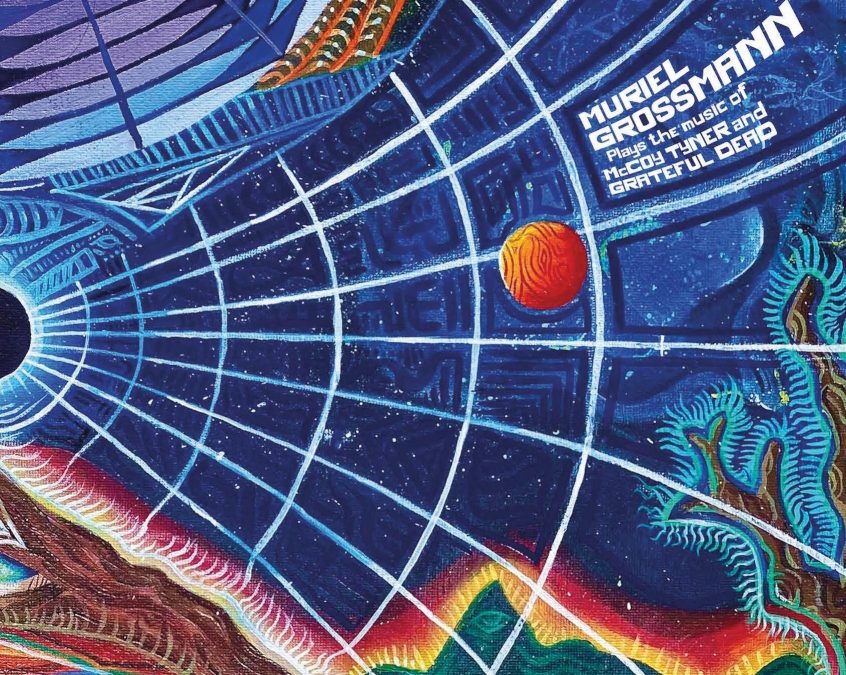
Muriel Grossmann – Plays the Music of McCoy Tyner and Grateful Dead – [TrackList follows] – Dreamland DR 19 CD; CD 1: 56:17; CD 2: 52:17 [12/29/25] ****:
(Muriel Grossmann – tenor saxophone, soprano saxophone (tracks 4, 8), harmonium (tracks 2, 4, 6, 8), tambura (tracks 4, 8), percussion (tracks 4, 8); Radomir Milojkovic – guitar; Abel Boquera – Hammond B3 organ; Uros Stamenkovic – drums)
Spain-based saxophonist Muriel Grossman (born in Paris, raised in Austria) combines seemingly disparate music into a one-of-a-kind spiritual jazz presentation on Plays the Music of McCoy Tyner and Grateful Dead, issued in late 2025. The title implies a tribute or homage but there’s more to it. Instead, Grossman – who shifts between tenor and soprano sax and also adds harmonium and tambura – showcases the underlying craft and creation which links the former John Coltrane sideman with the deans of San Francisco’s psychedelic music scene while producing music firmly her own. “We playead this music using a sort of filter,” Grossman explains, “so it sounds like when I compose, record, and perform our own music. It’s somebody else’s music, but it sounds like our music.” Grossmann’s quartet also includes electric guitarist Radomir Milojkovic, Hammond B3 organist Abel Boquera and drummer Uros Stamenkovic.
The album is available as a 2-disc CD (the second disc includes four bonus alternate takes), a limited edition two-sided LP, or a digital download which has all of the CD material. This review focuses on the CD and digital releases.
The opener is a nearly 15-minute rendition of Tyner’s “Walk Spirit, Talk Spirit” (from his live 1973 LP Enlightenment). Tyner’s 24-minute all-acoustic original had Azar Lawrence on sax, Juni Booth on bass, Tyner on piano and percussion, and Alphonse Mouzon on drums. It is a tour de force of tone and vigor, from subtle gradations to a fast-moving energy. Grossman excludes Tyner’s intimate introduction and goes straight into the groove spotlighted by a direct Hammond B3 organ bass line with some bluesy keyboard asides. Grossman equals Lawrence’s mood and style, which in turn was influenced by Coltrane. There is finessed back and forth between sax and guitar although the guitar seems a bit light in extemporization and somewhat rigid especially during Milojkovic’s solo.
“Contemplation” (see 1967’s The Real McCoy) is one of Tyner’s most covered compositions. His nine-minute original is both meditative and insistent and reflects on faith and one man’s introspective thoughts. It was previously done by Mal Waldron, Alvin Queen, Ronnie Scott and others. Grossman stretches her translation into a 15-minute transcendent commendation with a bluesier deportment, where her tenor sax glides and glistens while she limns Tyner’s search for inner meanings. There’s also an extended guitar and organ give-and-take which provides some soulful push and pull.
The Dead and jazz were adjacent to each other but perhaps not in ways overtly apparent. Dead guitarist Bob Weir – who passed away in early January 2026 – has cited Tyner and Coltrane as two of his major inspirations which can be heard during some of Weir’s rhythm guitar chordings.
There’s an identifiable groove to Grossman’s 14-minute adaptation of the Dead’s “The Music Never Stopped,” (found on 1975’s Blues for Allah) co-written by Weir and lyricist/poet John Perry Barlow. Grossman’s arrangement, particularly the multifaceted improvisational moments, bring to mind Weir’s iconoclastic guitar and Grossman’s soloing should remind Dead fans of Weir’s often unpredictable rhythmic process. Milojkovic and Boquera lock in solidly throughout the funkier portions and Milojkovic gets spatially psychedelic toward the conclusion.
It makes sense Grossmann chose to do “The Other One” since it furnishes space and room for improvisation. The song began life as “The Faster We Go, the Rounder We Get” (co-composed by Weir), part of the four-section suite “That’s It for the Other One” from 1968’s Anthem of the Sun, the second Dead studio effort. The tune eventually morphed into “The Other One,” a frequent live Dead concert highlight. On her rendering of “The Other One” Grossmann supplies a slightly dissonant soprano sax, then Milojkovic and Boquera take over with psychedelic and blues elaborations which rotate around each other, and Grossmann then steps forward again with some Coltrane-esque contortions. Listening to Grossman’s “The Other One” makes one wonder what Coltrane might have thought of the Dead’s spiraling psychedelia.
The four bonuses on the CD and digital albums offer some interesting tweaks and twists and are worth exploring to hear the differing details and choices.
—Doug Simpson
Muriel Grossmann – Plays the Music of McCoy Tyner and Grateful Dead
TrackList:
CD 1:
Walk Spirit Talk Spirit
Contemplation
The Music Never Stopped
The Other One
CD 2:
Walk Spirit, Talk Spirit (alt. take)
Contemplation (alt. take)
The Music Never Stopped (alt. take)
The Other One (alt. take)

by Audiophile Audition | Jan 12, 2026 | Classical CD Reviews
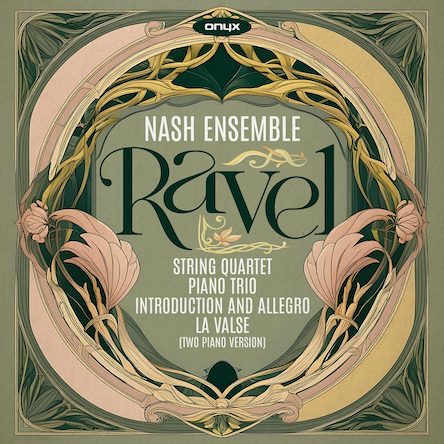
NASH ENSEMBLE plays RAVEL = Introduction and Allegro; Piano Trio in A minor; La Valse (two-piano version; String Quartet in F major – The Nash Ensemble – ONYX4270 ((75:55) (10/02/25) [Distr. by PIAS] *****:
The chamber music of composer Maurice Ravel (1875-1937) justifies Stravinsky’s epithet, “the most perfect of Swiss watchmakers,” analogy that characterizes Ravel’s sense of clarity, precision, and exotic coloring. The Nash Ensemble addresses some of the major compositions, 1902-1920, recorded 14-17 April at Yehudi Menuhin School in Surrey, under the supervision of Producer Andrew Keener. The Ravel album is dedicated to the memory of Amelia Freeman (1940-2025), sixty years the Artistic Director of the Nash Ensemble.
Despite Ravel’s stricture that “music must be emotional first a intellectual second,” the tension between Ratio and Eros colors his entire oeuvre, and the 1905 Introduction and Allegro for harp and ensemble, commissioned by Erard to highlight the virtues of its double-action, pedal harp, conforms to the demands of a concertino in the manner of a septet in G-flat major. Harp solo Lucy Wakeford establishes the dominance of her instrument in the measure 4 arpeggio, weaving a sensuous 4/4 theme, one of three, that the flute (Philippa Davies) and clarinet (Richard Hosford), and the cello (Adrian Brendel) have initiated, respectively. The shift to ¾ and moins lent (less slowly) graduates to a crescendo, only to dissipate in preparation for the sonata-form Allegro. While the harp will sang and dance the main theme in variants, color effects from viola (Lars Anders Tomter) and brilliant pizzicato strings will urge the music to the final, glistening harp cadenza, whereby trills from winds and strings lead us to a brief solo interlude by Wakeford, just prior to a dazzling, whirlwind coda.
Conceived on the cusp of World War I, March-August, 114, Ravel’s Piano Trio vibrates with aspects of his Basque heritage and his fertile, exotic imagination. Ravel often decried the incompatibility of the percussive piano and the soft string tones, but he manages to discover a marvelous, if eccentric, blend of color that results in musical magic. The opening movement, Modéré, relies on the repetitive 8/8 rhythms from the Basque zortzico, unusual in refusing to modulate for the second theme away from the tonic minor. The theme moves in small, scalar increments until it jumps a fourth as it concludes.
The second movement, perhaps, proves the most original: a pantoum, a Malaysian verse form in which two themes interlock through lines 2 and 4 of each four-line stanza, to become the first and third of the next stanza. In essence this movement embodies a scherzo and trio, juxtaposing ¾ injections by the string payers against the long 4/2 notes of the keyboard. Benjamin Nabarro, violin and Adrian Brendel, cello execute fiercely quick repeated, even in left-hand pizzicato, while pianist Simon Crawford-Phillips seduces us with melody. The slow Passacaglia movement testifies to Ravel’s penchant for Baroque taste. Marked Très Large ¾, the polyphonic technique taught Ravel by André Gadalge manifests itself in an 8-bar, processional theme – appearing first in the piano’s lowest register – reiterated eleven times, a concession to the Great War a step away from his Tombeau de Couperin suite. The pungent last movement Final: Animé, relies on two antagonistic rhythms, 5/4 and 7/4, a Basque construction that has violinist Nabarro’s having to negotiate, with precision, arpeggios and trills in harmonics. The Nash Trio performs this demanding but acerbically satisfying music with seamless aplomb.
I have noted elsewhere Ravel’s tendency to explode several of his dance forms, especially the Bolero and his 1920 homage to Johann Strauss and the Vienna Waltz, La Valse. Alistair Beatson and Simon Crawford-Phillips collaborate in the 2-piano version, a swirling mass of dance music that culminates in a self-destructive bacchanal. “Voluptuousness to the point of paroxysm” state Ravel’s own characterization of this virtuoso, tragic and demonic piece that sways and convulses in the style of Liszt but remains cross-fertilized by French savoir-faire.

Maurice Ravel, 1925
Finally, the cyclical Ravel F Major Quartet of 1902, which, while resonating the influence of Debussy’s 1893 Quartet in G Minor, maintains a striking individuality. Among the other sonic glories of the first movement Allegro moderato, “very gentle,” the dialogue between first violin Benjamin Nabarro and viola Lars Anders Tomter for the expressive, two-octaves-apart, secondary theme stands out for sheer, suave execution. The second movement, Assez vif, palpitates with cross rhythm typical of Iberia, pizzicato ¾ against 6/8, a concession no less to the gamelan sound of Java, but sonically open in a manner reminiscent of what Beethoven achieves in his middle quartets, Op. 59/1 and the “Harp,” Op. 74. By the end of the movement, he music’s “symphonic” dimensions burst forth in multiple-stop demands on the two violins, here executed fortissimo.
Much of movement one’s thematic tissue finds recycling in the third movement, Très lent, in which Tomter’s viola makes expressive points with stylistic glamour. The other players’ tremolo figures support a mysterious, muted atmosphere, rife with the feeling of a rhapsodic nocturne that Bartok might have envied. The last movement, vif et agité, thrusts stormy eighth notes in variable rhythms of 5/8, ¾, and 5/4, indulgent of emotional flourishes and demonstrative rhetoric. Recollections of movement one abound, but here these allusions have been blended in a storm both consoling and anxious, a musical enigma of which Fauré disapproved.
–Gary Lemco
by Audiophile Audition | Jan 11, 2026 | Jazz CD Reviews, SACD & Other Hi-Res Reviews
This is the epitome of vibrant acoustic guitar jazz!
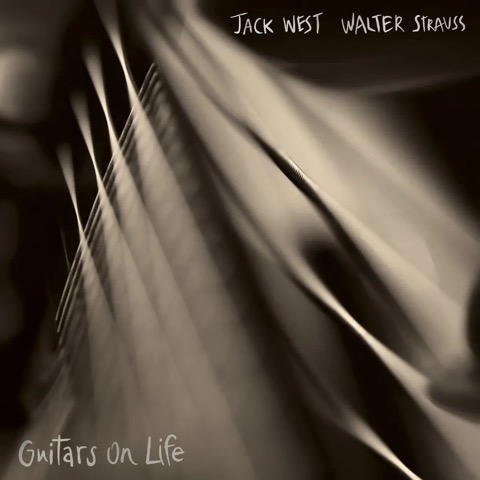
Jack West/Walter Strauss – Guitars On Life – Otá Records OTA 1037 [1/23/2026] 180-gram translucent stereo vinyl, 42:37 ****1/2
(Jack West – acoustic guitar; Walter Strauss – acoustic guitar)
Acoustic guitar in jazz began in the 1920’s. An early figure in this movement was Eddie Lang, the first renowned jazz guitar soloist. Others included Lonnie Johnson, Carl Kress and of course Django Reinhardt. This was also a staple of the Brazilian nylon-stringed instrumentation that defined that genre. While many jazz guitarists transitioned to electric, a new wave of acoustic players continue to emerge, including Julian Lage and John Pizzarelli. One of the modern acoustic virtuosos is Jack West. He is regarded for his rhythmic style, achieved on custom eight-string. He has released several albums with his band Curvature. West is adept at simultaneously playing percussion-based lines, slide, chords and bass.
West has been joined by fellow guitarist Walter Strauss for a new album on Oakland-based Otá Records. Guitars On Life. features seven original compositions and one cover performed as a steel-string duet. The music is spontaneous and has no overdubbing. On most of the tracks, West provides the tempo and slide runs. Strauss contributes lead. Side A opens with “More Guitar”. West’s relentless percussive chords are complemented by Strauss’ precise lead. West lays down bass lines and Strauss delivers forceful notation on his solo. A shared up tempo (with occasional harmonizing chords) makes this jam incendiary. The lone cover (Stevie Wonder’s “I Wish”) captures the funkiness and grooves of the original.
Both West and Strauss excel at finger picking and exchange with seamless chemistry. Both take solos, and West’s hook-filled bass lines and “drumming” are compelling. On “Youth”, the basic instrumental roles are intact, but there is a softer bluesy undercurrent. Strauss’ runs are fluid and have deep complexity. West manages to create a substantial rhythm section. In a change of arrangement on “Across The Bardo”, Strauss plays rhythm and West takes the early lead. He has several nimble slide runs and eventually reprises the “finger drumming” and chords countering Strauss’ lead.
Blues grooves and hooks permeate “Double Bounce”. West’s unique bass-oriented riffs establish this jam against the lyrical translation of his musical partner. Again, the slide work adds texture to the cohesive interplay. After a signature drum/chord intro, “New Way Up” unfolds with a nuanced, melodic resonance. The pulsating undercurrent is still palpable, but there are delicate accents. Syncopated jazz timing is a strong undercurrent on “OO”. West frames this jaunty exploration with his furious bass picking while Strauss injects exotic motifs into his solos. There is a nice modulation at the end. The finale (“Follow The Water Down”) is a distinct change-of-pace. The instrumentation is atmospheric and exudes an airy hypnotic essence.
Guitars On life is an exuberant collection of acoustic guitar jazz. The sound mix (Adam Muñoz) is balanced and blends the dual guitars. (Note: Another Jack West album, Essential Curvature will also be released on the same date). Microphone placement is precise. This Bernie Grundman-mastered vinyl (Chris Bellman) is pristine with little surface noise and no hisses or pops.
Highly recommended!
—Robbie Gerson
Jack West/Walter Strauss – Guitars On Life
TrackList:
Side A:
More Guitar;
I Wish;
Youth;
Across The Bardo
Side B:
Double Bounce;
New Way Up;
OO;
Follow The Water Down


 Woody Shaw’s Love Dance from 1976, has the fiery trumpeter fronting a dream front line of horns, including tenor saxist, Billy Harper; a young Rene McLean on soprano and alto sax; and Steve Turre on trombones. The rhythm section is Joe Bonner on piano, Cecil McBee on bass, and Victor Lewis on drums. All these stalwarts went on to distinguished careers. Percussion duties are ably handled by Guilherme Franco, and congas from Tony Waters.