by Audiophile Audition | Mar 30, 2026 | Classical CD Reviews
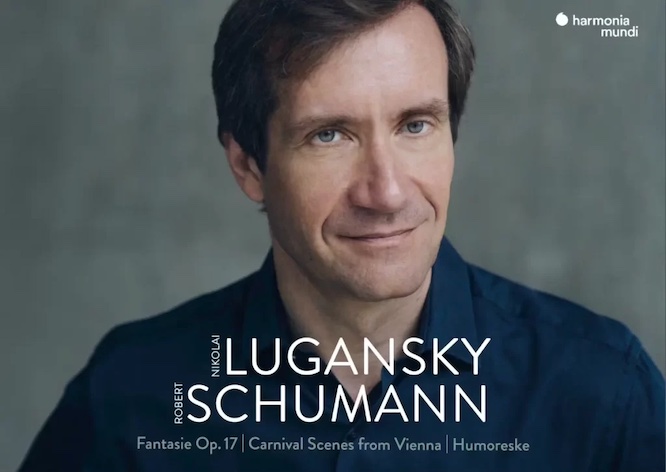
SCHUMANN: Fantasia in C Major, Op. 17; Faschingsschwank aus Wien, Op. 26; Humoreske in B-flat aor, Op. 20 – Nikolai Lugansky, piano – Harmonia mundi HMM 902753 (84:11) (2/6/26)[Distr. by PIAS] ****:
Pianist Nikolai Lugansky (26-28 May 2025) addresses three of Robert Schumann’s brilliant, imaginative constructs: the 1836 Fantasie in C; the Carnival-Jest from Vienna of 1839; and the Humoreske in B-flat Major, also from 1839. Inspired as much by his literary tastes as by his often frustrated romance with his future wife, Clara Wieck, Schumann experimented by subjecting his rhapsodic and spontaneous musical impulses to classical procedures, often with novel, startling results. Unlike his admired Beethoven, Schumann did not conquer large forms with easy security, and his extended pieces reveal a tendency to recycle short phrases in rondo form to achieve extended continuity. Nevertheless, Schumann’s simultaneous capacity for buoyantly exuberant spirits and refined, intimately passionate melodies guarantees the enduring status his body of piano works, some of which have gained high eminence in the canon of Romantic Music.
While I appreciate passion in performance, I take some umbrage at the clangor permitted Lugansky’s Steinway at the outset of the Fantasie, attributable to Nicolas Bartholomée for having rendered Lugansky more percussive than persuasive at several key points in this project. But Lugansky possesses a natural flair in Schumann, and his first movement of the Fantasie enjoys poise and poetic feeling, especially as he prepares to launch into the “legend” touched by Schlegel and Novalis. At moments, the music proceeds as a ballad in contrapuntally vocal motifs, addressed to Beethoven’s “distant beloved.” Lugansky’s florid runs and bass chords testify to a fluent technique in the service of noble aspirations, the pauses pregnant with attendant – if sonically inflated – drama.
Many commentators find parallels between Schumann’s martial middle movement and its parallel in Beethoven’s Sonata No. 31 in A-flat Major, Op. 110. A truly challenging, virtuoso, syncopated showpiece, especially in tis demonic coda, the movement alludes to Beethoven in his operatic guise, quoting from Fidelio. The Steinway tone once more proves trying, effecting a persistent fortissimo where softer nuances should be. The middle section relents a bit, allowing Schumann’s playful side some latitude. As energized as Lugansky performs this section, I had my first impression formed by a master colorist, Robert Casadesus.
The last movement shimmers with impulses from Beethoven’s Sonata quasi fantasia, the “Moonlight Sonata.” The sense of a haunting or haunted atmosphere permeates the progression, the tracery delicately intimate. Schumann regarded his Fantasie, dedicated to Franz Liszt, as among the most passionate pieces he ever conceived. Both Schumann and Liszt had engaged in a project to build, in Bonn, a monument to Beethoven; and this Fantasie served as a Greek obol, a symbolic coin to pay for traversal across the mythical Styx. A small but necessary token of love for the dead and for the ever much alive passion in Schumann’s heart for his absent Clara.
The year 1839 found Schumann in Imperial Vienna, and the engaging spirit of the city appealed to both Florestan and Eusebius, the duality in Schumann’s psyche. His five-movement Carnival-Prank, his self-styled “Romantic showpiece,” assumes some political irreverence when he parodies in the expansive, opening rondo the French patriotic song La Marseillaise, banned in Vienna since the time of Metternich. Again, Lugansky’s bold chords overly resonate with close microphone placement, but the antic humor of the piece shines through. The “jest” motif will serve as a unifying device throughout the composition. Follows a slow, wistful Romanze that utters a few terse phrases in obsessive plaints. The Scherzino enjoys a dotted-rhythm swagger that never quits its self-assured buoyancy, even as its chords modulate in unexpected directions. Intermezzo erupts with the passion of Schumann’s intensely personal Eusebius, a potent, ardent ( G minor) song rife with tender arpeggios. The last movement Finale offers a full-blooded toccata that Florestan asserts with flippant aggression, hand over hand. The secondary theme, too, casts a romantic ardor that ingratiates the piece to our collective memory, a phenomenon first revealed to me by Arturo Benedetti Michelangeli.
Set in the same B-flat major (and G minor) as the “Vienna Carnival,” Schumann’s 1839 Humoreske capitalizes on the German sense of synoptic perspective, a la Dante, whose Divine Comedy passes through stages of dire, grotesque tragedy and spiritual contemplation to a cosmic appreciation of the totality of Life. Recall that mit humour constitutes one of the tempos of initiation in the Dances of the Davids-League. Like Vladimir Ashkenazy, Lugansky savors this mesmerizing piece of “inwardness,” opening with a lovely Einfach that is soon countered by Sehr rasch redolent with the writings of Jean-Paul Richter that literally “gallop” in Schumann’s often martial sensibility. The force of Lugansky’s attacks enjoy a piercing resonance, the kind of vibrancy in Schumann that Horowitz would project.
Hastig plays like a powerfully extended, sectionalized Chopin étude in dynamics and color combinations. More delicate, chromatic colors ensue from Lugansky in the ternary Einfach und zart, which begins contemplatively but urges forward into another toccata. The soft return of the initial material has a decided poignancy from Lugansky. Innig defines one of the true essences in Schumann, a charming, dotted dance emergent from the tender, opening musings. Eusebius has spoken, so Florestan must declaim in Mit einegem Pomp, a multi-knuckled, vehement exercise in layered, chordal chromatics and shifting metrics. A little softer, in my estimation, would have been preferred. Schumann marks his finale, Zum Beschluss, or “onwards to decision,” which has the quality of a contemplative ballade, a rather puzzling postlude in terms of its searching, dark chromatic line. If humor inhabits this canonic study, it lies in subtle contrasts of chiaroscuro and a gentle reprise of small melodic kernels that have permeated and tied the whole together.
—Gary Lemco

.
by Audiophile Audition | Mar 30, 2026 | Pop/Rock/World CD Reviews, SACD & Other Hi-Res Reviews
Intervention Records releases a vibrant 45r.p.m. 180-gram vinyl of Carl Perkins’ Sun Records catalog.
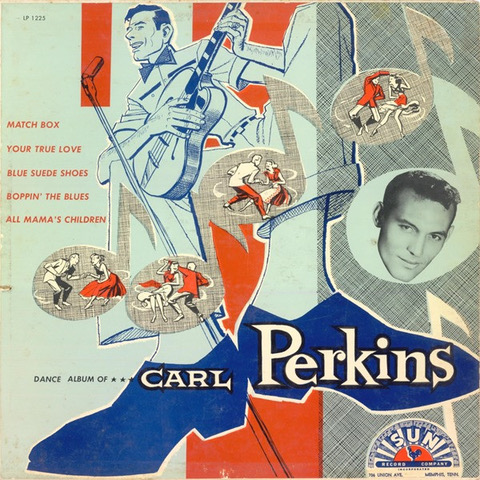
Carl Perkins – Dance Album Of Carl Perkins – Sun Record Company LP-225 (1958)/Intervention Records IR-038 (2026) 180-gram 45 r.p.m. mono vinyl, 31:04 *****:
(Carl Perkins – guitar, vocals; plus many others)
The rockabilly phenomenon began at Sun Records. The rock and roll crossover stars included. Elvis Presley, Jerry Lee Lewis, Johnny Cash and Roy Orbison. Perhaps the most notable of the Memphis-based rockabilly artists was Carl Perkins. “The King Of Rockabilly” wrote hit songs like “Blue Suede Shoes”, “Honey Don’t”, “Matchbox” and “Everybody’s Tryin’ To Be My Baby”. These became part of the commercial music scene, covered by artists like The Beatles (maybe the biggest disciples), Jimi Hendrix, Elvis, Johnny Cash and Eric Clapton. Perkins was highly regarded for his nimble guitar techniques consisted of finger picking, arpeggios, open stringing, note-bending and cross picking.
Intervention Records has released a 180-gram 45 r.p.m. mono vinyl of the 1958 album, Dance Album Of Carl Perkins. This was a compilation of singles and B-sides (with 10 original compositions). These 12 tracks, logging in at approximately 31 minutes is a quintessential look at rockabilly and the legacy of Perkins. Side A opens with the eternal rock and roll classic, “Blue Suede Shoes”. This swinging jam has youthful energy (“Go Cat!), country blues power and nimble guitar licks. Perkins has deep country roots. “Movie Magg” has subtle touches like harmonic guitar notation and a slight nod to traditional “yodel” singers. In an expansive arrangement, “Sure To Fall” has flowing tempo, ragged harmonizing and jangling guitars that frame Perkins’ emotional vocal delivery. His intermingling of blues and contemporary idioms is prevalent on “Gone, Gone, Gone”. It becomes a personal signature and will get anyone up dancing at a roadhouse. Another popular single, “Honey Don’t” is a breezy hook-filled jam that stands the test of time. The subject of angst-ridden love and rock and roll is a natural fit for the crisp instrumentation and vocals.
There is an element of good vibes in these cuts. Perkins steps up for his home state in “Tennessee”, name dropping Eddy Arnold, Red Foley and the first atomic blonde. But the reaL focus is playing in “the hillbilly way”. Humor abounds on “The Right String/Wrong YoYo”, as Perkins puts a lot of energy into the finger picking and yowling vocals. Another often-covered single, “Everybody’s Trying To Be My Baby” is translated to a bluesy shuffle with punctuated instrumentals and vocals. Another rollicking blues jam is “Matchbox”, utilizing propulsive rhythm and plenty of rebellious attitude. There is a change in musical direction on “Your True Love”. This feels like a country version of doo wop with soulful back up vocals. The finale, “Boppin’ The Blues” is pure rockabilly and swings like r & b.
This re-mastered vinyl of Dance Album Of Carl Perkins is an excellent addition to any rock and roll collection. Using original 1/4’ analog tapes (in a three-step process) from Sun Records, the mix (Kevin Gray/CoHEARent Audio) is crystalline and potent with detailed attention to Perkins’ guitar and fluid vocals. While the sound is augmented from the 1950’s studio aesthetics, it is not overproduced and never interferes with the straight ahead dynamics. This pressing (Gotta Groove Records) is pristine with little surface noise or tonal distortion.
Highest recommendation!
—Robbie Gerson
Dance Album Of Carl Perkins – Intervention Records
Side A:
Blue Suede Shoes; Movie Magg; Sure To Fall; Gone, Gone, Gone; Honey Don’t; Only You
Side B:
Tennessee; Wrong YoYo; Everybody’s Tryin’ To Be My Baby; Matchbox; Your True Love; Boppin’ The Blues.

by Audiophile Audition | Mar 29, 2026 | Classical CD Reviews
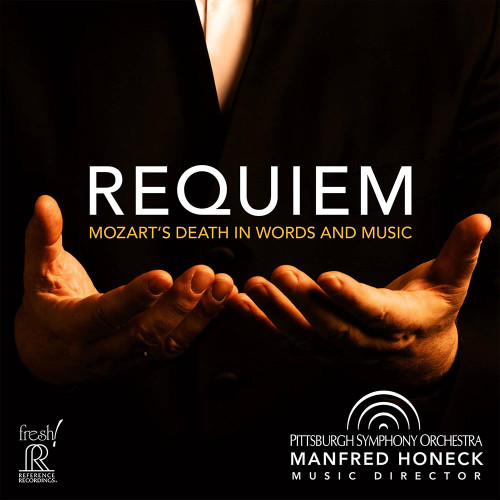
“Requiem – Mozart’s Death in Words and Music” = Mozart Requiem; Masonic Funeral Music; “Laudate Dominum”; Ave verum corpus; Gregorian chants – F. Murray Abraham, narrator/ Jeanine De Bique, soprano/ Catriona Morison, mezzo-soprano/ Ben Bliss, tenor/ Tareq Nazmi, baritone/ Pittsburgh Sym. Orch./ Manfred Honeck – Reference Recordings multichannel SACD FR-761, (complete listing and credits below) 60:13 ***1/2:
To be honest—I am not sure that this program works in the way that conductor Manfred Honeck envisions it. He has been offering this program in concert for a long time (in fact, I believe you can find it on YouTube), and it is obviously an extremely personal, and pious meditation on both the death of one of the greatest geniuses of all time as well as a profoundly introspective attempt at consideration of human death and the hope that lies beyond this mortal coil. Honeck lays out a liturgical scheme of the Requiem by Mozart in the context of a Requiem for Mozart. Interspersed are a few other pieces by the composer, and short tropes of Gregorian chant and poetry and scripture readings.
Yet buyer beware! This is not a performance of the Mozart Requiem in toto that you may be seeking. Though Honeck makes use of the Süssmayr completions, everything beyond the “offertorium” – Sanctus, Benedictus, Agnus Dei, Communio, Lux Aeterna, and Cum sanctis tuis – are absent.
So what to make of this? Seeing this in concert is probably a wonderful experience, because you know what you are in for, and the concept is a fascinating one. Listening to it on SACD (in splendiferous sound/mirror super audio sonics) is also an invigorating and very devotional exercise, the renderings of every piece done beautifully, with the orchestra and (thankfully) very large chorus trained to a fare-thee-well. But for repeated listening I am not sure; perhaps every once in a while I will pull this out, but I am far more likely to grab a favorite recording of the Requiem sans interpolations, as the piece itself is such a marvelously devotional and spiritual undertaking by itself.
To note—had it been a complete recording of the Requiem alone, it would have shot to the top five or six of the best versions available. Honeck, as usual, brilliantly defends everything he does in this music, looking at the notes and emotional context of the work to justify any dynamic changes and tempi that he chooses. You might not agree with all of it, but after reading his explanations one certainly cannot fault the logic of his arguments, and after so many sterile period instrument performances over the years, a little passion in interpretation is genuinely welcomed.
It was tough to review this, as a steady basis for evaluation is absent. Let me say this—If it is just the Requiem you seek, you might look elsewhere. If this sort of thing interests you, a combination liturgical reconstruction and philosophical meditation on life and death using Mozart’s own as a template, then you will not be disappointed as all performances are superlative.
—Steven Ritter
Requiem – Mozart’s Death in Words and Music
Requiem in D Minor, K. 626
Masonic Funeral Music in C Minor, K. 477
“Laudate Dominum” from Vesperae solennes de confessore, K. 339
Ave verum corpus, K. 618
various Gregorian chants
F. Murray Abraham, narrator
Jeanine De Bique, soprano
Catriona Morison, mezzo-soprano
Ben Bliss, tenor
Tareq Nazmi, baritone
Pittsburgh Symphony Orchestra
Manfred Honeck, conductor
by Audiophile Audition | Mar 28, 2026 | Pop/Rock/World CD Reviews, SACD & Other Hi-Res Reviews
Johnny Cash’s Sun Records debut gets a significant vinyl upgrade and sounds better than ever!
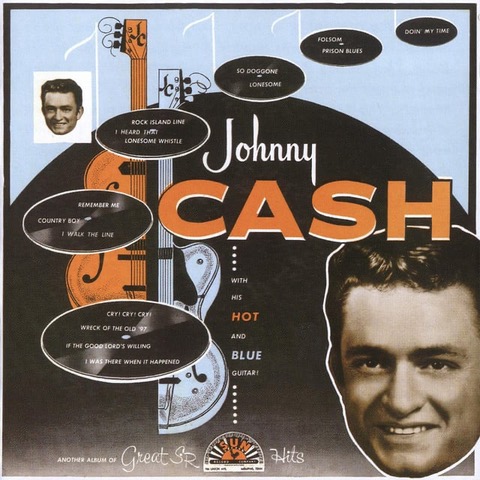
Johnny Cash – Johnny Cash With His Hot And Blue Guitar! – Sun Record Company LP-1220 (1957)/Intervention Records IR-039 (2026) 180-gram 45 r.p.m. mono vinyl ****1/2:
(Johnny Cash – acoustic guitar, vocals; Luther Perkins – electric guitar; Marshall Grant – double bass)
The influence of Memphis record label Sun Records on modern rock and roll is significant. The intermingling of blues with country music created a new genre called rockabilly. Often recorded with minimal instrumentation, songs included “snapback” and echo. In 1954, a local singer named Elvis Presley released “That’s All Right”, leading the way for other seminal hits like “Blue Suede Shoes” (Carl Perkins), and “Whole Lotta Shakin’ Goin’ On” (Jerry Lee Lewis). One of the earliest crossover country stars was Johnny Cash. While his roots were in gospel, he ended up at Sun Records in Memphis with all of the artists trying to reach a rock and roll audience. But Cash was a different breed of musician, creating his own unique blend of folk, blues and traditional country.
Intervention Records has released a 180-gram 45 r.p.m. mono vinyl of the 1957 debut on Sun Records, Johnny Cash With His Hot And Blue Guitar!. The instrumentation is pared-down with Cash on acoustic guitar, Luther Perkins on electric and Marshall Grant on double bass. The focal point is Cash’s rumbling baritone. Side A opens with a classic talking blues train song, “Rock Island Line” (popularized by Huddie Ledbetter). Cash narrates the opening verse as the band creates a trademark 50’s “boom chick-a-boom” groove. There is a tempo uptick that is catchy. Next up is an unforgettable prison/train song from Hank Williams, “I Heard That Lonesome Whistle”. In a slower waltz-time, Cash recounts the poor decisions of a young man with his unique vocal style. His humorous enunciation of the word “lonesome” is uncanny.
Picking up the tempo, “Country Boy” (the first of four original compositions) has a lively feel with imagery of fishing, working and even dogs. “If The Good Lord Is Willing” (an early Jerry Reed song), is a foot-stomping exploration of romance viewed through a gospel lens. Even in the beginning, Johnny Cash had a trademark style. His first single “Cry, Cry, Cry” is a master class in the relentless burden of unrequited love with rhythmic inflection and a rolling musical structure. Cash’s larger-than-life voice permeates the amiable, sardonic 3/4 time arrangement of “Remember Me”.
Cash manages to exude pathos and humor on “So Doggone Lonesome”. His relaxed delivery merges with Sunday testimony (and backup vocals) on “I Was There When It Happened”. Like most of the songs on this album, it feels authentic and impossible to imagine any other musician coming up with a comparable version. One of the certain highlights is “I Walk The Line”. With impeccable rhymes and railroad cadence, Cash weaves his commitment to love with emotional verve and unexpected singing range. Returning to restless traveling, “The Wreck Of Old ’97” is high-octane. Perhaps the signature number for early Johnny Cash is the heart-wrenching ‘Folsom Prison Blues”. This also represents some of his best songwriting. Phrases like “I shot a man in Reno, just to watch him die” and “I let that lonesome whistle blow my blues away” are part of the outlaw culture. The finale (“Doin’ My Time”) embraces the ever-present themes of jail and being with “that gal of mine”.
Johnny Cash With His Blue And Hot Guitar! is a historical recording. Cash transcends the Sun Records rockabilly genre with fresh roots-based music, showcasing a consistent artistic vision. The re-mastered sound (100 % analog with a 1/4” transfer from original master tapes) and modern lacquer pressing expand the overall sound dynamics (Kevin Gray/CoHEARent Audio). The “low-fi” sensibility is maintained with quiet aesthetics and excellent centering of Cash’s deep voice.
Highly recommended!
—Robbie Gerson
Johnny Cash With His Hot And Blue Guitar!
TrackList:
Side 1: Rock Island Line; I Heard That Lonesome Whistle; Country Boy; If The Good Lord Is Willing; Cry, Cry, Cry; Remember Me
Side 2: So Doggone Lonesome; I Was There When It Happened; I Walk The Line; The Wreck Of The Old ’97; Folsom Prison Blues; Doin’ My Time.
by Audiophile Audition | Mar 26, 2026 | Classical CD Reviews, Classical Reissue Reviews
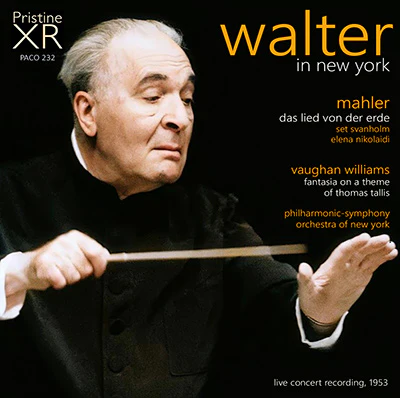
WALTER in NEW YORK = VAUGHAN WILLIAMS: Fantasy on a Theme by Thomas Tallis; MAHLER: Das Lied von der Erde – Set Svanholm, tenor/ Elena Nikolaidi, contralto/ New York Philharmonic Orchestra/ Bruno Walter – Pristine Audio PACO 232 (74:18) [www.pristineclassical.com] *****:
Pristine captures a special moment in the New York musical scene: from Carnegie Hall, 22 February 1953, Bruno Walter leads a radio-broadcast concert featuring the music of Vaughan Williams and Mahler, a most compelling aural spectacle of works set in contrasting modes of expression. Let me comment at the outset that Walter’s sonic achievement, the homogeneity of tone he achieves in the Philharmonic strings, anticipates in phrase and intensity of line, what Dimitri Mitropoulos would brilliantly commit to CBS for posterity in 1958.
Vaughan Williams had been working on his own English Hymnal, when in 1910, he came upon the third of nine psalm tunes composed in 1567 for the Archbishop Parker’s Psalter, Thomas Tallis’ Why Fumeth in Fight. Vaughan Williams conceives his Fantasia as a concerto-grosso study in contrasted string antiphons, comprised of a full string orchestra (as ripieno), a string quartet (as concertino), and a chamber string ensemble. The Fantasia premiered at the Gloucester Festival, and it has since had advocates of divergent temperaments, from Sir Adrian Boult, Sir John Barbirlli, and Leopold Stokowski to Louis Lane. Walter’s forces lean into the lush torment of the string line with a passion only equaled in my view by Mitropoulos. The mounted fury and retreating pulsations of the piece converge at a fearsome climax, a graduated rush tantamount to Wagner’s Tristan.
Gustav Mahler (1860-1911), eternally dreadful of the number “nine” for his symphonic oeuvre, turned to his love for poetry to fashion (1908-09) his six-movement Das Lied von der Erde, assembled after Hans Bethge’s The Chinese Flute, a series of ancient meditations on life and death, a profoundly personal revelation by Mahler concerning his obsession with mortality and the frailty of the human condition. Mahler only resumed the chronological numbering of his symphonies after “the curse of the Ninth” had passed, at least in his estimation. Swedish tenor Set Svanholm (1904-1964), noted for his Wagnerian characterizations after WW II, joins Bruno Walter and Greek contralto Elena Nikolaidi (1909-2002). Svanholm sets the tone in “The Drinking Song of Earth’s Woe,” whose poetic mode by Li Bai remains demure and detached, but whose musical realization verges on hysteria. “Dark is life, dark is death” as a refrain recurs, each entry one half-step higher, a hymn to existential pessimism.
The second movement, “The Lonely One in Autumn” (Qian Qi), provides a subdued, bucolic contrast, both celebrating and lamenting the ephemeral beauty of Nature, with Nikolaidi’s plaintive tone’s demonstrating the same stamina and unsentimental resolve as that of Svanholm. Her approach eschews the staggering drama we find in Kathleen Ferrier but instead provides a searching directness of expression that carries its singular pathos. Movement three, “Of Youth,” depicts a party inside a pavilion that borders a lake, so that the reflected image upon the water of the callow youths “comments” on the lucid illusion of strength and vitality. The “exotic” character of Mahler’s instrumentation basks in colors, transparent and intense, a wonderful, abbreviated ternary-form, alternative to what the French Impressionists were constructing at the same period in musical history.
Another singular contrast in human interaction enters with “Of Beauty,” intoned by Nikolaidi, as a group of young maidens sits by a riverbank plying restrained tones while, on horseback, a small band of young men pass by. Whatever flirtation exists in the meeting, the music explodes into fanfare effects, with Nikolaidi’s becoming more insistently breathless. The postlude proves hazy, transparent, and lyrically nostalgic in a chamber-music texture. “The Drunken Man in Spring” serves as a dramatic comic-relief, a pointed scherzo, an expression of emotional indifference to fate and mortality: “Life is a dream, so why worry and travail? I drink all day, glutting my fill, until I can imbibe no more!” Svanholm thrusts the inflated baits at Fate with hearty passion, the irony of the occasion indeed a snake devouring its own tail.
Mahler’s last movement, “Der Abschied,” compresses poetry by Mong Hao-Ran and Wang Wei with (final) lines added by Mahler himself. We have leave-taking on a grand scale, yet delicately intoned and colored by brass, winds, strings, mandolin, harp and celesta, while the contralto calmly contemplates the terrible neutrality of the universe as we pass away. The Earth does indeed abideth forever, while Man contemplates his ephemeral presence. “Endless, endless shines the blue horizon. . .”
There do appear moments in Nikolaidi’s performance that rival what Walter and Ferrier achieved in pure pathos for their collaborations. Hearken to her repeated “Warum?” in the course of the long narrative. And shall we not credit flute principal John Wummer (1899-1977) for his endearing, oft flutter-tongued, contribution to the unity of effect? But never forget Bruno Walter’s long and fruitful experience in this work, which he launched into the musical world in 1911, shortly after the death of its composer. Walter’s advocacy, his faith in the message of this demanding, doubting, suffering composer, never wavered in stalwart, musical integrity and firmness of vision. Many thanks to Pristine and Andrew Rose for yet another document of musical authenticity on the highest level.
—Gary Lemco
by Audiophile Audition | Mar 24, 2026 | Jazz CD Reviews, SACD & Other Hi-Res Reviews
Ingrid Jensen’s Landings, another winner in the Newvelle 10 Anniversary collection…
Ingrid Jensen – Landings – Newvelle Records #NV037 – 180 gm audiophile vinyl – 2025 – ****1/2
(Ingrid Jensen – trumpet; Gary Versace – organ and piano – Marvin Sewell – guitars; Jon Wikan – drums; George Coleman – tenor sax (Side A #1)
For the second in the Newvelle Records tenth anniversary collection of five 180 gm vinyls, the label is presenting noted jazz trumpeter, Ingrid Jensen on Landings, with a quartet, on eight tracks. Ingrid is backed by organist, Gary Versace; guitarist, Marvin Sewell; and drummer, Jon Wikan, (Ingrid’s husband).
The mastering by Matthew Lutthans, and pressing on gorgeous clear vinyl, is of course, first rate, as Newvelle is noted for exquisite acoustics, and album packaging with over-sized coffee table quality album artwork (for this series, they are using Ragnar Kjartansson, with gallery art paintings).
The tracklist consists of five band originals, as well as three covers. Covering multi-genre influences, there is a polish, and a heavy swing throughout, with Jensen’s burnished trumpet tone, blended with Gary Versace’s soulful organ, and Marvin Sewell’s guitar prowess. Jon Wikan is rock solid on drums, steady, and always in the pocket.
Whether it be funk, modal, hard bop, or fusion, the interplay between the quartet is locked in, especially the communication between Ingrid and Gary.
Special guest, tenor saxist, George Coleman, still vital at age 91, opens the session with his “Amsterdam After Dark.” It’s classic hard bop, spiced up with Versace, on what appears to be a Hammond organ. It would be at home on a golden age Blue Note or Prestige date.
Ingrid’s “New Body” is moody and melancholic, with rubato guitar, and Jensen’s muscular trumpet playing has the power of a Woody Shaw, and the emotional impact of Miles Davis during his pre-electric period. Carla Bley’s “Ida Lupino” has a Latin vibe, and Marvin Sewell’s classical style guitar is featured, as well as the trumpet and organ sharing time. Also Versace’s swirling organ accents add to the mix. Next is Ingrid’s “Handmaiden’s Tale” a duet with Versace, now on piano.
The title track opens Side 2. It’s a post bop blend with fusion, and a heavy electric feel. The quartet blends seamlessly. Marvin Sewell’s “The Workers Dance,” is done in waltz time, and Marvin is taking lead, and the group’s layered mix is simply beautiful.
Versace’s “Many Homes, Many Places” has a heavy dose of funk, and Ingrid and Gary trade lead. “Home,” written by Jim Knapp, is languid, with some “grease” supplied by Versace. It would be right at home in a detective noir soundtrack.
From start to finish, this is a great album, with top notch sound. It has a contagious joy that translates to a deeply satisfying listening session. Highly recommended!
—Review by Jeff Krow
Ingrid Jensen – Landings
Trackist:
Side 1: Amsterdam After Dark, New Body, Ida Lupino, Handmaiden’s Tale
Side 2: Landings, The Workers Dance, Many Homes Many Places, Home

by Audiophile Audition | Mar 23, 2026 | Classical CD Reviews, Classical Reissue Reviews
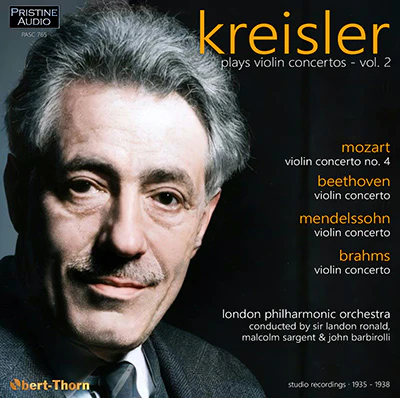
KREISLER plays Violin Concertos, Vol. 2 – Concertos by Mozart, Beethoven, Mendelssohn, Brahms – Pristine Audio PASC 765 (2 CDs = 2 hrs 14:48, detailed contents listed below) [www.pristineclassical.com] *****
Austrian violinist Fritz Kreisler (1875-1962) chose to re-record selected concertos in his repertory in order to take advantage of the improved electronic medium of the HMV studios in the 1930s. Though his early pedagogy embraced a Belgian tradition, Kreisler refined a decidedly Viennese approach to his music-making, founded on the performance style of Henri Wieniawski. Kreisler favored a showy, dramatic flair that emphasized large chords, virtuoso bowing techniques, double-stop and triple-stop fingering with tremolos and portamentos applied, delicate harmonics and pizzicatos, and always a fervent melodic line that urged his captivating, “liquid” tone. In the annals of great violin playing, perhaps Menuhin and Shumsky come closest to the pleading effect of Kreisler’s tone.
I began my audition of Mark Obert-Thorn’s meticulous transfers with the Mendelssohn Concerto (8 April 1935) with Landon Ronald. I find the performance compelling, if a bit mannered, in that Kreisler likes to underline every breathed phrase with a sighing effect, a product of his constant vibrato and emphasis on portamento. The gait remains leisurely, noble, ardently romantic, especially in the broad expressivity of the Andante movement. The innate charm and sincerity of Kreisler’s musical demeanor remain solid, despite the occasional nervousness of intonation. The sheer airiness of the last movement, its delicately brisk articulation, makes us admire the musician whose ease of phrase and sense of line require more study.
The Brahms Concerto, led by John Barbirolli (12 & 22 June 1936), enjoys a potent orchestral introduction from Barbirolli, whose career would soon take a fateful turn to New York to succeed Toscanini with the New York Philharmonic Orchestra. Kreisler openly admired Barbirolli, praising him as among the finest of accompanists. Kreisler’s projects a whiplash entry for the Allegro ma non troppo, rather gypsy in style, but rounding off in a delicate trill to a sweetly warm cantabile. Even the lengthy, parlando filigree enjoys a songful ease of motion until the arrival of the big melody over orchestral pizzicatos, intoned by Kreisler with burnished rapture. Kreisler’s aggressive attacks for the entry of the secondary episode heralds Barbirolli’s fanfare response, an ardent sense of the heroic line. That Kreisler can achieve a clean, chaste line no less finds occasional testimony in his quick adjustments of register and bow pressure. Having Kreisler perform his own, distinguished cadenza – as he does in the other two concertos – adds to the grandeur of the occasion.
The virtuosity of the London Philharmonic – itself the creation of the adventurous Sir Thomas Beecham – has a notable representative in oboe principal Leon Goossens, who does honor to the intimately persuasive Adagio. The last movement, the gypsy rondo, opens with an animal thrust that vibrates with feral passion. Kreisler applies a rasping effect and rapid strokes that border between staccato and spiccato effects, inspiring Barbirolli to exult in the occasion. The pace of the movement remains brisk, ardent without bathos or forced sentimentality. The momentum catches divine fire, and we should wonder with Lady Macbeth, who knew the old man had so much blood in him?
The Mozart D Major Concerto with Malcolm Sargent (11 February 1938) stands as Kreisler’s final, European commercial recording with orchestra. Like many violin soloists, Kreisler felt drawn to Mozart’s 1775 Concerto in D, with its French taste and courtly balances, capped by a “Strassburg” bagpipe melody that graces the last movement rondeau. The opening movement, Allegro, enjoys both ceremonial pomp and the luxuries of a serenade or cassation – given the elegance of the LPO woodwinds – with violin obbligato. Kreisler’s tone and technical fluency more than suggests why the Viotti Concerto No. 22 remained dear to his heart. A gracious, light hand guides the music to several dazzling displays of subtle, musical shifts in rhythm and inflection, suave and genial. The burnished sheen from Kreisler in this and all cadenzas warrant the price of admission.
The Andante cantabile second movement, though entirely lovely in execution, moves at a largo or adagio tempo, typical of virtually every performance I know, except that by Jiri Novak and Vaclav Talich. Richly lyrical and intimate as the performance by Kreisler realizes, the effect remains antiquated, but happily in the grand style. The last movement, Andante grazioso – Allegro ma non troppo, proffers a graceful, stately dance consisting of two themes, the second of which proves more animated. Kreisler plies his lowest string to invoke the hurdy-gurdy nostalgia of rural Austria or Italy. The leisurely canter concludes in a reprise of the animated version of the dance, intensified by a blaze of harmonious assistance from Maestro Sargent.
Fritz Kreisler had recorded the Beethoven Concerto in D in 1926 with Leo Blech and the Berlin state Opera Orchestra, a rendition some commentors find more classically controlled than the present version with John Barbirolli (16 and 22 June and 17 July 1936). The visceral, passionate impulse in the Barbirolli reading of the first movement Allegro ma non troppo, however, tends to support whatever tempo (rubato) decisions Kreisler may have imposed upon the linear progression of the concerto. The arioso passages in Beethoven sing with elegant grace, and Kreisler’s trill work maintains its diaphanous luster. Kreisler sustains his long line with taut control, segueing (via floating trills) to the marcato episodes with no loss of warm tension. The rapt sincerity of expression proves ubiquitous, and Barbirolli appears moved to gripping vehemence in his responses in the tutti sequences. As Richard Wagner points out in his 1870 essay on Beethoven, each musical element has become melody, testified to ultimately by the Fifth Symphony, where rhythm and melody become indistinguishable. It takes a discerning ear to catch the momentary finger slip in the contrapuntal cadenza, and to what end does one claim it? The coda provides the very soul of aesthetic closure, after some masterful playing has been accorded us.
A grand leisure suffuses the wonderful Larghetto second movement, a theme and variations in which Kreisler and the LPO woodwinds collaborate on an exalted level. Kreisler’s flute tone accompanies the LPO bassoon – and soon with pizzicato strings – in tender colloquy that springs from Orpheus himself. Another of Kreisler’s improvisatory cadenzas leads to the main impulse of the Rondo: Allegro, exerted with robust energy from both participants, with Kreiser’s demonstrating finesse in the various bowings at cadences required to add color to the warmly plastic proceedings. Barbirolli hustles to the suspended cadence for Kreisler’s final cadenza, a brilliant coloratura piece in itself that insists on elasticity of a sustained line. The hushed tones Barbirolli elicits from his ensemble gradually explode into what friend Richard Wagner called “the apotheosis of the dance,” the phrase I hereby transpose for my own, respectful purposes.
—Gary Lemco
KREISLER plays Violin Concertos, Vol. 2 (1935-38)
1MOZART: Violin Concerto No. 4 in D Major, K. 218;
2BEETHOVEN: Violin Concerto in D Major, Op. 61;
3MENDELSSOHN: Violin Concerto in E Minor, Op. 64;
2BRAHMS: Violin Concerto in D Major, Op. 77 – Fritz Kreisler, violin/
1London Philharmonic Orchestra cond. Malcolm Sargent/
2London Philharmonic Orchestra cond. John Barbirirolli/
3London Philharmonic Orchestra cond. Sir Landon Ronald
.
by Audiophile Audition | Mar 23, 2026 | Jazz CD Reviews, SACD & Other Hi-Res Reviews
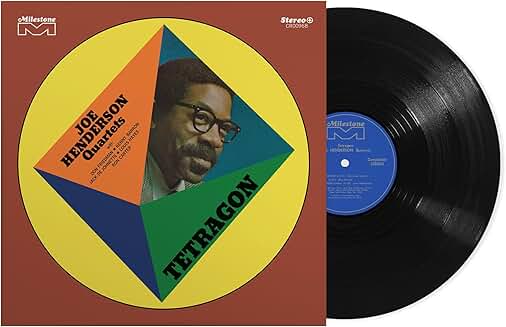
Joe Henderson’s Tetragon, now back on audiophile vinyl…
Joe Henderson – Tetragon – Milestone/Jazz Dispensary/Craft Recordings #CR00968 – 180 gm vinyl – 1967/68 – 42:04 – ****
(Joe Henderson – tenor sax; Don Friedman or Kenny Barron – piano; Ron Carter – acoustic bass; Jack DeJohnette or Louis Hayes – drums)
As part of their Top Shelf Series, Craft Recordings, is re-issuing a long out of print, Joe Henderson album, Tetragon, recorded in 1967 and 1968. Milestone Records, the original label, used two different rhythm sections, both with top grade credentials. The pianists were either Don Friedman, or Kenny Barron; and on the drum chairs were Jack DeJohnette, or Louis Hayes. Bassist, extraordinaire, Ron Carter, appears on both sessions All the players had already hit their strides as first call sidemen, or serving as leaders themselves.
As always, Craft has gone first class with this release, using lacquers cut from the original master tapes, by Kevin Gray at Cohearant Audio, and pressing on 180 gm vinyl. The albums are housed in a tip-on jacket.
At the time of this recording, Joe Henderson had fully established his career, and Milestone used him as the only horn here. Henderson was known for his dark tone, aggressive, and often pushing the envelope into very “free” territory. He could also be velvety, if needed, on ballads. Tetragon has a nice combination of both, on the seven tunes, with a few standards, and two tracks each, written by Henderson or Carter.
Side 1, opens with the standard, “Invitation,” and it is taken mostly straight ahead, with Joe immediately taking center stage, and an an excellent flowing solo by Don Friedman. “R.J.” was written by Carter for one of his sons. Don handles the fast tempo with ease, while Joe’s astringent tone jumps out.
“The Bead Game” is pure avant garde blowing by Joe, with no apparent melody. Jack DeJohnette is a perfect drummer for this track. Henderson goes out on stop/start runs, wild, and seemingly using free association. Certainly, it’s not for everyone.
Side 2, has the title track, a blues, which is right up the alley for Kenny Barron. Carter has an introspective bass solo, and Joe jumps in with intensity.
“Waltz for Sweetie,” written by Walter Bishop, is a welcome respite, a lovely ballad, and once again, the underrated, Don Friedman, has lovely choruses.
The closer, Cole Porter’s “I’ve Got You Under My Skin,” is taken at a brisk clip. Joe stays with the melody, but adds some “free” expression, when he sees fit.
Fans of Joe Henderson’s post bop career will find lots to like here. The remastered audiophile acoustics will enable listeners to fully appreciate his talents.
—Review by Jeff Krow
Joe Henderson – Tetragon
Tracklist:
Side 1: Invitation, R.J., The Bead Game
Side 2: Tetragon, Waltz for Sweetie, First Trip, I’ve Got You Under My Skin

by Audiophile Audition | Mar 19, 2026 | Classical CD Reviews
LISZT: Piano Transcriptions = Widmung; Isoldes Liebstod; Spinnerlied; Der Doppelgänger; Ständchen; Der Müller und der Bach; Frühlingsglaube; Soirées de Vienna; Valse de l’opera Faust – Indré Petrauskaité, piano – divine art ddx 21144 (51:57, comprehensive listing below) (12/11/25) [Distr. By Naxos] ****:
Lithuanian pianist Indré Petrauskaité boasts a distinguished pedagogy that includes Peter Flankl, John O’Conor, Robert Levin, Boris Berman, Leif Ove Andsnes, and Paul Lewis. The present all-Liszt-transcriptions album, recorded in 2007, embraces a portion of the Liszt legacy especially attracted to other composers for their potential as creative, virtuoso show-pieces that demonstrate the fecundity of the piano as both a salon and “symphonic” instrument.
Petrauskaité opens the recital with Liszt’s transcription of Robert Schumann’s 1840 lied “Widmung,” a florid arrangement of a love song meant for Clara Schumann, the composer’s newly-wed. The recording by Ruth Slenczynska set a standard that yet endures, and the present rendition projects its own, ardent lyricism, given that Liszt embellishes the left hand with a throbbing ardor and then proceeds, via cascades and daring leaps, to imbue the second half of the song with vehemence worthy of a virtuoso étude that echoes Schubert’s Ave Maria at the coda.
The 1867 transcription of “Isoldes Liebestod” unfolds slowly, in liquid figures under Petrauskaité, the harmonies unwilling to resolve as the tension mounts in symphonic evocations of erotic love and transcendent death. Some pianists prefer Moszkowski’s passionate rendering of this music, but Liszt has a full, titanic grasp of the symbolism of this sustained spasm of emotion, ending with the intertwining of the thumbs, the ivy and the vine. The sparkle and flavor of Petrauskaité’s closing arpeggios more than suggest her capacities in Debussy.
The 1860 transcription of Wagner’s “Spinning Chorus” from The Flying Dutchman flaunts keyboard virtuosity in runs and trills, all executed by a light hand. The influence of Mendelssohn’s A Midsummer Night’s Dream seems no less a presence, elfin and transparent. The layering of the registers as we approach the darting motions of the coda enjoys an astonishing fleetness of execution. A very different affect ensues, in the form of Schubert’s eerie lied after Heine, “Der Doppelgänger,” of 1828. The B minor tonality, as sustained by repetitive, dark chords and tremolos, attains a dire menace, as the narrator gazes upon his old beloved’s home to find it occupied by himself! In this rendition, Dostoyevsky might have found an echo of his reflections on this disturbing motif.
The urge to self-destruction finds grim realization in Schubert’s 1823 “Der Müller und der Bach,“ Liszt’s transcription’s dating from 1846. The recitative-like progression bears the weight of fatal self-reflection; and it is here that, in her liner notes, that Petrauskaité reveals the presence of a new Steinway instrument, a strong sonority long denied the concert halls of her home city, Kleipeda, Lithuania. Emotional consolation follows, in the form of Schubert’s 1820 lied “Frühlingsglaube,” the poem by Uhland set for solo keyboard by Liszt in 1838.
The need for affective calm establishes itself in A-flat major, a lovely parlando that allows Liszt to introduce – within this Spring evocation – improvisatory elements and their assuaging colors. A beautiful transparency illuminates the reading. The last of the Schubert song transcriptions, “Hark, Hark, the Lark” (1826), derives from Cymbeline, Shakespeare’s 1611 Celtic romantic tragedy. Liszt set this song for solo piano between 1837-38. The virtuosity in this piece is most subtle, lying in degrees of touch and inflection rather than bold, stentorian declamations.
In a rather percussive mode, Petrauskaité sails into Schubert’s Soirées de Vienne, arrangements by Liszt of selected Schubert waltzes, which exist in plenty. When the pulverized dust clears, some enchanting dances emerge, swaying, lilting, and darting forward as the impulse requires. Liszt’s idea of improvisation lies in adding fioritura to the waltz in variation, shifting registers and accents while maintaining a basic pulse, a lesson well taught by Chopin. For seven minutes, we bask in the throes – not always gentle but splendidly ornamented – of the salon world well documented by Stefan Zweig in The World of Yesterday.
For her grand coda, Petrauskaité chooses what would offer the most bravura opportunity: Gounod’s Faust waltz as arranged by Liszt. Our artist in her notes mentions Gyorgy Cziffra as among the great exponents of this brilliant piece, but she opts for a lyrically subdued reading, although her instrument projects its own, upper-register pearls. Introspective, the interpretation gives us the meditative Faust, less in the throes of Mephistopheles than of Gretchen (or Marguarite, if you prefer), rippling and advancing by such water drops as we find in the Villa d’Este. Liszt’s own fioritura, of course, must intrude, and we soon feel as though in the grip of one of the more pungent Hungarian Rhapsodies. The last pages serve as cadenza-coda, a super changed plummet above and below, ending with the hammer blows of fate.
—Gary Lemco
Indré Petrauskaité – LISZT: Piano Transcriptions
Widmung, S. 566;
Isoldes Liebstod, S. 447;
Spinnerlied from Der Fliegende Hollander, S. 440;
Der Doppelgänger, S. 560/12;
Ständchen (after Shakespeare), S. 558/9;
Der Müller und der Bach, S. 565/2;
Frühlingsglaube, S. 558/7;
Soirées de Vienna No. 6, S. 427;
Valse de l’opera Faust, S. 407
by Audiophile Audition | Mar 17, 2026 | Jazz CD Reviews, SACD & Other Hi-Res Reviews
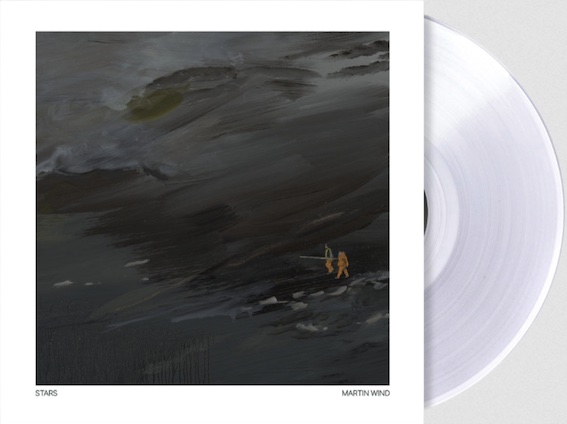
Martin Wind – Stars- “and a good time was had by all…”
Martin Wind – Stars – Newvelle #NV036 – 180 gm vinyl – 2025 – *****
(Martin Wind – bass; Anat Cohen – clarinet; Kenny Barron – piano; Matt Wilson – drums)
Newvelle Records, the exquisite boutique LP label is celebrating their tenth anniversary with their Newvelle 10 series. It consists of five albums to be issued at the beginning of 2026, and every few months, concluding in August.
Each album is getting the deluxe treatment, (just like they have been doing since the label was founded by Elan Mehler!), this time with Stoughton tip-on gate fold jackets, mastering by Matthew Lutthans, and using Quality Record Pressings, on clear white vinyl. The album artwork, was done by Ragnar Kjartansson, and would be suitable for display.
Opening the series is bassist Martin Wind’s Stars. What better way to start the series than teaming Martin with three members, who could each command center stage at Avery Fisher Hall: clarinetist, Anat Cohen; iconic pianist, Kenny Barron; and drummer for all seasons and genres, Matt Wilson.
The song list consists of three Wind originals, and six other tracks, including two by Ellington, one by an Ellington bassist (Aaron Bell), a Brazilian samba, a Bud Powell tune, and a chestnut (“Stars Fell on Alabama”), made famous by Ella and Louis.
What stands out immediately is the ease and sophistication shown by this dream quartet. Anat Cohen’s clarinet tone is glorious and ethereal, as she caresses the melodies, like frosting on the cake. What can you say about Kenny Barron that hasn’t been said in spades over the years? His touch is golden, silky smooth, and this song selection is made for him, whether it be swing, blues, or a bit boppish (on Bud Powell’s “Wail”). Matt Wilson is the perfect drummer for this setting, with great accents, and tasty brush work.
Martin Wind is clearly in heaven, having the chance to finally back Kenny, with Anat and Matt onboard, just to sweeten the pot. Martin’s originals shine, as he provides the pulse on “Life,” honors James Moody, with whom he backed for years, on “Moody,” and helps set a wistful, melancholy mood on “Standing at the Window Waving Goodbye.” He also shows his arco bass chops on the Brazilian samba, “Pra Dizer Adeus,” which was also made to order for Anat Cohen’s love of this idiom.
The Ellington tunes, “Black Butterfly,” and “The Feeling of Jazz,” would do Duke proud, with Cohen providing Johnny Hodges’ sensuousness on the former, the group’s easy going swing bringing a Cotton Club vibe to both.
The closer, “Stars Fell on Alabama” is old school sweetness, and a happy ending to a, “put a smile on your face” pure class session. What a delightful way to celebrate a ten year anniversary. We’ll surely get more chances to honor Newvelle, as the rest of the series unfolds in the next several months!
—Review by Jeff Krow
Martin Wind – Stars – Newvelle
Tracklist:
Side A: Passing Thoughts, Life, Black Butterfly, Moody, Wail
Side B: The Feeling of Jazz, Pra Dizer Adeus, Standing at the Window Waving Goodbye, Stars Fell on Alabama