by Audiophile Audition | May 31, 2026 | Pop/Rock/World CD Reviews, SACD & Other Hi-Res Reviews
Craft Recordings releases a re-mastered vinyl of a modern bluegrass legend.
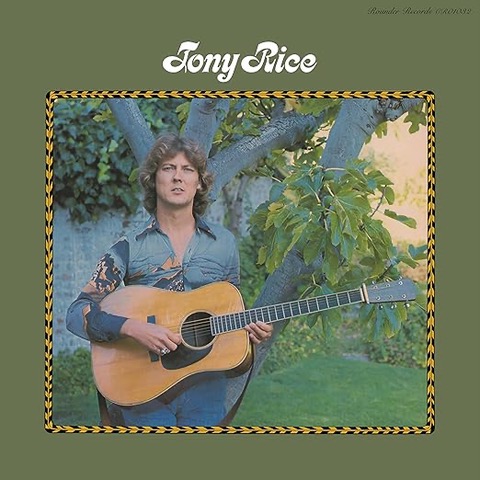
Tony Rice – Tony Rice – Rounder Records (1977)/Craft Recordings CR01032 [06/05/2026] stereo vinyl, 41:37 ****1/2:
(Tony Rice – guitar, vocals; Larry Rice – mandolin, vocals; Todd Phillips – bass; Jerry Douglas – Dobro – Richard Greene – violin; Darol Anger – violin; David Grisman – mandolin, vocals; J.D. Crowe – banjo, vocals)
Bluegrass guitarist, composer and singer Tony Rice was an influential figure in Modern Country. His acoustic style reflected a variety of genres, including jazz, bluegrass and folk, like his contemporary David Grisman. His playing (which included flat-picking and cross-picking) was rhythmic, and the solos were crisp and economical. Rice played with the likes of Grisman, Norman Blake, Ricky Scaggs, Peter Rowan, Chris Hillman, Jerry Garcia, Alison Kraus and Bela Fleck. He is regarded as an influential guitarist who infused measured, well crafted lines into his instrumentation.
Craft Recordings has released a re-mastered vinyl of Rice’s 1977 self-titled album. Joining him is an all-star lineup consisting of Jerry Douglas, David Grisman, Larry Rice, Darol Anger, J.D. Crowe and Richard Greene. This recording contains no overdubbing and is rooted in bluegrass, but with stylistic diversity. Side One opens with a traditional song, “Banks Of The Ohio”. With brother Larry on mandolin and tenor harmony, the song glides with breezy articulation and earnest vocals, framing a tale of failed romance and murder. Jerry Douglas and Richard Greene add some interesting accents on dobro and violin.
“Rattlesnake” exudes a Django-inspired resonance with Rice, Grisman and Anger (violin) exchanging lively solos. In a waltz-time lament, “Mr. Engineer” boasts three-part harmony and Rice’s deft guitar in crafting another love disappointment, replete with railroad imagery. A freewheeling jam (“Plastic Banana”) is illuminated by the energetic riffs from Grisman and Rice, with Greene providing counterpoint. “Don’t Give Your Heart To A Rambler” is another traditional “cautionary tale” that features J.D. Crowe on banjo. Rice’s “high” baritone is fluid and adds emotional depth. Returning to instrumental format, “Farewell Blues” is an adrenalized country picking jazz ramble, showcasing guitar, banjo mandolin, violin and dobro all propelling the up tempo arrangement.
Side Two has a similar mixture of instrumental and vocal numbers. “Way Downtown” (notable part of Doc Watson’s repertoire) is a sprightly performance with great soloing by Crowe, Rice and Grisman. “Stoney Creek” is an unadulterated bluegrass celebration with solos on dobro, guitar, mandolin and violin. It touches on different modes, but stays in the musical pocket that defines this album. Slowing down the tempo to a gentle 3/4 signature,
“Hills Of Roan County” (also covered by Ralph Stanley and Townes Van Zandt) has dual violins, subtle guitar and a very heartfelt vocal delivery by Rice. “Eighth Of January” (another traditional composition) is scaled down to a quartet, with scintillating runs by Rice and Anger. A certain highlight is “Big Mon” as Grisman unleashes blistering runs. Greene and Anger shine on their duet. Crowe and Douglas bring passion and texture to this cohesive translation. The finale (“Temperance Reel”) may be the most jazz-infused track with Grisman and Greene cutting loose with swinging verve.
Tony Rice is a unique listening experience. Re-mastered sound (Kevin Gray/Cohearant Audio) is vibrant with pristine detail and great stereo separation .The instrumental acuity is consistent and accessible.This vinyl (Fidelity Record Pressing) is excellent with minimal surface noise and no hisses or pops. There are incisive liner notes from San Francisco Examiner writer Phillip Elwood. It is an album that can be appreciated by bluegrass aficionados and anyone looking to explore this unique genre.
Highly recommended!
—Robbie Gerson
Tony Rice
TrackList:
Side One: Banks Of The Ohio; Rattlesnake; Mr. Engineer; Plastic Banana; Don’t Give Your Heart To A Rambler; Farewell Blues
Side Two: Way Downtown; Stoney Creek; Hills Of Roane County; Eight Of January; Big Mon; Temperance Reel

by Audiophile Audition | May 28, 2026 | Classical CD Reviews
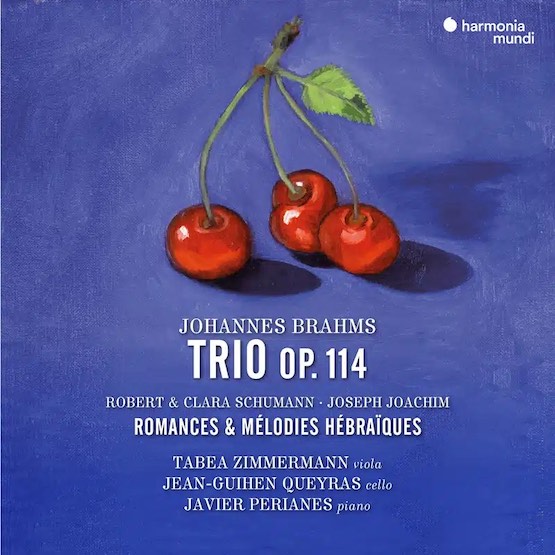
BRAHMS: Clarinet Trio in A Minor, Op. 114; BRAHMS/DIETRICH/R. SCHUMANN: F.A.E. Sonata: Scherzo in C Minor (arr. Zimmermann); C. SCHUMANN: Three Romances, Op. 22; R. SCHUMANN: Three Romances, Op. 94; JOACHIM: Hebrew Melodies for Viola and Piano, Op. 9 – Tabia Zimmermann, viola/ Jean-Guihen Queyras, cello/ Javier Perianes, piano – Harmonia mundi HMM 902789 (73:28) (3/13/26) [Distr. by PIAS] ****:
By 1891 Johannes Brahms seemed resigned to fade into obscurity, having composed nothing for over a year, and making only occasional visits musically since having completed his formal will. Yet, by chance, almost akin to Mozart’s discovery of a clarinet player, Anton Stadler, the city of Meiningen delivered to Brahms a rare talent in clarinet artistry, Richard Mühlfeld (1856-1907), a former violinist who became, through self-teaching, the orchestra’s principal clarinet player, who suddenly inspired Brahms to four significant works: two Sonatas, Op. 120; the Trio, Op. 114; and the Quintet, Op. 115. Having considered his Op. 111 String Quintet his last piece prior to official retirement, Brahms finds a melodic wellspring in the tone colors of the clarinet, and he offers love songs to the instrument proper. This disc (rec. 14-17 September 2025) places the Brahms Trio in the context of his inner circle of musical colleagues, the Robert Schumanns and violin virtuoso and pedagogue Joseph Joachim (1831-1907).
The disc proper opens with the hybrid collaborative piece, the so-called F.A.E. Sonata’s Scherzo movement, written in 1853 for violin and piano by Brahms as part of a four-movement that remained unpublished until 1935. Initially, as a kind of party joke for violinist Joseph Joachim, Brahms, Robert Schumann, and one of Schumann’s pupils Albert Dietrich (1829-1908) wrote the frei aber einsam (free but lonely) motto work “in expectation of the arrival of a revered friend,” with the proviso that Joachim identify each composer of the four movements, which he subsequently did. This C minor movement first revealed itself to this listener by way of Yehudi Menuhin. Zimmermann’s transcription captures the athletic, throaty vigor of the ternary-form work, whose middle section admits an ardent romantic’s sensibility.
The application of ternary, song-form no less dominates the Three Romances, Op. 94 by Robert Schumann, his sole composition (1849) for oboe and piano. While each of the triptych gravitates between the major and minor mode of A, They do betray that homogeneity of affect that infiltrates virtually all the late Schumann works with a tendency to repetition-in-variation. The first in A minor proceeds tranquilly, and Zimmermann’s transcription brings out the long, liquid capacities of her instrument (by Patrick Robin, 2019). Romance No. 2 enjoys a folk element in A major, whose middle section becomes increasingly, inwardly passionate. The last of the set, though marked Nicht schnell, exhibits the most agitated rhythmic impulses and sudden shifts of mood. Once more the middle section sounds much like something by his musical progeny, Brahms.
Clara Schumann (1819-1896), the composer, lists a brief catalogue, regrettably, since she possessed a distinctive voice apart from her husband’s influence. The Three Romances, Op. 22 (1853) were composed specifically for Joachim as a result if his performance of the Beethoven Concerto with conductor Robert Schumann. The long lines of the opening Andante molto do include a reference to Robert’s first violin sonata. The second movement Allegretto engages in playful dialogue with (transcribed) viola and piano. The third of the set, Leidenschaftlich Schnell, possesses a passionate intensity that Joachim declared “a delight to play, marvelous and heavenly.” Zimmermann’s persuasive arrangement makes of the viola – with some sweeping, ardent accompaniment from Perianes – a sweetly aerial vehicle for Clara Schumann’s ideas in homage to a gifted friend.
The musical catalogue for Joseph Joachim the composer remains scanty at best, barring his fine cadenzas for the major concertos of Beethoven and Brahms and an occasional overture or concerto. His three Hebrew Melodies for Viola and Piano (1855), according to the excellent notes by Stephen Pettitt, trace their etiology to 1815 poems by Lord Byron as set to music by one Isaac Nathan. The first, Sostenuto in G minor, proceeds in darkly long phrases and syncopated piano accompaniment, though the sound resembles Scottish rather than Hebraic airs. More “semitic” in sound, perhaps, the extended second Melody, Grave in C minor, might have influenced Max Bruch’s notion of a Hebrew chant in distinctive declamatory and wistfully arioso periods. The last of the set, Andante cantabile in F major, proceeds chromatically in extended viola lines, the piano rhythms in shifting motion.
The viola arrangement of the Brahms Clarinet Trio belongs to the composer himself, a pragmatic gambit to allow Joachim and Clara Schumann to enjoy the score. The dominant character of the mature Brahms style lies in the balance of textures he achieves, given his long experience of instrumental sonorities. Queyras’ Stradivari 1707 cello opens the initial Allegro with two themes, repeated and expanded by the viola. The time values increase in riding arpeggios and falling scales, the piano’s having introduced some broken phraseology. Brahms utilizes his gift for counterpoint and his penchant for falling thirds in the development, the emotional intensity having also increased as much in quiet episodes as in full-throttled, forceful statements. I must confess that, at moments, the proximity of tenor in the viola and cello run dangerously close to an overlap, blurring their individual character.
The calm Adagio that follows lasts for a mere 54 measures; nevertheless, it embraces (in falling thirds) a diapason of emotion, set in two extended themes, the second of which benefits from the cello’s pizzicato. The colloquy of three instruments achieves a mournful but honed sentiment that sustains us to the end with rich and varied tones from Zimmermann. The third movement, Andantino grazioso, provides an Austrian interlude in the form of a waltz, vocally the equivalent of his Opp. 52 and 65 Love-Song Waltzes. The rustic middle section would yodel if the clarinet were present, but the rocking metrics sway and enchant us in their amiable grace.
Brahms intermingles the competing rhythms 2/4 and 6/8 for the final movement, Allegro, with an occasional incursion in 9/8. A gypsy sensibility inflects this passionate music, rife with metrical adjustments in which the three instruments, especially the cello, demonstrate fiery, bravura energy. Perianes, too, comes quite alive in this movement, his Steinway declamatory and resolute. Annotator Pettitt defines the 2/4 coda as “returning us to a somber, if epic landscape.”
—Gary Lemco
by Audiophile Audition | May 25, 2026 | Pop/Rock/World CD Reviews, SACD & Other Hi-Res Reviews
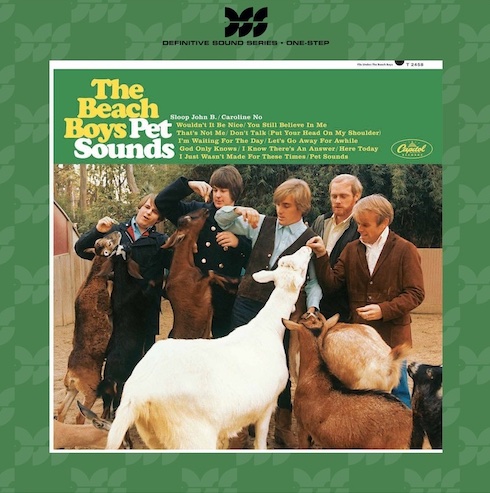
Cause for Celebration – The Ultimate Audiophile LP edition of Pet Sounds!..
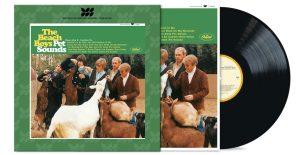
The Beach Boys – Pet Sounds – Definitive Sound Series/Capitol Records #DSS 6 – Mono 180 gm Audiophile LP – 1966/1972 – *****
(Brian Wilson – vocals, piano, organ, producer; Carl Wilson – vocals, lead & electric guitar; Mike Love – vocals; Al Jardine – vocals, tambourine; Bruce Johnston – vocals; Dennis Wilson – vocals, drums; Tony Asher – guest lyricist; complete credits below)
There have been several issues of The Beach Boys iconic Pet Sounds recording over the years. Some have boasted improved sound. But none can rival the 60th anniversary audiophile LP just released by Definitive Sound Series using their “one-step” process. Utilizing EQ’d original mono tapes found in 1972. and pressed on 180 gm high-definition vinyl, listeners will find a whole new revelatory sound experience.
This DSS version uses the one-step process which eliminates multiple steps in the plating process, and brings to a new level the intricate arrangements and harmonies that Brian Wilson brought to his masterpiece. Brian was inspired by Phil Spector’s “Wall of Sound,” as well as The Beatles’ Rubber Soul album, from the previous year.
To call Brian a “taskmaster” would be a major understatement. Just reviewing the number of musicians above (seldom acknowledged) that contributed to his vision is incredible. He had access through The Wrecking Crew’s contacts to some of the best studio musicians available in the Los Angeles area. Several noted jazz artists such as Barney Kessel, Jim Horn, Plas Johnson, Urbie Green, and Red Callender took part.
This was the eleventh studio album from the group and it took four months to complete the project. Its mix of pop, jazz, classical, and exotic themes remains unique today and for its time it went way beyond the sophistication of this period. Its use of overdubs, and glorious harmonies, backed by a soundscape of instruments, was beyond its times, while its historical significance has only increased over the years.
Listening to its youthful yearnings, self awareness, with doubts and hopes, on such classics like “I Wasn’t Made for These Times,” “God Only Knows,” and
“I’m Waiting for the Day,” is both touching and deeply moving, while “Don’t Talk (Put Your Head on My Shoulders)” and “Caroline No,” and “Wouldn’t It Be Nice,” bring back such memories of happier times.
This special edition of Pet Sounds will only be issued in numbered 6000 copies. Each will come with a certificate of authenticity. It is guaranteed to sell out promptly. Don’t miss your chance!
-Review by Jeff Krow
The Beach Boys – Pet Sounds
Track List:
Side 1:
Wouldn’t It Be Nice, You Still Believe in Me, That’s Not Me, Don’t Talk (Put Your Head on My Shoulder), I’m Waiting for the Day, Let’s Go Away For Awhile, Sloop John B
Side 2:
God Only Knows, I Know There’s an Answer, Here Today, I Just Wasn’t Made for These Times, Pet Sounds, Caroline No
Performing Musicians
Brian Wilson – vocals, piano, organ, producer;
Carl Wilson – vocals, lead & electric guitar;
Mike Love – vocals;
Al Jardine – vocals, tambourine;
Bruce Johnston – vocals;
Dennis Wilson – vocals, drums;
Tony Asher – guest lyricist
Members of The Wrecking Crew & associated musicians:
Hal Blaine, Jim Gordon, Ritchie Frost, Nick Martinis, Frank Capp, Gary Coleman, Julius Wechter – drums
Carol Kaye, Ray Pohlman, Lyle Ritz, Chuck Berghofer, Arnold Belnick – bass
Glen Campbell, Barney Kessel, Al Casey, Jerry Cole, Mike Deasy, Bill Strange, Kyle Burnett – guitars
Don Randi, Larry Knechtel, Al de Lory – keyboards
Jim Horn, Plas Johnson, Steve Douglas, Bill Green, Paul Horn – saxes/flutes
Ray Caton, Virgil Evans, Henry Laubach, Ollie Mitchell, Al Porcino – trumpets
Lew McCreary, Urbie Green, Richard Nash, Gail Martin, Ernie Tack – trombones
Alan Robinson, David Duke, Arthur Maebe, Richard Perissi – french horns
Leonard Hartman- English horn, clarinet
Red Callender – tuba
plus 12 strings & four specialty instruments

by Audiophile Audition | May 22, 2026 | Classical CD Reviews, Classical Reissue Reviews
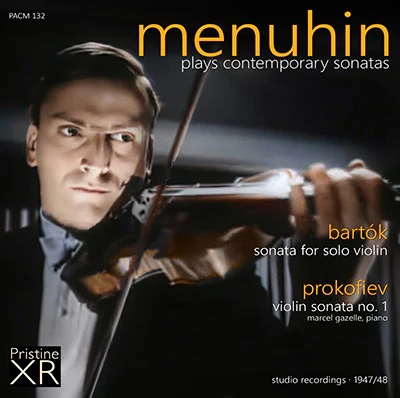
MENUHIN plays Contemporary Sonatas = BARTOK: Sonata for Solo Violin, Sz. 117; PROKOFIEV: Violin Sonata No. 1 in F Minor, Op. 80 – Yehudi Menuhin, violin/ Marcel Gazelle, piano – Pristine Audio PACM 132 (53:04) [www.pristineclassical.com] *****:
I met violinist Yehudi Menuhin (1916-1999) for the first time in Atlanta, Georgia in 1980, on a Saturday, after having heard him perform the previous evening the Elgar Violin Concerto, one of many of his personal, prized specialties. He greeted me in his suite at the Fairmont Hotel, glad that I bore many of his vinyl LPs. Early in our conversation he beamed, “I am so touched to find someone so familiar with my work!” I must state that Menuhin’s demeanor, in conversation, totally fixated on his guest, as though my words and presence were all that meant anything at that moment.
I inquired into Menuhin’s decision in 1947 – the same year he committed to recording history his performance of the Bartok Solo Violin Sonata – to return to Germany, only just beginning to recuperate after the destruction of WW II and actively pursuing, under international jurisdiction for retribution, various, guilty parties of the Holocaust:
“Mr. Menuhin, there are fellow Jews who consider you ‘a dirty Jew’ because you opted to participate in German cultural reconstruction.”
“Yes, I am only too aware. But I received an invitation to perform the Beethoven Violin Concerto in Berlin with Wilhelm Furtwaengler – the greatest of concertos with the greatest of orchestra conductors, and I had to make a decision. Obviously, with the recent revelations of the mass destruction of human beings in Germany, many people felt every German ought to be pushed into the sea. Absolutely, a legitimate reaction. I felt, however, deeply, that if the world were to heal, I must be part of the process. My presence would be unique – after all – my name “Yehudi” means quite literally ‘the Jew.’ There would be no ambivalence.”
“Among my many recordings of you, one of my favorites is that of the Nielsen Concerto with Mogens Wöldike.”
“Thank you. You know, we achieved such good harmony together, that some of the musicians asked if I had Danish in my heritage? But more significantly, in my meeting with the composer Sibelius, he asked me directly whom I thought was the greatest living composer! I felt caught between honesty and courtesy. But he saved me any embarrassment: he stated directly that Bartok was the greatest living composer.”
Which brings us to consider Menuhin’s recording 2-3 June 1947, of Bartok’s Solo Sonata, commissioned by Menuhin, dedicated to him, and premiered in New York City – after minor alterations to facilitate the realization – on 26 November 1944. Given Bartok’s intellectual penchant for academic rigor – he read Beethoven string quartets at bedtime – we experience a pungent stridency, a severity of demeanor that dominates the emotional affect of the work, even in spite of the Magyar, rhythmic vitality that infiltrates the last movement. Bartok has synthesized much of the Bach sonata and partita craftsmanship to his own ends for this work in four movements. The opening Tempo di ciaccona alternates between agonized gestures and ardent, plaintive assaults into the harmonic atmosphere. Either in dialogue or in chromatic ariosi, the musical line exudes a rich but dissonantly poised tautness, rife with folk harmonies in counterpoint. Menuhin’s plaintive tone imbues a tragic humanity to the occasion.
The Fuga, curiously, exerts a degree of melodic freedom to the procedure, despite its four-voice, initial motif. The episodes introduce new subjects, each of them clearly articulated whether by the bow of by pizzicato inversions of the material. The rapid shifts in register and bow technique display no mean gymnastics from Menuhin, who often advised Bartok on the technical resources demanded of the solo. Late in the Fuga, a buzzing motif sallies forth to allow a throbbing, rasping contour in harmonics. The Melodia projects something of Bartok’s patented “night-music” affect, proceeding in expanded degrees of the intervals: sixths, octaves, and tenths, settling high on the instrument’s flute tone or descending low into viola regions. Intensely meditative, the music virtually asks for our silence as it luminously proceeds.
The concluding Presto meant to realize true Magyar tonal elements in quarter tones, but Menuhin convinced Bartok to remain in the traditional chromatic system. The muted, buzzing introduction breaks off precipitately into a driving series of agonized scalar passages and quick alternations of register. A degree of humor persists in the juxtaposition of flighty motifs and ardent, even voluptuous, passages of multiple stops. The coda, too, opens with a quiet scalar synthesis of the three main impulses, only to sail upwards into the realm of the gods.
Menuhin and Marcel Gazelle (1907-1969) recorded Prokofiev’s First Violin Sonata (1938-1946) for EMI on 1 October 1948, the 1946 debut having been given by Russian virtuoso David Oistrakh with pianist Lev Oberin. Likely sympathetic in tone to Prokofiev’s “war” pain sonatas, this Violin Sonata opens, Andante assai, with a series of low, hazy, descending chords pregnant with uneasy sentiments, the melodic content anguished and pleading over persistent grumblings from Gazelle. A rising gesture attempts to bring a degree of light into this malevolent darkness, but the (buzzing) gloom persists. The pizzicato riffs offer no relief from the meandering scale, while the piano intones a bass dirge that has left us in die straits.
The ensuing Allegro brusco injects strident, rasping impulses in C major, and arising melody maintains a martial contour. The activity becomes fierce, combative, but just as suddenly obsessive in a demented character. The texture lightens grudgingly, always ready to engage in combat. A lyrical impulse struggles upward but gets swallowed in the heaving, percussive sonorities. The lyrical strain finally gains a kind of nervous ascendancy, but the underlying agitation had become more unforgiving as the violin sweeps upward to the coda. Gazelle has solo entry in the Andante, to which Menuhin has equal access, and the two sing a wavering arioso in F major. A melancholy intimacy takes form, in a three-note pattern that serves as a persistent plea. The texture lightens to allow the orison an aerial space, while Gazelle plays a parlando line that joins Menuhin in the most emotionally rapt occasion experienced thus far. It stutters to a flighty, diminished call that evaporates.
The Allegrissimo finale opens with a furor in the major mode of F that does relent, in its own way, to a series of stuttered phrases over Gazelle’s extended parlando. A pizzicato pattern begins a new section, aggressively impassioned, that bears a kind of gypsy rapture, only manic. The music has modulated back into its minor mode, Andante assai, dark and menacing, as Menuhin weaves a series of hazy scalar patterns. The opening of the sonata proper emerges, sadly plaintive, and the music leaves us lamenting for the fate of our century.
Despite its relative brevity, this album stands as a potent document of the connection between composer and loyal performer, given Menuhin’s singular conviction that music bears a moral purpose.
—Gary Lemco
by Audiophile Audition | May 19, 2026 | Classical CD Reviews, Classical Reissue Reviews
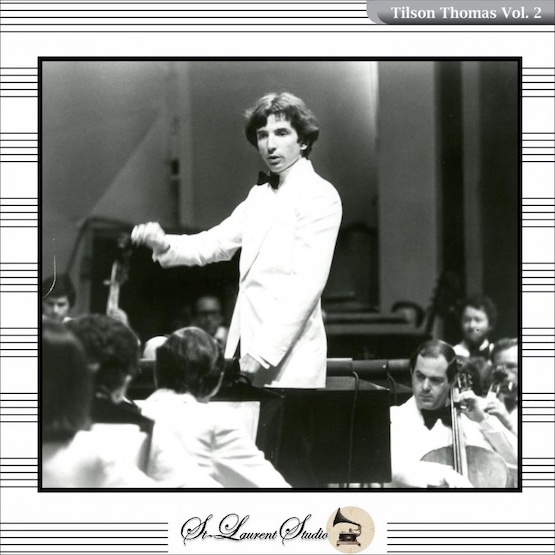
BACH: Suite No. 3 in D Major, BWV 1068; R. STRAUSS: Also sprach Zarathustra, Op. 30; BRAHMS: Piano Concerto No. 2 in B-flat Major, Op. 83 – Malcolm Frager, piano/ Boston Symphony Orchestra. Michael Tilson-Thomas – Yves St-Laurent YSL T-1815 (2 CDs = TT: 106:46) [www.78experience.com] ****:
The recent death of conductor Michael Tilson-Thomas (1944-2026) stirs a host of musical and artistic memories, especially given my own residence as a reviewer and broadcaster in the Bay Area, 2000-2025. Tilson-Thomas had assumed the mantle of both Dimitri Mitropoulos and Leonard Bernstein, tirelessly championing American musical composition and music education, while continuing to deliver a wide-ranging repertory from the Classics. One particularly glowing occasion involved Sibelius’ symphonies six and seven, in incandescent realization, these with the San Francisco Symphony. Another striking moment occurred after a piano recital in Atlanta by Tilson-Thomas that included Mussorgsky’s Pictures at an Exhibition, where while waiting on the line of congratulatory admirers, I spotted actor Jeff Corey – a friend of the conductor’s family, as it turned out – who invited me to join his acting class.
The Boston Symphony concert of 8 December 1973 opens with J.S. Bach’s ever-popular Suite No. 3 in D Major, (c. 1717-1723), whose revered “Air” receives a brisk andante realization, devoid of romantic sentimentality. The opening “Ouverture” enjoys a ceremonial pomp and resonance that maintains an elastic, dignified lyricism hose contrapuntal grandeur shines through. The playing by concertmaster Joseph Silverstein (1932-2015) illuminates Bach as well as Richard Strauss for his tonal richness and technical security. At the time of this concert, first trumpet Roger Boisin had retired, but his successor plays most admirably. The inflections for the two “Gavotte” movements, bouncily animated, remind me of Hermann Scherchen’s approach. The last two movements proceed with the same luster and graceful momentum, with the concluding “Gigue’s” igniting a grateful audience response.
Tilson-Thomas’ gift for leading large forces finds a happy vehicle in the Richard Strauss 1896 symphonic poem Thus spake Zarathustra, after the philosophical meditation by Friedrich Nietzsche. Recall that Nietzsche himself embraced contradiction as a viable element of human nature, so it comes as little surprise that the various appearances of Strauss’s “world riddle” motif will remain unresolved and even blatantly dissonant. The famous C-G-C opening has girth and immediacy, which Koussevitzky no less relished in his 1930 recording. The second section, Von den Hinterweltern, enjoys lyrical breadth but not the sustained intensity Fritz Reiner provided in Chicago.
“The Grave-Song,” juxtaposed with the succeeding “Of Science and Learning” pits the two dramatic forces in human finitude at odds, with the intricate figure of the latter section’s embracing, a la Liszt’s Faust-Symphonie, the tones of the whole chromatic scale, for their pursuit of all possibilities. Tilson-Thomas urges the BSO “The Convalescent,” to its joyful culmination in the luxuriousDas Tanzlied, Nietzsche’s assertion of amor fati, love of fate. Late in this section, set in C major, the B minor Das Grablied recurs, if only to complete the total acceptance of Man’s finitude. The “chimes at midnight” toll for a lonely existence of the Night Wanderer, exactly what Nietzsche chose to relish. An enthusiastic Boston audience applause reassures our conductor that he is not alone.
Joining Tilson-Thomas for the Brahms 1881 Piano Concerto No. 2 in B-flat Major, we have American virtuoso Malcolm Frager (1935-1991), one of the more noted pupils of the great Brahms and Schumann disciple, Carl Freidberg (1872-1955). Clarity and optimism of spirit define the large opening movement, Allegro non troppo, which often beckons its poignant, “symphonic” texture out of the Black Forest. We can appreciate Frager’s huge landings in the various periods that define the first movement’s sonata-form progress, the alternation of huge block chords and fluent arpeggios with staccato filigree that easily transition into monumental gestures. The alert character that emanates between solo and individual orchestral choir members enjoys a palpable congeniality of effect, given the warm patina the BSO projects throughout the entire score.
The “tiny wisp of a scherzo” in D minor ensues, the structural innovation that added a new dimension and girth to the concerto format, with an emotionally turbulent character that testifies to the composer’s own concept of sturm und drang. Frager urges the momentum breathlessly forward, the intervening, meditative riffs notwithstanding. Both collaborators maintain the epic scale of the score, even permitting the softer periods a degree of refined intimacy. The central D major section enjoys a hymn-like sonority, answered by Frager in his most brisk toccata style, then relenting into a warm salon moment that soon explodes into a jubilant exclamation of the opening motif in a hazy then stentorian mode.
The wonderful Andante relishes two minutes of cello arioso with strings and woodwinds before Frager enters, so we have soon succumbed to the idyll’s enchantments. The easy ballade darkens into passionate tumult in B-flat minor, in which we can savor Frager’s vibrant trills and large or broken chords. The needed calm, here in F# major, attains an almost static serenity in the mode of a pian and winds serenade or intermezzo. The uncredited cello soloist leads us, by circuitous routes, back to the tonic key along with a lithe Frager, whose upper register sings most transparently.
The five-part Allegretto grazioso communicates a large, buoyant (Mozart-like) dance character, with an occasional Hungarian flavor that can erupt into some volcanic bravura. The long singing lines – an alternation of march and ardent, romantic lyric – revel in their mixed orchestral blends, with Frager’s injecting that degree of virtuosic impetus which thrilled us in movement two. Frager and French horn invite us to the closing energies, mostly in triple meter, the keeps the flightiness fresh and bold. This long concert has had the audience in the palm of its hand, and now all hands are free to explode in admiration.
—Gary Lemco
by Audiophile Audition | May 15, 2026 | Classical CD Reviews
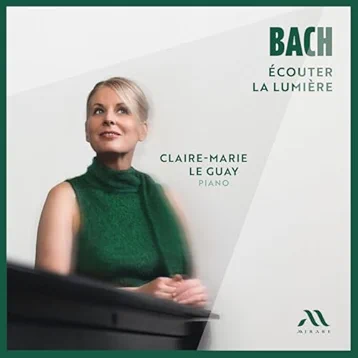
BACH: Écouter La Lumière = Works by BACH; VIVALD; MARCELLO; BUSONI; DUTILLEUX; RAMEAU – Claire-Marie Le Guay, piano – Mirare MIR792 (60:00) (3/6/26), complete contents detailed below) [Distr. by PIAS] ****:
Pianist Claire-Marie Le Guay assembles (8-10 July 2025) an hour’s homage to J.S. Bach, whose work she celebrates as a direct, visionary connection between earth and heaven, the selected works chosen for “their intensity of expression” in the effort to inspire “an inner listening experience: Le Guay offers the traversal as an experiment in dynamic, emotional, and spiritual contrasts. She opens boldly, with a single (Steinway) piano transcription of the Allegro from Vivaldi’s Concerto for 4 Keyboards, as “symphonic” a sound as could be accomplished without excess. Immediately, exquisite contrast, a Largo from Vivaldi in Bach’s arrangement, inward and intimate. The parlando droplets already subsume much of Scarlatti, the French Baroque and even an operatic impulse.
The aggressive, extensive Prelude, BWV 922 combines Bach’s brilliant toccata style with an ardent, arioso intimacy that much anticipates Schumann. At times, Le Guay’s sonority becomes percussive and harsh, but her control of timbres remains impressive. The allusions to the Chromatic Fantasy reverberate throughout. Alexandre Tharaud has transcribed a potent moment from the St. Matthew Passion, Pilate’s anguished attempt to spare Jesus the punishment the crowd of resentful pharisees demands. The vocal power of the keyboard assumes the same intimacy we know from the slow movement of the Klavier Concerto No. 5 in F Minor. The somber procession from Vivaldi’s Organ Concerto in Bach’s transcription continues the mood of exalted introspection, where even the passing tells suggest aerial eddies from cherubs’ wings.
For pure inspired solitude, the “Aria” from the Goldberg Variations bears its own bower of ardent bliss. The pearly legato Le Guay applies does not cater to the harpsichord sonority, a la Glenn Gould. At track 11, Le Guay proffers the slow, chromatically intricate Variation No. 25 from the Goldbergs, a passage not some primal mystery. No less haunted, the Adagio from Marcello’s D Minor Oboe Concerto has us recall what Wilhelm Kempff could realize in this music, since Le Guay proves equally poignant here. The spirit of Kempff rises once more for the chorale Ich ruf zu dir, Herr Jesu Christ, in the sturdy Busoni arrangement.
The spirit of engaged dialogue infiltrates the Praeludium in D Major from the 6 Little Preludes, to which Le Guay attaches the multicolored Fugue from BWV 904, a moment of Bach’s “learned style,” to cite the authority of J.C. Bach. Le Guay instills again an organ sonority to the occasion, clear and articulately forceful, at once.
The last five selections assume, if I may, a more “secular” temper, although the two Sarabandes – from English Suite 6 and Partita 4, respectively – carry their own sense of transcendence. Their Spanish, ornamental beauty slows down our meditational sensibility, and we feel the urge of the aesthetic impulse to claim a religious ecstasy. The Prelude of Rameau captures a serene and thoughtful sense of elevated taste, an ornamental tracery in varied tempos, an adagio and gigue. From the Well-Tempered Klavier, Book I, we have something akin to a musical Book of Genesis, so the demonic Prelude in D minor rounds out the survey, the vision of the ouroboros in passionate filigree. But I have not commented upon the one “outsider” to the Baroque family, Henri Dutilleux (1916-2013) and his singular Au gré des ondes – Hommage à Bach, which proceeds slowly, a measured, steady parlando whose simplicity of means creates a rarified moment of veneration.
—Gary Lemco
Claire-Marie Le Guay – Écouter La Lumière
VIVALDI/BACH: Concerto for 4 Harpsichords, BWV 1065 (trans. F. Noack): Allegro;
Concerto in G Major, BWV 1073: Largo;
Concerto for Organ in D Minor, BWV 596 – Largo e spiccato;
BACH: Prelude in A Minor, BWV 922;
St. Matthew Passion, BWV 244: “Aus liebe” (trans. A. Tharaud);
Goldberg Variations, BWV 988: Aria and Variation 25 “Adagio”;
Praeambulum in D Major, BWV 924;
Fantasie and Fugue, BWV 904: Fugue;
Well-Tempered Klavier, Book I: Prelude No. 2, BWV 847;
MARCELLO/BACH: Concerto for Oboe in D Minor, BWV 974: Adagio;
BACH/BUSONI: Ich ruf zu dir, Herr Jesu Christ, BWV 639;
English Suite No. 6 in D Minor, BWV 811: Sarabande;
Partita No. 4 in D Major, BWV 828: Sarabande;
DUTILLEUX: Au gré des ondes – Hommage à Bach;
RAMEAU: Suite in A Minor: Prelude
by Audiophile Audition | May 14, 2026 | Jazz CD Reviews
Oh, the joys of being a jazz fan in New York City…
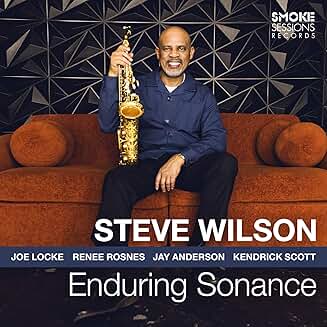
Steve Wilson – Enduring Sonance – Smoke Sessions Records #SSR-2601 – CD – 43:31 – ****1/2
(Steve Wilson – alto and soprano sax, flute; Joe Locke – vibraphone; Renee Rosnes – piano & Fender Rhodes; Jay Anderson – bass; Kendrick Scott – drums; Kevin Newton – french horn on “Quiet Girl” and “Francisco”)
Only in the boroughs of New York City ( mostly Manhattan) can a jazz fan have their choice of seeing live, jazz super stars on a nightly basis. The reason is simple. That’s where the premier jazz artists live. It is easy to record there, and there are many universities nearby to teach students.
When these musicians tour, they are likely to be backed by local musicians, most quite capable, but likely not able to properly rehearse with traveling artists. Often times, the song list has to be standards that are well known, and easy to follow.
Steve Wilson, the veteran saxophonist, has the benefit of having an all-star backing band for his latest release on Smoke Sessions Records, Enduring Sonance. Each of the members of his quintet could easily be a headliner when they travel. But being able to record in New York City, and residing nearby, they form a dream quintet, Jazz aficionados will recognize their names, and know their abilities. Their recordings, whether as leaders, or backing musicians, would fill more than several pages.
Wilson’s latest release, his tenth as a leader, is primarily a ballad project, featuring his warm, inviting tone on soprano, alto, and flute. The addition of vibraphonist, Joe Locke, expands the musical palette, well beyond a sax plus rhythm section date. On Quincy Jones’ “The Eyes of Love,” Locke’s vibes makes the tune pop with energy.
In addition to her formidable skills on piano, Renee Rosnes, handles all the arrangements, and she shines on Billy Childs’ “Quiet Girl,” which opens the CD, and she helps honor George Cables’ lovely, “Helen’s Song,” written for Cables’ soulmate. Drummer, Kendrick Scott, is featured on “Pieces of Dreams,” while bassist, Jay Anderson, as steady as they come (he is the bassist in Maria Schneider’s magnificent jazz orchestra) adds his touch on “The Surest Things Can Change.”
Steve gets to weave his magic on soprano sax on Eliane Elias’ “A Volta,” and on alto sax on “How Long?” which also features Jay Anderson. The closing track, “Francisco,” features guest, Kevin Newton, on french horn, his warm tone fitting in nicely, in a mellow fashion.
I was privileged to attend the CD release party for this marvelous CD, while visiting Manhattan recently. It was a highlight of my trip. The magic of hearing this marvelous quintet can be shared on this well recorded disc. If you can’t hear this group live, this is the next best thing!
—Review by Jeff Krow
Steve Wilson – Sonance
Tracklist:
Quiet Girl
Helen’s Song
Pieces of Dreams
How Long?
A Volta
The Eyes of Love
The Surest Things Can Change
Francisco
by Audiophile Audition | May 14, 2026 | Classical CD Reviews, Classical Reissue Reviews
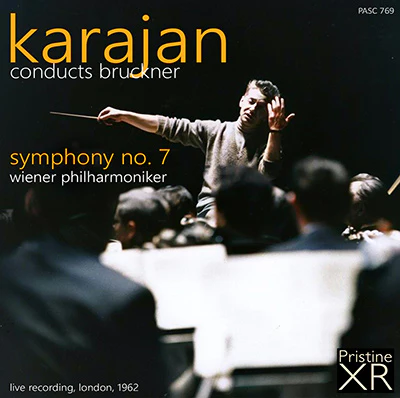
BRUCKNER: Symphony No. 7 in E Major, WAB 107 – Vienna Philharmonic Orchestra/ Herbert von Karajan – Pristine Audio PASC 769 (64:14) [www.pristineclassical.com] *****:
Pristine’s issue of the 6 April 1962 performance in Vienna of the Bruckner Seventh Symphony, with the Vienna Philharmonic led by Herbert von Karajan (1908-1989) resonates rather personally for me, since I experienced my first Bruckner in concert with this very same work under Karajan’s direction in New York, with that city’s Philharmonic Orchestra. Karajan’s tenure in Vienna and Berlin posed some problems for music connoisseurs, entirely discounting Karajan’s political affiliations. Karajan boasted a refined, homogeneous sonic image, literally devoid of “rough edges.” The smooth gloss he achieved, the blending of a luminous whole, became his especial pride, which combined with his closed eyes during performance, added a decidedly aesthetic mystique to the occasion. Karajan managed to create a temenos, a sacred space, a rarified bower of musical execution, virtually unmatched – excepting Furtwaengler, Horenstein, and Celibidache – by any other interpreter.
By now, the etiology of the 1884 Seventh Symphony has become common parlance, with its homages to Richard Wagner, especially in the scoring of tubas and the liturgical character of the C# minor Adagio, by which time Wagner’s death in 1883 had been announced. The Allegro moderato’s opening sequence – the tremolando strings that reveal a cello melody that floats over two octaves in just over 24 measures – leading to a pair of melodies that woodwinds and brass, respectively, deliver Bruckner’s epic scope with a contradictory, “leisurely urgency” under Karajan, whose forces weave a seamless progress in dignified periods. I recall, at age fourteen, my uneasy resolve to hear this huge work through, having not yet uncovered the nasty epithet from Brahms that Bruckner’s symphonies were “tortured boa constrictors.” Then, as now in this Royal Festival Hall performance, Karajan urges the music with a logical, emotional rigor that never sacrifices lyricism for bombast. The richness of Bruckner’s interior lines compels us at each moment to consider Bruckner’s mode of musical development as unique to himself. Potent, hymnal orisons alternate with whimsical, Austrian dances in rustic figures. Somehow, by circuitous intricacy, the coda has become colossal, a revelation of “God’s Grandeur” akin to the best lines from Gerard Manley Hopkins.
Karajan molds the great Adagio movement, conscious that its chromatic contours maintain a chorale of immense power and beauty, a rare distillation of Bach, Schubert, Wagner, and Beethoven, that relishes blazing fanfares and luxurious pedal points. The deep majesty – especially poignant in the F# major period and its deep strettos – of the low strings and high horns bestows an uncanny measure of solemnity to the occasion; no wonder that this one movement “redeemed” Bruckner for many skeptical listeners. Rarely has Bruckner’s written designation Sehr feierlich sustained such regal intensity. The overwhelming climax, marked by cymbal crashes and thunderous timpani, resolves into a simple flute call over pizzicato strings and a another orison from the French horns, eventually finding a long-sought peace in haunted, heart-throbbing acceptance close to Valhalla.
The A minor Scherzo ever suggests a cross between a trumpet, barnyard call and Wagner’s “Ride of the Valkyries,” and the Vienna audience, after the long vigil of the Adagio, feels alert to the robust energies Karajan releases in pungent regalia. In advance of the Trio, Karajan milks the swaggering hunting rhythm so it resembles a peasant waltz. The Trio proper enjoys a grateful repose, constant shifts in the orchestral texture remind us of Bruckner’s fondness for the diapason of his chosen instrument, the church organ. The voluptuous, earthy rhythm takes up the da capo, enriched by competing, syncopated impulses, the various choirs sharing alternating, four-bar phrases. The “Valkyries” win, defiantly.
And so on to the last movement, Finale, opening with he first of three intertwined themes. Strings and woodwinds vibrate in Austrian nature sounds, but the second theme, a poised chorale worthy of Schubert, will soon prove its ascendancy over all rival motifs. The third motif, ff, an athletic fanfare, presents a martial bias, emblematic of the “Wagner tubas” idea with their invocation from Das Rheingold. Bruckner’s various inversions of his motifs testify to long study of Beethoven, but the declamatory mode remains kindred to Wagner. The sweet, secondary theme leads the recapitulation, enhanced by glowing brass colors. The initial opening arises, now in full brass pageantry, the string almost manic in their insistence. A concession to cyclic form ensues, with allusions from movement one, but the massive momentum to a solid E major triumph cannot, will not, be denied. Pristine has cut short what must have been a Saturnalia of enthusiastic applause.
—Gary Lemco
by Audiophile Audition | May 13, 2026 | Jazz CD Reviews
Orchestral jazz, at its best…
John Beasley & SWR Big Band – Invisible Piano – o-tone music #OT079-2-CD – 38:27 – *****
(John Beasley – Steinway Spirio piano, synthesizer – SWR Big Band – Guest artist – Magnus Lindgren – flute)
Choosing the SWR Big Band from Stuttgart, Germany, was a wise decision for pianist and composer, John Beasley, on his new release, Invisible Piano.
John was commissioned for this project, and the SWR Big Band is made up of veteran European musicians, who are sponsored and supported, and capable of tackling complex projects. They have won a Grammy Award for Best Arrangement in 2021, while Beasley has already been awarded two Grammy Awards himself.
Inspired by a painting by Max Ernst, shown at the Staatsgalerie in the Stuttgart Museum, John sang melodic lines into his I Phone. Taking the further creative step by using the Steinway Spirio, their high resolution player
piano, an instrument that enables playback, recording, and editing performances on a handcrafted Steinway grand piano. For this CD, Beasley recorded the piano tracks in late February, 2022, at Steinway Hall, while the balance of the recording, conducted by John, was recorded in early June, 2023, at the SWR Funkstudio, in Stuttgart.
The results are stunning. It’s a blend of jazz and classical themes, with rich improvisation. Beasley’s piano is a force of brilliant melodic beauty, while the 20 piece big band, including guest Magnus Lindgren, on flute, rise to the occasion, especially the woodwind section. The brass section also has their say, adding heft to the arrangements. Beasley wrote, arranged, and conducted the five originals, and the CD ends with a sublime “Fire and Rain,” from James Taylor, and “Can’t Hide Love,” from the pen of Skip Scarborough, made famous by Earth, Wind, and Fire.
Some highlights include, “Concentric,” with Lindgren’s flute solo, and several mood changes. There is some playful call and response between flute and the lower register horns. “Woman With Chariot,” shows the band’s power, highlighted by Martin Auer’s trumpet, and a dreamy arrangement. There is spirited interplay on “Galaha,” and I could see it used on a movie soundtrack, with its lovely melody.
The title track is glorious, as it reaches for the heights, with a passionate sax solo, and grand classical motifs blended with improvisation. “Danseur Espagnol,” is a three ring circus led by Marc Godfroid, on trombone, and Beasley’s piano solo shining bright. Mood changes occur, till the tune closes with a brass growl.
There is so much to love here, as it keeps listeners in rapture, wondering where John Beasley’s creative mind will lead us in unpredictable ways. It’s jazz orchestral splendor demanding multiple listening sessions to fully appreciate!
—Review by Jeff Krow
John Beasley & SWR Big Band – Invisible Piano
Tracklist:
Concentric
Woman With Chariot
Galaha
Invisible Piano
Danseur Espagnol
Fire and Rain
Can’t Hide Love

by Audiophile Audition | May 11, 2026 | Classical CD Reviews, Classical Reissue Reviews
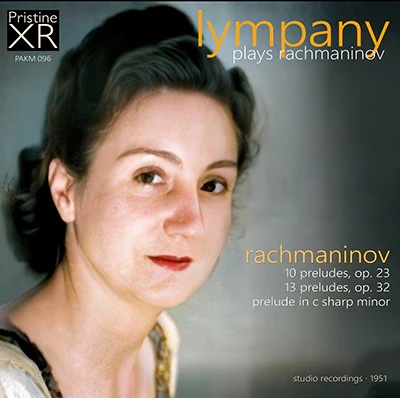
RACHMANINOV: The 24 Preludes – Moura Lympany, piano – Pristine Classical PAKM 096 (73:20) [www.pristineclassical.com] *****:
Dame Moura Lympany (1916-2005) remains among the most gracious and conscientious of British musicians, a lyrical artist of thought and intuition who possessed a towering technique that did not ostentatiously assert itself despite her broad, virtuoso repertory. Pristine revives her 1951 complete Rachmaninov Preludes, a musical enterprise she had addressed for Decca shellacs 1941-1942 and would once more, in stereo sound for Erato, in 1993. Born in Cornwall as Mary Gertrude Johnstone, she adopted her stage name at the suggestion of conductor Basil Cameron that arranged her mother’s maiden name, Limpenny along with a Russian diminutive of Mary. Lessons with Mathilde Verne (1868-1936) and Tobias Matthay (1858-1945) proved decisive in the formation of her musical approach, though later study with Edward Steuermann and Ilona Kabós refined her technique in 20th Century compositions. Her recordings of concertos by Rachmaninov, Mendelssohn, Schumann, Saint-Saens, and Khachaturian have consistently rewarded repeated listening, projecting a freshness and spontaneity of effect that avoids mannerism associated with more “potent” interpreters. This 1951 version of the Preludes had life on the Testament label.
Pristine has done an exemplary job in eliminating defects from which the Decca/Testament issue of these readings suffered. The stunning bass chords in the ubiquitous Prelude in C# Minor ring without upper level shatter, especially precious since Lympany sports a fluid legato and stunning sense of structural transition. The searching, poetic character of No. 1 in F# Minor has a lyrically volcanic No. 2 in B-flat Major as successor, the tumult of arpeggios and thick chords controlled but ardently driven. The mincing, martial figures of No. 3 in D Minor achieve a limpid, flexibly luminous texture. Poetic reflection suffuses No. 4 in D Major, diaphanous in color content but tautly focused on what the composer called “the point” in drooping phrases. Lympany’s sonic palette offers a dazzling array of colors, immediately persuasive, tinted cautiously by an idiosyncratic rubato. The infectious, militant buoyancy of No. 5 in G Minor finds a spectacular haze in its middle section, a sensuous romance. The dream-nocturne No. 6 in E-flat Major enjoys a hazy insistence, palpably intimate. Swirling arpeggios mark No. 7 in C Minor, an eddy of toccata motion, soft in allure and vibrant periods. The A-flat Major, No. 8, extends energies from a colorful, mesmeric eddy of impulses, Lympany’s selective pedal adding a seductive bass line. The brief Prelude No. 9 in E-flat Minor conveys a nervous syncopation, a study in distinct legato and staccato touches, much in the Chopin style. Rachmaninov’s Op. 23 ends with Prelude No. 10 in G-flat Major, here played by Lympany in the style of a ballade, taking on girth, color, and dynamic nuance in a richly parlando style. Lympany’s palette feels a mere step away from Debussy in its graded hues.
Massive chords and deft articulation define Lympany’s hefty realization of Prelude No. 1 in C Major from the Op. 32 set of 1910. The Schumann-like innigkeit of the Prelude No. 2 in B-flat Minor projects an insistent nostalgia that spins a long-lined melodic curve. Prelude in E Major throbs with Russian bells, virtually an orchestral tone-poem set upon a troika. The tonic minor, that in E, Op. 32, No. 4, casts a severe, dramatic tenor in the form of a colloquy that becomes quite intense, offering a temporary, far-and-away emotional asylum in its middle section. The relentless momentum regains ascendancy, though Lympany avoids a mere cacophony of percussion in order to release its melodic kernel. While Lympany’s shaping of the diaphanous Prelude No. 5 in G Major projects exquisite sensitivity, she still must yield to Benno Moiseiwitsch for interpretive alchemy of rarest invention. The No. 6 in F Minor intrudes upon us, an angry toccata a la Russe by way of Franz Liszt. The wide leaps and jabbing accents flutster Lympany not at all. The ensuing F Major Prelude approaches the same technical issues with a lighter, happier countenance, the patented cross rhythms in voluptuous, fluid motion.
For volatility of articulation, Rachmaninov’s terse Prelude No. 8 in A Minor has few rivals, here performed with an aggressive boldness that ripples with steely control. The companion Prelude in A Major, builds on a series of rising chordal patterns, almost a hymn-in- progress. Chopin would qualify as the likely model but influenced by a sense of Bach’s legacy fertilized by Russian chimes. “The Return” served as Rachmaninov’s definition of No. 10 in B Minor, and Moiseiwitsch had to concur. Lympany kneads a striking concoction of melodic clusters based on the falling motif, and the whole rises in a yeast of explosive, yet tempered fury. Another fine female interpreter, Gina Bachauer, had, like Lympany, a singular sympathy for this massive, poignant work. Does the piece end with an evocation of the South Seas, or is that Hollywood talking? The Prelude in B Major plays in the form of an antique dance, cautiously lyrical. Lympany generates throbbing, tremolando tension for No. 12 in G# Minor, a cascade of mystery and reverie that dissolves into a spatial ether. The final Prelude in D-flat Major rather serves as an epilogue to the entire set, in the lyrical-dramatic fashion of Robert Schumann. Eschewing rubato for its own sake, Lympany exhibits a fine sensibility for narrative proportion, especially since this prelude verges on the composer’s notion of an étude-tableau. The epic finality of the last chords may well stand for Moura Lympany’s especial sound, a mastery of every aural nuance.
—Gary Lemco