by Audiophile Audition | May 5, 2026 | Classical CD Reviews
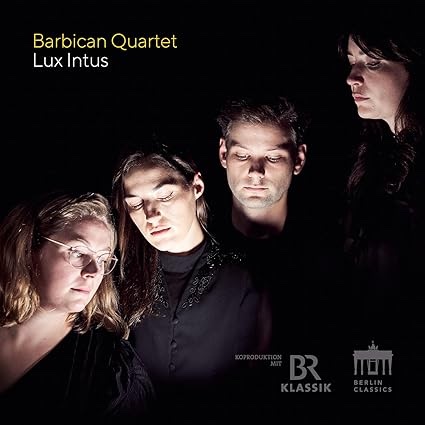
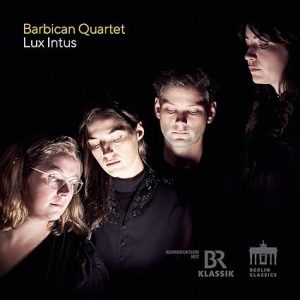
BARBICAN QUARTET: LUX INTUS – MOZART: String Quartet No. 21 in D Major, K. 575; R. CLARKE: Poem for String Quartet; BRITTEN: String Quartet No. 1 in D Major, Op. 25; ELGAR (arr. Slenczka): Nimrod from Enigma Variations, Op. 36; S. JANI: Postlude – Barbican String Quartet – BR Klassik 0303340BC (67:45) (11/2025) [Distr. by Naxos] ****:
Recorded in May 2025, this album whose rubric Lux Intus (“inner light”) unites the selected compositions, features the Barbican Quartet – Kate Maloney and Amarins Wierdsma, violins; Christoph Slenczka, viola; and Yoanna Prodanova, cello – performing works by Mozart, Prokofiev, Rebecca Clarke, Elgar, and Sophia Jani. The appeal aims at the inner voice of the quartet ensemble, the viola and (in Mozart) the cello, those instruments which shed an interior illumination upon their surrounding brethren.
The program opens with Mozart’s 1889 – though published posthumously in 1791 – Quartet in D Major, the first of the so-called “Prussian quartets” ostensibly meant for King Frederik William II, an adept cello player. The airy writing of the opening Allegretto instantly reminds us of Mozart’s own proficiency on the viola; but after a brief delay, the cello assumes the lead in its high register, creating a sense of a concertante quartet consisting of four virtuosi. Indeed, the instruments converse most genially, and the cello will often descend to insert a more emphatic moment of punctuation. The first violin part intones rather nasally, perhaps an attempt to project a (vocal) sense of original instrumentation.
Mozart spreads his melodic material in his Andante over the entire texture, once more instilling a truly collaborative, operatic effort. Expressive and intimate, this movement offers passing dissonances that resolve on lush chords, with the cello’s contribution having become most persuasive. Anticipating Bartok – in his Concerto for Orchestra – Mozart creates a pattern of duos in his genial Menuetto: Allegretto, which proclaims, in the Trio, the cello the resonant voice in a concerted moment of opera buffa. A distinct similarity exists in the melodic contour of the last movement Allegretto, resembling that of movement one. Viola and cello lead the ensemble, project a luxurious richness to an otherwise daintily explosive texture, set a rondo with variants. Juxtaposed against the political climate of the French Revolution, the work feels incredible secure in its means, conceived for an aristocracy whose own days would be numbered while this music endures.
Composer Benjamin Britten experienced a self-imposed exile in the United States at the outbreak of WW II. A declared pacifist, he accepted a commission from Mrs. Elizabeth Sprague Coolidge ($400) for this work to be premiered by the Coolidge String Quartet. A veteran viola player, Britten demonstrates in his initial Andante sostenuto – Allegro vivo a keen sense of his instrument’s tessitura, placing the viola line in the bass while the two violins and cello (pizzicato) sing in high, close intervals. The scoring reflects Britten’s sound concerns with his opera Peter Grimes, especially the “Dawn Sea Interlude.” Tempo I offers an unearthly rondo, contrasting abruptly with Tempo secondo, Allegro vivo. Syncopated in dizzying gestures, two impulses alternate over the cello’s low plaints. Eventually, the entire complex evaporates.
The spirit of Beethoven seems to merge with that of Shostakovich for the second movement, Allegro con slancio, a compressed scherzo-march in triplets trenchant with irony and acerbic wit. The 5/4 rhythm of the Andantino calmo transports us back to Britten’s Peter Grimes, particularly the “Moonlight Sea Interlude.” High violins compete with the viola and cello’s lower range, suddenly urging forth an organ-like sonority quite plaintive, even anguished. Commentators have dubbed this music “a requiem for a lost world.” The organ texture returns, casting the cello into its pizzicato motion while the upper strings sing the coda to an extended lament.
The final movement, Molto vivace, demonstrates Britten’s mastery of intricate, robust counterpoint, much the legacy of his teacher, Frank Bridge. This resurgence of energy includes the scherzo-like, rapidly running counterpoint of its opening, sharp, punctuated chords and the strong unison theme from the two violins and viola. The cello’s takes a solo position against his fellow strings. The pesante tune will return two octaves above its original position, the entire tissue having become symphonic and sonically daring as it sails into a final cadence.
Rebecca Clarke’s 1926 Poem for String Quartet presents a moody, eight-minute piece from a composer whose major emphasis lay in her dedication to the viola. The modal syntax of the piece casts a delicate sense of shadow, the more plaintive element expressed by the first violin. The cello repeats a sequence soon co-opted by the other strings, the dynamic’s becoming softly intimate. The last bar assigns the gesture to the viola, drawing in the warm, hazy timbre into a homogeneous, velvet hue.
Intimacy and intensity mark violist Christoph Slenczka’s arrangement of Elgar’s “Nimrod” Variation from the 1899 Enigma Variations. A celebration of Elgar’s supporter, the publisher Augustus J. Jaeger, the music evolves slowly and a trifle dissonantly, purportedly a discussion between Elgar and Jaeger on the subject of Beethoven string quartets. But the “secret” theme may likewise be operative, the presence of J.S. Bach in the powerful, “symphonic” progress.
The ecstatic visions conclude with Postlude (2025) by Sophia Jani, a piece ordinally conceived for four saxophones. Passages of various chords shared by the quartet members generate vibrations rather than any distinct melody, “spotlights” on motifs that do not reveal what they signify. Whether such an aesthetic proves existentially “illuminating” remains a matter of taste for a little over five minutes.
—Gary Lemco

by Audiophile Audition | May 3, 2026 | Classical CD Reviews, Classical Reissue Reviews
RIMSKY-KORSAKOV:
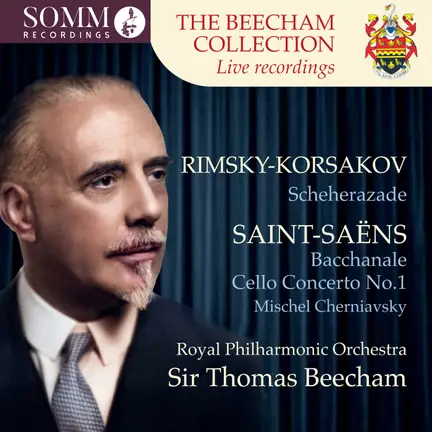
RIMSKY-KORSAKOV: Scheherazade; SAINT-SAENS: Bacchanale from Samson et Dalila, Cello Concerto – Sir Thomas Beecham – SOMM-BEECHAM 34 (70:03) (4/17/26; complete credits below) [Distr. by Naxos] *****:
Culled from three distinct concerts by Sir Thomas Beecham (1879-1961), SOMM Producer and Audio Restoration Engineer Lani Spahr assemble music by Rimsky-Korsakov and Saint-Saens, masters of the color-music idiom whose works Beecham realizes in festive, jubilant style. Even as Beecham appeared at Kingsway Hall 17-10 March and 28 March 1957 for recording sessions, he scheduled Rimsky-Korsakov’s epic symphonic suite Scheherazade in concert 21 March, as though the studio performance served as a rehearsal for a much more energized version of his interpretation. While some connoisseurs of Rimsky-Korsakov’s 1888 extravaganza have criticized Beecham’s performance for agogic errors, preferring renditions by Reiner, Karajan, or my own alternative leader, Markevitch (with the LSO), the Beecham forever conveys a sense of story-telling, while Canadian-born concertmaster Steven Staryk (b. 1932) invokes a truly “feminine” point of view that befits the context of these Arabian Nights.
The SOMM collection opens with the thrilling excerpt from Saint-Saens’ opera Samson et Dalila, the Bacchanale, from the concert of 24 April 1960. In his accompanying note, Jon Tolansky testifies as an attendee of the concert, to Beecham’s having become “a generator of electric lightning” in the course of his performance. From the initial oboe entry (Terence MacDonagh), the level of intensity suggests controlled rage, intermittently interrupted by sensuality in exotic colors. The frenzied drive Beecham achieves seems not to disturb the accuracy of intonation one whit. While the middle section projects the languor of Samson’s ill-fated infatuation, the da capo metamorphoses into a force of nature, what Tolansky describes in apocalyptic terms: “the Royal Festival Hall seemed to be shaking in a catastrophic earthquake.”
Beecham, who much championed the music of French composer Camille Saint-Saens (1835-1921), never committed any of the string concertos to recording, so having the Cello Concerto in A Minor from the concert of 19 October 1958 adds a major account to his discography. The soloist Mischel Cerniavsky (1893-1982) had performed in a trio with his brothers while youths in their native Odessa. An essentially lyrical work, it offers few moments of profundity, but it does savor instrumental beauty of tone, which Cerniavsky possesses in abundance. The Andantino second movement enjoys a particularly courtly flavor, a delicate minuet with pizzicato accompaniment and nice work from the RPO bassoon (Gwydion Brooke). Propulsion and deft ensemble mark the last movement, Tempo primo, which does boast one lovely melody that Cerniavsky – as does his contemporary Gregor Piatagorsky on records – relishes in expressive power. The cooperative hustle Cerniavsky and Beecham realize in the last several pages, including the repetition of the arioso melody, captures both intimacy and dynamism whose energies receive opulent affection from the concert audience.
We have in this live Beecham Scheherazade an Eastern vision that sheds any false chastity of demeanor. The languorous nostalgia of Steven Staryk’s thoughtful solo finds resplendent response from the orchestra, ostensibly the incremental softening of Sultan Schakhriar’s bitter heart. The first movement vibrantly captures the sensation of weaving a tale literally by virtue of intertwined instrumental choirs in E and C, as Sinbad’s ship embarks on its epic journey. The juxtaposition of colossal masses of sound against the individual clarinet (Jack Brymer) or cello lament seems to have transferred the antique concerto grosso to a new level.
A new solo from Staryk invokes “The Story of the Kalendar Prince,” rife with individual colors that blend in with a soft, cantering, dance theme whose innately sensual melodic power never wanes. Jack Brymer’s clarinet solo has all the freedom of movement required to stir the brass and battery to respond with a “legendary” motif not far from Wagner’s “Magic Fire.” The militancy has something of Mozart’s janissary effects, here set near a mosque or muezzin’s retreat. The flute’s elongated solo suggests an aerial locale above the skies, despite the Sultan’s perceptible grumblings.
The RPO strings assume pride of place in their sympathetic reading of the “The Young Prince and the Young Princess,” a lovely Andantino quasi allegretto in 6/8, that serves as a ternary-form, pastoral intermezzo in an otherwise dramatic narrative. We hear echoes from Balakirev’s Tamara tone-poem, notable for oriental colors. Beecham has been intent on letting his forces have their head for the final movement, Allegro molto, 6/8, “Festival at Baghdad. The Sea. The Ship Breaks against a Cliff Surmounted by a Bronze Horseman.” Once the snare drum and trumpet enter the propulsion, the magical splendor of the (brazen) occasion bursts into inspired flame, and the tiny retreats in tempo do not relax the tension. The presence of a pageant, a visual spectacle, imposes itself, wild and militant, an ecstatic music dervish. A literally “frenetic” climax subsides to a lyrical, much-awaited reconciliation between the Sultan and the now vindicated Scheherazade, both resolved in the tonic major, to the eternal gratification of a grateful concert audience.
Much recommended for a permanent place on “the record shelf.”
—Gary Lemco
Sir Thomas Beecham conducts Rimsky Korsakov, Saint-Saëns
RIMSKY-KORSAKOV: 1Scheherazade, Op. 35;
SAINT-SAENS: Bacchanale from Samson et Dalila, Op. 47;
2Cello Concerto No. 1 in A Minor, Op. 33 –
1Steven Staryk, violin/
2Mischel Cherniasky, cello/
Royal Philharmonic Orchestra
by Audiophile Audition | Apr 30, 2026 | Jazz CD Reviews, SACD & Other Hi-Res Reviews
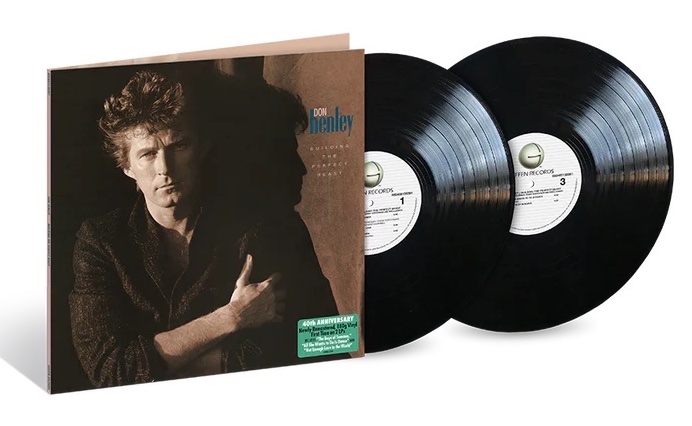
Interscope Records releases a vibrant re-mastered 180-gram double vinyl of Don Henley’s enduring solo album.
Don Henley – Building The Perfect Beast – Interscope Records 602465150391 40th anniversary 180-gram 2-LP [4/29/2026], 46:41 ****1/2:
(Don Henley – drums, keyboards, percussion, vocals; Mike Campbell – guitar, synthesizer, percussion; Steve Porcaro – synthesizer, programming; Danny Kortchmar – guitar, keyboards bass, percussion; Larry Klein – bass; Lindsay Buckingham – guitar, vocals; Ben Tench – piano, keyboards synthesizer; Pino Palladino – bass; Charlie Sexton – guitar; Belinda Carlisle – vocals; David Paich – piano, synthesizer; Tim Drummond – bass; Sam Moore – vocals; Ian Wallace – drums; Albhy Galuten – synclavier; Mike Boddicker – synthesizer, emulator programming, sequencing; Kevin McCormick – African drums; Patty Smyth – vocals; Martha Davis – vocals, chant; Michael O’Donahue – chant; Carla Olson – chant John David Souther – chant; Waddy Wachtel – chant; Randy Newman – synthesizer; Jim Keltner – drums; Bill Cuomo – synthesizer, percussion, programming)
Texas-born Don Henley was a founding member of the Eagles. The band began as a folk rock/country-influenced act (with original members Glenn Frey, Randy Meisner and Bernie Leadon). Rising to the apex of the rock world, Henley’s songwriting partnership with Frey defined the success of the group with songs like “Desperado”, “Tequila Sunrise”, “One Of These Nights”, “Best Of My Love” and “Hotel California”. When the Eagles disbanded in 1980, Henley embarked on a productive solo career. Singles like “Dirty Laundry’, “All She Wants To Do Is Dance”, “The Boys Of Summer”, “The End Of The Innocence” and “The Heart Of The Matter” sustained his prominence as a lead singer and collaborative songwriter.
Interscope Records has released a 2-LP 180-gram re-mastered vinyl of Henley’s second solo album, Building The Perfect Beast. Backed by a veritable “who’s who” of Los Angeles musicians, Henley’s unique raspy “low” tenor is surrounded by a layered tapestry of synthesizer/guitar rock arrangements. Like his work with the Eagles, the songwriting contemplates satire, wry introspection, social commentary and troubadour romanticism. Side One opens with “The Boys Of Summer”. With a synthesizer groove-infused tempo, Henley recounts a desperate sense of lost love (“…My love for you will still be strong, after the boys of summer have gone”) and irony (“…Out on the road today, I saw a DEADHEAD sticker on a Cadillac…”). The urgent vocal performance captures the moment. Jaunty medium-tempo reflections of imperfect romance, “Not Enough Love In The World” and “You Can’t Make Love” are accessible melodies that move effortlessly. In a change of pace, the title track is hard-charging with enhanced studio effects, chants and unrestrained lead vocals.
There are socio-political themes in Henley’s lyrics that provide a deeper context to the songs.. “All She Wants To Do Is Dance” has a groove-infused dance vibe, but with cautionary lyrics about the U.S. involvement in Central America. This track received significant airplay on MTV. Another highlight is the inclusion of the elegiac “A Month Of Sundays”, that didn’t appear on the 1984 vinyl. Scaled down instrumentation and Henley’s plaintive delivery underscore the haunting lament of the farmer narrator. “Sunset Grill” is a whimsical biting observation of 80’s Los Angeles. Henley intermingles nostalgia with fears about changing society. Heavy synthesizer runs help to frame the dichotomy of holding onto the past and being resigned to a tenuous future. The finale (“Land Of The Living”) has a laid-back feel with exploration of love’s redemptive nature. (“…And I was slippin’ away, you came and pulled me through…”)
This re-mastered double vinyl of Building The Perfect Beast will be a valuable addition to any vinyl rock collection. Vibrant musical arrangements and incisive lyrics keep this album relevant.
Highly recommended!
—Robbie Gerson
Don Henley – Building The Perfect Beas
TrackList:
Side One: The Boys Of Summer; You Can’t Make Love; Man With A Mission
Side Two: You’re Not Drinking Enough; Not Enough Love In The World; Building The Perfect Beast
Side Three: All She Wants To Do Is Dance; A Month Of Sundays
Side Four: Sunset Grill; Drivin’ With Your Eyes Closed; Land Of The Living.

by Audiophile Audition | Apr 29, 2026 | Classical CD Reviews, Classical Reissue Reviews
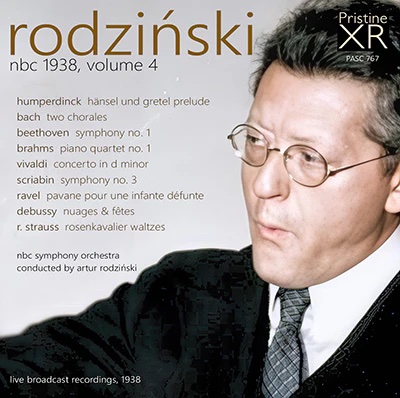
RODZIŃSKI NBC 1938, VOL. 4 = Humperdink, Bach, Beethoven, Brahms, Vivaldi, Scriabin, Ravel, Debussy, R. Strauss – NBC Symphony Orchestra/ Artur Rodzinski – Pristine Audio PASC 767 (2 CDs = 79:45; 78:01, complete contents detailed below) [www.pristineclassical.com] *****:
Andrew Rose and Pristine Audio conclude, with this Volume 4, their fascinating revival of the NBC Symphony concerts led by Artur Rodzinski (1892-1958) that preceded the assumption of the post of Music Director by Arturo Toscanini. The two programs here included, from December 24 and 31, 1938, respectively, offer a wide range of musical styles, some of which Toscanini did not embrace; and so, we have extremely rare documentation of the catholic taste Rodzinski brought to the podium in New York City. The Pristine XR sound process delivers a visceral, vibrant array of orchestral colors throughout.
The 24 December concert opens with Humperdinck’s 1893 Prelude to Hansel und Gretel, a Christmas-Eve delight, given the composer’s utterly lyrical application of Wagnerian procedures. Rodzinski elicits an extravagant, persuasive sheen from his NBC strings, and of the passages of brass in a militant aspect retain their hearty luster. Rodzinski had served with Stokowski in Philadelphia, doubtless imbibing that maestro’s affection for Bach chorale transcriptions. The Respighi arrangement of Nun komm, der Heiden Heiland proceeds with somber contrapuntal – and slightly, romantically mannered – dignity, ardent in its anticipation of Grace. My own affection for Wachet auf, ruft uns die Stimme derives from WNYC’s “Masterwork Hour” of yesteryear, a call to this faithful servant of classical music. Devotional and stately in tempo, this rendition lets us savor the festive richness of the NBC low strings and supporting brass.
The first major work for this evening, the Beethoven 1799 First Symphony, represents Rodzinski’s only document of this pioneer work of the composer who would redefine the symphony genre. The very opening, with its deliberate withholding of the tonic key, alerts us that a fecund mind drives the musical imagination. Once the Allegro con brio arrives, Rodzinski relishes – including the repeat – his athletically energetic element, the NBC woodwinds brilliantly pointed. The second movement, Andante cantabile con moto, after its canonic beginning, saunters with gently abandon within its repetitive structure, alternately martial and buoyant. Particularly vivacious, the Menuetto frolics in a most rambunctious manner, no longer willing to abide by courtly standards. A note of menace marks the Finale: Adagio – Allegro molto e vivace whose momentum discards anything like polite convention. Rodzinski has the music serve as an explosive, virtuoso vehicle for his NBC ensemble, which after any pause and hiatus, renews the energy with unfettered panache. Once the audience frees themselves from the grip of Rodzinski’s musical spell, the applause flows generously.
In 1937, the “progressive” composer Arnold Schoenberg decided to orchestrate the 1855 Brahms Piano Quartet No. 1 in G Minor. Schoenberg claimed that when performed in its original, chamber music medium, the pianist too often drowns out the strings, “and I want to hear everything!” In order to achieve a broad, symphonic effect, Schoenberg re-scored the piano quartet, now featuring percussion, glockenspiel, xylophone, cymbals, bass and snare drum, triangle, and tambourine. The E-flat clarinet will execute some folk-like motifs, and the trombones play glissandos, as they must do in Schoenberg’s own Pelleas und Melisande, Op. 5. If the Beethoven symphony had not confirmed the NBC virtuoso prowess, certainly this score under Rodzinski’s febrile direction dismisses any and all doubts!
The music itself, as in the first and third movements, projects large arcs of contrasting moods, consolingly lyrical or sternly martial in affect. The second movement Intermezzo emerges as kin to the early Brahms serenades, Opp. 11 and 16, though it, too, has some dark moments. Arguably, the center of gravity occurs in the Andante con moto third movement. Beginning in the manner of a hymn, the new orchestration assigns the music a girth that compares to an excerpt from Mendelssohn. Suddenly, a series of dotted chords invoke a quick, martial impulse that soon gains ascendancy of no mean order. In ternary form, however, the opening motifs reappear in a more resignedly placid, serenade guise. The last movement, a throwback to the Brahms gypsy days with violinist Eduard Reményi, whirls playfully in a series of color variants, especially using Schoenberg’s spliced-on battery instruments. This lusty Rondo alla zingarese only lacks a Universal Pictures set from Curt Siodmak to complete its “kitchen-sink” sensibility of motley effects. For the last pages, Rodzinski has the NBC move from a chamber music combination of robust urgency and tender sentimentality. For the last pages, Rodzinski moves from an intimate chamber music sequence to an after-burners manic coda, obviously to bring down the house.
Disc 2, the New Year’s Eve concert, opens its diverse color-program with Siloti’s arrangement of Vivaldi’s Concerto grosso in D Minor from L’estro armonico, a piece equally popular with Serge Kousssevitzky in Boston. The thick harmonization of the NBC strings notwithstanding, the rendition displays warmth and discipline, at once. The second movement, Adagio e spiccato, conveys a deep, ecclesiastical feeling, especially befitting the tides of the season.
Rodzinski next addresses the monumentally solipsistic ego of Alexander Scriabin, whose Third Symphony of 1905 claims an unbroken succession of vision in three interlocked movements that embraces the competing and playful forces of creation. A dire sense of menace opens Luttes, the conflict between God and Humanity. By harmonic twists and turns tossed among diverse choir members, the music appropriates post-Wagnerian, hymns and orisons, yearning motivic kernels, the periods “oceanic,” for want of a better term. Almost imperceptible at first, the second movement Voluptés enters, a call from the seductive and erotic impulse in Nature. Do we hear evocations of Wagner’s Forest Murmurs and later, Gliere’s Ilya Mourometz? The ardor of the music seems interrupted by competing forces, especially by the trumpet. Suddenly, we find ourselves in the throes of the Jeu Divin, the cosmic play of eternal forces. The trumpet call asserts itself forward and inverted, perhaps Scriabin’s attempt at the ouroboros, the cyclical mystery of creation. A rhapsodic militancy takes possession of the momentum, the syntax of Scriabin’s harmonic progress tonal but no less boundless. A solo violin has consistently uttered some response to the dynamics proffered by the Universe, whose totality Scriabin would eventually try with his concept, Mysterium. With the final drumbeats here, The Divine Poem receives an enthusiastic, earthly response.
An immediate contrast ushers forth in Ravel’s dreamy 1910 Pavane for a Dead Princess, orchestrated from the original 1899 piano piece. In suggestive modal harmonies, Ravel invokes a sense of placid acceptance and spiritual repose. Rodzinski insists on a diaphanous, transparent orchestral patina. The late, sighing figures in winds and strings bear repetition. Music of Debussy, two of his Nocturnes, follows, conceived as grisailles, studies in degrees of shade, a la Rembrandt and J.W.N. Turner. Nuages pulsates in deftly erotic colors, while Fêtes bristles with kinetic energies. The intensity of Debussy’s colors in winds, strings, and brass do not suffer in comparison with anything from Respighi. The distant procession then approaches, a veritable, quick march along the Via Appia. Having overwhelmed us with its swirling colors, the fierce tumult cautiously relents into a bucolic ether.
As fitting for New Year’s Eve, Rodzinski says farewell by means of the Richard Strauss first dance sequence of waltzes from Der Rosenkavalier, his sympathies in concert with Clemens Krauss and Hans Knappertsbusch in Vienna. Lush and exuberant, the gaiety of the occasion bodes nothing of the political climate of the times. The brisk articulation from the NBC strings maintains a joyful energy that literally throbs with earthly delights.
Pristine has retained the closing remarks by Gene Hamilton, and we will retain this sound document indefinitely.
–Gary Lemco
RODZIŃSKI NBC 1938, VOL. 4
HUMPERDINCK: Hansel und Gretel Prelude;
BACH (orch. Respighi): Nun komm, der Heiden Heiland, BWV 659; Wachet auf,ruft uns die Stimme, BWV 645;
BEETHOVEN: Symphony No.1 in C Major, Op. 21;
BRAHMS (arr. Schoenberg): Piano Quartet No. 1 in G Minor, Op. 25;
VIVALDI (arr. Siloti): Concerto in D Minor, Op. 3/11;
SCRIABIN: Symphony No. 3 in C Minor, Op. 43 “The Divine Poem”;
RAVEL: Pavane pour une infante defunte;
DEBUSSY: Nuages; Fêtes;
R. STRAUSS: Der Rosenkavalier: Waltzes – First Sequence
by Audiophile Audition | Apr 23, 2026 | Classical CD Reviews
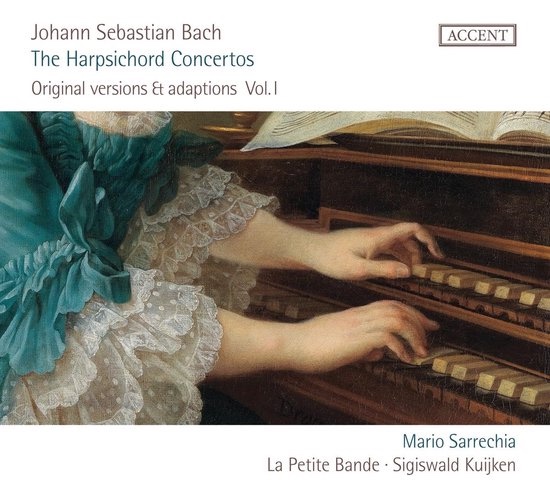
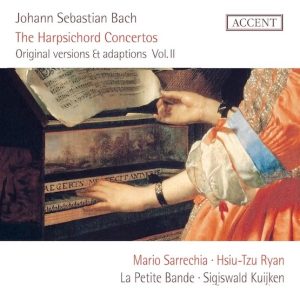
J.S. BACH: the Harpsichord Concertos, Vol. II = Harpsichord Concerto in D Minor, BWV 1052; Harpsichord Concerto in F Minor, BWV 1056; Violin Concerto in E Major, BWV 1042; Harpsichord Concerto in G Minor, BWV 1058 – Mario Sarrechia, harpsichord/ Hsiu-Tzu Ryan, harpsichord/ Sigiswald Kuijken, violin/ La Petite Bande – Accent ACC 24417 (64:31) (3/6/26) [Distr. by Alliance Entertainment] ****:
Recorded 13-16 July 2025, this set represents the second of a triptych devoted to Bach’s surviving harpsichord concertos, conceived around 1738, much in the manner of Antonio Vivaldi, whose Lombardic rhythms manage to infiltrate the Bach outer movements. Bach often arranged earlier compositions – whether they be sinfonias, chorales, and cantatas – in either full transcriptions or selected excerpts as appropriate for instrumental expression. My own model for authentic and original versions of Bach was Austrian violinist Edward Melkus (b. 1928) and his ensemble Capella Academica Wien, who, after WW II, recorded some 200 baroque works, featuring the wire E-string rather than that made of gut. Brussels-born Sigiswald Kuijken (b. 1944) devoted himself to the baroque violin and the “authentic” style in 1969, resting his instrument under the collarbone. His sound, especially nasal, lends itself to the dry clarity he wishes to project, with limited or absent vibrato.
The expansive Concerto No. 1 in D Minor relies on Bach’s Cantata 146 for its melodic-dramatic content, and it has had exponents on the grand piano as diverse as Edwin Fischer., Sviatoslav Richter, and Glenn Gould. Mario Sarrechia infuses motor propulsion and ornamental flourishes generously, the ripieno strings layered and sonorous. The harpsichord soon emerges from the texture with a solemn gravitas. The G minor Adagio, also from Cantata No. 146, projects a thoughtful, lamenting moment of dark contemplation in tripping, marcato figures. The passing, sighing dissonances project an eerie hue, over which the harpsichord offers a recitative-arioso. Elaborate and serious, the last movement Allegro owes its said energies to Cantata 188’s sinfonia. Kuijken does manage some virile hustle in the tempo, though few will ever compete with Glenn Gould and Dimitri Mitropoulos in Amsterdam.
One of my enduring memories of a realization of Bach’s F Minor Concerto derives from Grant Johannesen’s appearance at the Atlanta Symphony concerts. The second movement Adagio, in A-flat, clearly a transmutation of an oboe concerto, had in its poignant intimacy, my thinking of my idol in this music at the time, Edwin Fischer. “Isn’t that curious,” offered Johannesen at our intermission meeting, “I was thinking precisely of Edwin Fischer while I played.” Hsiu-Tzu Ryan does the honors in the solo part here, limpidly thoughtful, lyrically affectionate. Rich ornamentation marks the last movement, Presto, a bit slow for my taste but resolute and athletic.
Bach’s Violin Concerto in E Major has been a concert staple for me ever since I first encountered it via Giaconda da Vito and Rafael Kubelik. Hearing the sparkling work with the great Leonid Kogan and Dimitri Mitropoulos did me no harm. Sigiswald Kuijken leads the ensemble from his solo part, strict baroque tradition. Tempos remain brisk, the articulation clean, the passing grace-notes generous in nasal sonority. The piece had been originally set for harpsichord, 1717-1723, and then recast. Bright in color, it represents a rare violin concerto in E major – except for the ubiquitous Vivaldi – and we don’t see one again until Paganini’s (recently uncovered) Third Concerto. The Adagio in C# minor bears a haunted, melancholy temper, its opening ground bass seeming to imply a chaconne concept over which the solo violin muses nostalgically. The spirit of the dance invests the last movement, Allegro assai, a joyful, confident rondo that invites variants from Kuijken.
Bach arranged his own Violin Concerto in A Minor, BWV 1041 as a harpsichord concerto, now in G minor. The solo part for BWV 1058 has expanded, the string part transposed down a whole tone. In a staid 2/4 time, the opening Allegro proceeds in a variation of antiphonal voices between the concertino solo and the ripieno ensemble. The Italianate second movement, Andante in B-fat major enjoys the lyrical, highly ornamental color of the solo harpsichord – once more the gifted Mario Sarrechia – in a pattern of short notes in the solo against long notes from the strings. The last movement Allegro assai, set in a contrapuntally scored 9/8, moves in the spirit of a rustic jig, almost a stomping dance in boisterous polyphony. The music moves so effortlessly, we have hardly savored its charms when it becomes time to rehear it.
—Gary Lemco
by Audiophile Audition | Apr 22, 2026 | Jazz CD Reviews
A deep dive into Davis.
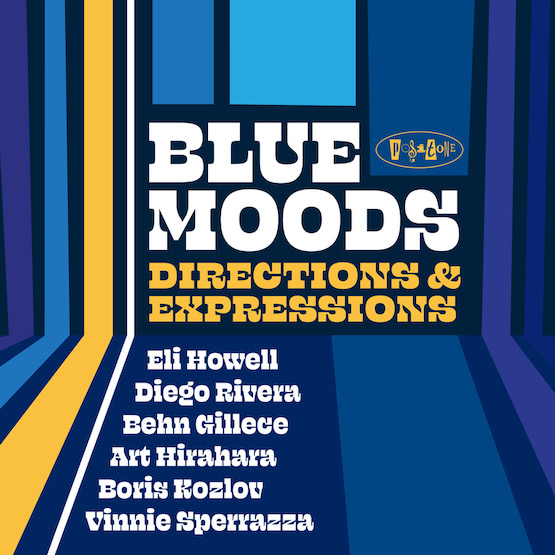
Blue Moods – Directions & Expressions – [TrackList follows] – Posi-Tone PR8274; 61:18 [4/17/26] ****:
(Diego Rivera – tenor & soprano saxophones; Art Hirahara – piano; Boris Kozlov – bass; Eli Howell – trombone; Behn Gillece – vibraphone; Vinnie Sperrazza – drums; Marc Free – producer)
Blue Moods’ Directions & Expressions is the fourth tribute project in an ongoing series from the Posi-Tone label. Previous Blue Moods records celebrated Freddie Hubbard (2025’s Force & Grace), Duke Pearson (2024’s Swing & Soul), and Charles Mingus (2022’s Myth & Wisdom). Coincidentally, a 1955 Miles Davis album was titled Blue Moods. So, it is apt the group Blue Moods now focuses on Davis. Directions & Expressions includes ten interpretations of lesser-known Davis-penned tunes. The 61-minute program has tenor and soprano saxophonist Diego Rivera, pianist Art Hirahara, bassist Boris Kozlov, trombonist Eli Howell, vibraphonist Behn Gillece and drummer Vinnie Sperrazza. The deletion of trumpet might seem unusual but it removes comparisons to Davis’ style and sound. Thus, the music is front and center and reveals Davis’ compositional command on several underappreciated songs.
The sextet kicks off with “Boplicity” from 1957’s compilation Birth of the Cool. Blue Moods stretches out on this cool jazz standard covered by Ronnie Cuber, Dave Liebman, Richie Cole and others. Davis’ nonet version showcased unison sound and colorful harmony. The Blue Moods’ arrangement has a light Latin rhythmic romp. Rivera and Howell craft some unified lines in a nod to the original, Gillece spins out a swinging solo, and that is followed by a sax improvisation.
“Somethin’ Else” is the title track from Cannonball Adderley’s 1958 Blue Note LP. At the time, Adderley was in Miles Davis’ First Great Quintet, so it made sense Davis wrote a piece for Adderley and also guested as a sideman. Blue Moods shrinks the tune to half the size of Adderley’s. Hirahara and Gillece furnish notable early solos, then there is a fine Rivera workout, and the band keeps it upbeat throughout.
Blue Moods evinces a facility for ballad material on “Circles,” from 1967’s Miles Smiles which featured Davis’ Second Great Quintet. Howell provides an interesting lower-register trombone tonality which contrasts with the higher register trumpet and sax on Miles Smiles. Gillece’s vibes also supply lower notes which support the Blue Moods’ appropriately moody, bluesy treatment. Another cut from Miles Smiles is “Stuff.” Davis’s 17-minute track had electric bass guitar and electric piano to fashion a jazz fusion feel. Blue Moods, on the other hand, concentrates on acoustic elements, pulls away from Davis’ groove jam approach – thus shaving ten minutes from the running time – and centers on melodic extemporization rather than Davis’ regulative rhythmic aspect.
Bop and post-bop are the foundations for “Agitation,” from 1965’s E.S.P., the debut of Davis’s Second Great Quintet. “Agitation” is the only E.S.P. tune credited solely to Davis and has an elasticity which mixes adventurous abstraction with a grounded structure. Blue Moods’ transformation of “Agitation” is anchored to a more straightforward bop stance although there are segments where the group breaks loose, particularly during the tune’s second half. One of the more obscure Davis works is “Générique,” from the soundtrack for Louis Malle’s 1958 crime film Ascenseur pour l’échafaud (English: Elevator to the Gallows). The beguiling number is worth discovering. Blue Moods maintains Davis’ pensiveness which permeates this darkly pigmented and noirish ballad.
The lengthiest and most emboldened selection is the 12-minute “La Suite De Kilimanjaro,” inspired by the title track from 1968’s Filles de Kilimanjaro. Davis’ release was transitional and formed a bridge between post-bop jazz and Davis’ full-on fusion on the subsequent In a Silent Way. Both versions offer spatial symmetry but done in different ways. Davis balanced acoustic and electric instruments whereas Blue Moods forges something akin to the Modern Jazz Quartet, especially during the first half where vibes interact with piano, bass and drums. The second half shifts to a faster, bop-bolstered stride where Rivera goes all out while the rhythm section brings the heat.
Another stimulant is “Lazy Susan/Half Nelson,” which melds two Davis compositions. “Half Nelson” (see Workin’ with the Miles Davis Quintet, taped 1956, released 1960) uses chord progressions from Tadd Dameron’s “Lady Bird.” “Lazy Susan” (from Miles Davis, Vol. 3, a 10-inch 1954 LP) is also a contrafact – a musical work based on a prior work – of “Lady Bird.” Blue Moods two-for-one is easygoing and swinging with lots of soloing and unison lines. There’s a lissome quality to “Fran-Dance,” a 1958 piece written by Davis for his then-wife Frances Taylor Davis, a ballerina and dancer. Blue Moods sustains a lightly-lush, late-night ambiance with an emphasis on vibraphone, piano and yearning horn spotlights. What to do with a funk vamp? Jettison the funk and preserve the vamp. That’s what Blue Moods does with “U’n’I,” from 1983’s Star People. No synths, no electric bass or electric guitar, no self-parody. It’s a cavorting and undulating album closer sure to get toes tapping and fingers snapping.
Tributes can be tricky to do. Stay too near to the original and its mimicry. Stray to far from the source and an artist may lose fans likely to enjoy the music. Blue Moods consistently hits a sympathetic equilibrium on their continuing tribute series. Directions & Expressions is insightful and imaginative; performed with panache and respect; and should be heard by listeners who appreciate what can be done with Davis’ compositions.
—Doug Simpson
Blue Moods – Directions & Expressions
TrackList:
Boplicity
Somethin’ Else
Circle
Stuff
Agitation
Générique
Lazy Susan/Half Nelson
La Suite De Kilimanjaro
Fran Dance
U’n’I
by Audiophile Audition | Apr 20, 2026 | Classical CD Reviews
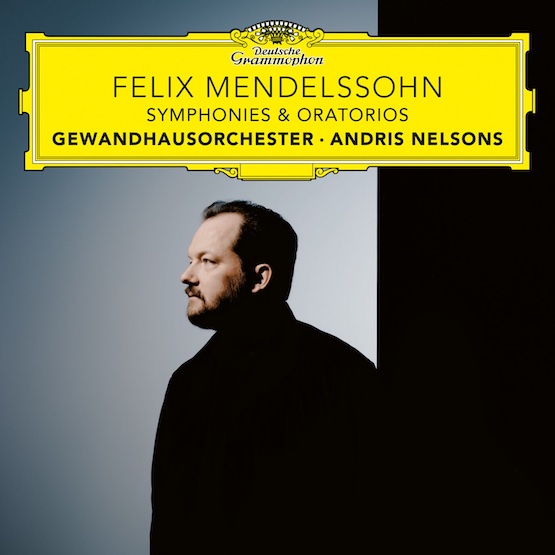
MENDELSSOHN: Symphonies & Oratorios – Gewandhausorchester Leipzig/ Andris Nelsons – Deutsche Grammophon DG 486 8178 (2/10/26) (7 CDs = 70:10; 55:05; 66:22; 61:49; 72:25; 74:03; 59:25; complete contents/credits detailed below) [Distr. by Universal] **8**:
Deutsche Grammophon collects the 2021-2024 recordings by Latvian maestro Andris Nelsons, including his readings of Mendelssohn’s oratorios, Elijah and St. Paul. Nelsons leads the Gewandhaus Orchestra of Leipzig, historically the very ensemble Mendelssohn himself conducted. I postponed my audition of the Biblical settings to enjoy Nelsons’ athletic rendition of the youthful (1824) C Minor Symphony No. 1, a product of an ardently inspired master at fifteen-years-old. Energetically dramatic in the manner of both Beethoven and Weber, the opening Allegro di molto oozes confidence and optimism. The two interior movements linger in the imagination for their songful appeal as well as jubilant buoyancy in the Menuetto. The last movement, Allegro con fuoco, reveals a young master of polyphonic procedures, the discipline derived from Bach and the previous mastery of thirteen string symphonies by which Mendelssohn’s craft attained a fine sheen.
Coupled on Disc 1 with Op. 11 we have Mendelssohn’s evocation of Sir Walter Scott’s highlands, his Symphony No. 3 in A Minor, “Scottish.” Composed over an extended period (of revision), 1829-1841, the work enthusiastically captures Mendelssohn’s fondness for the Edinburgh environs and their pageant of history. Strings and elegiac woodwinds intone, Andante con moto, the innate nobility of the landscape, a brisk tempo that does not compete with the sheer monumentality of effect garnered by Otto Klemperer and the Philharmonia Orchestra. The ensuing Allegro un poco agitato projects a virile, elastic swagger – wonderful in the cellos and timpani – much in line with that drive Dimitri Mitropoulos imparted to the score. The marvelous, diaphanous clarity of the woodwinds, especially the clarinet, in the Vivace non troppo, the scherzo, redolent of highland bagpipes, deserves repetition. Pathos and dignity suffuse the Adagio, alternately offering deep sincerity in the strings followed by a funeral march. The last movement, Allegro vivacissimo – Allegro maestoso assai, conveys the grumbling, impulsive, Scottish sense of militant virtues, concluding with a victory hymn.
“The jolliest piece I have written,” Mendelssohn’s words to describe his 1833 “Italian” Symphony, literally explodes with Nelsons’ exuberance for the opening Allegro vivace, whose lithe bluster rivals the same movement from Sir Thomas Beecham. Vivid trumpet calls saturate the lively atmosphere, a fervid sense of former Roman glories superimposed on a brilliant landscape. Andante con moto, the second movement proceeds a bit marcato to my taste, but persuasively evocative of a leisurely tour in pace and time. The ensuing, rather brisk, Con moto moderato hints more of the light-infused Black Forest than sunny Tuscany, given the luxurious horn calls and flute trills with their mesmerizing, bucolic colors. The dazzling hustle of the concluding Saltarello movement, Presto, enjoys the deft alternations of light and shade, thin and lush textures, to impart a fervent, enduring affection for the Italian ethos.
Disc 7 concludes with Mendelssohn’s musical celebration, 1830, of the centennial of the Augsburg Confession, a major rite of the Lutheran Church, his “Reformation” Symphony in D minor. Legend has it that, from the initial notes of the Gregorian Magnificat, Mendelsohn composed the entire score vertically, as if to commemorate its ecclesiastical rigor. Motifs like the “Dresden Amen” infiltrate the polyphonic texture, a progression that elicits awe and reverent menace, at once. Nelsons takes a huge lacuna prior to the “Amen” that recurs late in the recapitulation, a virtual signal for Wagner to usher forth his “Grail” motif from Parsifal. The second movement, Allegro vivace, begins as a muted woodwind serenade that soon gains heft and splendor, though it retains its function as an interlude. The brief Andante movement provides, arioso, a transition to the initial, woodwind devotions of the final movement, whose Lutheran hymn Ein feste Burg ist under Gott soon monumentally irradiates, Allegro maestoso, the finale. Remember Mendelssohn’s “War March of the Priests” from Athalie? A similar martial fervor invests Nelsons’ brisk delivery of the composer’s mighty contrapuntal filigree, set in contrasting, sweeping, orchestral antiphons.
For the 400th anniversary of Johannes Gutenberg’s printing press, 1840, the city of Leipzig heard Mendelssohn’s celebratory Symphony-Cantata Lobgesang, his “Hymn of Praise,” that reveres an invention heralding Mankind’s progress, “the armor of light” to cast off the darkness of paganism and illiteracy. Mendelssohn utilizes Martin Luther’s translation of the Bible, a vehicle of faith made available by the innovation of moveable type. In ten sections, the work finds its unity in the trombone hymn that sets the whole in motion in the contrapuntally rich “Sinfonia.” After the spirit of Beethoven’s Ninth, Mendelssohn invokes a vocal as well as an instrumental arsenal, a structural “hybrid,” that blurs the distinction between absolute music and ecclesiastical reverence. The cyclical character of the music reaffirms God’s plan in finding through Gutenberg “the Word,” now made available to all flesh. Movement six proves especially dramatic and poignant: three times “Watchman is the night past?” appears, answered by the radiant soprano and chorus alike, “The night Is past,” to invite a new era of (German) Reformation, affirmed by the chorale, Nun danket Alle Gott, in a capella chorus and then with full orchestra. The prevalence of J.S. Bach’s polyphony in conjunction with Mendelssohn’s innate Romantic diction, his potent sense of vocal impact, makes for a notable composition too often relegated to the composer’s less successful efforts.
Nelsons includes two oratorios familiar in the United Kingdom in their Victorian English translation, but in this case sung in German. Paulus (1832), heavily influenced by the cantatas and passions of J.S. Bach, results from a commission from the Saint Cecilia Society in Frankfurt. The narrative traces the transformation of the Jewish Pharisee Saul into the Apostle Paul as a result of the stoning and death of Saint Stephen and the events of the road to Damascus. Periods of lyrical contemplation in the various arias alternate with highly dramatic exclamations by the chorus that often resemble moments in Handel, even more than in Bach. The narrator in Paulus imitates the Evangelist in Bach’s St. Matthew Passion. After Saul causes the death of Stephen, the chorus intones “Happy and blessed are they who have endured.” Attend to the last pianissimo, “For though the body dies, the soul shall live forever.” Basso Georg Zeppenfeld characterizes a somewhat truculent Saul, but his voice finds wonderful solace in the soprano of Julia Kleiter, who in her aria, “Jerusalem!” reminds me of Lucia Popp.
Mendelssohn’s oratorio masterpiece, Elijah, results from a commission from the Birmingham Festival in 1845 to compose a work (here based on the Book of Kings) that would succeed Paulus. The life of the prophet Elijah epitomized the evolution of Jewish faith from worship of the Babylonian pantheon of idols and myths to the worship of one monotheistic God. Even as a convert to Protestantism, Mendelssohn retained a strong Jewish sense of identity, having remarked, “It took a Jew to resurrect Bach’s St. Matthew Passion!” In this case, the typically wrathful prophet will be borne aloft on an angel’s wings, a reward for his visionary powers. A key moment has Elijah come to the end of his earthly life, and the accompaniment disappears so the chorus may sing, a cappella, a mighty C Major fortissimo. Andrè Schuen has the title role, here realized with a fine-tuned instinct for dramatic conviction.
Kudos to the DG production team for having assembled a sincerely felt, musically alert series of performances by Nelsons, who proves himself a master of the Mendelssohn style.
–Gary Lemco
MENDELSSOHN: Symphonies & Oratorios
1Paulus, Op. 36; 2ELIAS, Op. 70;
Symphony No. 1 in C Minor, Op. 11;
3Symphony No. 2 in B-flat Major, “Lobgesang,” Op. 52;
Symphony No. 3 in A Minor, “Scottish,” Op. 56;
Symphony No. 4 in A Major, “Italian,”
Op. 90; Symphony No. 5 in D Minor, “Reformation,” Op. 107
1Julia Kleiter, soprano/
1, 2Wiebke Lehmkuhl, alto/
1,2Werner Guera, tenor/
1Georg Zeppenfeld, bass/
1,2,3MDR-Rundfunkchor/
1,2,3Philipp Ahmann, chorus master/
2Golda Schultz, soprano/
2Andre Schuen, baritone/
3Christiane Karg, soprano/
3Elsa Benoit, soprano II/
by Audiophile Audition | Apr 14, 2026 | Pop/Rock/World CD Reviews, SACD & Other Hi-Res Reviews
Craft Recordings releases an indie rock tribute to Fleetwood Mac for Record Store Day!
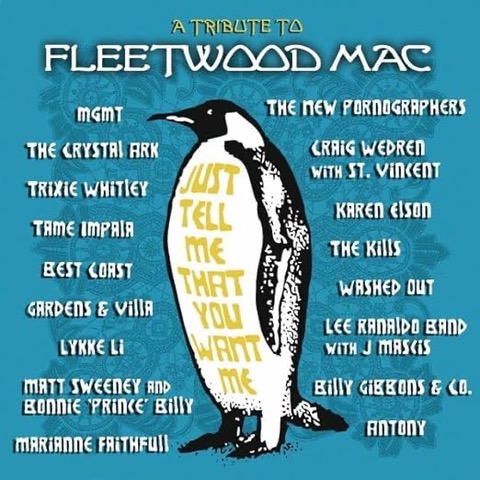
Just Tell Me That You Want Me – A Tribute To Fleetwood Mac – Craft Recordings CR 01003 [4/18/2026] 2-LP Translucent Sea Blue Vinyl Record Store Day, 87:01 ****1/2:
(Featuring Lee Ranaldo Band; Antony; Trixie Whitley; Billy Gibbons & Co.; Best Coast; The New Pornographers; Marianne Faithful; Lykka Li; Karen Elson; Matt Sweeney and Bonnie “Prince” Billy; Washed Out; Tame Impala; Craig Wedren with St. Vincent; The Kills; Gardens & Villa; The Crystal Ark; MGMT; Haim; The Entrance Band)
Just in time for Record Store Day 2026, Just Tell Me That You Want Me – A Tribute To Fleetwood Mac is an unusual collection of engaging covers. It covers a variety of eras from this band, including some of the the greatest hits and lesser known material. It is stylistically diverse, and plays like a shuffle. Side A consists of three Peter Green-penned songs. On the instrumental, “Albatross”. Lee Ranaldo creates a guitar-based sonic landscape of distortion and echo that captures the deep blues pedigree of Green. “Before The Beginning” (Trixie Whitley) is troubled blues with a driving pulse and gut-wrenching vocals. Billy Gibbons brings a slow-burning intensity to a slowed down “Oh Well”, changing the vibe. The Entrance adds a psychedelic dimension to the rendition of “The Green Manalishi” with a rocking tempo and crashing guitars.
Certainly Stevie Nicks is the most covered songwriter on this collection. Antony gives a faithful rendition of “Landslide” with warm idiosyncratic vocals and acoustic guitar. Karen Elson delivers a lithe version of “Gold Dust Woman” and keeps the ethereal feeling. One of the significantly re-arranged numbers is Best Coast’s “Rhiannon”. This seems like an artist trying to establish a more alternative pop statement. One of the weirdest arrangements is the fuzzy synthesizer treatment of “Sisters Of The Moon” (Craig Wedren with St. Vincent). It is a significant divergence from the Tusk single. (Note; There are four tracks from Tusk.) Many of these arrangements eschew the meticulous studio production in favor of more jagged acoustics. One of these is “Dreams” as performed by The Kills. It has a menacing edge. “Gypsy” as realized by Gardens & Villa has an interesting take, combining synthesizer/flute with vocals that emulate Nicks. One of the strongest cuts is “Silver Springs” by Lykke Li. Her vocals convey the heartfelt impact (with great echo and spooky aesthetics).
This album is at its most effective when the contributors cut loose. Oddly, there are only two Lindsey Buckingham songs. On “Tusk”, The Crystal transforms this into a groove-infused electronic flowing jam, still maintaining the number’s eccentricity. “That’s All For Everyone” (Tame Impala) is musically expansive with tracked vocals and spacey accents. Bob Welch’s “Future Games” (MGMT) utilizes digitally-altered voices and an other-worldly hypnotic soundscape, bringing an exotic, almost science-fiction aura.. Christine McVie has two compositions. Haim aligns with Mac’s version of “Hold Me” as jaunty pop. Conversely, The New Pornographers intermingle hard rocking and layered vocals to liven up “Think About Me”.
Just Tell me That You Want Me – A Tribute To Fleetwood Mac is a rewarding collection. Translating Fleetwood Mac to Indie rock is a compelling way to revisit this band’s diverse catalog. Vinyl aficionados will appreciate the translucent sea blue discs.
Highly recommended!
—Robbie Gerson
Just Tell Me That You Want Me – A Tribute To Fleetwood Mac
TrackList:
Side One: Albatross; Landslide; Before The Beginning; Oh Well; Rhiannon
Side Two: Think About Me; Angel; Silver Springs; Gold Dust Woman; Storms
Side Three: Straight Back; That’s All For Everyone; Sisters Of The Moon; Gypsy
Side Four: Tusk; Future Games; Hold Me; The Green Manalishi.
by Audiophile Audition | Apr 13, 2026 | Classical CD Reviews
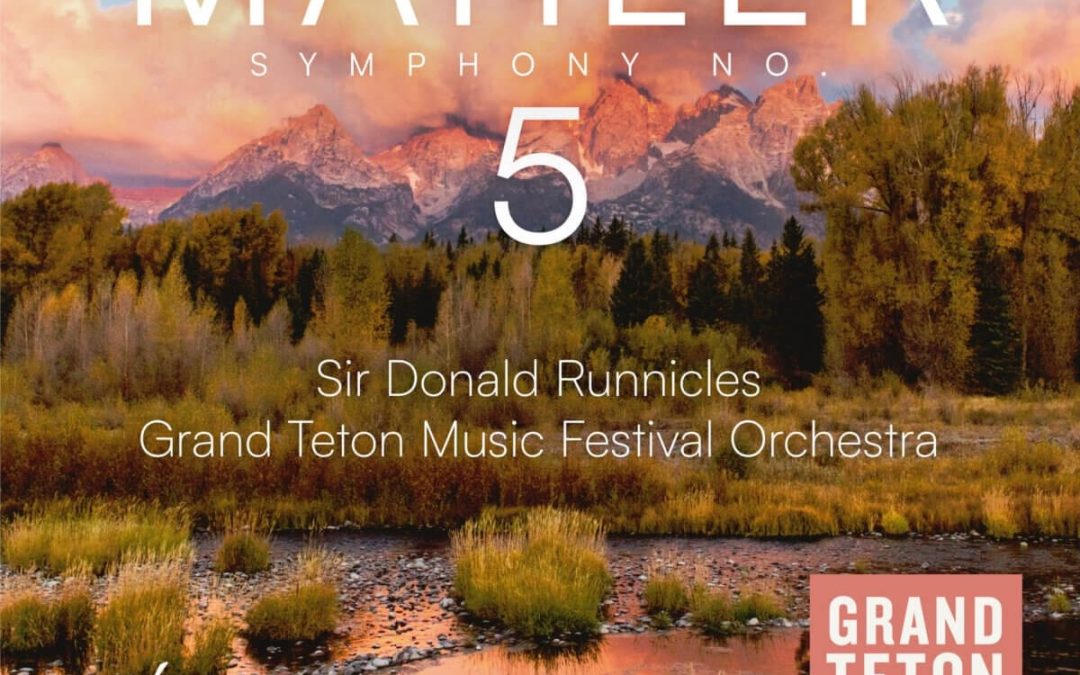
MAHLER: Symphony No. 5 in C# Minor – Grand Teton Music Festival Orchestra/ Sir Donald Runnicles – Reference Recordings FR-763SACD (72:57) (5/1/26) [Distr. by Naxos] ****:
Recorded 26-27 July 2024 at the Teton Village, Wyoming, we have a sober, stylistic performance of Gustav Mahler’s 1902 Fifth Symphony, led by Scottish conductor Sir Donald Runnicles (b. 1954), who has enjoyed a long, esteemed career in opera and symphonic music. At this period in the composer’s life, both mortality and conjugal bliss competed for primacy in his consciousness, the result of intestinal hemorrhage and his engagement to Alma Schindler. So, the Fifth Symphony realizes dual impulses, an awareness of tragic fate, via Beethoven’s Fifth motif in movement one, and the passionate “love letter” of the fourth movement Adagietto for strings and harp. If the first movement projects a funeral cortege, its ensuing, stormy, second movement announces a spiritual defiance to forces emanating from without. Mahler has turned away from folk song and lieder as sources of expressive power, and he becomes quite capable of inventing a hymn to affirm his faith, if not in an Almighty, then in the persistence of his will.
In three parts, the Fifth Symphony does not entirely reject Mahler’s avowed pantheism in his prior two symphonic works. Given that the expansive Scherzo (Part II) likewise serves two masters, the Viennese rural environs and the social world of the Strauss waltzes, we can appreciate the spiritual ambiguity that haunted Mahler. Horn principal Gail Willaims contributes a soulful emanation of the Vienna woods, after having intoned – with principal trumpet Thomas Hooten – the visceral energy of the opening movement’s motto. Mahler characterized his (contorted) central movement as “Mankind. . .at the zenith of life.” The initially charming dance pattern at times becomes persistent, even menacing, almost an adumbration of Ravel’s 1911 La Valse. Runnicles’ control of the many competing metrics proves persuasive and transparent at once, rather reminiscent of what Abbado, Boulez, and Haitink had achieved in this score. No less tonally ambiguous, the lovely, ever-familiar, anguished Adagietto flows at a calm but steady pace, avoiding bluster and sentimental ostentation. Musically, the movement lies along a continuum from Wagner to Debussy, a model of luminous, mystically diaphanous intimacy. Harp principal Allegra Lilly paints the various, modulating hues of this refined vision with intimations of a better world.
The last movement transitions to an essentially happy D major, a circuitous course that embraces much of the Adagietto’s motif but now within a contrapuntal context whose rustic energy occasionally reminds us of a whirling motif in Weinberger’s Schwanda the Bagpiper. Runnicles charters Mahler’s complex odyssey with a light hand, fervent and optimistic in tone. Mahler often spoke of the many “interruptions” that mark his movements’ progression. The sudden, intrusive energies herein somehow coalesce into a meaningful whole, legitimized by the Adagietto trope and the blazing chorale with which this last movement climaxes. Those last, sonically spectacular, 42 bars, Presto, argue for a vital resurgence of—if not rebellion against—the obstacles that do not originate from within.
—Gary Lemco
by Audiophile Audition | Apr 13, 2026 | Jazz CD Reviews, SACD & Other Hi-Res Reviews
Another excellent restored Ahmad Jamal live performance from Resonance Records.
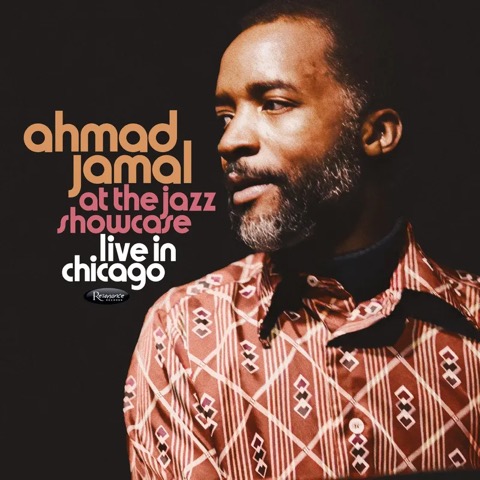
Ahmad Jamal At The Jazz Showcase: Live In Chicago – Resonance Records HLP-9085 180-gram 2-LP gatefold vinyl. Limited Edition First Pressing Record Store Day [4/18/2026], 102:30 ****1/2:
(Ahmad Jamal – piano; John Heard – bass; Frank Grant – drums)
Ahmad Jamal entered the jazz scene at the height of bebop. His approach was unlike most artists of that era. He utilized spacing, tension and release that was more aligned to Thelonious Monk. This allowed him to arrange for trio with a nod to “big band”. He influenced many jazz pianists including Bill Evans, McCoy Tyner, Fred Hersch, Monty Alexander and Herbie Hancock. One of Jamal’s biggest supporters was Miles Davis. Jamal remained true to his musical vision, and recorded for over 60 years.
Resonance Records has released a 180-gram double vinyl of a 1976 performance Ahmad Jamal At The Jazz Showcase: Live In Chicago. Joining him are John Heard on bass and Frank Grant on drums. This concert is among his finest. Side A opens with a 15-minute original composition, “Ahmad’s Song”. This is a complex arrangement that begins with classically-infused runs. Then the jam shifts into a broader diverse structure, but is anchored by a repeat/ ostinato feel. There are tempo adjustments and chord modulation. Jamal covers Antonio Carlos Jobim’s opus, “Wave”. Starting with a bluesy vamp, the trio transitions to a breezy medium-tempo with Brazilian motifs. The pianist trades chords and punctuated notation with subtle phrasing and syncopation. His rhythm, section stays in lockstep. Jazz pianists have always had a connection to Richard Rodgers. Also with a Latin feel, “Have You Met Miss Jones?” flows gracefully with soulful piano runs and breezy articulation. Another popular song that was adapted to jazz is Johnny Mandel’s “Theme From M*A*S*H”. Jamal infuses funky rhythm and muscular chording to frame the melody. He sustains the basic melody, but adds soul-jazz licks on the solos
One of the highlights is Herbie Hancock’s “Dolphin Dance”. The opening solo is masterful. After a minute, Jamal slides into gentle swing groove. When the trio re-engages, it becomes a rousing jam. Jamal alternates rumbling chords and fluid right hand runs. There are classic hard bop accents (with modulations) and some dissonance. It feels like there are different movements. The homage to Duke Ellington (“Prelude To A Kiss”) is another gem. Jamal weaves a sinewy melody line, accentuating the fuller sound and flexible elocution. Another pop reinvention, “A Time For Love” utilizes a breezy cadence with lush inflection and melodic flow. Jamal executes gentle finger-snapping runs with soulful timing. As described in the liner notes, “Swahililand” is compelling, with a vivid, exotic musical tapestry. There are moments of muscular funkiness and grooves, with exhilarating flourishes.
Ahmad Jamal At The Jazz Showcase:Live In Chicago is another important contribution to jazz restoration. It is on a par with the previously issued Emerald City Nights – Live At The Penthouse 1965-1966 albums. The re-mastered sound (Matthew Lutthans/The Mastering Lab) is sourced from Joe Segal’s original masters. It is clear and quieter than typical live recordings. There is an informative 8-page booklet with session information, photographs and interviews with Fred Hersch, Wayne Segal, Stu Katz and Eugene Holley Jr.
Highly recommended!
—Robbie Gerson
Ahmad Jamal At The Jazz Showcase: Live In Chicago
TrackList:
Side A: Ahmad’s Song; Wave
Side B: Have You Met Miss Jones?; Theme From M*A*S*H
Side C: Dolphin Dance; Prelude To A Kiss; A Time For Love
Side D: Swahililand; A Nightingale Sang In Berkeley Square.

 RIMSKY-KORSAKOV: