by Audiophile Audition | Jan 11, 2026 | Jazz CD Reviews, SACD & Other Hi-Res Reviews
This is the epitome of vibrant acoustic guitar jazz!
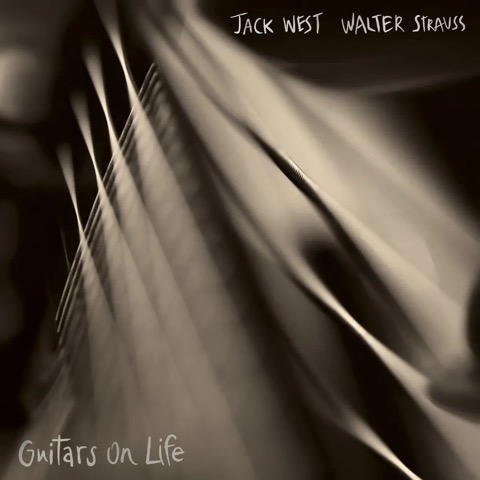
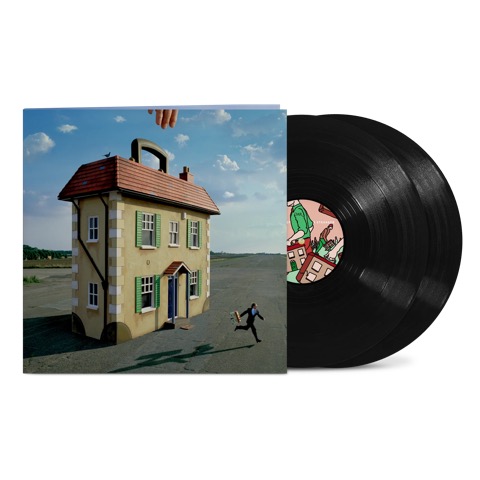
Jack West/Walter Strauss – Guitars On Life – Otá Records OTA 1037 [1/23/2026] 180-gram translucent stereo vinyl, 42:37 ****1/2
(Jack West – acoustic guitar; Walter Strauss – acoustic guitar)
Acoustic guitar in jazz began in the 1920’s. An early figure in this movement was Eddie Lang, the first renowned jazz guitar soloist. Others included Lonnie Johnson, Carl Kress and of course Django Reinhardt. This was also a staple of the Brazilian nylon-stringed instrumentation that defined that genre. While many jazz guitarists transitioned to electric, a new wave of acoustic players continue to emerge, including Julian Lage and John Pizzarelli. One of the modern acoustic virtuosos is Jack West. He is regarded for his rhythmic style, achieved on custom eight-string. He has released several albums with his band Curvature. West is adept at simultaneously playing percussion-based lines, slide, chords and bass.
West has been joined by fellow guitarist Walter Strauss for a new album on Oakland-based Otá Records. Guitars On Life. features seven original compositions and one cover performed as a steel-string duet. The music is spontaneous and has no overdubbing. On most of the tracks, West provides the tempo and slide runs. Strauss contributes lead. Side A opens with “More Guitar”. West’s relentless percussive chords are complemented by Strauss’ precise lead. West lays down bass lines and Strauss delivers forceful notation on his solo. A shared up tempo (with occasional harmonizing chords) makes this jam incendiary. The lone cover (Stevie Wonder’s “I Wish”) captures the funkiness and grooves of the original.
Both West and Strauss excel at finger picking and exchange with seamless chemistry. Both take solos, and West’s hook-filled bass lines and “drumming” are compelling. On “Youth”, the basic instrumental roles are intact, but there is a softer bluesy undercurrent. Strauss’ runs are fluid and have deep complexity. West manages to create a substantial rhythm section. In a change of arrangement on “Across The Bardo”, Strauss plays rhythm and West takes the early lead. He has several nimble slide runs and eventually reprises the “finger drumming” and chords countering Strauss’ lead.
Blues grooves and hooks permeate “Double Bounce”. West’s unique bass-oriented riffs establish this jam against the lyrical translation of his musical partner. Again, the slide work adds texture to the cohesive interplay. After a signature drum/chord intro, “New Way Up” unfolds with a nuanced, melodic resonance. The pulsating undercurrent is still palpable, but there are delicate accents. Syncopated jazz timing is a strong undercurrent on “OO”. West frames this jaunty exploration with his furious bass picking while Strauss injects exotic motifs into his solos. There is a nice modulation at the end. The finale (“Follow The Water Down”) is a distinct change-of-pace. The instrumentation is atmospheric and exudes an airy hypnotic essence.
Guitars On life is an exuberant collection of acoustic guitar jazz. The sound mix (Adam Muñoz) is balanced and blends the dual guitars. (Note: Another Jack West album, Essential Curvature will also be released on the same date). Microphone placement is precise. This Bernie Grundman-mastered vinyl (Chris Bellman) is pristine with little surface noise and no hisses or pops.
Highly recommended!
—Robbie Gerson
Jack West/Walter Strauss – Guitars On Life
TrackList:
Side A:
More Guitar;
I Wish;
Youth;
Across The Bardo
Side B:
Double Bounce;
New Way Up;
OO;
Follow The Water Down

by Audiophile Audition | Jan 5, 2026 | Classical CD Reviews
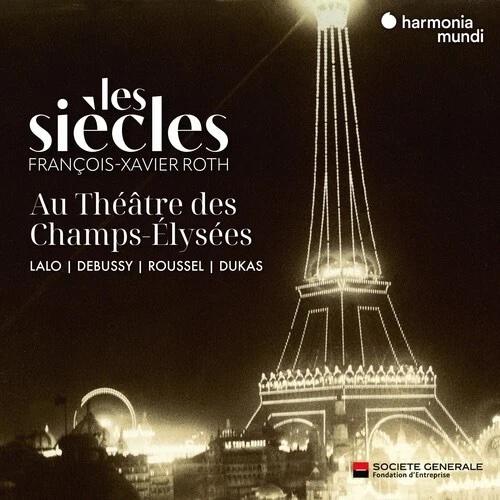
Les Siècles au Théâtre des Champs-Elysées = LALO: Namouna Suite; DEBUSSY: Prélude a l’Après-midi d’un faune; ROUSSEL: Bacchus et Ariane Suite; DUKAS: L’Apprenti sorcier – Les Siècles/ François-Xavier Roth – Harmonia mundi HMM 902736 98 (61:14, complete listing below) (9/19/25) [Distr. by PIAS] ****:
The period instrument ensemble Les Siècles, led by its founder François-Xavier Roth (b. 1971), has, since its inception in 2003, distinguished itself for clarity and precision in 19th and 20th Century repertory. The present live concert, recorded 10 January 2023, focuses on French music of rather virtuosic caliber, allowing several of the orchestra musicians opportunities for solos that combine fluency and intensity.
The program opens with five excerpts from Edouard Lalo’s 1882 ballet Namouna, set in Spanish style on the island of Corfu, featuring a devoted slave whose love for her master protects him from various intrigues. Proffering both audacious harmonies and rhythms, the music anticipates moments in later Ravel and Stravinsky, but remains notable for its own color schemes and instrumental blends. The cello line of the Prélude – Andante enjoys a rich, hefty sonority, while the supporting tissue seems infused with Wagnerian motifs from Das Rheingold.
Sterling string pizzicati mark the ensuing Sérénade while selected woodwinds illuminate the punctuated, declamatory melodic line. For haunted transparency of effect, the tender Theme and Variations elicit a sensuous contour. Parades de foire relish a militant hustle and muscular arioso reminiscent of the best in Bizet. The ensemble woodwinds, brass, and battery declare their own virtuosity in the final number, Fête foraine, a whirlwind only a step away from Petrushka.
The virtues of Claude Debussy’s 1894 Prélude a l’Après-midi d’un faune have often been lauded, given the remarkable fluidity of the color scheme, having high instruments descend into nether regions while low instruments savor the arial regions to which the flute (Marion Ralincourt) invites them. Briskly paced (under nine minutes), the urgent Symbolist effects do not achieve the haze that Svetlanov attained in London by lingering in amorous space for thirteen minutes. Still, Ralincourt’s period flute, from 1892, proves enough of a siren to lure us into ecstasies, supported by some dazzling hap effects.
Conductor Roth cherishes composer Albert Roussel as a local, creative resource, given that Roussel (1869-1937) had been born in Tourcoing, the local base for Les Siècles. The Suite No. 2 from the 1930 ballet Bacchus et Ariane presents nine movements, all relatively brief, that depict the abduction of Ariadne by Dionysus, as told by Ovid. Once more, Ms. Ralincourt’s flute – a Louis Lot instrument – compels our attention.
Contrapuntal technique vies with angular rhythmic and melodic contours that imbue the score with a neo-Classical sensibility close to Stravinsky’s work around the same time period. The pounding fervor of Danse d’Ariane invests the music with a motor power quite reminiscent of Prokofiev. The final scene, a glorious apotheosis set Allegro molto, has a bacchanal conclude with Bacchus’ having crowned the head of Ariane with stars, true Cecil B. DeMille.
Roth and spirited company conclude with the 1897 concentrated masterpiece by Paul Dukas, his The Sorcerer’s Apprentice, after a ballad by Goethe. Set as a one-movement symphonic poem in C minor, the scherzo evolves two themes to capture the hubris of the magical upstart, one of them a direct utterance of the Beethoven “fate” motif.
Rather than repeat all of the testimonials to Mickey Mouse in Disney’s 1940 animation Fantasia, let me suggest a few literary companions: read Nathaniel Hawthorrne’s “Dr. Heidegger’s Experiment” for a parallel moment of supernatural prowess. In Ralph Ellison’s novel Invisible Man, the narrator has a similar “bucket scene” that ultimately explodes out of control, only in fire instead of water. Dukas’ compelling bassoon part comes to us via Michaël Rolland, who plays a Buffet Crampon instrument from around 1900. The appropriately ferocious performance conjures up rousing audience appreciation for an evening of consistent musical witchery.
—Gary Lemco
Les Siècles au Théâtre des Champs-Elysées
LALO: Namouna – Suite No. 1;
DEBUSSY: Prélude a l’Après-midi d’un faune;
ROUSSEL: Bacchus et Ariane – Suite No. 2, Op. 43;
DUKAS: L’Apprenti sorcier
Les Siècles/ François-Xavier Roth
by Audiophile Audition | Dec 31, 2025 | Classical CD Reviews
Mozart – Horn Concertos Nos 2 & 3, Flute Concert No. 2 – Forgotten Records FR 2427 (54:04, complete credits below) [forgottenrecords.com] ****:
Forgotten Records restores vintage DG recordings from 1956, music by Mozart performed by German artists who had to compete with horn virtuoso Dennis Brain and flute virtuoso Jean-Pierre Rampal for primacy in this repertory. The two conductors featured, Leopold Ludwig (1908-1979) and Fritz Lehmann (1904-1956), noted for their security in an imposing range of repertory, provide solid, colorful accompaniment for the two instrumentalists. Horn player Kurt Blank earned distinction from his association with the RIAS Symphony Berlin, especially as led by its principal conductor Ferenc Fricsay (1914-1963). Flute player Gustav Scheck (1901-1984) enjoyed a career with the Hamburg State Opera and the Wenzinger Chamber Orchestra.
Mozart conceived four horn concertos for friend (and victim of Mozart’s coy humor) Joseph Leutgeb (1732-1811), in truth a gifted player from Salzburg of the natural, valveless horn who received in Mozart’s scores teasing, salacious, and demeaning remarks in multicolored inks, like “For you, Mr. Ass,” “quick, get on with it,” and “sheep could trill like that.” Leutgeb tolerated Mozart’s gruff humor and managed to master the delightful effects Mozart invented for the horn, involving hand stopping to achieve the dancing and hunting motifs of immediate wit and chromatic, plastic charm.
The two concertos in E-flat major, composed respectively in 1783 and 1786, owe debts to Joseph Haydn, but no less to Michael Haydn, whose slow movement from his Horn Quintet in A-flat Major likely served as a model for the Romance: Larghetto of the Concerto No. 3. In the first movement Allegro, solo Blank executes the dotted rhythms and scalar melodies with easy grace. Although not so fluidly deft in the last movement Allegro as legendary Dennis Brain in his historic collaboration with Herbert von Karajan, Blank injects quick, agile humor into the hunt motifs that define Mozart’s ironic concession to Leutgeb’s splendid gifts. So, too, the 6/8 “hunting” Rondo from the Concerto No. 4 proves equally engaging, especially in contrast with the shimmering tone presented in the Romance movement. Blank’s smooth transitions between the horn’s upper and lower registers testify to a seamless technical command.

Wolfgang Amadeua Mozart
Mozart’s Flute Concerto No. 2 in D Major (1778) constitutes his re-casting of his earlier Oboe Concerto, K. 314, originally conceived for a Dutch player of the Salzburg Court Orchestra. The new commission, as it were, came from a gifted (but limited) amateur Ferdinand Dejean, as part of a group of pieces that included three flute quartets. Despite Mozart’s bristling at both the short fee and the amateur’s technical deficiencies, he produced an idiomatic, often colorfully compelling work of enduring quality. Gustav Scheck and the ever-reliable Fritz Lehmann provide a rich tapestry through which Scheck glides and soars in the opening Allegro aperto whose cadenza is an object lesson in breath control and instrumental nuance. The slow movement projects a sincere melancholy supported by the orchestra’s sustained melody line. Lastly, the 2/4 Allegro finale indulges in a rondo theme Mozart found distinctive enough to reuse in his opera The Abduction from the Seraglio. When Mozart “steals” from himself, no one feels any poorer. For the better part of an hour, this disc rewards us with Mozart’s spontaneous joie de vivre.
—Gary Lemco
Mozart – Horn Concertos Nos 2 & 3, Flute Concert No. 2
1Horn Concerto No. 3 in E-flat Major, K. 447;
1Horn Concerto No. 4 in E-flat Major, K. 495;
2Flute Concerto No. 2 in D Major, K. 314
1Kurt Blank, horn/
2Gustav Scheck, flute/
1RIAS Symphony Berlin/
2Bamberg Symphony Orchestra/
1Leopold Ludwig, conductor/
2Fritz Lehmann, conductor
by Audiophile Audition | Dec 30, 2025 | Jazz CD Reviews
Big band jazz has a home in Vancouver, B.C. …
Vancouver Jazz Orchestra Meets Brian Charette – Cellar Music Group # CMF0552925 – CD – 59:49 – *****
(James Danderfer – lead alto sax, soprano sax, clarinet; Geoff Claridge – alto & soprano sax, clarinet; Steve Kaldestad – tenor sax; Connor Lum – tenor sax; Mia Gazley – baritone sax, bass clarinet; Andy Hunter – lead trombone; Nebyu Yohannes & Ellen Marple – trombone; Jim Hopson – bass trombone; Michael Kim – lead trumpet; Derry Byrne, Jocelyn Waugh & Julian Borkowski – trumpet; Dave Sikula – guitar; David Caballero – bass; Jesse Cahill – drums; Jack Duncan – percussion; Brian Charette – Hammond organ;
Brad Turner – trumpet (#4,5) – Cory Weeds – tenor sax (#10) )
Having a dream of starting up a jazz big band in a major Canadian city with the capability to make a debut CD that can be compared to more well established regional bands, takes vision, skill, long range planning and much support, for this to be more than a “pipe dream” with good intentions, but not enough follow through.
Fortunately for multi- instrumentalist, James Danderfer, living in Vancouver, B.C., it’s also the stomping grounds of saxophonist, Cory Weeds. Cory is the founder of Cellar Music Group, a label that can hold its own with the best of jazz labels, specializing in mostly straight-ahead swinging releases, with an emphasis on hard bop and soul jazz. Weeds is an entrepreneur, who in addition to performing himself, both promotes and produces superb releases on his label. Cory had the wherewithal to assist Danderfer with the work in putting together this dream project.
The dream is now complete with the release of the Vancouver Jazz Orchestra Meets Brian Charette. Right out of the box, it’s a sure fire winner. There is not a weak track here. No filler. It swings like mad. Including noted Hammond organist, Brian Charette, could have been a risk, as there are few big bands that include the Hammond organ as a lead instrument. The “greasy” sound of the Hammond usually fits a small grouping, with maybe a saxophonist and guitarist. Here, Brian does more than provide a strong background, as he complements the “heat” that this horn heavy band brings. No intrusion, just fitting in “just right,” adding requisite swing to the heft that the horns provide.
In addition to Charette, the inclusion of trombonist, Andy Hunter, who is spending a year in Vancouver, is a savvy move, as Andy brings in the experience he gained with the WDR Big Band from Germany. Local trumpet legend Brad Turner (his CD on Cellar Music is a “must-have” for trumpet fans) adds his fire to “As Luck Would Have It,” and also on Herbie Hancock’s classic, “The Sorcerer.”
Band members contribute in writing nearly all the other tracks. The arrangements are tight, and there is a polish to the finished product that has to elicit pride in the years work to bring this dream to a fruition.
Other great tracks include Jill Townsend’s arrangement on “Don’t Call Before 10,” that honors the memory of local musician, Ross Taggart, as well Brian Charette’s “Honeymoon Phase,” that shows his mastery of the Hammond, as well as the closer, Danderfer’s “The Same Od You With the Same Old Blues,” that brings the VJO Executive Director, Mr. Weeds, into the mix, to end this near one hour excursion to a happy close.
Big band jazz has a home in Vancouver, and now it’s time to let the down stairs neighbors in the U.S. know its not just The Big Apple that can provide the feel good music that jazz big band fans love. All 17 pieces of the VJO deserve praise for helping James Vanderfer and Cory Weeds show that VanCity can hang with the best…
—Jeff Krow
Tracklist:
Equestrian Interlude,
Don’t Call Before 10,
Lado A Lado,
As Luck Would Have it,
The Sorcerer,
Shimmy!,
Oh Brother,
Colour Contrast,
Honeymoon Phase,
The Same Old You With the Same Old Blues
by Audiophile Audition | Dec 29, 2025 | Classical CD Reviews
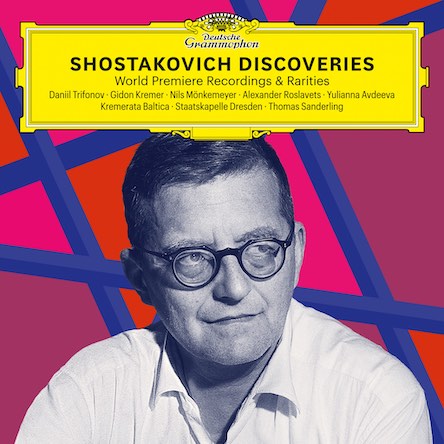
SHOSTAKOVICH DISCOVERIES = Anti-Formalist Rayok; Impromptu for Viola and Piano; Scherzo for Piano; Three Fugues for Piano; Three Fragments from theThe Nose; Five Pieces for Two Violins and Piano; In the Forest; Prelude and Fugue for Piano in C# minor; Murzilka; Yelabuga Nail – DG 28948671908 (78:00) (5/23/25) [Distr. by Universal] ****:
Marking the 50th anniversary year of Shostakovich’s death, Shostakovich Discoveries features world premiere recordings and rarities from the renowned composer, performed by such artists as Daniil Trifonov, Gidon Kremer and Nils Mönkemeyer. Most of the pieces were recorded at the International Shostakovich Festival in Gohrisch (Saxony), the world’s only annual Shostakovich festival.
The totalitarian Stalin regime in Soviet Russia restricted and even destroyed many creative artists, Dmitri Shostakovich (1906-1975) among those whose works were selectively repressed. Recently, musicologist Olga Digonsaya has unearthed some 300 compositions, in varying states of completion, from the composer’s estate in Gohrisch, near Dresden, Germany. The works cover a range of dates, 1920-1955, in diverse arrangements and genres. This disc offers 10 compositions, several in their world premiere performances.
Anti-Formalist Rayok (1948) is a bitterly satiric cantata for bass voice and chorus, a parody of the political correctness that insisted upon a clear distinction between “Realism and Formalism on Music,” the latter unsympathetic to the needs of “The People.” The bass becomes four characters, and their discussion abuses music with dissonances and atonal effects. Recall that a melodious Lezghinka was Stalin’s preferred style. We must look everywhere for instances of subversion: Vigilance!
Impromptu for Viola and Piano (1931) was discovered in 2017. The sad Adagio in G minor lasts for 17 measures, and the ensuing, folksy Allegro is 20 bars. Respectively, the two sections imitate the styles of Glinka and Tchaikovsky.
Scherzo for Piano, Op. 1a (c. 1920) is a keyboard reduction of an orchestra piece Shostakovich penned at 15. A folk tune that invokes some contrapuntal development, it enjoys a light, dizzy, percussive brightness. The middle section, sentimental, may owe debts to Prokofiev and the romance of the night club.
Three Fugues for Piano (1934) testify, as do his Op. 34 and Op. 87 contrapuntal collections, to Shostakovich’s veneration of J.S. Bach. The pieces here soon emerge as character pieces: No. 1 is lyrical and meditative; No. 2 brief but animated in staccato figures; No. 3 projects a mood of nostalgic reflection.
Three Fragments from the opera “The Nose” (after Gogol, 1928): Shostakovich wrote his full opera in 1931 on the 1836 satiric short story that mocks society’s obsession with status. After a potent organ solo, the Entr’acte: In front of the Cathedral breaks into a
raucous dance. A substantial timpani and brass fanfare marks the Beginning of Act III, rife with wind and percussion effects for a mock, military episode. Entr’acte No. 10a assumes the character of a weakly accented waltz or polka. The martial impulse again makes its presence known, but the dissonant tone remains mockingly inflated.
Five Pieces for Two Violins and Piano (1933-55) represent a compendium of tunes from various sources: the Prelude from the 1955 The Gadfly; the Gavotte, Elegy and Polka derive from 1930s dance suites; and the Waltz from an animated cartoon film of the opera The Tale of the Priest and his Worker Balda (1936). The present, chamber music arrangement (1961) was created by Levon Atovmayan.
In the Forest (1919) originally appeared in the 12-year-old composer’s lesson book as an arpeggiated, piano solo improvisation. It sounds, in its trills, often like a musical box.
Prelude and Fugue for Piano in C# minor (1950) had meant to be included in the Op. 87 set of 24 Preludes and Fugues. The Prelude exploits a Romantic ethos, positing the C major triad inverted. The knotty Fugue projects a quirky, asymmetrical rhythmic verve, at times quite aggressive.
Murzilka had been a children’s magazine in the mid 1920s; here, in this 1944 piano piece of a mere 22 measures, Shostakovich fashions a humoresque in two-part, staccato style. Sometimes in two keys at once, the piece may suggest a hunt episode.
Yelabuga Nail (1971) takes its grim tone from a poem by Yevgeny Yevtushenko that relates the suicide in 1941 of celebrated poet Marina Tsvetayeva, likely impelled by Stalin’s political lackeys. Set for bass voice and piano, the writing proves harsh, anguished, and punishing. The use of chord progressions in 5/4 would become a motto for Symphony No. 15.
–Gary Lemco
SHOSTAKOVICH DISCOVERIES
1Anti-Formalist Rayok;
2Impromptu for Viola and Piano;
3Scherzo for Piano, Op. 1a;
3Three Fugues for Piano;
4Three Fragments from the opera The Nose;
5Five Pieces for Two Violins and Piano;
6In the Forest;
7Prelude and Fugue for Piano in C# minor;
7Murzilka;
8Yelabuga Nail
1Alexei Mochalov, Andrei Pushkarev, Kremerata Baltica/
2Nils Mönkemeyer, Rostislav Krimer/
3Daniil Trifonov/
4 Staatskapelle Dresden, Thomas Sanderling/
5Gidon Kremer, Madara Petersone, Georgijs Osokins/
6Daniel Ciobanu, piano/
7Yulianna Avdeeva/
8 Alexander Roslavets, Andrei Korobeinikov
by Audiophile Audition | Dec 26, 2025 | Classical CD Reviews, Classical Reissue Reviews
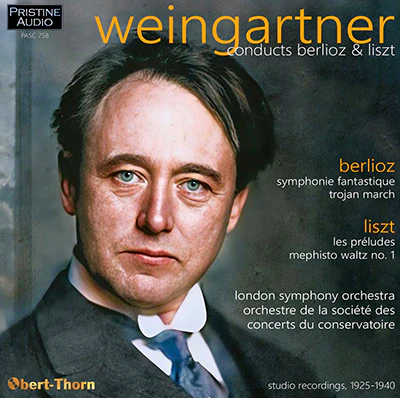
FELIX WEINGARTNER conducts = LISZT: Les Préludes; Mephisto Waltz; BERLIOZ: Trojan March from Les Troyens; Symphonie fantastique – London Symphony Orchestra, Orchestre de la Société des Concerts du Conservatoire – Pristine Audio PASC 758 (77:44; complete credits below) [www.pristineclassical.com]
Producer and Audio Restoration Engineer Mark Obert-Thorn turns his scrupulous attentions to the partial legacy of Austrian conductor Felix Weingartner (1863-1942), notable as the first to record the complete Beethoven symphonies and rediscover the C Major Symphony of the youthful Georges Bizet in 1935. Though trained and supported by Franz Liszt, Weingartner assumed a classical style, literalist and dynamically sensitive – much in the manner of Arturo Toscanini – unlike the more subjective and dramatically expressive wielders of the baton, like Willem Mengelberg.
The program opens with a reading (rec. 28 February 1940) of Liszt’s 1854 symphonic poem Les Préludes, after the poet Lamartine, the third of Liszt’s forays into the tone-poem genre. Less volatile and passionately driven than the famed Willem Mengelberg version from 1929 Amsterdam, the Weingartner performance has a distinct clarity of line, especially given the economy with which Liszt builds the entire one-movement structure from an initial grund-gestalt. The LSO’s interior lines, the woodwinds and low basses, add a rich sense of texture to Liszt’s progression that embraces tenderness and militant, brass aggression as two sides of the thematic coin.
From the same recording session, Weingartner leads a simmering, strutting performance of Liszt’s 1859 Mephisto Waltz, a realization that alternately throbs with pagan, sensuous life and pines in languorous, romantic enchantment. Based on Nikolaus Lenau’s 1836 poem, the music creates a stunning impression of a village wedding dance at which the devil steals the principal violin to intoxicate Faust and his smitten partner. The LSO strings steal the show with splendid, virtuosic runs, scales, and various whirling and galloping effects, while the winds and brass punctuate the occasion with sly intimations. The extended harp part, transparent and fluid, much suggests what Weingartner might have accomplished in Tchaikovsky. As it stands, Weingartner died short of bringing to fruition his concept of Liszt’s Tasso – Lament and Triumph, which he meant to record later in 1942.
Obert-Thorn provides auditors a moment in which Weingartner rivals Sir Thomas Beecham for potent expression, in the Trojan March from Berlioz’s Les Troyens (rec. 21 July 1939), with the Paris Conservatory Orchestra. Along with the ceremonial pomp in the brass and strings, the woodwinds retain tat especially, nasal character endemic to authentic French sonority. The graduated tension of the galloping figures, their collective, stratified crescendo, communicates a festive energy made opulent by the fiercely accurate musicianship from all participants.
Weingartner had already recorded the Berlioz 1830 “program” Symphonie fantastique for the acoustic process early in 1925, but the advent of the electrical medium obviated its release, since Weingartner was eager to seize upon the improved sound, returning to the score for sessions in London 28 & 29 October and 1 November 1925. Opening softly, the emphasis on the first, lyrical appearance of the so-called idée fixe that permeates the narrative, Weingartner keeps a flexible leash on the rhythmic pulse. Cramped sonics restrain the impact of the music as it stealthily creeps in demonic force, the narrator’s having been irresistibly compelled by the fatal attraction of his beloved. Wavering between dreamy, passionate intoxication and spasmodic despair, the music benefits from Weingartner’s directness of approach, which does not lack for singing lines. Plagal harmonies conclude the extended reverie with a sense of religious devotion.
Weingartner opens the grand ball sequence with more marcato than is the wont of other conductors, but the mesmeric flow soon enthralls our narrator. Only the tiniest bit of rubato informs the pulse, which soon delivers the beloved’s soft undulation into the ballroom. Given his existential doubts about his worthiness and her fidelity, the music becomes desperate, even manic, with a bass descending scale’s hinting at an awaiting abyss of calamity.
The consolations of Nature, much in the Romantics’ ethos and sensibility, invests this pastoral with temporary solace. Berlioz’s innate pantheism raises the ranz des vaches to a primal hymn akin to that of Beethoven of his Sixth Symphony, before primal doubts beckon a thunderstorm both ontological and spiritual. Weingartner’s brisk pacing does not detract from the vast contours he illuminates, the chiaroscuro of the Berlioz romantic syntax, especially bequeathed the bass drum.
The final two movements, both consisting of nightmare visions, make us regret the limited sonic image from the 1925 shellacs. The efficacies of the Berlioz counterpoint, however, suffer no diminishment. These two “episodes in the life of an artist” recount his murder of his beloved, his sentence and execution, and his otherworldly punishment. Ascribed to the effects of having imbibed opium, the phantasmagoria resemble moments in De Quincey, with the last movement’s bearing a strong resemblance to Hawthorne’s “Young Goodman Brown,” in which the eponymous hero and his beloved Faith find themselves inducted into a Devil’s coven. The “March to the Scaffold” proceeds with grinding malice, the “beloved” motif inverted and distorted for its spiteful power. At the coda, the plucked strings intimate our protagonist’s head severed, departed for the awaiting basket. Trumpets announce his advent into Hell’s Black Sabbath, where any number of polyphonic grotesqueries greet his descent, the mocking idée fixe now in concert with the Dies irae of the Requiem Mass.
Weingartner had recorded the two Liszt piano concertos with Emil von Sauer in 1938; and now, we lament that the two Liszt acolytes did not collaborate on the Totentanz.
—Gary Lemco
FELIX WEINGARTNER conducts BERLIOZ and LISZT
LISZT: Les Préludes; 1Mephisto Waltz No. 1;
BERLIOZ: 2Trojan March from Les Troyens; 1Symphonie fantastique, Op. 14a
1London Symphony Orchestra
2Orchestre de la Société des Concerts du Conservatoire
by Audiophile Audition | Dec 24, 2025 | Jazz CD Reviews, SACD & Other Hi-Res Reviews
O.A.R.’s direction change is chronicled on this 2-LP 20th anniversary vinyl of Stories Of A Stranger.
O.A.R. – Stories Of A Stranger – 20th Anniversary Edition – Lave Records/Everfine Records(2005)/Craft Recordings CR00936 (2025/) 2-LP gatefold stereo vinyl ****1/2:
Mark Roberge – guitar, lead vocals; Richard On – guitar, vocals; Benj Gershman – bass; Jerry DePizzo – saxophone, guitar, piano; Chris Culos – drums); Joe Gore – guitar, lap steel guitar; Bernie Worrell – piano, Hammond organ, Rhodes piano; synthesizer, clarinet; synth bass, mellotron; Colin Smith – percussion, tambourine, shaker; Vincent Nguini – baritone saxophone; Jerry Harrison – guitar, keyboards, celeste, percussion, drum programming, radio shortwave; Lenny Pickett – saxophone; Brian Switzer – trumpet; Raw Sun – vocals; Toby Lightman – vocals; Matt Nathanson – vocals; Cassidy – vocals; Kristen Henderson – vocals; Cathy Henderson – vocals)
Like many alternative rock bands, O.A.R. (Of A Revolution) achieved recognition performing on the college circuit. They relied on extensive touring and word-of-mouth to build a loyal audience. The core lineup included Mark Roberge (lead vocals, guitar), Richard On (guitar), Benj Gershman – bass), Chris Culos (drums) and Jerry Depizzo (saxophone, guitar). Their music combined elements of reggae, ska, folk and pop. The band was renowned for animated live shows that added to their community status. Eventually, O.A.R.garnered some mainstream success with the release of their fifth album, Stories Of A Stranger. Songs like “Heard The World”, “Love And Memories” and “Lay Down” received increased airplay. In 2006, they played two sold-out shows at Madison Square Garden. Additionally, the group is active in a variety of charities and special performances. O.A.R. continues to tour and record, as they enter their third decade.
Craft Recordings has released a 2-LP reissue of Stories Of A Stranger, which has bonus cuts. Produced by Jerry Harrison, the album is a shift to a more expansive, polished aural landscape, with several additional studio players. Side 1 opens with a pop rock arrangement (“Heard The World”). Roberge’s philosophical angst (“…Nothing’s gonna save me. I’m hanging from the nearest tree”) is framed by acoustic and electric guitar. The final coda is magnetic. “Love And Memories” adopts some of the band’s earlier musical templates. Roberge’s urgency is set against a pulsating beat and crisp backup vocals with cynical lyric imagery. In a palpable change of mood, “Wonderful Day” is breezy and reggae-infused with infectious chords and a raucous saxophone (DePizzo). Affirmative narrative also fits the musical style. This unique intermingling of jaunty tempo, hooks, saxophone and plaintive yearning is infectious. A call and response vocal (Toby Lightman) is excellent.
Revisiting a more affirmative, romantic message, “Lay Down” is another funky ska jam with propulsive drums and Roberge’s most energetic vocal performance. O.A.R. feels comfortable in reggae mode. “Program Director” is musically effusive, while providing a critical view of radio politics, with some Jamaican rap and layered instrumentation. In a change of pace, “Nasim Joon” is a soulful ballad that has some Memphis-type shading. Personal anxiety is never far away in the straight-ahead rocker, “Tragedy In Waiting”. But there is a fervent hope for a better state of mind with nimble saxophone shading. The band’s introspective views on “Daylight The Dog” (“…If you’re lost in the dark, get to where you can see…”) is paired with rock and roll attitude. Exploring ambivalence on “Dakota” (“…You saw everyone as an angel, But what about the thief?…”) feels second nature to the songwriting. A certain highlight is the muscular, hard rocking opus, “52-50”. At nearly 9 minutes, this is the most ambitious multi-faceted track on Stories Of A Stranger. It has a relentless cadence and piercing guitar solo that permeates a breathless transition. It displays intensity and complex musical textures. The final side has three live cuts and a studio number (“Sometimes”) from the original sessions, adding to the luster of this release.
This vinyl reissue is a great look at evolving contemporary rock with a broader sound mix. Vinyl enthusiasts will appreciate the eye-popping Storm Thorgerson (Dark Side Of The Moon, I Robot) cover.
Highly recommended!
—Robbie Gerson
TrackList:
Side 1: Heard The World; Love And Memories; Wonderful Day; The Stranger
Side 2: Lay Down; Program Director; Nasim Joon; Tragedy In Waiting
Side 3: Daylight The Dog; One Shot; Dakota; 52-50
Side 4: Sometimes (Stories Of A Stranger Sessions); Heard The World (Live); Lay Down (Live); About Mr. Brown (Live)
by Audiophile Audition | Dec 22, 2025 | Classical CD Reviews
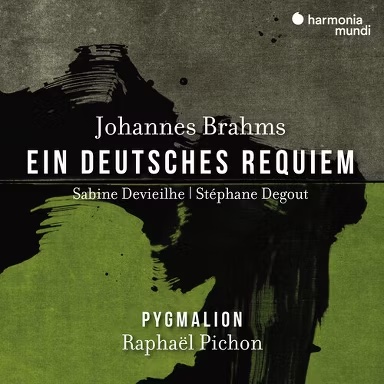
BRAHMS: Ein deutsches Requiem, Op. 45 – Sabine Devieilhe, soprano/ Stéphane Degout, baritone/ Pygmalion/ Raphaël Pichon – Harmonia mundi HMM 902772 (65:07) (10/1025) [Distr. By PIAS] ****:
Dvorak once remarked that he found in his musical idol Brahms not one ounce of genuine religious devotion; yet, between 1866 and 1869 Brahms labored arduously to expand what had been a cantata for the death of Robert Schumann into a most ambitious vocal work. Eschewing the traditional Latin mass, the missa pro defunctis, Brahms adopted the Protestant texts drawn from Martin Luther’s German translation of the Bible, freely incorporating passages from both Testaments in sympathy with the composer’s desire to mourn the dead and comfort the living, at once. Given the composer’s predilection for Classical architecture, Brahms constructs a seven-movement work that achieves remarkable symmetry and artistic closure in the form of a loose palindrome, aligning the work more with the Aesthetic Movement, in which Art vied with Religion for supremacy in celebrating an omnipotent Deity.
Raphaël Pichon (b. 1984), a countertenor and violinist, organized Pygmalion in 2006, an ensemble of 37 singers, with a mission to perform a variety of musical genres on original, period instruments. The spare application of vibrato in the case of Brahms creates a startlingly antique sound, simultaneously chaste and pungent, relishing the dramatic juxtapositions of dynamics in Brahms that move from inward quietude to an eruption of emotional vehemence. Where many conductors on period instruments favor excessively slow speeds, Pichon often impels the music with furious haste, as in the polyphony of the baritone meditation Herr, lehre doch mich. . ., with its resounding tympanic pedal on D for over 50 measures. Equally affecting, there resounds the monumental sixth movement, Denn wir haben hie Kleine bleibende Statt, a lament for the ethereal nature of existence that concludes with a resounding sense of triumph over Death. At the coda, Pichon rushes breathless into the last movement, literally a sweet transfiguration of the work’s beginning, cyclically blending the fate of mourners and the mourned in a perpetual pattern of acceptance.
The two soloists deliver fine, sensitive readings of their respective texts, given my own experiences with Elizabeth Schwarzkopf and Gundula Janowitz in the soprano part, and the likes of Hans Hotter, Tom Krause, and Dietrich Fischer-Dieskau in the bass part. The second movement, Denn alles Fleisch es its die Gras, proves especially poignant, a morbidly conceived waltz-march that Pichon invests with towering presence, gradually moving by stealth to a shattering fortissimo. The sudden shift to female voices of consolation renders the contrast with effective nuance. What endears us to this reading lies in the clarity of textures, an invasion of light a la J.W.N. Turner, where the classic performances by Karajan, Klemperer, Lehmann, and Walter opt for giant cumulus clouds to announce our pageant toward Eternity.
—Gary Lemco
by Audiophile Audition | Dec 18, 2025 | Pop/Rock/World CD Reviews, SACD & Other Hi-Res Reviews
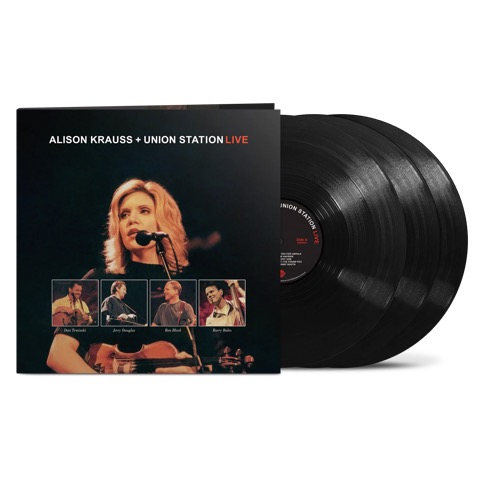
Craft Recordings’ new Alison Kraus + Union Station Live vinyl is modern bluegrass at its best!
Alison Kraus + Union Station: Live – Rounder Records (2002)/Craft Recordings CR00933 180-gram triple stereo vinyl, 54:11 ****1/2:
(Alison Kraus – fiddle, vocals; Barry Bales – double bass, vocals; Ron Block – banjo, guitar, vocals; Jerry Douglas – resonator guitar, dobro, vocals; Dan Tyminski – guitar, mandolin, vocals; Larry Atamanuik – drums)
Bluegrass has been at the core of country music for a very long time. A pioneer in this genre, Bill Monroe became the first big name. Others included The Stanley Brothers Earl Scruggs and Lester Flatts. The music developed in Appalachia and was influenced by African-American styles like blues, jazz and Irish folk. Bluegrass is known for utilizing acoustic instrumentation, including fiddle, guitar, mandolin, banjo and stand-up bass. The sound is considerable up tempo with “breakdowns” and stacked vocal harmonies.
As country music evolved, bluegrass added other instruments (dobro, harmonica, accordion and electric guitar). Alison Kraus and Union Station over the last quarter-century have become the modern face of this popular tradition, incorporating it into broader country references and popular contexts. O Brother Where Rt Thou? was the ultimate crossover with its roots-based soundtrack. To date, Kraus has garnered 15 Grammys and numerous other awards.
Craft Recordings has released a 180-gram triple vinyl of Alison Kraus + Union Station Live. Initially released in 2002, the concert was recorded over two days at the Louisville Palace. It is a fitting and lively presentation of the band’s catalog and artistic integrity. The concert opens with “Let Me Touch You For Awhile”. Kraus’ crystalline soprano (with subtle vibrato) is front and center. Her emotional urgency is palpable and the acoustic instrumentation is excellent. She joins her stellar band on violin for the classic bluegrass arrangement on “Choctaw Hayride”. Dulcet vocals and pop sensibility can be heard on “The Lucky One”, a long-standing AKUS staple.
Kraus’ unexpected breakthrough “Baby Now That I’ve Found You” is blissful and her vocal pitch is unwavering. Dan Tyminski handles the lead vocals on the gospel-infused. “Bright Sunny South” and Kraus’ violin is nimble and prominent. The quintet glides through an accessible set, with up tempo numbers (“Every Time We Say Goodbye”, “Tiny Broken Heart”, “Cluck Old Hen”) and all of the musicians shine on these. Slower tempos like “Stay”, “Broadway”, “Ghost In This House” are heartfelt and delivered with sincerity.
A certain highlight is “A Tribute to Peador/O’Donnell/Monkey Let The Hogs Out”. Featuring Jerry Douglas on dobro, this is a textured instrumental that builds momentum. Tyminski and Douglas offer a country blues duet on “The Boy Who Wouldn’t Hoe Corn”. They are joined by the rest off the group. Tyminski’s iconic take on the traditional “I Am A Man Of Constant Sorrow” is a master class on all things bluegrass. This is clearly a band with all members embracing the group concept.
Kraus’ shimmering voice permeates tunes like “Maybe” and “When You Say Nothing At All”. They are equally adept at rollicking numbers like “We Hide And Seek”. She brinks sultry nuances and a modicum of grittiness to “Oh Atlanta”. Another show-stopper, “Down To The River To Pray” is a gospel litany framed in gorgeous a cappella harmony.
Alison Kraus + Union Station Live is another triumph for Craft Recordings. The sound mix (with lacquers cut by The Mastering Lab) is balanced and the volume amplification never detracts from the clarity of the acoustic instrumentations. Kraus’ gorgeous voice is a focal point.. The vinyl (Quality Record Pressings) is pristine with no surface noise, hisses or pops.
Highly recommended!
—Robbie Gerso
Alison Kraus + Union Station: Live
TrackList:
Side A: Let Me Touch You For Awhile; Choctaw Hayride; The Lucky One; Baby, Now That I’ve Found You; Bright Sunny South
Side B: Every time You Say Goodbye; Tiny Broken Heart; Cluck Old Hen; Stay;Broadway
Side C: Ghost In This House; Forget About It; Faraway Land; A Tribute To Peador O’Donnell/Monkey Let The Hogs Out
Side D: The Boy Who Would’t Hoe Corn; Take Me For Longing; I Am A Man Of Constant Sorrow; Maybe
Side E: We Hide & Seek; But You Know I Love You; When You Say Nothing At All; New Favorite
Side F: Oh, Atlanta; Down To The River To Pray; There Is A Reason
by Audiophile Audition | Dec 18, 2025 | Classical CD Reviews, Classical Reissue Reviews
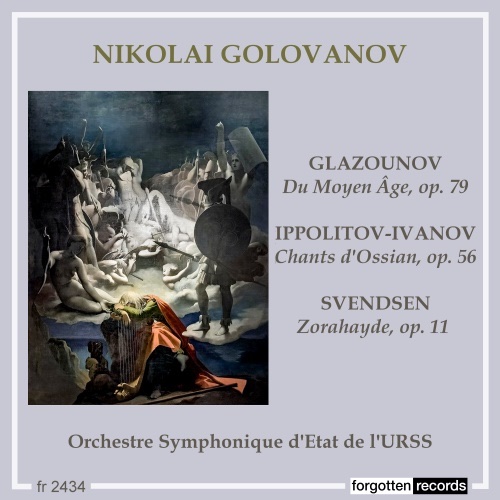
Nikolai Golovanov = GLAZOUNOV: From the Middle Ages, Op. 79; IPPOLITOV-IVANOV: Songs of Ossian, Op. 56; SVENDSEN: Zorahayde, Legend for Orchestra, Op. 11 – State Symphony of the USSR/ Nikolai Golvanov – Forgotten Records FR 2434 (66:02) [www.forgottenrecords.com] ****:
Russian conductor Nikolai Golovanov (1891-1953) gleans the decided benefit of Forgotten Records’ restoration of the 1952 and 1950 performances of vivid, colorful music by Glazounov, Ippolitov-Ivanov, and Norway’s second most-famous composer, Johan Svendsen (1840-1911). Noted for his distinctive work with the Bolshoi Opera, Golovanov fell out of favor with the despotic whims of Josef Stalin, who censured Golovanov for his choice of a Jewish lead soloist, Mark Reizen, for a production of Boris Gudonov. A brilliant colorist, Golovanov imbues his interpretations with a vivid sense of drama, and the Russian repertory flourishes under his capacity for lyrical nuance. The two opening selections have had previous review from me in 2010, when the Historic Recordings UK label brought the original Melodiya discs out in transfers by Neal Kurz. With the addition that Forgotten Records’ transfers prove equally quiet and seamless, I retain much of my original thinking on the first two offerings.
The Suite From the Middle Ages (1902) by Alexandre Glazounov (1865-1936) has had various conductors of the past devoted to its colors, like Victor de Sabata and Fabien Sevitzky. The Suite is cast in E Major in four movements, the first a rather erotic affair of lovers who embrace while a churning sea casts itself at their castle’s foundations. The ensuing Scherzo: Allegro assai jitters with Russian character, a clear imitation of balalaikas juxtaposed against the Dies Irae from the Requiem Mass. Truly virtuosic playing emanates from the Moscow Radio strings, brass, percussion, and harps, colored as a festival of dervishes.
The Troubadour’s Song approaches the love music from Prokofiev’s Romeo and Juliet for the melodic evocation of romance by starlight. At moments, the scoring resembles a piece by Respighi. The music enjoys a stately and delicate grace – in strings and harps – certainly touched by Hollywood’s having co-opted this sound for every Biblical epic we know. The Finale: Allegro movement, The Crusaders, begins with a call to arms, quite heraldic, and a pageant, a militant tocsin, emerges reminiscent of Rimsky-Korsakov’s The Battle of Kershenetz, the trumpets and piccolo riding out in full caparison. Some fugal writing – likely obligatory, courtesy of Tchaikovsky’s legacy –slows down the drama but shows off Glazounov’s pedagogy.
The Sons of Ossian Suite (1925) by Mikhail Ippolitov-Ivanov (1859-1935) treats the Celtic bard musically – as had Gade and Mendelssohn – recall that Ossian is Fingal’s father, as in the Fingal’s Cave Overture. The first section, Lake Lyano, offers us wonderful color effects, similar to the Enchanted Lake of Liadov. The rocking rhythms enjoy the fact that Golovanov can elicit great tone from his bassoon, double basses and low strings. Some, however, may find his tempo sluggish, more like Rachmaninov’s Isle of the Dead. The use of low winds and strident horns and cymbals reflects palpable Liszt influence, particularly the string passages from Eine Faust-Symphonie and Les Preludes, which Golovanov takes full throttle.
The sensual middle movement, Kolyma’s Song, utilizes woodwinds and swirling strings to effect its lyrical pulse and evocation of the Russian soil. The melody, however, seems derivative of the opening section of Rimsky-Korsakov’s The Invisible City of Kitezh. Perhaps the most Tchaikovsky-like movement, Ossian’s Monologue on Contemporary Heroes, employs balletic and martial figures, the brass, tympani, and cymbals in full glory. The conscious attempt to create a musical edifice, a potent apotheosis, finds its merits and its sonic splendor in Golovanov’s reading.
Svendsen composed Zorahayde, Légende pour Orchestre, Op. 11, in August 1874 (rev. 1879) in Christiania. Svensen adapted a text from the American author Washington Irving (1783-1859), an extended, moody scene that retells a Moorish legend about love, magic, and religious conflict. Svendsen’s work, in six sections, focuses on the story’s turning point, which is the meeting between Zorahayde and Jacinta by the fountain, a moment in fact that parallels Svendsen’s own romance with his future wife, Sarah Levett. Violin pizzicatos and solo effects create a mood of nostalgic reflection and dramatic anticipation, supported by ominous winds, a sense of building, passionate tension. A more animated section invokes the mortal storm that ensues, and the passionate theme that emerges proceeds to the quiet coda with decided languor.
—Gary Lemco