by Audiophile Audition | Feb 26, 2026 | Classical CD Reviews
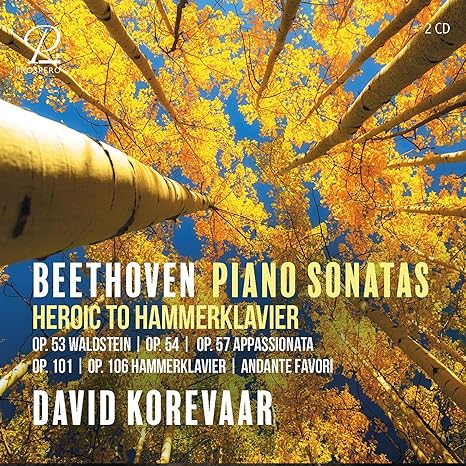
BEETHOVEN: Piano Sonatas Op. 53 “Waldstein”; Op. 54; Op. 57 “Appassionata”; Op. 101; Op. 106 “Hammerklavier”; Andante favori WoO 57; – David Korevaar, Piano – Prospero Records PROSPO111 (2 CDs = 71:17; 66:57)(3/4/25) [Distr. by PrestoMusic] *****:
I recently received the Prospero 2-CD set of five Beethoven sonatas and the Andante favori as performed by David Korevaar, himself a pupil of both Earl Wild and Abbey Simon, who deeply recognizes the historical significance and influence of Beethoven’s epic contribution to the genre. The complete recording of Ludwig van Beethoven’s 32 piano sonatas was published digitally in six volumes in the Fall 2025.
I called David Korevar at his Colorado residence to speak at some length of his – yet another – Beethoven cycle on records.
Gary Lemco: You refer to this latest installment of the 32 as “an act of hubris”, invoking the Greek sense of a fatal flaw. Why so?
David KorevaarK: Perhaps it lies in my having heard Rudolf Serkin live at Carnegie Hall performing the Waldstein. There are dozens of monumental readings by great pianists, and now I offer my own perspectives.
GL: You point out the thematic and rhythmic similarities between this sonata and Mozart’s The Abduction from the Seraglio.
DK: Besides the literal transposition of Mozart’s figures, there lies in Beethoven the capricious sense of humor that commentators often overlook. The sense of spontaneity and improvisation is there, too, characteristics both composers share in abundance.
GL: You obviously relish the recording process, not such a common trait among musicians.
DK: I do, though certain masters did not – like Artur Schnabel. He could become quite impatient with the entire process of making records, though he could achieve wonderful results, like his Mozart Rondo in A Minor, K. 511. His line is fluid and operatic, the rhetoric feels spontaneous.
GL: Schnabel left copious notes to his edition of the Sonatas, but he seems to abandon all his careful detail when he sits down and plays, given the sheer emotionality of the documents we have.
DK: That’s a bit too general a statement. Schnabel can be precise, when he is not hurried. He, like many of us who follow Beethoven, felt troubled by the metronome markings left either by Beethoven or his editors. Some of these can be downright bewildering or obstructive, though Perahia did a convincing job in my opinion with the Hammerklavier. Beethoven’s slow movements need to be clear in texture, as should be his fugues. On the other hand, the finale of the Waldstein proffers a phantasmagoria of comic opera colors that pure speed can blur.
GL: You mention the humor that pervades Beethoven’s music, and you begin your first set with the F Major, Op. 54. You play this piece, which I first heard via Sviatoslav Richter, with a deft verve.
DK: This sonata has its quirks: the influence of Haydn merges with the style of C.P.E. Bach, and the Romantic impulse is evident. Beethoven had acquired an Erard instrument, and he felt eager to exploit a larger dynamic range. We certainly feel the grandeur in the Op. 57 “Appassionata,” where what you mentioned the “Aeolian harp” effect has become prominent.
GL: The early sonatas, too, indicate a grandeur of their own; and here, I am thinking of the Sonata No. 4 in E-flat Major, Op. 7.
DK: Definitely, there and in the Op. 2, No. 2, when you take the repeats: the design is vast, symphonic. Beethoven explicitly calls his second movement Largo, con gran espressione. I venture that the Op. 7 already anticipates much of the Hammerklavier Sonata. They both advance a “leisurely” conception of music. The undervalued Op. 22 reverses the application of virtuosity in the Op. 7, though they have similar rondos.
GL: I always think of the 32 sonatas an experimental laboratory, a workshop to explore possibilities in melody, rhythm, and harmony, as well as in design, especially in counterpoint.
DK: A good analogy, if I think of the Op. 78 and its economical use of intervallic ideas, its witty compression. Even frequently used measures become unrecognizable after a lyrical presentation and then in patterns of sudden density. I have also come to appreciate the less “ambitious” sonatas, like the two of Op. 14, which are wonderful, given the beauty of the middle movement of that in E Major.
GL: And then there are the late sonatas. . .
DK: There are so many challenges in these, not the least of which is coherence amongst conjunctive and disjunctive ideas. The liberation of the trill proffers a whole new series of prospects. The intense intimacy seems at war with the limits of the instrument. And how does one capture “profundity”?
GL: You cite “superlatives” in your notes to this first edition. You have achieved several, I’d say,
DK: Thanks; it’s been a pleasure talking to you.
David Korevaar: Heroic to Hammerklavier
Piano Sonata No. 3 in C Major, Op. 53 “Waldstein”;
Andante favori in F Major, WoO 57;
Piano Sonata No. 22 in F Major, Op. 54;
Piano Sonata No. 23 in F Minor, Op. 57 “Appassionata”;
Piano Sonata No. 28 in A Major, Op. 101;
Piano Sonata No. 29 in B-flat Major, Op. 106 “Hammerklavier”

by Audiophile Audition | Feb 21, 2026 | Classical CD Reviews, Classical Reissue Reviews
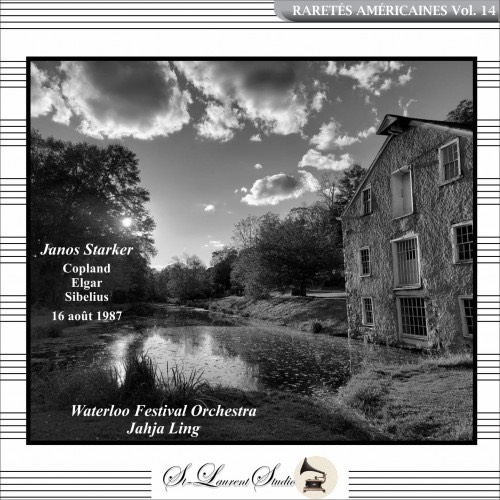
Raretés Américaines, Vol. 14 = COPLAND: An Outdoor Overture; ELGAR: Cello Concerto in E Minor, Op. 85; SIBELIUS: Symphony No. 2 in D Major, Op. 43 – Janos Starker, cello/ Summer Waterloo Festival Orchestra/ Jahja Ling – Yves St-Laurent YSL T1711 (2 CDs = 36:11; 45:30) [www.78experience.com] *****:
The opportunity to savor the imperial artistry of cellist Janos Starker (1924-2013) should forever be embraced, and this live rendition of the 1919 Cello Concerto by Sir Edward Elgar from 16 August 1987 pre-dates the RCA recording with Leonard Slatkin by some 10 years. Chinese-American conductor Jahja Ling (b. 1951) became the first musician of his ancestry to assume the post of a major American ensemble, the San Diego Symphony, as well as leading the Sa Francsico Youth Orchestra before establishing a long-term relationship with the Cleveland Orchestra that lasted for 38 seasons.
Ling opens the program with Aaron Copland’s 1938 An Outdoor Overture, conceived as an “optimistic” vehicle for orchestra, commissioned by Alexander Richter, Music Director of the High School of Music and Art in New York City. A hearty energy salutes us, as Copland starts with the full orchestra, and then a prolonged trumpet solo ensues. A martial, percussive theme, rather jaunty, with echoes of the trumpet tune, yields to a persuasive, lyrical melody for strings. The syncopations return for another march, more resolute. Copland then assembles the diverse impulses into a mix of insistence and consolation, deftly organized. The verve and open-air character of the music begot its “outdoor” sobriquet, and the coda rounds off its confident sensibility.
Janos Starker makes his presence known at once, his recitative firm and plaintive, answered by clarinet, bassoon, and horn, until the cello takes up the meandering theme that soon develops into a mighty, impassioned declaration of poignant feeling. The move to a suave E major flows without seams, and Starker’s sojourns into high register convey blithe energy. The main theme diminishes to segue, crescendo and pizzicato from Starker, into the Lento opening of the second movement. The Allegro bustles with 16th notes, with Starke’s maintaining an elastic tension in perpetual motion.
The Adagio, 3/8, sighs with reminiscence, the Starker restraint polished and understated without any loss of pathos. The rough energy of the last movement has Starker crescendo and fortissimo, Allegro, 2/4, leading a martial impulse complemented by Starker’s urgent declamations. A silken dialogue ensues between solo and responding ensemble. A fugal section ensures that the German mind will approve of Elgar’s means. Starker’s capacity to make his Goffriller instrument sing emerges in glorious Technicolor, a consistent, “gem-like flame,” to paraphrase Walter Pater. The fusion of sheer power and refined intimacy imbues the performance with a rare nobility. The final measures and their resultant coda confirm that the audience has been well convinced of the stateliness of the occasion.
The Second Symphony of Sibelius (1901-02) emerges as a mosaic of musical impulses that converge into a pantheistic paean, a hymn to landscape. The music has had many esteemed adherents, among them Kajanus, Beecham, Karajan, Erhling, and Sanderling, but none so apocalyptic in vision as Koussevitzky. From the Allegretto’s outset, Ling invests a warm affection into Sibelius’ figures, advancing the long line that ends with a woodwind and timpanic flourish. That critic Virgil Thomson could deem this powerful, ardent score “provincial” strikes me as envious condescension. The merger of brass fanfare, chirping woodwinds, and fluttering strings creates a bucolic tapestry of fervent beauty.
Sibelius begins his Tempo andante, ma rubato with a timpani roll and restless, bass pizzicato strings – the pride of Koussevitzky’s BSO – from which a bassoon tune struggles to emerge within an Aeolian harmonic context. A dramatic struggle ensues, much in the Brahms vein, from which the melodic tissue will surge with passionate vitality. The pregnant pauses assume a telling, mystical character as the landscape opens to throbbing, pantheistic suggestion.
The sudden death of Sibelius’ sister-in-law may have inspired the sorrowful oboe theme that interrupts an otherwise breathless scherzo, Vivacissimo, that whistles with some dark portent toward the grand finale that, attacca, will bloom from the voluptuous froth of the third movement. The discipline of Ling’s ensemble shines through, quite a remarkable homogeneity of texture accomplished within the limits of a summer music festival. Sibelius would comment that, for him, “pieces of Heaven’s floor had been presented to him in mosaic,” so the last movement, Finale: Allegro moderato rises up as a progressive unveiling of a mystically grand, cosmic design. This performance, wrought neither by Koussevitzky or his faithful acolyte de Carvalho, achieves its especial grandeur that deserves the widest possible acclaim.
—Gary Lemco
by Audiophile Audition | Feb 20, 2026 | Jazz CD Reviews, Pop/Rock/World CD Reviews, SACD & Other Hi-Res Reviews
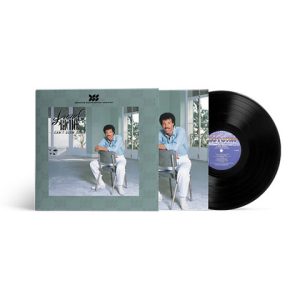
Universal Music Group releases a stunning vinyl upgrade to Lionel Richie’s Grammy-winning album.
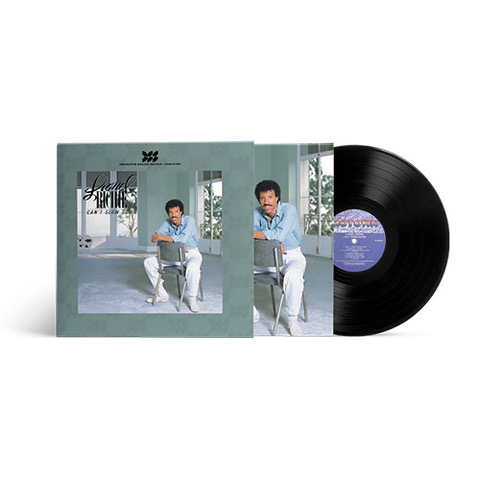
Lionel Richie – Can’t Slow Down – Motown Records (1983)/Interscope-Capitol [Definitive Sound Series/One-Step Audiophile Limited Edition 180-gram LP} (2/20/2026) *****:
(Lionel Richie – keyboards, piano vocals; David Cochrane – guitars, synthesizer, vocals; Paul Leim – drums; Greg Phillinganes – synthesizers; Abraham Lobriel – bass; Darell Jones – guitars; Tim May – guitars; John Robinson – drums; Paulinho da Costa – percussion; Richard Marx – vocals; David Foster – keyboards; Jeff Porcaro – drums; Steve Lukather – guitar; Michael Boddicker – keyboards; plus many others)
In 1983, Lionel Richie released his second album as a solo artist, Can’t Slow Down. It produced five hit singles, including two number ones (“All Night Long”, “Hello”). Richie, who had fronted The Commodores earlier in his career, was moving towards a broader audience with different musical aesthetics. Can’t Slow Down garnered album of the year at the Grammys, and propelled the Alabama-born musician to the height of 1980’s popular music alongside Michael Jackson, Prince and Bruce Springsteen. He became a major asset to the relocated Motown Records. MTV increased his crossover appeal.
Interscope-Capitol has released a limited-edition audiophile vinyl of Can’t Slow Down. This is a notable upgrade, part of the Definitive Sound Series/One-Step process. A cadre of top-flight session musicians add to the sonic luster. Side One opens with the title cut. With smooth layered instrumentation and a funk-driven beat, Richie’s vocals are soulful and accessible. A certain highlight is “All Night Long”. Among the tight percussion, instrumentation (horns, synthesizers) and rhythm, Richie delivers an ebullient lead vocal. The musical tapestry exudes a Caribbean-infused vibe and there is a plethora of tracked background singing and chants that are magnetic. In a change of pace, “Penny Lover” injects balladry into the flowing instrumentals. There is a hypnotic call and response vocal coda. All of the song elements fit seamlessly. Another ballad, “Stuck On You” is amenable and intermingles country and pop influences.
Returning to r&b hook-driven grooves, “Love Will Find A Way” has a steady tempo that allows Richie to showcase emotional resonance. The steady bass and drums are countered by atmospheric keyboards and spacious back up vocals. Meticulous arrangements elevate these songs. “The Only One” sways with pop sensibility. The final chorus picks up some intensity. Returning to dance vibes, “Running With The Night” is hard-rocking soul music with a relentless beat and positive energy. Punctuated synth accents and an incendiary electric guitar solo (Steve Lukather) propel the number, framing Richie’s mellifluous singing. The finale (“Hello”) is sensitive pop balladry. It is stripped down with Richie’s most earnest vocal performance.
This album is a step forward in audiophile vinyl. The re-mastered sound (Chris Bellman/Bernie Grundman)) is sourced from the original analog master tapes (coincidentally by Grundman). It is dynamic and packs a real punch (especially on the lower end). Richie’s voice is centered and blends with the thick instrumentation. The Neotech VR900-D2 180-gram vinyl pressing (RTI) is pristine and captures the music in a quiet aural landscape. Superior packaging includes a tip-on jacket inside a slipcase.
Highest recommendation!
—Robbie Gerson
TrackList:
Side A: Can’t Slow Down; All Night Long (All Night); Penny Lover; Stuck On You
Side B: Love Will Find A Way; The Only One; Running With The Night; Hello
by Audiophile Audition | Feb 18, 2026 | Classical CD Reviews
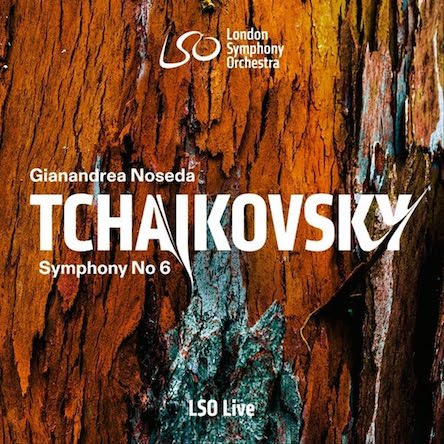
TCHAIKOVSKY: Symphony No. 6 in B Minor, Op. 74 “Pathetique”; MUSSORGSKY: Prelude to Khovantschina – London Symphony Orchestra/ Gianandrea Noseda – LS00895 (49:30) (12/3/25) {Distr. by PIAS] ****:
Noseda and the LSO recorded Tchaikovsky’s 1893 Sixth Symphony 6-7 December 2023, a lyrical, direct approach the does not indulge in the “staggering blows of fate” of the grand interpreters Mengelberg, Furtwaengler, Mravinsky, and Bernstein. The tragic elements remain, from the opening low bassoon and its hushed surroundings, the weeping character of the Adagio’s melancholy main theme, which soon subsides quietly, only to explode in emotional rebellion. The Allegro non troppo proceeds as a furious exercise in competing textures in counterpoint, intruded upon by militant forces. Some fine sense of transition emerges as Nosada builds his contending impulses, often reacting to each other antiphonally. The LSO trumpets and strings, alert and brilliant, and then the timpani, drive the music in a linear, resolute procession. The lyric quietude that resolves the first movement, even as thunder passes by, casts a tender resignation into the horizon.
The string and woodwind homogeneity of tone that literally defines the LSO sweeps the 5/4 Allegro con grazia second movement along in balletic gestures, the middle section -given the persistent drum beats – more cognizant than the surface offers of a fatal impulse at the heart of experience. Disturbed yet beautiful, this music possesses a siren-like allure that presents a false hope of reconciliation. The third movement, despite its Allegro molto vivace heroics, only drives Tchaikovsky’s ironies deeper, the potentially triumphant march rhythms undercut by metric irregularities whose power had been first revealed in the Beethoven Eroica. Noseda imposes a light but steely, vivid drive upon the music, and we might think of Toscanini’s approach to this score.
Whether the last movement Finale: Andante lamentoso – Andante inspired Gustav Mahler’s sense of tragic, symphonic design remains speculative, but Tchaikovsky’s heartfelt eulogy for his own soul communicates a forlorn sincerity rare in music. The descending motifs compete in minor and major; and, ending in major, become perhaps increasingly plaintive, a lesson inscribed by Gluck in his Orfeo. Noseda proceeds deliberately, without rhetorical exaggeration, allowing Tchaikovsky’s numbers to narrate a grievous collapse that desperately seeks to restore some happy resolution before inexorable darkness triumphs.
Noseda complements his program with Mussorgsky’s 1874 Prelude to the opera Khovantschina, unfinished at the time of the composer’s death in 1881 and subsequently re-touched by Rimsky-Korsakov. Subtitled as “Dawn Breaking over the Moscow River,” the luscious score – first revealed to this reviewer by Leopold Stokowski – features fine playing by oboe Timothy Rundle. The LSO strings and winds shimmer palpably in a haze of sound as evocative as it is lovely, a real testament to the composer’s natural melodic powers. Certainly, LSO could have attached more Russian music to this otherwise charming program.
—Gary Lemco
by Audiophile Audition | Feb 16, 2026 | Classical CD Reviews, Classical Reissue Reviews
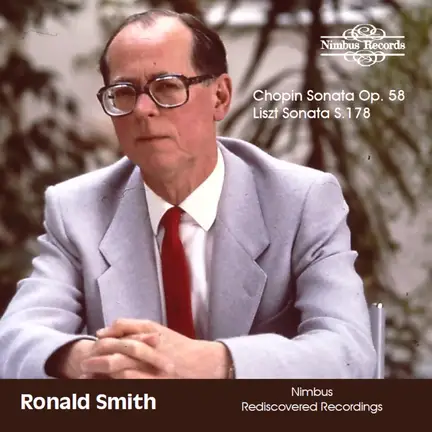
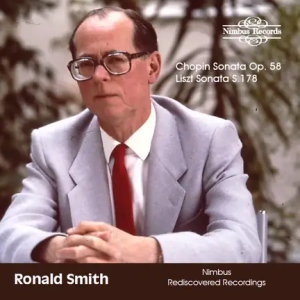
Ronald Smith: Rediscovered Recordings = CHOPIN: Piano Sonata No. 3 in B Minor, Op. 58; LISZT: Sonata in B Minor – Ronald Smith, piano – Nimbus NI 7115 (54:24) (3/6/26) [www.wyastone.co.uk] *****:
In a recent letter to me concerning this Nimbus release of February and August 1980 recordings by British pianist Ronald Smith (1922-2004), record collector and radio broadcaster Lance G. Hill noted, “Isn’t it a pity that many of the younger generation do not know of Ronald Smith, an imposing artist?” Correlative to Hill’s remark, Nimbus record producer Adrian Farmer writes:
The sessions in 1980 were both ‘analogue,’ being made on reel-to-reel tape machines. We had little idea how quickly such Industry wide state-of-the-art technology would be brutally swept aside by the arrival of digital recording, and its market counterpart, the Compact Disc. Ronald’s Chopin Etudes were released on LP the following year. The LP sleeve went as far as announcing the catalogue number of the upcoming Chopin/Liszt Sonata pairing. The master was approved and ready to go. But all things ‘digital’ upended all sense: the record world, its media and followers clamored for digital recordings of standard works. Labels rushed to satisfy the demand (Nimbus was no exception), and unreleased ‘analogue’ masters fell into a dark hole. Ronald Smith’s later digital recordings enjoyed immediate release, but not so the Chopin/Liszt Sonatas, until now, 45 years on.
Ronald Smith, despite his natural affinity for music of the Romantic Era, found his greatest inspiration from having worked with Swiss master Edwin Fischer (1886-1960) in the music of J.S. Bach. Fischer’s penchant for classical architecture in music brought discipline and clarity to the otherwise difficult, almost impenetrable scores of Valentin Alkan and Mili Balakirev, both of whom Smith championed. His coloration for Chopin’s 1844 Sonata in B Minor graces the first movement Allegro maestoso with a florid combination of idiosyncratic Bach counterpoint and Chopin’s especial chromatic harmony. The runs and small, right-hand canons flow with a liquidity of motion that conveys a lyrical momentum informed by the dramatic content, a hybrid of nocturne and ballade. While the volume and dynamics retain their capacity for explosive propulsion, the atmosphere remains one of intimate restraint, more of Robert Casadesus and Alfred Cortot than of Vladimir Horowitz.
Smith’s Scherzo: Molto vivace bears an elfin quickness, offset by a hazy, introspective episode rife with unresolved harmonic motion. We think that Smith would excel in the four Chopin Impromptus, where the fleetness of his diaphanous runs would enjoy full rein. If ever the art of Bellini’s operatic bel canto found instrumental means, Chopin’s third movement Larghetto proves the analogy secure. After an opening in dotted rhythms, a groping series of chords resolves into a sustained, processional nocturne of extraordinary, mesmeric power. Smith fashions an interior dialogue of seamless beauty, the keyboard’s having renounced anything like percussive power. The moments of recitative savor the silences between the chords, where true drama lies. The last movement Finale: Presto non tanto unleashes Smith’s flair for bravura expressivity, a potent rondo whose fury does not abate. Smith hurtles through Chopin’s martial sensibility, wherein brilliant runs and cascades tumble forth in breathless impetuosity, a force from the Romantic Abyss. The coda rounds of a cataclysmic sense of dramatic flourish, a proclamation of hard journey well met.
Franz Liszt’s 1854 Sonata in B Minor has inspired much rhetorical speculation on its ‘meaning’ or ‘programmatic intent.’ Liszt himself offered no clues to this unique piano composition, sometimes referred to – given its Beethoven-like girth, vehemence of expression, and dynamic, polyphonic means – as “Beethoven’s 33rd Sonata.” For both lyric power and unity of form, the Sonata has few rivals, since it compresses into one extended movement a ground theme that permeates the work entirely, sometimes as a fugato impulse played against itself in inversion. Likely having taken Franz Schubert’s 1822 Wanderer Fantasy as his model, Liszt subdivides the one movement into four sections (three, in the present recording divisions), displaying what Blake would call ‘fearful symmetry,’ as the key scheme: C-E-A-flat-C draws a fatal, epic circle around the plethora of emotions and shifts of mood. Ronald Smith here enters the realm dominated by the likes of Horowitz, Cziffra, Cortot, Kentner, Petri, Arrau, and Barere for theatrical bravura on the grand scale.
After a mysterious Lento assai, Smith launches (sotto voce) into the group of three themes that establish the exposition, including a voluptuous appearance of the amazing trill that hurdles the material into Dante’s depths. The grand D major theme offers lyrical consolation as the original motif transforms itself while maintaining its essential character, close to Hegel’s dictum: “the Idea unfolds itself in the form of being different.” The silken runs and resolute marcatos proceed with stunning clarity of motion, Allegro energico, pulverizing and insistent. Andante sostenuto The provides the heart of the music, a slow movement suavely consoling and perhaps religious in its gossamer realignment of the opening motif. Smith plays the entire section in the manner of a bravura improvisation, at moments sounding like an operatic reminiscence. The various fingering approaches Smith utilizes play like a compendium on piano technique, a textural tour de force.
Then, after the opening riff, Liszt offers the fugato announcing the third, demonic progression. Serving as a kind of development section, the expansive fugue injects a fury into the textural mass that defies classical categories. Each articulation of the impulse intensifies the staggering effect, so no wonder the orchestral version often appeared in Universal horror films! The consolation of the D major theme arises out of the emotional rubble, devoutly delivered and beatific in visionary power. Smith then mounts to a grueling, cataclysmic moment, furioso, since it is better to rule in Hell than to serve in Heaven, the ultimate expression of individualistic pride. Yet, Liszt resists the apotheosis of the Abyss and reintroduces his grand anodyne, the Andante sostenuto theme after a pregnant silence. The snake bites its own tail; the ouroboros, the eternal circle, is complete.
—Gary Lemco
by Audiophile Audition | Feb 13, 2026 | Pop/Rock/World CD Reviews, SACD & Other Hi-Res Reviews
A beautifully remastered 4 LP retrospective of the career of Yusuf/ Cat Stevens…
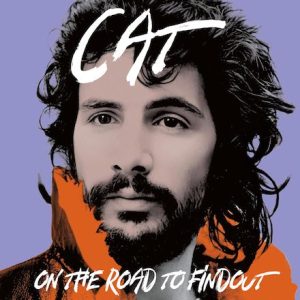
Yusuf/Cat Stevens – On The Road to Find Out – 4 LPs (140 gm vinyl) – Island Records/ Cat-O-Log Records/ Universal #00602478281914
The career of musician extraordinaire, known by most as Cat Stevens, has had a wide ranging six decade ride, with half of that time out of the public’s primary view.
Born in 1948 in London, named Steven Demetre Georgiou, he changed his name to Cat Stevens, in the mid-60s. His first single, “I Love My Dog,” was recorded in 1966. Blessed with matinee idol looks, and a voice that could melt hearts, Stevens had a string of early 1970s albums that found honored places in million of homes both in Europe and the United States. Mona Bone Jakon, Tea for the Tillerman, Teaser and the Firecat, and Catch Bull at Four would alone make for a successful career. He continued to record until late in 1978, when he became disillusioned with the recording industry and converted to Islam, taking on the name, Yusuf Islam. He did not record secular music again until 2006. Between 2006 and 2023, an additional six albums have found a return to more commercial fare.
A much needed career retrospective of Yusuf/Cat Stevens has been needed to appreciate his talents. Recently a 4 LP boxed set, On the Road to Find Out, made up of 47 tracks (32 from 1967-1978, and an additional 15 tracks from 2006-2023), is a must-have for his fans. There is also a 2 CD version, but for vinyl fans, the deluxe treatment makes vinyl the way to go. The lacquers were cut by Geoff Pesche at Abbey Studios in London. Mastering duties were handled by Mazel Murad at Katara Studios. The set has custom outside cardboard sleeves and plastic lined inner sleeves. The large booklet features song lyrics and notes by Cat. For hard core fans, also released is a separate biography with the same title. Both would make a fine gift.
Most all of the 1970s hits are included on the first two plus albums, including “Wide World,” “Morning Has Broken,” “Father and Son,” and “Peace Train,” to name just a few. There are winning covers of “Here Comes My Baby,” “The First Cut is the Deepest,” Sam Cooke’s “Another Saturday Night,” and an acoustic version of George Harrison’s “Here Comes the Sun.”
What also stands out is that more current material over the last fifteen to twenty years, that show that Yusuf/Cat has retained the rich, soothing voice that captivated us over a half century ago. On the more recent album, An Other Cup , he channels John Lennon’s “Imagine,” with “Maybe There’s a World,” on a plea for a border less world. There is also a gritty, “Don’t Let Me Be Misunderstood,” that would be a good companion to the version of Eric Burdon with The Animals. His “rock” creds stand out on “Gold Digger,” and there is a moving rendition of Edgar Winter’s “Dying to Live.”
Stevens induction to the Rock and Roll Hall of Fame in 2014, re-introduced the general public to this musical chameleon, and its about time for a renewed appreciation of Mr. Yusuf/Cat Stevens. This remastered box set can only help the process…
Review by: Jeff Krow
Yusuf/Cat Stevens – On The Road to Find Out
Tracklist:
Side One:
I Love My Dog, Matthew and Son, Here Comes My Baby, The First Cut is the Deepest, Lady D’Arbanville, Trouble
Side Two:
Where Do the Children Play?, Wide World, Father and Son, Tea For the Tillerman, Don’t Be Shy, If You Want to Sing Out, Sing Out
Side Three:
The Wind, How Can I Tell You, Morning Has Broken, Moonshadow, Peace Train, I Want to Live in a Wigwam
Side Four:
Sitting, Can’t Keep It In, Foreigner Suite (Excerpt), The Hurt, Ready, Oh Very Young
Side Five:
Another Saturday Night, Majik of Majiks, Banapple Gas, (Remember the Days of the) Old Schoolyard, (I Never Wanted) to be a Star
Side Six:
Just Another Night, Last Love Song, Butterfly, Heaven/Where True Love Goes, Maybe There’s a World, Don’t Let Me Be Misunderstood
Side Seven:
Thinking ‘Bout You, Roadsinger, Gold Digger, Dying to Live, Blackness of the Night, Grandsons
Side Eight:
Miles From Nowhere, On the Road to Find Out, Father and Son, Here Comes the Sun (acoustic), All Nights All Days, Take the World Apart
by Audiophile Audition | Feb 13, 2026 | Classical CD Reviews, Classical Reissue Reviews
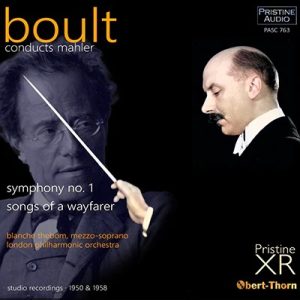
MAHLER: Symphony No. 1 in D Major; Songs of a Wayfarer – Blanche Thebom, mezzo-soprano/ London Philharmonic Orchestra/ Sir Adrian Boult – Pristine Audio PASC 763 (61:58) [www.pristineclassical.com] *****
Producers and Recording Engineers Mark Obert-Thorn and Andrew Rose have resuscitated two Mahler performances 1950 (for RCA) and 1958 (for Everest), respectively, led by Sir Adrian Boult (1889-1983) and featuring American mezzo-soprano Blanche Thebom (1915-2010) in Mahler’s 1885 lyric song-cycle, Lieder eines fahrenden gesellen. Unlike Bruno Walter’s CBS recording with Mildred Miller, this reading enjoys a lyric directedness and aerial suasion without heaviness, despite the songs’ bittersweet melancholy of unrequited love. While Bruno Walter had the direct communication with Mahler and his musical circle, Boult – much influenced by the conducting pedagogy of Fritz Steinbach – pursues a literal, unsentimental, understated approach that maintains emotional dignity and requisite passion at all points of expressiveness.
The music moves between a communion with Nature’s beauty and its simultaneous neutrality, even cruelty. The beloved’s eyes, more than any other feature, haunts the narrator, infiltrating the calls of Nature and its seductions to love, tinging the very atmosphere with a dire implacability of tragic fate. The second of the songs celebrates the tangible urge to Nature’s procreative power, the overwhelming beauty of the fields, the lust for life. The melodic tissue, pregnant to become the motif of the First Symphony, basks in its own lyric aspirations to eternal beauty. Thebom nuances her diction and timbre to allow resignation to color the last measures, just prior to real anguish of the third song, “I have a burning knife in my breast.” This powerful expression of fatal passion approaches an operatic scena, rife with aching, relentless self-reproach. The last of the songs condemns the narrator to amorous exile, at the behest of the beloved blue eyes. The funereal motif will no less appear in the third movement of the First Symphony. Here the fatal tempo accompanies a series of farewells, much in the spirit of Schubert. Harp and strings introduce a new theme, a quest for forgetfulness, some balm in Nature to quell the sense of eternal loss. The orchestral tissue seems to proclaim Nature’s indifferent judgment on such suffering.
Everest recorded the 1888 First Symphony in stereo, and the sonic impact remains transparently immediate. The inverted pedal point that marks the first movement’s pantheistic fanfare injects a sovereign mystery to the proceedings, what will become an emotional calamity in the very brightest of settings. The harp chords convey a delicate, personal anguish in the midst of an existential plenty. By the latter part of the development, the song Ging heut’ Morgen über’s Feld, has been compounded into a dire and solemn tocsin, an admixture of consolation and wrenching loss.
The A major Scherzo and Trio, based upon an Austrian Ländler, has rarely sounded so innately waltz-like, taken at a brisk, unmannered tempo. The music gains force and urgency, a momentum that would belong to Toscanini, were he inclined to lead this music. We move immediately into the D minor funeral-march parody on Bruder Jacob, the French folk song now a grotesquerie after E.T.A. Hoffmann and Callot, announced by the symphony’s double-bass. The middle section, with its klezmer motifs, sounds like circus music that anticipated Kurt Weill. Suddenly, harp and strings, as in the last of the Wayfarer cycle, intrude with the longing for forgetfulness, exuding the languor of world-weariness. The funeral march returns, more insistent, more unremitting, undercut by the black humor of self-incrimination. The high dissonances in th winds might come from a strangled Till Eulenspiegel.
Despite the chaotic, even vulgar, assaults of the F minor tempest announcing the last movement, Boult manages a sobering clarity of line, the various thematic impulses articulated with dramatic and linear force, while favoring what Obert-Thorn characterizes as “balance over excess.” The melodic counterthemes offer solace and romantic vigor, at once. The LPO battery section, along with the brass, make their presence known, the sudden shifts of texture superbly transitioned with a smoothness that likens this final, emotional construct to a Liszt one-movement symphonic poem. At just after nine minutes, the opening pedal-point returns, a call to cyclicism, pregnant with Nature’s contradictory imperatives. For Mahler, as perhaps for James Joyce in his collection Dubliners, love (in fugato) survives the irrevocable desolations, a result of the persistence of human will. Here, in Mahler’s exalted return to D major, he exerts his most Beethoven-driven energy, a martial herald of the mortal storms that lay in wait for music’s most tormented, inspired soul.
For Mahler with a distinct difference, this album comes much recommended.
—Gary Lemco
by Audiophile Audition | Feb 11, 2026 | Jazz CD Reviews, SACD & Other Hi-Res Reviews
This is a vibrant, eclectic acoustic jazz compilation.
Jack West – Essential Curvature – Otá Records OTA1038 180-gram translucent stereo double vinyl, ****1/2:
(Jack West – 6-string acoustic guitar; slide; 8-string acoustic guitar; Scott Proffitt – percussion; Jim Santi Owen – morsing; Calder Spanier – soprano saxophone; Brian Hill – 6-string acoustic guitar; Ricky Carter – percussion; Joel Davel – marimba; Steve Robertson – percussion; Mike Marshall – mandolin; Dean Magraw – 6-string acoustic guitar Peter Valsamis – drums; Scott Amendola – drums; Mark Summer – cello; Darian Gray – drums; Joel Davel – Marimba Lumina; David Phillips – pedal steel)
Jack West is an innovative acoustic jazz guitarist. His style (at times reminiscent of Michael Hedges) is a mixture of jazz, folk, rock and funk, usually performed on a 6-string or 8-string guitar. His band work (Curvature) is noted for improvisational acuity, rhythmic punctuation and multi-faceted instrumentation. From 1996-2003, they released five albums to critical acclaim. Otá Recoprds has released a sixteen-track compilation of Curvature songs, with an emphasis on his collaboration with various Bay Area musicians, including drummer Scott Amendola, cellist Mark Summer (Turtle Island Quartet) and marimba artist Joel Davel. Side A opens with “Big Ideas”. This is a pulsating groove-filled 8-string acoustic guitar number that has bluesy imagery and unique instrumentals (marimba, cello and drums). It is upbeat and has some nimble slide work. “Slinky” is also bluesy with unexpected sound effects, funky tempo and more slide work. On “Interaction Shift”, a steady cadence is hypnotic, pairing with a second guitarist (Dean Magraw) who deliver crisp jazz-infused solos. Davel’s marimba (who also solos) combines with drummer Peter Valsamis to create a Brazilian texture that is magnetic. “Not Touching” has a similar musical vibe, and the addition of soprano saxophone weaves exotic motifs into the arrangement.
In a slower groove, “This Life May Be Monitored” is replete with slides and note-bending on 8-string acoustic with interesting cello accents. West’s runs are precise and display impeccable timing. The dual guitar returns on “Moon With A View”. It is jaunty. The marimba (which is understated and at times delicate) and percussion (Ricky Carter) fit in seamlessly. West again executes note-bending slide runs that are evocative. A deliberate rhythm is maintained throughout “Something About The Dream”. West and Summer blend for a haunting reverie with Amendola in a rare trio performance. Picking up the pace, “Quarter Past Stockton” moves like a swaying country-jazz piece with tempo and atmospheric resonance. In another change, “Nigel’s Dream” reverses direction with West and Magraw switching lead and rhythm. The marimba is low-key and integral to the musical dynamics. Adding some funk attitude (“Oil Vein”), West, Carter and Davel establish a visceral hooked groove, while Spanier counters with some melodic runs and nuanced free form expression. “Colored Shells” is scaled down to West and Proffitt and the overall sound is soulful and relaxed. West is equally adept at complexity in quartet format with “Closer To The Sky”,“Helicopter” and “Backwards Over Bend”. Each arrangement is unique and showcases the genuine diverse approach to jazz. There are also unexpected touches like mandolin on the folk-driven “True South”. The finale, “Christina’s Song” is a sinewy, mellower translation that adds another layer to the creativity of these musicians.
Essential Curvature is a refreshing, inspired collection of acoustic jazz. The complexities of the different tracks (with very incisive liner notes by West) are notable. This sound mix is detailed with excellent stereo separation and the vinyl pressing (Bernie Grundman Mastering) is pristine.
Highly recommended!
—Robbie Gerson
Essential Curvature
TrackList:
Side A: Big Ideas; Slinky; Interaction Shift; Not Touching
Side B: This Life May Be Monitored (For Quality Assurance); Moon With A View; Something About The Dream; Quarter Past Stockton
Side C: Nigel’s Dream; Oil Vein; Colored Shells; Closer To The Sky
Side D: Helicopter; Backwards Over Bend; True South; Christina’s Song

by Audiophile Audition | Feb 9, 2026 | CD+DVD, Classical CD Reviews
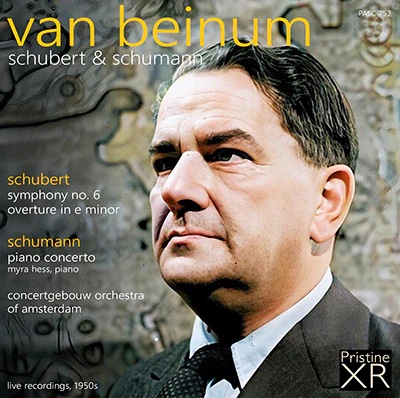
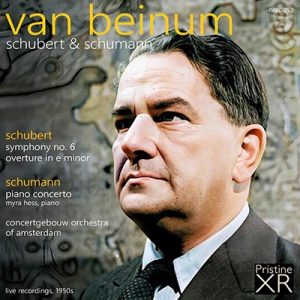
Van Beinum = SCHUBERT: Overture in E Minor, D. 648; Symphony No. 6 in C Major, D. 589; SCHUMANN: Piano Concerto in A Minor, Op. 54 – Myra Hess, piano/ Concertgebouw Orchestra of Amsterdam/ Eduard van Beinum – Pristine Audio PASC 752 (66:39) [www.pristineclassical.com] *****:
Pristine Audio, courtesy of the private collection of recorded performances of Francsico A.M. Joffily B. Mello, restores in solid sound music by Schubert and Schumann as led by Eduard van Beinum (1900-1959), who succeeded Willem Mengelberg at the helm of the Concertgebouw Orchestra without the imposition of any dictatorial ethic. The centerpiece of his album lies in the Schumann Piano Concerto from15 November 1956, featuring legendary British pianist Myra Hess (1890-1965) in the solo role. While the dates of performance of the two Schubert entries remain unknown, their aural impact has fine resolution and instrumental detail, immediately attested to by woodwinds of the Concertgebouw in the Schubert overture.
Beinum opens with an energetic rendition of Schubert’s 1819 Overture in E Minor, composed for Vienna but withdrawn from the general music population until 1886, for his collected works. The dramatic poise of the seven-minute piece bears the influence of Beethoven, with some sensitive articulation from the Concertgebouw winds and strings, and a sweet shaping of the brief but touching main melody. The accompanying note from Andrew Rose testifies to “a sparkle and delicacy that van Beinum clearly relishes.”
While some may quibble at the digital inaccuracies incurred by Dame Myra Hess, here late in a brilliant career, she and van Beinum deliver a poetic, nuanced account of Schumann’s one contribution (1845) to the piano concerto medium. Throughout the performance sonic treasures emerge from her colored arpeggios and careful runs, while the Concertgebouw oboe alerts us to a real talent at work. The Intermezzo has a particularly romantic and misty seduction, while the entry, attacca subito, into the Allegro vivace has a real schwung. Rather than reaching for the epic moment, the collaboration retains a loving, intimate affection. At times, Beinum injects a passion into the orchestral tissue that has us once more appreciating his flair in the repertory he savored. The athletic Allegro vivace last movement, marches, dances, and sings in a wondrous simultaneity of effect, all to the sheer delight of a most responsive audience.
Beinum concludes with Schubert’s 1818 Symphony No. 6 in C Major, which despite it occasional nods to Beethoven’s sense of drama, retains a lyric charm and boisterous energy entirely the composer’s own. Rossini and the lighter side of Haydn seem the more immediate models for Schubert’s elevated spirits, which can themselves become quite intense. The transparency of texture Beinum elicits supports an elastic flow of melody in the first movement Allegro, after an ominous Adagio.
Schubert sets the second movement Andante in two contrasted impulses, a gavotte-like melody that Haydn would admire, and a second that follows a triplet-laden interruption. Brinum gives the Scherzo: Presto a lithe, athletic buoyancy, his string section alerted to the nuances of the tip of the bow. The momentum sustained, it enjoys a robustly pert definition, and the sense of the strings and (high) winds’ delighting in their imitative (mechanical-clock) antics that permeate the reading. The finale, Allegro moderato, inhabits the self-same space as masterful Haydn, with tenderly deft Mannhein rockets, except for a sudden explosion or two that adumbrate the later “Great” Symphony also in C major. Beinum’s dynamic control adjusts so surely, that if I had to guess at the conductor, I might render Bohm or Karajan as my choices. The grandly exhilarated coda completes a most successful discovery from a valued, personal archive.
Thanks to Pristine Audio for this one.
—Gary Lemco
by Audiophile Audition | Feb 5, 2026 | Classical CD Reviews, Classical Reissue Reviews
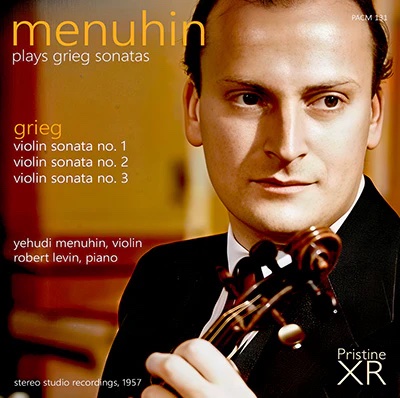
GRIEG: Violin Sonata No 1 in F Major, Op. 8; Violin Sonata No. 2 in G Major, Op. 13; Violin Sonata No. 3 in C Minor, Op. 45 – Yehudi Menuhin, violin/ Robert Levin, piano – Pristine Audio PACM 131 (63:40) [wwwpristineclassical.com] ****:
Yehudi Menuhin (1916-1999) and pianist Robert Levin (b. 1947) recorded the three Grieg violin sonatas for HMV 9-11 October 1957, originally in monaural sound, but Pristine and Andrew Rose’s XR process has revitalized the sonic impact to fill out Menuhin’s sweetly searching tone and Levin’s ripely idiomatic accompaniment. Grieg’s three sonata cover a 20-year period, 1865-1887, and they each bear aspects of his Norwegian folk heritage and his Germanic, musical disposition. Sonata No. 1 in F may exert the most “Romantic” elements, “rich in models” (as Grieg put the case), meaning that its influences lie in Schumann and Mendelssohn as purveyors of immediate, gratifying melodies.
Grieg was twenty-two at the time of his F Major Sonata, and perhaps the two opening chords – in E minor, A minor (for Grieg) – of Beethoven’s Eroica Symphony left their echo in Grieg’s imagination for his (contrarily) melancholy Allegro con brio. So, too, Beethoven’s Op. 24 “Spring Sonata” in F may carry over to Grieg for vigorously dramatic spontaneity and tenderly lyrical assaults. The second movement, Allegretto quasi andantino, however, opts explicitly for the folk effects of the Hardanger fiddle and the springar dance form. The use of fervent double-stopping over pedal points in the Trio section imitates the Hardanger’s limited division of nine strings, four of which are bowed while the five remaining strings vibrate sympathetically.
Grieg’s studies with Ole Bull fired his love for Norwegian folk idioms, albeit Danish at first. Menuhin’s hearty, throaty tone compels us, as it did Franz Liszt, to recognize a major talent in the young Grieg. The last movement, Allegro molto vivace, generates brisk energy qualified by reflective musing, even as the music feels an urge to dance and stretch its wings. The academic side of German training comes forth in the fugato section, but Grieg’s natural rhapsodic power dismisses the schoolbooks. Levin’s piano part becomes audacious in spurts, the keyboard arpeggios and runs quite bold, only to retreat in gently rhythmic filigree. The coda dances limberly in high, unbuttoned spirits.
Grieg had been recently married, aged 24, when he conceived his Violin Sonata No. 2 in G Major, Op. 13. After a slightly disturbed Lento doloroso, the first movement cascades into the Allegro vivace, rife with national, folk touches that seem to call for Peer Gynt or Troldhaugen. Despite the heavy reliance on German classical form, the sheer exuberance of the violin line, in soaring figures from Menuhin, captures the sizzling repartee set in Norwegian impulses. The yearning to dance rather overwhelms the tone of the fitful second movement, Allegretto tranquillo, opening and closing in the minor mode, but often exuding the thrill of life and then retreating into pensive reflection. At key cadences the music would seem to exhaust its sensibility, only to begin the dance anew. A brief solo cadenza by Menuhin precedes the quiet coda. A sort of bravura dazzle permeates the last movement, Allegro animato, leisurely and whimsical, at once. The dance becomes buoyantly infectious, even intoxicated, in its passionate ardor, and whatever melancholy may have informed the opening movement has been utterly dispersed in the ecstasies of abundant vitality.
Grieg spoke of his 1887 Third Violin Sonata, Op. 45, composed at Troldhaugen, as conveying “wider horizons.” The dramatic possibilities of the C minor mode Grieg exploits immediately, Allegro molto ed passionato, exuding a feverish intensity from Menuhin. The secondary tune ripples with Norwegian sentiment, combining with the intensely expressive capacities in Grieg, here summing up his chamber music energies in a final piece of which he felt justly proud. Violin and piano collaborate in an openly operatic dialogue of consummate, concentrated power. If Beethoven has not marked this (fiery) aspect of score, then perhaps Wagner has made a passing impression.
Marked Allegretto espressivo alla Romanza, the second movement bears the imprimatur of Grieg’s gorgeous melodic gift, here vulnerable to Menuhin’s especial capacity for lyrical tenderness. The sustained arioso carries us into a briefly syncopated dance sequence, with piercing pizzicato effects and high violin tessitura. The athletic vigor of the central section only intensifies the aching return of the ardent opening melody, with Levin’s adding his own intimate coloration. The last movement, Allegro animato, begins as a village dance, literally throbbing with life. Menuhin’s violin in multiple stops affords us an orchestral sound. The dance becomes alternately muscular and mischievous, then it yields to Grieg’s penchant for sweetness cast in national colors. The whirling-dervish dance resumes, intent on a trajectory that refuses compromise. Willpower alone seems to sustain the course, wherein, to quote Yeats, “a terrible beauty is born.” Despite the exertion of volatile emotion, the consoling power of the dolorous melody returns, just before the feral dance impulse brings the resonating structure to a close.
—Gary Lemco