by Audiophile Audition | Mar 9, 2026 | Pop/Rock/World CD Reviews, SACD & Other Hi-Res Reviews
Craft Recordings releases a new vinyl of Wille Nelson’s country music standards album.
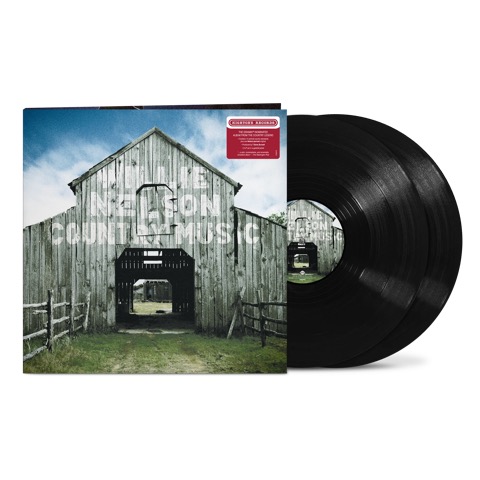
Willie Nelson – Country Music – Rounder Records (2010)/Craft Recordings/High Tone Records CR00976 (2026) 180-gram stereo double vinyl, 54:57 ****1/2:
(Willie Nelson – gut-string acoustic guitar, vocals; Jim Lauderdale – vocal harmony; Buddy Miller – electric guitar, vocal harmonies; Chris Sharp – acoustic guitar, vocal harmony; Dennis Crouch – acoustic bass; Riley Baugus – banjo; Ronnie McCoury – mandolin; Mike Compton – mandolin; Russell Pahl – pedal steel; Stuart Duncan – fiddle; Shad Cobb – fiddle; Mickey Raphael – harmonica)
The crossover of country stars into the mainstream has been evolving over decades. Artists like Johnny Cash, Dolly Parton, Kenny Rogers, Shanis Twain and Taylor Swift are prominent examples of this cultural shift. Perhaps there is no greater symbol of this movement than Willie Nelson. The Texas-born singer-songwriter achieved some success with compositions like “Crazy” (Patsy Cline), “Funny How Time Slips Away” (Billy Walker), and “Pretty Paper” (Roy Orbison). When Nelson recorded in Nashville, sales were moderate and he was not a fit for that scene. After relocating to Austin, things changed significantly. Willie became the face of a new country genre, outlaw music. It allowed him to express honky tonk with a nod toward counterculture. He became a beloved icon and recorded in a variety of styles including pop, jazz and traditional. Nelson is universally respected and has collaborated with a diverse group of stars.
Craft Recordings/High Tone Records has released an updated 180-gram vinyl of the 2010 album Country Music. This was a collection of traditional country music (one Nelson song) that was recorded with primarily acoustic instruments in minimal arrangements. Side A opens with “Man With The Blues”. A relaxed haunting vocal performance provides a spiritual aura. The simple accompaniment enhances the plaintive context. Nelson’s laid-back conversational approach permeates the 1948 Ernest Tubbs hit, “Seaman’s Blues”. Mandolin and pedal steel accents (with the always dependable gut string guitar) infuse the gospel sentiment. Waltz time, flexible slide and violin pick up the tempo on Merle Travis’ classic love song, “Dark As A Dungeon”. Unrequited love meets low-keyed honky tonk on “Gotta Walk Alone”. Nelson simply inhabits these songs. Whether it’s heartbreak (“Gotta Walk Alone”) or Sunday morning testimonial (“Satan Your Kingdom Must Come Down”), the production frames Nelson’s vocals with atmospheric resonance. Even heartache (“My Baby’s Gone”) has a soothing effect on the listener. “Freight Train Boogie” picks up the pace and is reminiscent of “The Singing Brakeman”.
Each arrangement is concise. Another Ray Price gem, “You Done Me Wrong” has a breezy dance vibe and trademark country regret. There are many historical connections in the song list. The up tempo “Pistol Packin’ Mama” was a rare country & western hit during World War II. A gentle flow (in 3/4 time) envelops “Ocean Of Diamonds” with great fiddle and Nelson’s authentic vocal delivery. A nimble guitar solo anchors the humorous “Drinking Champagne”. Wilson and the studio players ease into numbers like “I Am A Pilgrim” and “House Of Gold”, never straying from the back-porch vibe. The finale, “Nobody’s Fault But Mine” is deeply felt and feels like deep reflection.
This vinyl is the epitome of traditional acoustic country music. The sound is balanced with excellent stereo separation. There is a subtle ambiance to the mix with Nelson’s vocals centered and complemented delicately by the instrumentation. The vinyl pressing is pristine. It transcends nostalgia and genre.
Highly recommended!
—Robbie Gerson
Willie Nelson – Country Music
Side A: Man With The Blues; Seaman’s Blues; Dark As A Dungeon; Gotta Walk Alone
Side B: Satan Your Kingdom Must Come Down; My Baby’s Gone; Freight Train Boogie; Satisfied Mind
Side C: You Done Me Wrong; Pistol Packin’ Mama; Ocean Of Diamonds; Drinking Champagne
Side D: I Am A Pilgrim; House Of Gold; Nobody’s Fault But Mine.

by Audiophile Audition | Mar 6, 2026 | Classical CD Reviews, Classical Reissue Reviews
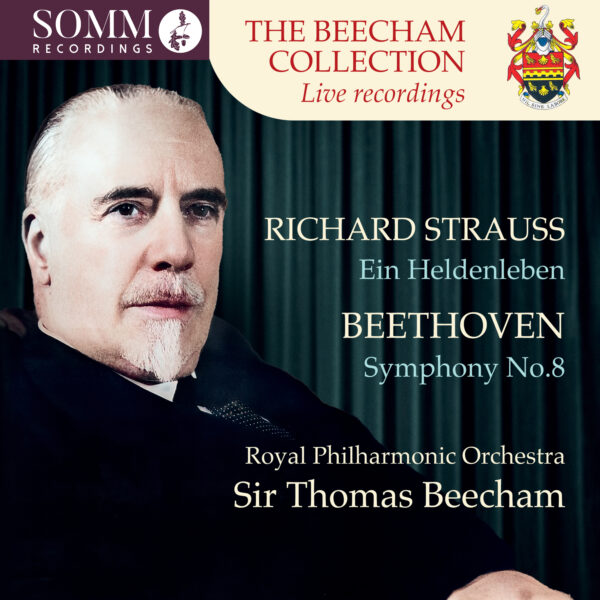
BEETHOVEN: Symphony No. 8 in F Major, Op. 93; R. STRAUSS: Ein Heldenleben, Op. 40 – Arthur Leavins, violin/ Royal Philharmonic Orchestra/ Sir Thomas Beecham – SOMM-Beecham 33 (67:56) [Distr. by Naxos] *****:
SOMM and audio restoration producer and engineer Lani Spahr restore a vivacious, even thrilling, pair of 1956 performances from the “inimitable” Sir Thomas Beeecham (1879-1961) at the helm of his Royal Philharmonic Orchestra, from respectively 17 October (Beethoven) and 12 December (Strauss). Both works, the Beethoven Eighth and the Strauss symphonic poem Ein Heldenleben, remained among Beecham’s favorite scores, through which his unbuttoned enthusiasm became a palpable Force of Nature.
From the outset of Beethoven’s first movement, Allegro vivace e con brio, Beecham sets a whirlwind tempo that sallies forth without a misstep. More than one commentator has christened the Beecham sound “torrential,” and this assault into Beethoven’s fecund and boisterous Symphony No. 8 (1814) proves true to form. The composer held this delightfully eccentric score in especial affection, and its means, forever Classical in design and architecture, reveal a saucy and mischievous turn where Haydn and Mozart remain conventional. Beecham has the second movement Allegretto scherzando chug along in 16th note parodies of the at-the-time-new metronome, his woodwinds, especially the bassoon, in fine fettle.
Eventually, the mechanism overwinds itself and flies off into space. A rural roughness guides the Tempo di menuetto, too sturdy to qualify as courtly music. Though the Trio, marked by horn and clarinet solos, bears aspects of a cassation, the impulse urges to grow larger, beyond a mere soothing interlude. The finale, a rough-house Allegro vivace, allows Beecham to invest his patented bombast in full Technicolor, mischievous and dynamically explosive. The spaces between notes drip vital energy, and the (sometimes contrapuntal) evolution of the movement, with our good friend the bassoon, rollicks forward to its exorbitant coda with splendid resolve, a definitive Eighth!
Richard Strauss conceived his 1899 symphonic poem Ein Heldenleben as a musical glorification of his own ego; but beyond that, the score celebrates his esteemed, horn-player father Franz, his wife Pauline, and even Beethoven’s Eroica, sharing the same key of E-flat major and identifiable scalar passages. The score demands huge forces well disciplined to the virtuoso requirements in technique and temperament.
Beecham launches the six-movement colossus with an epic sense of scale, given the central theme’s occupying three-and-one-half octaves. After an appropriately raucous attack by the hero’s critics, The Hero’s Helpmate appears, rather in an understated solo volley by Arthus Leavins. Despite some emotional, moody contortions in this section, wife Pauline evokes the passionate ardor worthy of a lifetime partner. If a sense of marital contention lies within the love-scene, the real conflict reveals itself in the polyphonic assaults of section IV: The Hero’s Battlefield.
Husband and wife take up their “sea of troubles” in dramatic fanfare, given Beecham’s brass and battery forces that shine forth. As an exercise in orchestral, contrapuntal discipline, the craft and its realization have few peers. The RPO cymbals generate a life force of their own, along with thunderous emanations from brass and timpani. The ardent reprise of the Hero theme segues into triumphant victory, so that he may now indulge the fruits of his various labors: The Hero’s Works for Peace.
A virtual litany of the Strauss oeuvre, we hear allusions to Guntram, Don Juan, Also Sprach Zarathustra, Tod und Verklärung, Don Quixote, and Till Eulenspiegel. Beecham sets aa leisurely pace for basking reflection, especially poignant in the RPO woodwinds and strings. Each musical allusion floats within its own, warm halo. The Hero may now ascend to Valhalla, the string motif almost reminiscent of Wagner’s Rienzi, now intertwined with the last movement from the Eroica. Twitters from the Adversaries still endure, since history will persist in controversy. But the consolations of love and companionship, along with well-wrought celebrity find resolution in The Hero’s Retirement from this World, a more optimistic reading of Tod und Verklärung. The applause erupting from Royal Festival Hall suggests that Sir Thomas Beecham shares the laurels with the composer.
—Gary Lemco
by Audiophile Audition | Mar 5, 2026 | Jazz CD Reviews
A “win-win” for big band jazz lovers- Classic V-Disc 10 CD box set…
Classic V-Disc Big Band Jazz Sessions – Mosaic Records #MD10-284 – 10 CD box set – 1943-1948 – ****
(Big Bands include: Woody Herman, Les Brown, Charlie Barnet, Stan Kenton, Boyd Raeburn, Gene Krupa, Buddy Rich, Harry James, Claude Thornhill, Count Basie, Lionel Hampton, Glen Gray, Jimmy and Tommy Dorsey, Glenn Miller, Jimmy Lunceford, Don Redman, Hal McIntyre)
The 1940s were arguably a “golden” period for jazz big bands. Bands could travel, and audiences were eager to dance. An issue arose however, when the musicians’ union placed a ban on commercial recordings, because the union felt that the major recording labels were taking jobs from local performing artists, and not paying royalties to the musicians royalty funds. This ban took place from 1942-1944.
When the United States entered World War II, and GIs were sent to Europe, a fortuitous opportunity arose, and now 80+ years later, big band jazz lovers can rejoice. What happened then, was that the armed services felt that morale of the troops would benefit from having the chance to listen to their favorite music. The recording ban was halted for the GIs (only), as long as the records were not available commercially. Musicians were not to be paid, and recording labels could not profit. Since shellac, which had been used for 78 rpm records, was in short supply, a “vinyl-lite” product was used.
The records were called V-Discs, short for Victory Discs, and they became a roaring success, as small record players were sent to Europe for the soldiers. What made these V-Discs even more special is that because there were no restrictions, big bands could avoid cross label artist conflicts, and also since they were 12″ discs, tracks could be lengthened providing longer solos, and opportunities for improvisation. The discs and masters were supposed to be destroyed after the war, but many were kept, and the Library of Congress has a complete set.
There were over 800 separate releases (including classical music), and 8 million were sent to servicemen world wide. Each side could handle six and a half minutes in length, large enough to handle a full extended song.
Now we get to the good part… Mosaic Records, the boutique jazz label for jazz aficionados, has just issued a 10 CD set, (Classic V-Disc Big Band Jazz Sessions), comprising 218 tracks, with six alternates, all completely remastered by Nancy Conforti and Shane Caroll, using 24-bit technology. All but one CD exceed 70 minutes.
Acoustics are superb, full and rich, and the intros by the band leaders are included, heartwarming to hear, as they relay love to our soldiers, with the hope that they enjoy their brief respite from battle.
Review of the band leaders above, reveal that they include nearly all the major big bands of that era, with the exception of Duke Ellington.
Here are some of the highlights, beginning with the first CD:
There are four Woody Herman sessions. “Red Top” is blistering with notable solos from Bill Harris on trombone, Flip Phillips on tenor sax, and Herman leading the way on clarinet. This was a dream version of his “herd” as the band included the Candoli brothers, Neal Hefti, and Chubby Jackson and Dave Tough in the rhythm section. Jackson and Tough lead the group, without Woody, on “Meshugah,” Yiddish for “crazy,” and Chubby makes a great “cheerleader” for the group.
Les Brown’s group featured a velvety Ted Nash on tenor, on Ellington’s
“Prelude to a Kiss,” and an early visit with Doris Day, on vocals, on “Take Me in Your Arms.”
Charley Barnet’s 1944 group had Barney Kessel on guitar, and Dodo Marmarosa on piano. The group does a feisty version of “Pompton Turnpike,” and Peanuts Holland is super hip on vocals on Nat King Cole’s “Straighten Up and Fly Right,” adding a nice trumpet solo.
Stan Kenton only had one V-Disc session, that included June Christy on vocals, on “That’s the Stuff You Gotta Watch,” and trumpeter Ray Wetzel singing on another Nat King Cole number, “I’m a Shy Guy.”
Drummer, Gene Krupa, used 10 string players, and five different vocalists on his sessions. There is a robust tenor solo by the great Charlie Ventura on “The Very Thought of You,” and his bands’ horn power is on full display on “Ooh, Hot Dog (Boogie Blues)” that has Anita O’Day on vocals, and altoist, Johnny Bothwell, showing a Johnny Hodges influence.
Buddy Rich had three V-Disc sessions. Standouts are tenor legend, Allan Eager, on “Daily Double,” and Jimmy Giuffre and Hal McKusick on “Four Rich Brothers.”
The popular trumpeter, Harry James’ 1945 band had 30 members and 16 strings giving a full production for the troops. I dug Willie Smith on alto and clarinet, on “Rose Room.”
A highlight of this set (of course) is four sessions from Count Basie. We get to hear a legendary front line of Buck Clayton, Buddy Tate, Don Byas, and Harry “Sweets” Edison. To top it off, Basie had a brief wartime reunion with Lester Young. (Young was later replaced with Lucky Thompson in 1945).
The gang takes on “Kansas City Stride,” “Circus in Rhythm,” each with a “Pres” solo, while Jimmy Rushing does a righteous version of “Gee, Baby Ain’t I Good to You?”
Lionel Hampton had 1944/45 dates, and there is the requisite version in two parts (nearly nine minutes) of “Flying Home,” with solos spread around, while “Screamin’ Boogie” builds with the band exhorting each other.
Glen Gray’s band (Casa Loma Orchestra) was an early big band sensation, and their arrangements were copied by many other groups. Cornetist, Bobby Hackett, shines on “No Name Jive.”
A highlight for soldiers were sets by Jimmy and Tommy Dorsey. It was a major coup to have the two brothers (who had feuded for years) re-unite for a two track session. They both share time on “More Than You Know.”
Jimmy’s own date shows an early bop influence, with Dizzy Gillespie’s arrangement on “Grand Central Getaway,” while Jimmy’s talents on alto sax and clarinet shine on “Long John Silver.”
Tommy Dorsey had nearly 80 V-Discs which included radio, and film soundtracks. He features a soulful Charlie Shavers on trumpet and vocals of “At the Fat Man’s.”
Captain Glenn Miller had three sessions included in this set. His best known V-Disc was “St. Louis Blues March,” considered a masterpiece at the time. His ballads of “Stardust,” and “Stormy Weather,” had lush backing from strings, while his version of “Moon Dreams” was reinterpreted later by Miles, Mulligan, and Konitz.
Two of the later CDs include Armed Services Bands, with trombonist, Kai Winding, in a Coast Guard Band, soloing on “Annie Laurie.”
There are also dates from Jimmy Lunceford and Don Redman. Don swings hard with his alto sax on “Redman Blues.”
For both fascinating listening and historical significance, there is so much to recommend here. In addition to this fine big band music, there is a 44 page LP sized booklet with full discography, and erudite liner notes from historian, David J. Weiner. There will be only hand numbered 5000 sets issued.
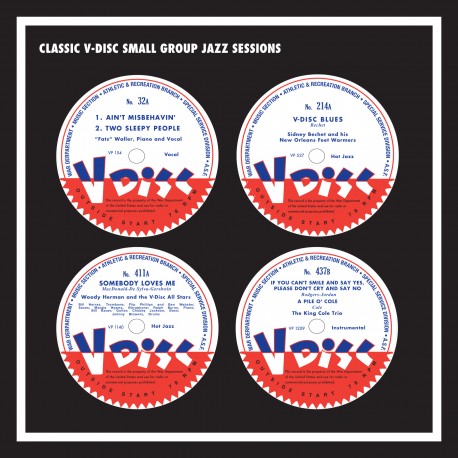
Kudos to Mosaic Records and producer, Scott Wenzel, for taking on such a massive project. For fans of small jazz groupings from this era, Mosaic also issued an 11 CD set of V-Discs (Classic V-Disc Small Group Jazz Sessions). Both come well recommended. They are available from the label at www.mosaicrecords.com
CD 1: 77:16
CD 2: 76:03
CD 3: 77:03
CD 4: 62:40
CD 5: 78:33
CD 6: 76:36
CD 7: 76:09
CD 8: 75:34
CD 9: 78:31
CD 10: 77:55
–Review by Jeff Krow
by Audiophile Audition | Mar 1, 2026 | Classical CD Reviews
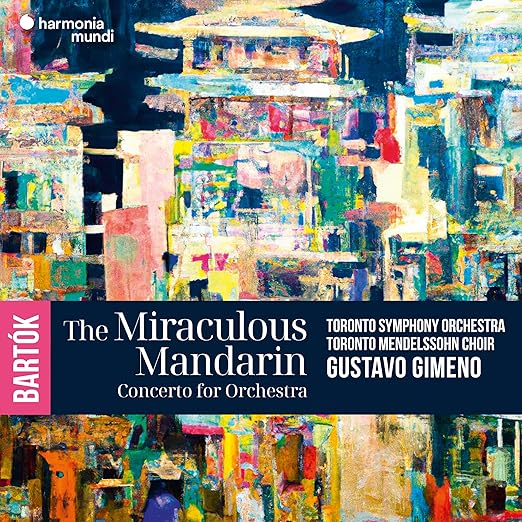
BARTOK: The Miraculous Mandarin, Op. 19; Concerto for Orchestra; LEBEL: the sediments – Toronto Symphony Orchestra/ Toronto Mendelssohn Choir/ Gustavo Gimeno – Harmonia mundi HMM 905365 (12/11/25) (80:13) [Distr. by PIAS] ****:
After my first encounter with the suite from Bartok’s 1926 pantomime The Miraculous Mandarin (via the RCA recording by Jean Martinon), I retained the impression of a violent, expressionist score, quite without any sense of its theatrical merits. But then, around 1974, I accepted an invitation to attend a performance of the complete version – though lacking the chorus included in this recording – by the Rochester Philharmonic under the direction of associate conductor Isaiah Jackson, with the assistance of the Claude Kipnis Mime Theater. With the orchestra situated behind a thin scrim, and the mime artists directly forward, Bartok’s dark, political allegory of love and death suddenly made the composer emerge as a true man of the theater, and so I wrote my review, “Cruel Beauty,” for my college newspaper at SUNY Binghamton.
A most visceral Beginning announces, in violent, discordant energies, the rising of the curtain, with the setting as depicted by the Hungarian author Melchoir Lengyel, of a vacant city street that a gang of thugs use to attract and to attack strangers. Their chief lure is a young girl who poses in a window to seduce unwary travelers. The first two “seduction games” involve an elderly, debonair gentleman and a timid young man, both of whom the gang victimizes.
The third game, however, introduces a mysterious, Chinese Mandarin, whose eyes emit a demonic luster, especially when he beholds the young girl. The woodwinds in this piece rage and squeak in uncanny, frightful shrieks and twitters, their intervals leaping with feverish abandon. The brass and battery section of the orchestra, much expanded, invoke a colossal menace in modal and pentatonic scales, an aroused power of which the thugs have no concept. Attempts to stab and to strangle the Mandarin prove futile, and only when he possesses his inamorata does he succumb to death.
The fifth section, The Girl’s Dance, seems less a dance than a series of ugly, spasmodic gestures that manage to achieve an erotic waltz buried in conflicting rhythmic pulsations. Bartok’s means have borrowed much from Stravinsky’s barbaric convulsions of Le Sacre du Printemps. Section six, The chase – The tramps leap out, had a most effective realization from the Kipnis troupe, who ran in place with exhaustion’s suffusing the futile pursuit of the Mandarin.
After having been suffocated from a lamp bracket, Suddenly the Mandarin’s head appears shimmers and froths in misty ecstasies, a musical equivalent of some Aubey Beardsley nightmare that Richard Strauss overlooked. Bartok builds a dissonant, multilevel Liebestod from the morass of musical elements, the chorus now sighing according to the laws Debussy set forth in his third Nocturne, Sirènes. The wordless chorus breaks off in agony, leaving the last section, The Mandarin falls to the floor, not with a bang but with a whimper.
Emilie Cecilia Lebel (b. 1979) received a commission from the Toronto Symphony for the sediments, a one-movement, nine-and-one-half minutes long tone poem that plays like an extension of what used to pass as “space music.” It emerges as a series of dynamic effects for a large ensemble, heavy on the percussion that alternates with water and bird motifs. Long pedal points with cymbal sostenuto extend the “emotion,” if you will, of the composer’s reaction to the writing of Rachel Carson, who years ago alerted us about our fatal stresses on the Earth. This is the work’s world premiere recording.
Bartok’s Concerto for Orchestra (1943) already enjoys a thorough etiology of its commission by Koussevitzky (whose performance exists despite its non-commercial source) and at least two monumental recordings, by fellow Hungarians, Ferenc Fricsay and Fritz Reiner. Conceived as a hybrid symphony and concerto grosso, the piece relies on the use of diatonic harmony, for the most part, despite the versatility of the scoring and its colors drawn from the music of Bartok’s native land. Like his Third String Quartet, the Concerto proffers an arch-form in five movements, in the course of which every orchestral choir enjoys a brief, virtuoso status. The opening Introduction by Gimeno roes streamlined, driven linearly and recorded (21-23 November 2024) in sterling sound.
A snare drum announces (and concludes) the second movement, Giuoco delle coppie, “Game of the Pairs,” in which woodwind duets savor alternating intervals: bassoons in sixths, oboes in thirds, clarinets in sevenths, flutes in fifths, and the muted trumpets in major seconds. A brass chorale intrudes, only to cede to triple woodwinds at the da capo.
The slow introduction to movement one supplies the vibrant, thematic fodder for the mournfully anguished Elegia third movement. The fourth movement, Intermezzo interrottto, opens with a lyrical recollection of his native Hungary, presenting a beauty that appealed to comic Ernie Kovacs for a brilliant scena on his TV show. The “interruption” of the title occurs with wicked, parodic allusions from the Shostakovich 7th Symphony “Leningrad,” popular at the time. Bartok combines the coarse humor with a quote: a Lehar march from The Merry Widow.
Gimeno opts for the elongated version of the last movement, Finale, a potent rush to judgment that includes some pert fugal writing. Elegant brass fanfare work from the TSO illuminates the swift energy of this colossal movement, which just as suddenly breaks off into a moment of mock-pastoral, likewise treated in extended fugato. The clarity of line defines a polished, intelligently sculpted version of Bartok’s Concerto, which along with the full score of The Miraculous Mandarin, make a compelling case for Gimeno’s inclusion into the pantheon of fine Bartok interpreters.
–Gary Lemco
by Audiophile Audition | Feb 28, 2026 | Jazz CD Reviews, SACD & Other Hi-Res Reviews
English jazz tribute band with an unexpected inspiration.
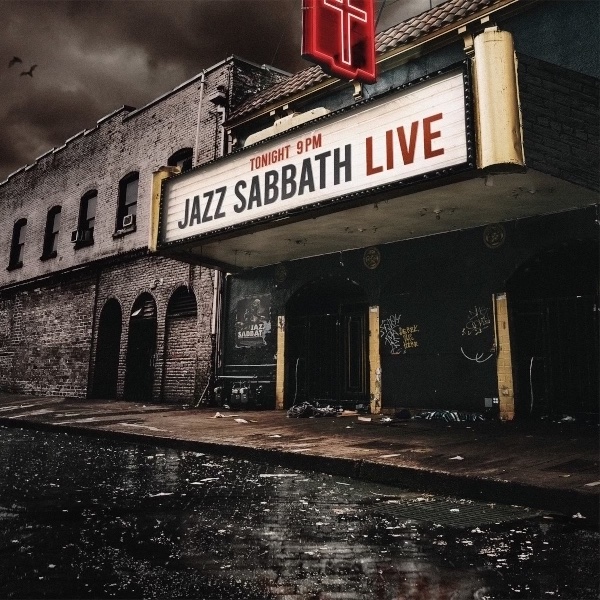
Jazz Sabbath – Jazz Sabbath Live – [TrackList follows] – Blacklake BL411406; CD 1: 41:35; CD 2: 39:13 [2/20/26] ****:
(Jacque T’Fono [Jack Tustin] – upright bass; Juan Take [Arthur Newell] – drums; Milton Keanes [Adam Wakeman] – piano)
Imagine if you will, this scenario. An English jazz band forms in the late 1960s. They write a batch of compositions. They are nicked (stolen) by a new group called Black Sabbath, who turn the jazz material into hard rock music.
That’s the purported – and very fictional – backstory for the trio Jazz Sabbath.
The reality is Jazz Sabbath was created by keyboardist/guitarist Adam Wakeman, son of keyboardist Rick Wakeman (prog rockers Yes and a lengthy solo career). The younger Wakeman toured in both Black Sabbath (2004–2017, 2025) and Sabbath singer Ozzy Osbourne’s band (2004–2025). On a lark one night in 2013 Wakeman played some Sabbath songs as improvised jazz in a hotel bar. That idea gelled over time and Jazz Sabbath initially appeared in a YouTube mockumentary in early 2020 quickly followed by their first release.
In theory, a jazz threesome performing only Ozzy-era Black Sabbath shouldn’t be anything but a goof. But this is bona fide jazz, not some horrible hybrid. Sabbath devotees might recognize some themes but overall this is music for jazz listeners not rock fans.
The double album Jazz Sabbath Live – available as a limited-edition two-LP; two-CD; digital download; streaming files; and tape cassette – is the group’s fourth full-length and first live project, taped at the Paradox jazz club in Tilburg, The Netherlands on March 20, 2025. The live trio consists of Wakeman (credited as Milton Keanes) on acoustic piano; upright bassist Jack Tustin (AKA Jacque T’Fono); and drummer Arthur Newell (his punny moniker is Juan Take).
The show commences with the title track from Black Sabbath’s 1970 debut. The original rock version is riff heavy and uses a tritone known as the diabolus in musica, due to tonal qualities suggesting Satanic connotations. Jazz Sabbath maintain a foreboding menace by utilizing the opening, ominous riff transposed from electric guitar to acoustic piano but shift to a brighter and up-swinging perspective about halfway through the six-minute rendition.
Magic – black or otherwise – permeates “The Wizard,” also from Black Sabbath’s first LP. The Sabbath cut kicks off with bluesy harmonica and then adds a sludgy heavy-metal riff. Jazz Sabbath deftly modify the harmonica starting point into a drum intro and spin the theme into a sprightly eight-minute arrangement miles away from Sabbath’s sludge-blues treatment.
Yet another from the first Sabbath record is “Behind the Wall of Sleep,” about waking from a nightmare to a sunny morning. Wakeman converts the baleful primary motif into something hearty and robust while keeping a bit of a threatening timbre. This nearly ten-minute translation has lots to recommend: a memorable bass solo, rhythmic interplay and a head-nodding nimbus.
Another highlight from the concert’s first half is “Iron Man” – not inspired by the comic book superhero – from Black Sabbath’s 1970 sophomore LP Paranoid. The Bad Plus transformed this into a jazz composite on 2004’s Give which was punchy and aggressive with avant-garde percussive elements. Jazz Sabbath, on the other hand, switch “Iron Man” into an object decidedly different: it begins as a ballad and then boldly proceeds into a bopping approach closer in spirit to Oscar Peterson or Dave Brubeck.
Jazz Sabbath furnish a noteworthy, eight-minute adaptation of the title track from Paranoid during the concert’s second half. Wakeman crafts a pensive opening and then the trio traverses blues-tinted territory. Wakeman slows back down and provides a solo reminiscent of some of his father’s solo material, and the song’s second half goes fully into a jaunty romp.
Another high point of the live show’s latter half is the spacious “Rat Salad,” named after someone’s unkempt hair, which clocks in at a hefty 12 minutes. Black Sabbath’s two-minute instrumental is based on a much-longer drum solo used as a time filler for early Sabbath gigs, akin to Spinal Tap’s infamous ‘jazz odyssey.’ Thankfully Jazz Sabbath’s intuitive and fast-paced rendering is not all percussive. Newell does offer a drum introduction and later a three-minute solo, but the piano and bass have lots of improvisational instances.
If you’re looking for some jazz from an unusual source in a standard jazz style, Jazz Sabbath might be something to check out. The album can be streamed on Bandcamp and YouTube.
—Doug Simpson
Jazz Sabbath Live
TrackList:
CD 1:
Black Sabbath
The Wizard
War Pigs
Behind the Wall of Sleep
Iron Man
Fairies Wear Boots
CD 2:
Hole in the Sky
Paranoid
Into the Void
Rat Salad
Children of the Grave
by Audiophile Audition | Feb 26, 2026 | Classical CD Reviews
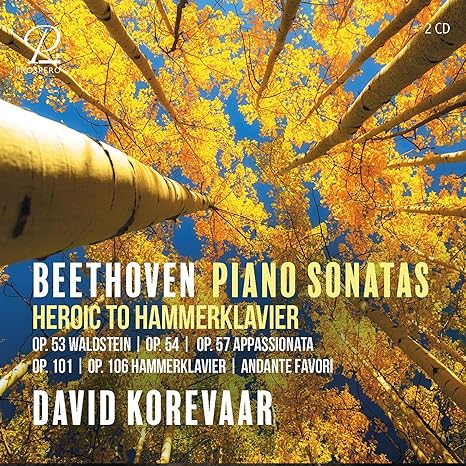
BEETHOVEN: Piano Sonatas Op. 53 “Waldstein”; Op. 54; Op. 57 “Appassionata”; Op. 101; Op. 106 “Hammerklavier”; Andante favori WoO 57; – David Korevaar, Piano – Prospero Records PROSPO111 (2 CDs = 71:17; 66:57)(3/4/25) [Distr. by PrestoMusic] *****:
I recently received the Prospero 2-CD set of five Beethoven sonatas and the Andante favori as performed by David Korevaar, himself a pupil of both Earl Wild and Abbey Simon, who deeply recognizes the historical significance and influence of Beethoven’s epic contribution to the genre. The complete recording of Ludwig van Beethoven’s 32 piano sonatas was published digitally in six volumes in the Fall 2025.
I called David Korevar at his Colorado residence to speak at some length of his – yet another – Beethoven cycle on records.
Gary Lemco: You refer to this latest installment of the 32 as “an act of hubris”, invoking the Greek sense of a fatal flaw. Why so?
David KorevaarK: Perhaps it lies in my having heard Rudolf Serkin live at Carnegie Hall performing the Waldstein. There are dozens of monumental readings by great pianists, and now I offer my own perspectives.
GL: You point out the thematic and rhythmic similarities between this sonata and Mozart’s The Abduction from the Seraglio.
DK: Besides the literal transposition of Mozart’s figures, there lies in Beethoven the capricious sense of humor that commentators often overlook. The sense of spontaneity and improvisation is there, too, characteristics both composers share in abundance.
GL: You obviously relish the recording process, not such a common trait among musicians.
DK: I do, though certain masters did not – like Artur Schnabel. He could become quite impatient with the entire process of making records, though he could achieve wonderful results, like his Mozart Rondo in A Minor, K. 511. His line is fluid and operatic, the rhetoric feels spontaneous.
GL: Schnabel left copious notes to his edition of the Sonatas, but he seems to abandon all his careful detail when he sits down and plays, given the sheer emotionality of the documents we have.
DK: That’s a bit too general a statement. Schnabel can be precise, when he is not hurried. He, like many of us who follow Beethoven, felt troubled by the metronome markings left either by Beethoven or his editors. Some of these can be downright bewildering or obstructive, though Perahia did a convincing job in my opinion with the Hammerklavier. Beethoven’s slow movements need to be clear in texture, as should be his fugues. On the other hand, the finale of the Waldstein proffers a phantasmagoria of comic opera colors that pure speed can blur.
GL: You mention the humor that pervades Beethoven’s music, and you begin your first set with the F Major, Op. 54. You play this piece, which I first heard via Sviatoslav Richter, with a deft verve.
DK: This sonata has its quirks: the influence of Haydn merges with the style of C.P.E. Bach, and the Romantic impulse is evident. Beethoven had acquired an Erard instrument, and he felt eager to exploit a larger dynamic range. We certainly feel the grandeur in the Op. 57 “Appassionata,” where what you mentioned the “Aeolian harp” effect has become prominent.
GL: The early sonatas, too, indicate a grandeur of their own; and here, I am thinking of the Sonata No. 4 in E-flat Major, Op. 7.
DK: Definitely, there and in the Op. 2, No. 2, when you take the repeats: the design is vast, symphonic. Beethoven explicitly calls his second movement Largo, con gran espressione. I venture that the Op. 7 already anticipates much of the Hammerklavier Sonata. They both advance a “leisurely” conception of music. The undervalued Op. 22 reverses the application of virtuosity in the Op. 7, though they have similar rondos.
GL: I always think of the 32 sonatas an experimental laboratory, a workshop to explore possibilities in melody, rhythm, and harmony, as well as in design, especially in counterpoint.
DK: A good analogy, if I think of the Op. 78 and its economical use of intervallic ideas, its witty compression. Even frequently used measures become unrecognizable after a lyrical presentation and then in patterns of sudden density. I have also come to appreciate the less “ambitious” sonatas, like the two of Op. 14, which are wonderful, given the beauty of the middle movement of that in E Major.
GL: And then there are the late sonatas. . .
DK: There are so many challenges in these, not the least of which is coherence amongst conjunctive and disjunctive ideas. The liberation of the trill proffers a whole new series of prospects. The intense intimacy seems at war with the limits of the instrument. And how does one capture “profundity”?
GL: You cite “superlatives” in your notes to this first edition. You have achieved several, I’d say,
DK: Thanks; it’s been a pleasure talking to you.
David Korevaar: Heroic to Hammerklavier
Piano Sonata No. 3 in C Major, Op. 53 “Waldstein”;
Andante favori in F Major, WoO 57;
Piano Sonata No. 22 in F Major, Op. 54;
Piano Sonata No. 23 in F Minor, Op. 57 “Appassionata”;
Piano Sonata No. 28 in A Major, Op. 101;
Piano Sonata No. 29 in B-flat Major, Op. 106 “Hammerklavier”
by Audiophile Audition | Feb 21, 2026 | Classical CD Reviews, Classical Reissue Reviews
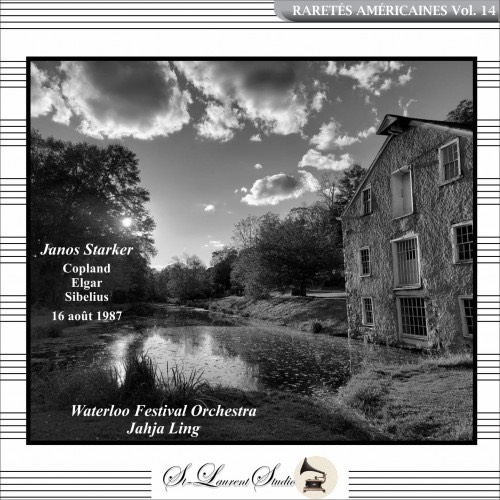
Raretés Américaines, Vol. 14 = COPLAND: An Outdoor Overture; ELGAR: Cello Concerto in E Minor, Op. 85; SIBELIUS: Symphony No. 2 in D Major, Op. 43 – Janos Starker, cello/ Summer Waterloo Festival Orchestra/ Jahja Ling – Yves St-Laurent YSL T1711 (2 CDs = 36:11; 45:30) [www.78experience.com] *****:
The opportunity to savor the imperial artistry of cellist Janos Starker (1924-2013) should forever be embraced, and this live rendition of the 1919 Cello Concerto by Sir Edward Elgar from 16 August 1987 pre-dates the RCA recording with Leonard Slatkin by some 10 years. Chinese-American conductor Jahja Ling (b. 1951) became the first musician of his ancestry to assume the post of a major American ensemble, the San Diego Symphony, as well as leading the Sa Francsico Youth Orchestra before establishing a long-term relationship with the Cleveland Orchestra that lasted for 38 seasons.
Ling opens the program with Aaron Copland’s 1938 An Outdoor Overture, conceived as an “optimistic” vehicle for orchestra, commissioned by Alexander Richter, Music Director of the High School of Music and Art in New York City. A hearty energy salutes us, as Copland starts with the full orchestra, and then a prolonged trumpet solo ensues. A martial, percussive theme, rather jaunty, with echoes of the trumpet tune, yields to a persuasive, lyrical melody for strings. The syncopations return for another march, more resolute. Copland then assembles the diverse impulses into a mix of insistence and consolation, deftly organized. The verve and open-air character of the music begot its “outdoor” sobriquet, and the coda rounds off its confident sensibility.
Janos Starker makes his presence known at once, his recitative firm and plaintive, answered by clarinet, bassoon, and horn, until the cello takes up the meandering theme that soon develops into a mighty, impassioned declaration of poignant feeling. The move to a suave E major flows without seams, and Starker’s sojourns into high register convey blithe energy. The main theme diminishes to segue, crescendo and pizzicato from Starker, into the Lento opening of the second movement. The Allegro bustles with 16th notes, with Starke’s maintaining an elastic tension in perpetual motion.
The Adagio, 3/8, sighs with reminiscence, the Starker restraint polished and understated without any loss of pathos. The rough energy of the last movement has Starker crescendo and fortissimo, Allegro, 2/4, leading a martial impulse complemented by Starker’s urgent declamations. A silken dialogue ensues between solo and responding ensemble. A fugal section ensures that the German mind will approve of Elgar’s means. Starker’s capacity to make his Goffriller instrument sing emerges in glorious Technicolor, a consistent, “gem-like flame,” to paraphrase Walter Pater. The fusion of sheer power and refined intimacy imbues the performance with a rare nobility. The final measures and their resultant coda confirm that the audience has been well convinced of the stateliness of the occasion.
The Second Symphony of Sibelius (1901-02) emerges as a mosaic of musical impulses that converge into a pantheistic paean, a hymn to landscape. The music has had many esteemed adherents, among them Kajanus, Beecham, Karajan, Erhling, and Sanderling, but none so apocalyptic in vision as Koussevitzky. From the Allegretto’s outset, Ling invests a warm affection into Sibelius’ figures, advancing the long line that ends with a woodwind and timpanic flourish. That critic Virgil Thomson could deem this powerful, ardent score “provincial” strikes me as envious condescension. The merger of brass fanfare, chirping woodwinds, and fluttering strings creates a bucolic tapestry of fervent beauty.
Sibelius begins his Tempo andante, ma rubato with a timpani roll and restless, bass pizzicato strings – the pride of Koussevitzky’s BSO – from which a bassoon tune struggles to emerge within an Aeolian harmonic context. A dramatic struggle ensues, much in the Brahms vein, from which the melodic tissue will surge with passionate vitality. The pregnant pauses assume a telling, mystical character as the landscape opens to throbbing, pantheistic suggestion.
The sudden death of Sibelius’ sister-in-law may have inspired the sorrowful oboe theme that interrupts an otherwise breathless scherzo, Vivacissimo, that whistles with some dark portent toward the grand finale that, attacca, will bloom from the voluptuous froth of the third movement. The discipline of Ling’s ensemble shines through, quite a remarkable homogeneity of texture accomplished within the limits of a summer music festival. Sibelius would comment that, for him, “pieces of Heaven’s floor had been presented to him in mosaic,” so the last movement, Finale: Allegro moderato rises up as a progressive unveiling of a mystically grand, cosmic design. This performance, wrought neither by Koussevitzky or his faithful acolyte de Carvalho, achieves its especial grandeur that deserves the widest possible acclaim.
—Gary Lemco
by Audiophile Audition | Feb 20, 2026 | Jazz CD Reviews, Pop/Rock/World CD Reviews, SACD & Other Hi-Res Reviews
Universal Music Group releases a stunning vinyl upgrade to Lionel Richie’s Grammy-winning album.
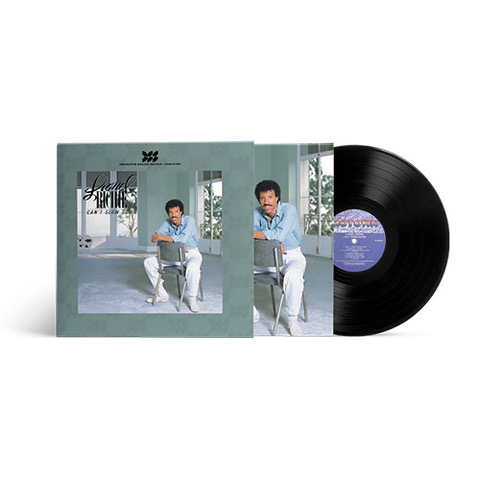
Lionel Richie – Can’t Slow Down – Motown Records (1983)/Interscope-Capitol [Definitive Sound Series/One-Step Audiophile Limited Edition 180-gram LP} (2/20/2026) *****:
(Lionel Richie – keyboards, piano vocals; David Cochrane – guitars, synthesizer, vocals; Paul Leim – drums; Greg Phillinganes – synthesizers; Abraham Lobriel – bass; Darell Jones – guitars; Tim May – guitars; John Robinson – drums; Paulinho da Costa – percussion; Richard Marx – vocals; David Foster – keyboards; Jeff Porcaro – drums; Steve Lukather – guitar; Michael Boddicker – keyboards; plus many others)
In 1983, Lionel Richie released his second album as a solo artist, Can’t Slow Down. It produced five hit singles, including two number ones (“All Night Long”, “Hello”). Richie, who had fronted The Commodores earlier in his career, was moving towards a broader audience with different musical aesthetics. Can’t Slow Down garnered album of the year at the Grammys, and propelled the Alabama-born musician to the height of 1980’s popular music alongside Michael Jackson, Prince and Bruce Springsteen. He became a major asset to the relocated Motown Records. MTV increased his crossover appeal.
Interscope-Capitol has released a limited-edition audiophile vinyl of Can’t Slow Down. This is a notable upgrade, part of the Definitive Sound Series/One-Step process. A cadre of top-flight session musicians add to the sonic luster. Side One opens with the title cut. With smooth layered instrumentation and a funk-driven beat, Richie’s vocals are soulful and accessible. A certain highlight is “All Night Long”. Among the tight percussion, instrumentation (horns, synthesizers) and rhythm, Richie delivers an ebullient lead vocal. The musical tapestry exudes a Caribbean-infused vibe and there is a plethora of tracked background singing and chants that are magnetic. In a change of pace, “Penny Lover” injects balladry into the flowing instrumentals. There is a hypnotic call and response vocal coda. All of the song elements fit seamlessly. Another ballad, “Stuck On You” is amenable and intermingles country and pop influences.
Returning to r&b hook-driven grooves, “Love Will Find A Way” has a steady tempo that allows Richie to showcase emotional resonance. The steady bass and drums are countered by atmospheric keyboards and spacious back up vocals. Meticulous arrangements elevate these songs. “The Only One” sways with pop sensibility. The final chorus picks up some intensity. Returning to dance vibes, “Running With The Night” is hard-rocking soul music with a relentless beat and positive energy. Punctuated synth accents and an incendiary electric guitar solo (Steve Lukather) propel the number, framing Richie’s mellifluous singing. The finale (“Hello”) is sensitive pop balladry. It is stripped down with Richie’s most earnest vocal performance.
This album is a step forward in audiophile vinyl. The re-mastered sound (Chris Bellman/Bernie Grundman)) is sourced from the original analog master tapes (coincidentally by Grundman). It is dynamic and packs a real punch (especially on the lower end). Richie’s voice is centered and blends with the thick instrumentation. The Neotech VR900-D2 180-gram vinyl pressing (RTI) is pristine and captures the music in a quiet aural landscape. Superior packaging includes a tip-on jacket inside a slipcase.
Highest recommendation!
—Robbie Gerson
TrackList:
Side A: Can’t Slow Down; All Night Long (All Night); Penny Lover; Stuck On You
Side B: Love Will Find A Way; The Only One; Running With The Night; Hello
by Audiophile Audition | Feb 18, 2026 | Classical CD Reviews
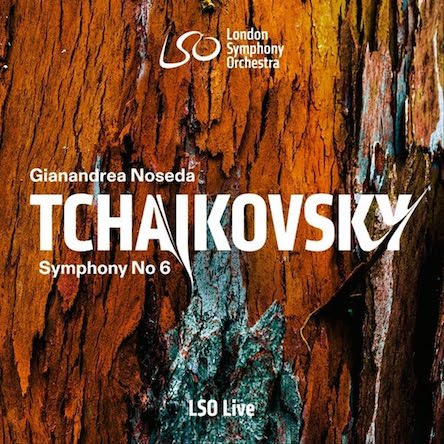
TCHAIKOVSKY: Symphony No. 6 in B Minor, Op. 74 “Pathetique”; MUSSORGSKY: Prelude to Khovantschina – London Symphony Orchestra/ Gianandrea Noseda – LS00895 (49:30) (12/3/25) {Distr. by PIAS] ****:
Noseda and the LSO recorded Tchaikovsky’s 1893 Sixth Symphony 6-7 December 2023, a lyrical, direct approach the does not indulge in the “staggering blows of fate” of the grand interpreters Mengelberg, Furtwaengler, Mravinsky, and Bernstein. The tragic elements remain, from the opening low bassoon and its hushed surroundings, the weeping character of the Adagio’s melancholy main theme, which soon subsides quietly, only to explode in emotional rebellion. The Allegro non troppo proceeds as a furious exercise in competing textures in counterpoint, intruded upon by militant forces. Some fine sense of transition emerges as Nosada builds his contending impulses, often reacting to each other antiphonally. The LSO trumpets and strings, alert and brilliant, and then the timpani, drive the music in a linear, resolute procession. The lyric quietude that resolves the first movement, even as thunder passes by, casts a tender resignation into the horizon.
The string and woodwind homogeneity of tone that literally defines the LSO sweeps the 5/4 Allegro con grazia second movement along in balletic gestures, the middle section -given the persistent drum beats – more cognizant than the surface offers of a fatal impulse at the heart of experience. Disturbed yet beautiful, this music possesses a siren-like allure that presents a false hope of reconciliation. The third movement, despite its Allegro molto vivace heroics, only drives Tchaikovsky’s ironies deeper, the potentially triumphant march rhythms undercut by metric irregularities whose power had been first revealed in the Beethoven Eroica. Noseda imposes a light but steely, vivid drive upon the music, and we might think of Toscanini’s approach to this score.
Whether the last movement Finale: Andante lamentoso – Andante inspired Gustav Mahler’s sense of tragic, symphonic design remains speculative, but Tchaikovsky’s heartfelt eulogy for his own soul communicates a forlorn sincerity rare in music. The descending motifs compete in minor and major; and, ending in major, become perhaps increasingly plaintive, a lesson inscribed by Gluck in his Orfeo. Noseda proceeds deliberately, without rhetorical exaggeration, allowing Tchaikovsky’s numbers to narrate a grievous collapse that desperately seeks to restore some happy resolution before inexorable darkness triumphs.
Noseda complements his program with Mussorgsky’s 1874 Prelude to the opera Khovantschina, unfinished at the time of the composer’s death in 1881 and subsequently re-touched by Rimsky-Korsakov. Subtitled as “Dawn Breaking over the Moscow River,” the luscious score – first revealed to this reviewer by Leopold Stokowski – features fine playing by oboe Timothy Rundle. The LSO strings and winds shimmer palpably in a haze of sound as evocative as it is lovely, a real testament to the composer’s natural melodic powers. Certainly, LSO could have attached more Russian music to this otherwise charming program.
—Gary Lemco
by Audiophile Audition | Feb 16, 2026 | Classical CD Reviews, Classical Reissue Reviews
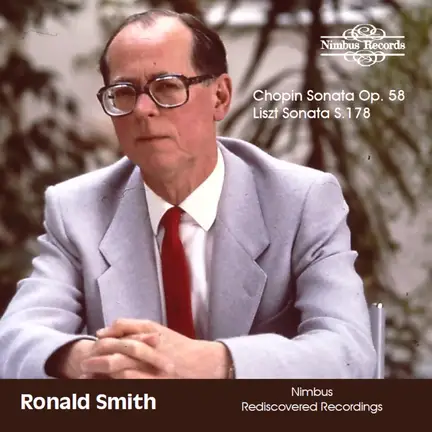
Ronald Smith: Rediscovered Recordings = CHOPIN: Piano Sonata No. 3 in B Minor, Op. 58; LISZT: Sonata in B Minor – Ronald Smith, piano – Nimbus NI 7115 (54:24) (3/6/26) [www.wyastone.co.uk] *****:
In a recent letter to me concerning this Nimbus release of February and August 1980 recordings by British pianist Ronald Smith (1922-2004), record collector and radio broadcaster Lance G. Hill noted, “Isn’t it a pity that many of the younger generation do not know of Ronald Smith, an imposing artist?” Correlative to Hill’s remark, Nimbus record producer Adrian Farmer writes:
The sessions in 1980 were both ‘analogue,’ being made on reel-to-reel tape machines. We had little idea how quickly such Industry wide state-of-the-art technology would be brutally swept aside by the arrival of digital recording, and its market counterpart, the Compact Disc. Ronald’s Chopin Etudes were released on LP the following year. The LP sleeve went as far as announcing the catalogue number of the upcoming Chopin/Liszt Sonata pairing. The master was approved and ready to go. But all things ‘digital’ upended all sense: the record world, its media and followers clamored for digital recordings of standard works. Labels rushed to satisfy the demand (Nimbus was no exception), and unreleased ‘analogue’ masters fell into a dark hole. Ronald Smith’s later digital recordings enjoyed immediate release, but not so the Chopin/Liszt Sonatas, until now, 45 years on.
Ronald Smith, despite his natural affinity for music of the Romantic Era, found his greatest inspiration from having worked with Swiss master Edwin Fischer (1886-1960) in the music of J.S. Bach. Fischer’s penchant for classical architecture in music brought discipline and clarity to the otherwise difficult, almost impenetrable scores of Valentin Alkan and Mili Balakirev, both of whom Smith championed. His coloration for Chopin’s 1844 Sonata in B Minor graces the first movement Allegro maestoso with a florid combination of idiosyncratic Bach counterpoint and Chopin’s especial chromatic harmony. The runs and small, right-hand canons flow with a liquidity of motion that conveys a lyrical momentum informed by the dramatic content, a hybrid of nocturne and ballade. While the volume and dynamics retain their capacity for explosive propulsion, the atmosphere remains one of intimate restraint, more of Robert Casadesus and Alfred Cortot than of Vladimir Horowitz.
Smith’s Scherzo: Molto vivace bears an elfin quickness, offset by a hazy, introspective episode rife with unresolved harmonic motion. We think that Smith would excel in the four Chopin Impromptus, where the fleetness of his diaphanous runs would enjoy full rein. If ever the art of Bellini’s operatic bel canto found instrumental means, Chopin’s third movement Larghetto proves the analogy secure. After an opening in dotted rhythms, a groping series of chords resolves into a sustained, processional nocturne of extraordinary, mesmeric power. Smith fashions an interior dialogue of seamless beauty, the keyboard’s having renounced anything like percussive power. The moments of recitative savor the silences between the chords, where true drama lies. The last movement Finale: Presto non tanto unleashes Smith’s flair for bravura expressivity, a potent rondo whose fury does not abate. Smith hurtles through Chopin’s martial sensibility, wherein brilliant runs and cascades tumble forth in breathless impetuosity, a force from the Romantic Abyss. The coda rounds of a cataclysmic sense of dramatic flourish, a proclamation of hard journey well met.
Franz Liszt’s 1854 Sonata in B Minor has inspired much rhetorical speculation on its ‘meaning’ or ‘programmatic intent.’ Liszt himself offered no clues to this unique piano composition, sometimes referred to – given its Beethoven-like girth, vehemence of expression, and dynamic, polyphonic means – as “Beethoven’s 33rd Sonata.” For both lyric power and unity of form, the Sonata has few rivals, since it compresses into one extended movement a ground theme that permeates the work entirely, sometimes as a fugato impulse played against itself in inversion. Likely having taken Franz Schubert’s 1822 Wanderer Fantasy as his model, Liszt subdivides the one movement into four sections (three, in the present recording divisions), displaying what Blake would call ‘fearful symmetry,’ as the key scheme: C-E-A-flat-C draws a fatal, epic circle around the plethora of emotions and shifts of mood. Ronald Smith here enters the realm dominated by the likes of Horowitz, Cziffra, Cortot, Kentner, Petri, Arrau, and Barere for theatrical bravura on the grand scale.
After a mysterious Lento assai, Smith launches (sotto voce) into the group of three themes that establish the exposition, including a voluptuous appearance of the amazing trill that hurdles the material into Dante’s depths. The grand D major theme offers lyrical consolation as the original motif transforms itself while maintaining its essential character, close to Hegel’s dictum: “the Idea unfolds itself in the form of being different.” The silken runs and resolute marcatos proceed with stunning clarity of motion, Allegro energico, pulverizing and insistent. Andante sostenuto The provides the heart of the music, a slow movement suavely consoling and perhaps religious in its gossamer realignment of the opening motif. Smith plays the entire section in the manner of a bravura improvisation, at moments sounding like an operatic reminiscence. The various fingering approaches Smith utilizes play like a compendium on piano technique, a textural tour de force.
Then, after the opening riff, Liszt offers the fugato announcing the third, demonic progression. Serving as a kind of development section, the expansive fugue injects a fury into the textural mass that defies classical categories. Each articulation of the impulse intensifies the staggering effect, so no wonder the orchestral version often appeared in Universal horror films! The consolation of the D major theme arises out of the emotional rubble, devoutly delivered and beatific in visionary power. Smith then mounts to a grueling, cataclysmic moment, furioso, since it is better to rule in Hell than to serve in Heaven, the ultimate expression of individualistic pride. Yet, Liszt resists the apotheosis of the Abyss and reintroduces his grand anodyne, the Andante sostenuto theme after a pregnant silence. The snake bites its own tail; the ouroboros, the eternal circle, is complete.
—Gary Lemco